第12章反応速度
The Half-Life of a Reaction反応の半減期
The half-life of a reaction (t1/2) is the time required for one-half of a given amount of reactant to be consumed. In each succeeding half-life, half of the remaining concentration of the reactant is consumed. Using the decomposition of hydrogen peroxide (Figure 12.2) as an example, we find that during the first half-life (from 0.00 hours to 6.00 hours), the concentration of H2O2 decreases from 1.000 M to 0.500 M. During the second half-life (from 6.00 hours to 12.00 hours), it decreases from 0.500 M to 0.250 M; during the third half-life, it decreases from 0.250 M to 0.125 M. The concentration of H2O2 decreases by half during each successive period of 6.00 hours. The decomposition of hydrogen peroxide is a first-order reaction, and, as can be shown, the half-life of a first-order reaction is independent of the concentration of the reactant. However, half-lives of reactions with other orders depend on the concentrations of the reactants.
英語のヒント
反応の半減期(t1/2)は、ある量の反応物の半分が消費されるのに必要な時間である。その後も半減期ごとに、残った反応物濃度の半分が消費される。過酸化水素の分解(図12.2)を例にすると、最初の半減期である0.00時間から6.00時間の間に、H2O2の濃度は1.000 Mから0.500 Mへ下がる。二つ目の半減期、6.00時間から12.00時間では0.500 Mから0.250 Mへ、三つ目では0.250 Mから0.125 Mへ下がる。H2O2の濃度は、続く各6.00時間で半分ずつになる。過酸化水素の分解は1次反応である。後で示せるように、1次反応の半減期は反応物濃度に依存しない。しかし、別の次数の反応では、半減期は反応物濃度に依存する。
First-Order Reactions1次反応
An equation relating the half-life of a first-order reaction to its rate constant may be derived from the integrated rate law as follows:
1次反応の半減期と速度定数を関係づける式は、次のように積分速度式から導ける。
Invoking the definition of half-life, symbolized requires that the concentration of A at this point is one-half its initial concentration:
で表す半減期の定義を使うと、その時点のAの濃度は初濃度の半分でなければならない。
Substituting these terms into the rearranged integrated rate law and simplifying yields the equation for half-life:
これらの項を変形した積分速度式に代入して整理すると、半減期の式が得られる。
This equation describes an expected inverse relation between the half-life of the reaction and its rate constant, k. Faster reactions exhibit larger rate constants and correspondingly shorter half-lives. Slower reactions exhibit smaller rate constants and longer half-lives.
英語のヒント
この式は、予想されるとおり、反応の半減期と速度定数kが反比例することを表す。速い反応は速度定数が大きく、それに対応して半減期が短くなる。遅い反応は速度定数が小さく、半減期が長くなる。
Example 12.11例題 12.11
Calculation of a First-order Rate Constant using Half-Life半減期から1次反応の速度定数を計算する
Calculate the rate constant for the first-order decomposition of hydrogen peroxide in water at 40 °C, using the data given in Figure 12.12.
図12.12のデータを使って、40 °Cの水中での過酸化水素の1次分解反応の速度定数を計算しなさい。
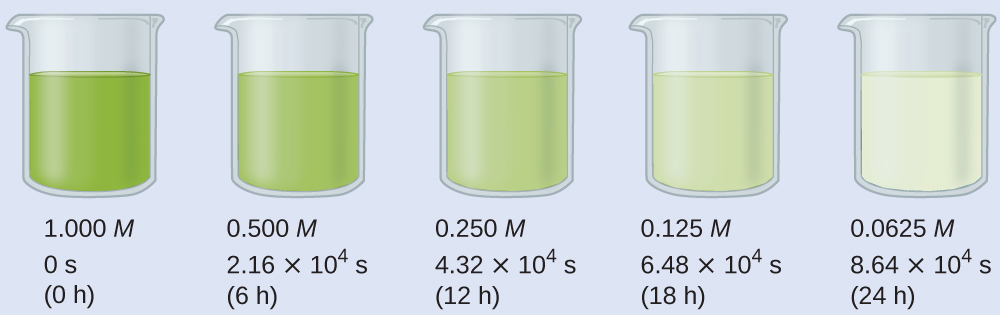

Figure 12.12図 12.12
The decomposition of H2O2 at 40 °C is illustrated. The intensity of the color symbolizes the concentration of H2O2 at the indicated times; H2O2 is actually colorless.
40 °CでのH2O2の分解を示している。色の濃さは、表示された各時刻のH2O2濃度を象徴している。実際のH2O2は無色である。
Solution解答
Inspecting the concentration/time data in Figure 12.12 shows the half-life for the decomposition of H2O2 is 2.16 104 s:
図12.12の濃度と時間のデータから、H2O2の分解の半減期は2.16 104 sと分かる。
Check Your Learning理解度を確認
The first-order radioactive decay of iodine-131 exhibits a rate constant of 0.138 d−1. What is the half-life for this decay?
ヨウ素131の1次放射性崩壊の速度定数は0.138 d−1である。この崩壊の半減期はいくらか。
Second-Order Reactions2次反応
Following the same approach as used for first-order reactions, an equation relating the half-life of a second-order reaction to its rate constant and initial concentration may be derived from its integrated rate law:
英語のヒント
1次反応と同じ方法を使えば、2次反応の半減期と、速度定数・初濃度を関係づける式を、積分速度式から導ける。
or
または
Restrict t to t1/2
tをt1/2に限定する。
define [A]t as one-half [A]0
[A]tを[A]0の半分と定める。
and then substitute into the integrated rate law and simplify:
次に積分速度式へ代入し、整理する。
For a second-order reaction, is inversely proportional to the concentration of the reactant, and the half-life increases as the reaction proceeds because the concentration of reactant decreases. Unlike with first-order reactions, the rate constant of a second-order reaction cannot be calculated directly from the half-life unless the initial concentration is known.
英語のヒント
2次反応では、は反応物濃度に反比例する。反応が進むと反応物濃度が下がるため、半減期は長くなる。1次反応とは異なり、2次反応の速度定数は、初濃度が分からなければ半減期から直接計算できない。
Zero-Order Reactions0次反応
As for other reaction orders, an equation for zero-order half-life may be derived from the integrated rate law:
ほかの反応次数と同様に、0次反応の半減期の式も、積分速度式から導ける。
Restricting the time and concentrations to those defined by half-life: and Substituting these terms into the zero-order integrated rate law yields:
時間と濃度を、半減期で定義されるものに限定する:および。これらを0次の積分速度式に代入すると、
As for all reaction orders, the half-life for a zero-order reaction is inversely proportional to its rate constant. However, the half-life of a zero-order reaction increases as the initial concentration increases.
英語のヒント
どの反応次数でも同じであるが、0次反応の半減期は速度定数に反比例する。ただし、0次反応の半減期は、初濃度が高いほど長くなる。
Equations for both differential and integrated rate laws and the corresponding half-lives for zero-, first-, and second-order reactions are summarized in Table 12.2.
0次、1次、2次反応について、微分速度式、積分速度式、対応する半減期の式を表12.2にまとめる。
Summary of Rate Laws for Zero-, First-, and Second-Order Reactions 0次・1次・2次反応の速度式のまとめ |
|||
|---|---|---|---|
Zero-Order 0次 |
First-Order 1次 |
Second-Order 2次 |
|
rate law 速度式 |
rate = k 速度 = k |
rate = k[A] 速度 = k[A] |
rate = k[A]2 速度 = k[A]2 |
units of rate constant 速度定数の単位 |
M s−1 |
s−1 |
M−1 s−1 |
integrated rate law 積分速度式 |
|||
plot needed for linear fit of rate data 速度データを直線で表すためのプロット |
[A] vs. t [A] 対 t |
ln[A] vs. t ln[A] 対 t |
vs. t 対 t |
relationship between slope of linear plot and rate constant 直線プロットの傾きと速度定数の関係 |
k = −slope k = −傾き |
k = −slope k = −傾き |
k = slope k = 傾き |
half-life 半減期 |
|||
Example 12.12例題 12.12
Half-Life for Zero-Order and Second-Order Reactions0次反応と2次反応の半減期
What is the half-life for the butadiene dimerization reaction described in Example 12.8?
例題12.8のブタジエンの二量化反応の半減期はいくらか。
Solution解答
The reaction in question is second order, is initiated with a 0.200 mol L−1 reactant solution, and exhibits a rate constant of 0.0576 L mol−1 min−1. Substituting these quantities into the second-order half-life equation:
英語のヒント
この反応は2次で、反応物の初濃度は0.200 mol L−1、速度定数は0.0576 L mol−1 min−1である。これらの量を2次反応の半減期の式に代入すると、
Check Your Learning理解度を確認
What is the half-life (min) for the thermal decomposition of ammonia on tungsten (see Example 12.10)?
タングステン上でのアンモニアの熱分解の半減期は何分か(例題12.10参照)。