第12章反応速度
Key Concepts and Summary重要な概念とまとめ
Integrated rate laws are mathematically derived from differential rate laws, and they describe the time dependence of reactant and product concentrations.
積分速度式は、微分速度式から数学的に導かれ、反応物と生成物の濃度の時間変化を表す。
The half-life of a reaction is the time required to decrease the amount of a given reactant by one-half. A reaction’s half-life varies with rate constant and, for some reaction orders, reactant concentration. The half-life of a zero-order reaction decreases as the initial concentration of the reactant in the reaction decreases. The half-life of a first-order reaction is independent of concentration, and the half-life of a second-order reaction decreases as the concentration increases.
反応の半減期は、ある反応物の量が半分になるまでの時間である。半減期は速度定数によって変わり、一部の反応次数では反応物濃度によっても変わる。0次反応の半減期は、反応物の初濃度が低いほど短くなる。1次反応の半減期は濃度に依存せず、2次反応の半減期は濃度が高いほど短くなる。
Key Equations重要な式
integrated rate law for zero-order reactions: 0次反応の積分速度式: |
half-life for a zero-order reaction 0次反応の半減期: |
integrated rate law for first-order reactions: 1次反応の積分速度式: |
half-life for a first-order reaction 1次反応の半減期: |
integrated rate law for second-order reactions: 2次反応の積分速度式: |
half-life for a second-order reaction 2次反応の半減期: |
Chemistry End of Chapter Exercises章末の化学演習
Exercises 32–49練習問題 32–49
Exercise 32問題 32
Describe how graphical methods can be used to determine the order of a reaction and its rate constant from a series of data that includes the concentration of A at varying times.
さまざまな時刻でのAの濃度を含む一連のデータから、グラフを使って反応次数と速度定数を求める方法を述べなさい。
Exercise 33問題 33
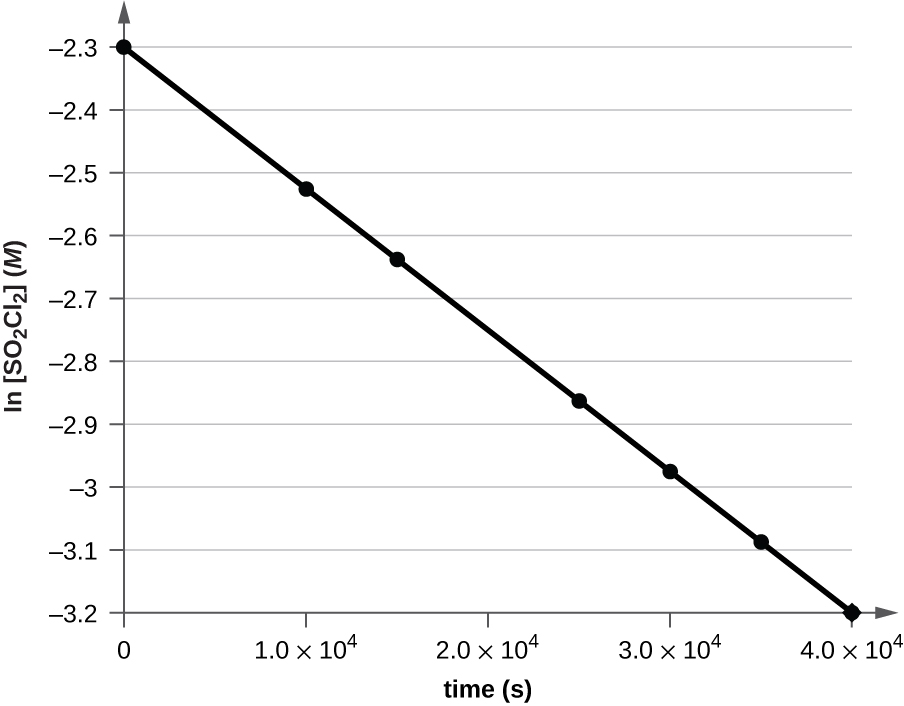
Use the data provided to graphically determine the order and rate constant of the following reaction:
与えられたデータを使い、グラフから次の反応の次数と速度定数を求めなさい。
Time (s) 時間 (s) |
0 |
5.00 103 |
1.00 104 |
1.50 104 |
[SO2Cl2] (M) |
0.100 |
0.0896 |
0.0802 |
0.0719 |
Time (s) 時間 (s) |
2.50 104 |
3.00 104 |
4.00 104 |
|
[SO2Cl2] (M) |
0.0577 |
0.0517 |
0.0415 |
Exercise 34問題 34
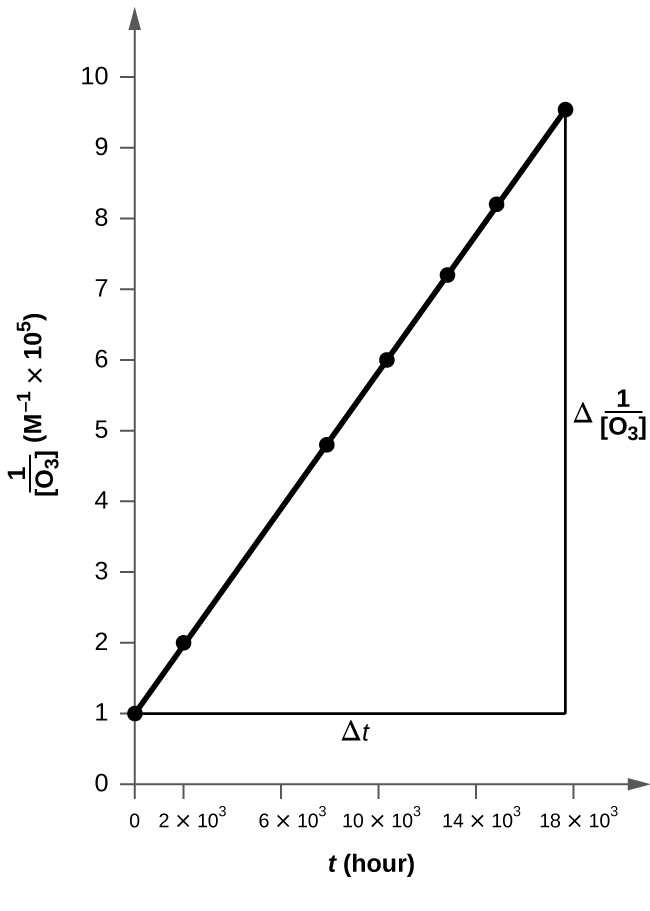
Pure ozone decomposes slowly to oxygen, Use the data provided in a graphical method and determine the order and rate constant of the reaction.
純粋なオゾンはゆっくりと酸素に分解する。 与えられたデータをグラフにし、反応次数と速度定数を求めなさい。
Time (h) 時間 (h) |
0 |
2.0 103 |
7.6 103 |
1.00 104 |
[O3] (M) |
1.00 10−5 |
4.98 10−6 |
2.07 10−6 |
1.66 10−6 |
Time (h) 時間 (h) |
1.23 104 |
1.43 104 |
1.70 104 |
|
[O3] (M) |
1.39 10−6 |
1.22 10−6 |
1.05 10−6 |
Exercise 35問題 35
From the given data, use a graphical method to determine the order and rate constant of the following reaction:
与えられたデータをグラフにし、次の反応の次数と速度定数を求めなさい。
Time (s) 時間 (s) |
5.0 |
10.0 |
15.0 |
20.0 |
25.0 |
30.0 |
35.0 |
40.0 |
[X] (M) |
0.0990 |
0.0497 |
0.0332 |
0.0249 |
0.0200 |
0.0166 |
0.0143 |
0.0125 |
Exercise 36問題 36
What is the half-life for the first-order decay of phosphorus-32? The rate constant for the decay is 4.85 10−2 day−1.
リン32の1次崩壊の半減期はいくらか。 崩壊の速度定数は4.85 10−2 日−1である。
Solution解き方
14.3 d
14.3 d
Exercise 37問題 37
What is the half-life for the first-order decay of carbon-14? The rate constant for the decay is 1.21 10−4 year−1.
炭素14の1次崩壊の半減期はいくらか。 崩壊の速度定数は1.21 10−4 年−1である。
Exercise 38問題 38
What is the half-life for the decomposition of NOCl when the concentration of NOCl is 0.15 M? The rate constant for this second-order reaction is 8.0 10−8 L mol−1 s−1.
NOCl濃度が0.15 Mのとき、NOClの分解の半減期はいくらか。この2次反応の速度定数は8.0 10−8 L mol−1 s−1である。
Solution解き方
8.3 107 s
8.3 107 s
Exercise 39問題 39
What is the half-life for the decomposition of O3 when the concentration of O3 is 2.35 10−6 M? The rate constant for this second-order reaction is 50.4 L mol−1 h−1.
O3濃度が2.35 10−6 Mのとき、O3の分解の半減期はいくらか。この2次反応の速度定数は50.4 L mol−1 h−1である。
Exercise 40問題 40
The reaction of compound A to give compounds C and D was found to be second-order in A. The rate constant for the reaction was determined to be 2.42 L mol−1 s−1. If the initial concentration is 0.500 mol/L, what is the value of t1/2?
化合物Aから化合物C、Dが生じる反応は、Aについて2次であると分かった。速度定数は2.42 L mol−1 s−1である。初濃度が0.500 mol/Lなら、t1/2はいくらか。
Solution解き方
0.826 s
0.826 s
Exercise 41問題 41
The half-life of a reaction of compound A to give compounds D and E is 8.50 min when the initial concentration of A is 0.150 M. How long will it take for the concentration to drop to 0.0300 M if the reaction is (a) first order with respect to A or (b) second order with respect to A?
化合物Aから化合物D、Eが生じる反応の半減期は、Aの初濃度0.150 Mのとき8.50 minである。反応が(a) Aについて1次、または(b) Aについて2次の場合、濃度が0.0300 Mへ下がるまでどのくらいかかるか。
Exercise 42問題 42
Some bacteria are resistant to the antibiotic penicillin because they produce penicillinase, an enzyme with a molecular weight of 3 104 g/mol that converts penicillin into inactive molecules. Although the kinetics of enzyme-catalyzed reactions can be complex, at low concentrations this reaction can be described by a rate law that is first order in the catalyst (penicillinase) and that also involves the concentration of penicillin. From the following data: 1.0 L of a solution containing 0.15 µg (0.15 10−6 g) of penicillinase, determine the order of the reaction with respect to penicillin and the value of the rate constant.
英語のヒント
一部の細菌が抗生物質ペニシリンに耐性をもつのは、ペニシリンを不活性な分子に変える、分子量3 104 g/molの酵素ペニシリナーゼを作るためである。酵素が触媒する反応の速度論は複雑になり得るが、低濃度では、この反応は触媒(ペニシリナーゼ)について1次で、ペニシリン濃度も含む速度式で記述できる。ペニシリナーゼ0.15 µg(0.15 10−6 g)を含む1.0 Lの溶液について、次のデータから、ペニシリンについての反応次数と速度定数を求めなさい。
[Penicillin] (M) [ペニシリン] (M) |
Rate (mol L−1 min−1) 速度 (mol L−1 min−1) |
|---|---|
2.0 10−6 |
1.0 10−10 |
3.0 10−6 |
1.5 10−10 |
4.0 10−6 |
2.0 10−10 |
Solution解き方
The reaction is first order. k = 1.0 107 L mol−1 min−1
反応は1次である。k = 1.0 107 L mol−1 min−1。
Exercise 43問題 43
Both technetium-99 and thallium-201 are used to image heart muscle in patients with suspected heart problems. The half-lives are 6 h and 73 h, respectively. What percent of the radioactivity would remain for each of the isotopes after 2 days (48 h)?
英語のヒント
テクネチウム99とタリウム201は、どちらも心疾患が疑われる患者の心筋の画像化に使われる。半減期はそれぞれ6 hと73 hである。2日後(48 h後)に、それぞれの同位体の放射能は何%残るか。
Exercise 44問題 44
There are two molecules with the formula C3H6. Propene, is the monomer of the polymer polypropylene, which is used for indoor-outdoor carpets. Cyclopropane is used as an anesthetic:
C3H6という分子式をもつ分子は二つある。プロペンは、屋内・屋外兼用カーペットに使うポリマー、ポリプロピレンの単量体である。シクロプロパンは麻酔薬として使われる。
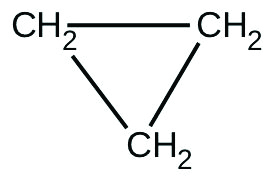
When heated to 499 °C, cyclopropane rearranges (isomerizes) and forms propene with a rate constant of
5.95 10−4 s−1. What is the half-life of this reaction? What fraction of the cyclopropane remains after 0.75 h at 499 °C?
5.95 10−4 s−1. What is the half-life of this reaction? What fraction of the cyclopropane remains after 0.75 h at 499 °C?
499 °Cに加熱すると、シクロプロパンは転位(異性化)してプロペンになる。速度定数は5.95 10−4 s−1である。この反応の半減期はいくらか。499 °Cで0.75 h後には、シクロプロパンはどれだけの割合で残るか。
Solution解き方
1.16 × 10³ s ; 20% remains
1.16 × 10³ s;20%が残る。
Exercise 45問題 45
Fluorine-18 is a radioactive isotope that decays by positron emission to form oxygen-18 with a half-life of 109.7 min. (A positron is a particle with the mass of an electron and a single unit of positive charge; the equation is Physicians use 18F to study the brain by injecting a quantity of fluoro-substituted glucose into the blood of a patient. The glucose accumulates in the regions where the brain is active and needs nourishment.
英語のヒント
フッ素18は、陽電子放出により酸素18へ崩壊する放射性同位体で、半減期は109.7 minである。陽電子は電子と同じ質量で、単位正電荷一つをもつ粒子である。反応式はである。医師は18Fを用いて脳を調べるため、フッ素置換したグルコースを患者の血液へ一定量注射する。グルコースは、脳の活動が活発で栄養を必要とする領域に集まる。
(a) What is the rate constant for the decomposition of fluorine-18?
(a) フッ素18の分解の速度定数はいくらか。
(b) If a sample of glucose containing radioactive fluorine-18 is injected into the blood, what percent of the radioactivity will remain after 5.59 h?
(b) 放射性フッ素18を含むグルコース試料を血液へ注射すると、5.59 h後には放射能が何%残るか。
(c) How long does it take for 99.99% of the 18F to decay?
(c) 18Fの99.99%が崩壊するのに、どのくらいかかるか。
Exercise 46問題 46
Suppose that the half-life of steroids taken by an athlete is 42 days. Assuming that the steroids biodegrade by a first-order process, how long would it take for of the initial dose to remain in the athlete’s body?
ある競技者が摂取したステロイドの半減期を42日とする。ステロイドが1次過程で生分解すると仮定すると、体内に残る量が初回投与量のになるまで、どのくらいかかるか。
Solution解き方
252 days
252日
Exercise 47問題 47
Recently, the skeleton of King Richard III was found under a parking lot in England. If tissue samples from the skeleton contain about 93.79% of the carbon-14 expected in living tissue, what year did King Richard III die? The half-life for carbon-14 is 5730 years.
最近、イングランドの駐車場の下で、リチャード3世の遺骨が見つかった。遺骨の組織試料に含まれる炭素14が、生きた組織に期待される量の約93.79%なら、リチャード3世は何年に亡くなったか。炭素14の半減期は5730年である。
Exercise 48問題 48
Nitroglycerine is an extremely sensitive explosive. In a series of carefully controlled experiments, samples of the explosive were heated to 160 °C and their first-order decomposition studied. Determine the average rate constants for each experiment using the following data:
ニトログリセリンは、極めて敏感な爆薬である。注意深く管理された一連の実験で、試料を160 °Cに加熱し、1次分解を調べた。次のデータを使い、各実験の平均速度定数を求めなさい。
Initial [C3H5N3O9] (M) 初濃度 [C3H5N3O9] (M) |
4.88 |
3.52 |
2.29 |
1.81 |
5.33 |
4.05 |
2.95 |
1.72 |
t (s) |
300 |
300 |
300 |
300 |
180 |
180 |
180 |
180 |
% Decomposed 分解した割合(%) |
52.0 |
52.9 |
53.2 |
53.9 |
34.6 |
35.9 |
36.0 |
35.4 |
Solution解き方
[A]0 (M) |
k 103 (s−1) |
|---|---|
4.88 |
2.45 |
3.52 |
2.51 |
2.29 |
2.53 |
1.81 |
2.58 |
5.33 |
2.36 |
4.05 |
2.47 |
2.95 |
2.48 |
1.72 |
2.43 |
Exercise 49問題 49
For the past 10 years, the unsaturated hydrocarbon 1,3-butadiene has ranked 38th among the top 50 industrial chemicals. It is used primarily for the manufacture of synthetic rubber. An isomer exists also as cyclobutene:
過去10年間、不飽和炭化水素の1,3-ブタジエンは、主要な工業化学品上位50種のうち38位に位置してきた。主に合成ゴムの製造に使われる。異性体としてシクロブテンも存在する。
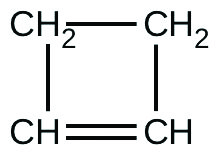


The isomerization of cyclobutene to butadiene is first-order and the rate constant has been measured as 2.0 10−4 s−1 at 150 °C in a 0.53-L flask. Determine the partial pressure of cyclobutene and its concentration after 30.0 minutes if an isomerization reaction is carried out at 150 °C with an initial pressure of 55 torr.
英語のヒント
シクロブテンからブタジエンへの異性化は1次反応で、0.53 Lのフラスコ中、150 °Cで測定された速度定数は2.0 10−4 s−1である。初圧55 torr、150 °Cで異性化反応を行うとき、30.0分後のシクロブテンの分圧と濃度を求めなさい。
half-life of a reaction (tl/2)
反応の半減期(tl/2)
time required for half of a given amount of reactant to be consumed
ある量の反応物の半分が消費されるのに必要な時間。
integrated rate law
積分速度式
equation that relates the concentration of a reactant to elapsed time of reaction
反応物濃度と反応の経過時間を関係づける式。