第12章反応速度
Heterogeneous Catalysts不均一系触媒
A heterogeneous catalyst is a catalyst that is present in a different phase (usually a solid) than the reactants. Such catalysts generally function by furnishing an active surface upon which a reaction can occur. Gas and liquid phase reactions catalyzed by heterogeneous catalysts occur on the surface of the catalyst rather than within the gas or liquid phase.
英語のヒント
不均一系触媒は、反応物と異なる相、通常は固相に存在する触媒である。一般に、反応が起こる活性な表面を与えることで働く。不均一系触媒に触媒される気相・液相反応は、気相や液相の内部ではなく、触媒の表面で起こる。
Heterogeneous catalysis typically involves the following processes:
不均一系触媒作用には、通常、次の過程が含まれる。
- Adsorption of the reactant(s) onto the surface of the catalyst反応物が触媒表面へ吸着する。
- Activation of the adsorbed reactant(s)吸着した反応物が活性化される。
- Reaction of the adsorbed reactant(s)吸着した反応物が反応する。
- Desorption of product(s) from the surface of the catalyst生成物が触媒表面から脱離する。
Figure 12.23 illustrates the steps of a mechanism for the reaction of compounds containing a carbon–carbon double bond with hydrogen on a nickel catalyst. Nickel is the catalyst used in the hydrogenation of polyunsaturated fats and oils (which contain several carbon–carbon double bonds) to produce saturated fats and oils (which contain only carbon–carbon single bonds).
英語のヒント
図12.23は、ニッケル触媒上で、炭素–炭素二重結合を含む化合物が水素と反応する機構の各段階を示す。ニッケルは、炭素–炭素二重結合をいくつも含む多価不飽和油脂を水素化して、炭素–炭素単結合だけを含む飽和油脂にする際に使う触媒である。
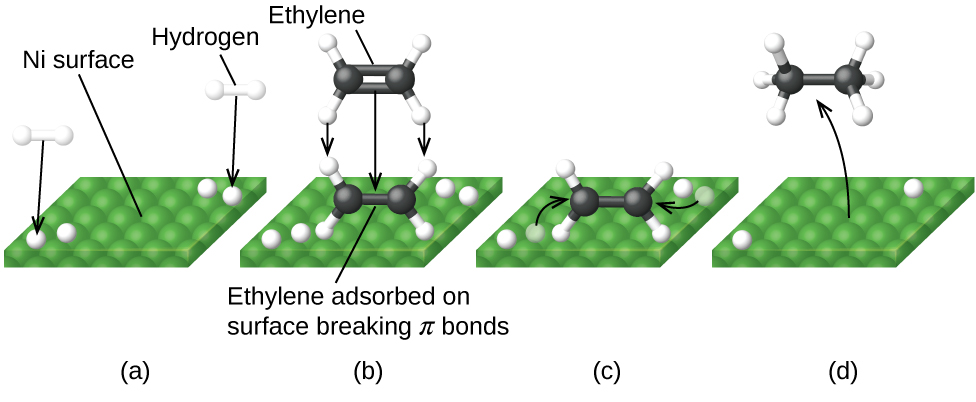

Figure 12.23図 12.23
Mechanism for the Ni-catalyzed reaction (a) Hydrogen is adsorbed on the surface, breaking the H–H bonds and forming Ni–H bonds. (b) Ethylene is adsorbed on the surface, breaking the C–C π-bond and forming Ni–C bonds. (c) Atoms diffuse across the surface and form new C–H bonds when they collide. (d) C2H6 molecules desorb from the Ni surface.
英語のヒント
Niが触媒する反応の機構。(a) 水素が表面に吸着し、H–H結合が切れてNi–H結合ができる。(b) エチレンが表面に吸着し、C–Cのπ結合が切れてNi–C結合ができる。(c) 原子が表面を拡散し、衝突すると新しいC–H結合を作る。(d) C2H6分子がNi表面から脱離す。
Many important chemical products are prepared via industrial processes that use heterogeneous catalysts, including ammonia, nitric acid, sulfuric acid, and methanol. Heterogeneous catalysts are also used in the catalytic converters found on most gasoline-powered automobiles (Figure 12.24).
英語のヒント
アンモニア、硝酸、硫酸、メタノールなど、多くの重要な化学製品が、不均一系触媒を使う工業過程で作られている。不均一系触媒は、大部分のガソリン車にある触媒コンバーターにも使われている(図12.24)。