第12章反応速度
12.2 Factors Affecting Reaction Rates12.2 反応速度に影響する要因
Learning Objectives学習目標
By the end of this section, you will be able to:
この節を終えると、次のことができるようになる。
- Describe the effects of chemical nature, physical state, temperature, concentration, and catalysis on reaction rates化学的性質、物理的状態、温度、濃度、触媒作用が反応速度に与える影響を述べる。
The rates at which reactants are consumed and products are formed during chemical reactions vary greatly. Five factors typically affecting the rates of chemical reactions will be explored in this section: the chemical nature of the reacting substances, the state of subdivision (one large lump versus many small particles) of the reactants, the temperature of the reactants, the concentration of the reactants, and the presence of a catalyst.
英語のヒント
化学反応で反応物が消費され、生成物ができる速度は、大きく異なる。この節では、化学反応速度に一般に影響する五つの要因を調べる。反応する物質の化学的性質、反応物の細かさ(一つの大きな塊か、多数の小さな粒子か)、反応物の温度、反応物の濃度、そして触媒の存在である。
The Chemical Nature of the Reacting Substances反応する物質の化学的性質
The rate of a reaction depends on the nature of the participating substances. Reactions that appear similar may have different rates under the same conditions, depending on the identity of the reactants. For example, when small pieces of the metals iron and sodium are exposed to air, the sodium reacts completely with air overnight, whereas the iron is barely affected. The active metals calcium and sodium both react with water to form hydrogen gas and a base. Yet calcium reacts at a moderate rate, whereas sodium reacts so rapidly that the reaction is almost explosive.
英語のヒント
反応速度は、関与する物質の性質に依存する。似て見える反応でも、反応物の種類によって、同じ条件で異なる速度を示すことがある。たとえば、金属の鉄とナトリウムの小片を空気にさらすと、ナトリウムは一晩で完全に空気と反応するが、鉄にはほとんど変化がない。反応性の高い金属であるカルシウムとナトリウムは、どちらも水と反応して水素ガスと塩基を生じる。しかしカルシウムが穏やかな速度で反応する一方、ナトリウムはほとんど爆発的なほど速く反応する。
The Physical States of the Reactants反応物の物理的状態
A chemical reaction between two or more substances requires intimate contact between the reactants. When reactants are in different physical states, or phases (solid, liquid, gaseous, dissolved), the reaction takes place only at the interface between the phases. Consider the heterogeneous reaction between a solid phase and either a liquid or gaseous phase. Compared with the reaction rate for large solid particles, the rate for smaller particles will be greater because the surface area in contact with the other reactant phase is greater. For example, large pieces of iron react more slowly with acids than they do with finely divided iron powder (Figure 12.6). Large pieces of wood smolder, smaller pieces burn rapidly, and saw dust burns explosively.
英語のヒント
二種類以上の物質の化学反応には、反応物どうしの密接な接触が必要である。反応物の物理的状態、すなわち相(固体、液体、気体、溶解した状態)が異なると、反応は相の界面だけで起こる。固相と、液相または気相との不均一反応を考えてみよう。大きな固体粒子に比べて小さな粒子の反応が速いのは、もう一方の反応物の相と接する表面積が大きいからである。たとえば、鉄の大きな塊と酸との反応は、細かい鉄粉の場合より遅くなる(図12.6)。大きな木片はくすぶり、小さな木片は速く燃え、おがくずは爆発的に燃える。
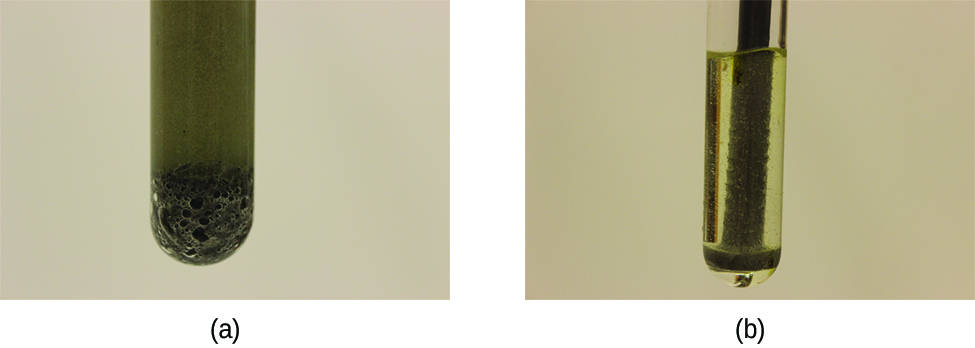

Figure 12.6図 12.6
(a) Iron powder reacts rapidly with dilute hydrochloric acid and produces bubbles of hydrogen gas: Fe(s) + HCl(aq) 2FeCl2(aq) + 3H2(g). (b) An iron nail reacts more slowly because the surface area exposed to the acid is much less.
(a) 鉄粉は希塩酸と速く反応し、水素ガスの泡を生じる:Fe(s) + HCl(aq) 2FeCl2(aq) + 3H2(g)。(b) 鉄のくぎは、酸に触れる表面積がずっと小さいため、反応が遅くなる。
Temperature of the Reactants反応物の温度
Chemical reactions typically occur faster at higher temperatures. Food can spoil quickly when left on the kitchen counter. However, the lower temperature inside of a refrigerator slows that process so that the same food remains fresh for days. Gas burners, hot plates, and ovens are often used in the laboratory to increase the speed of reactions that proceed slowly at ordinary temperatures. For many chemical processes, reaction rates are approximately doubled when the temperature is raised by 10 °C.
英語のヒント
化学反応は一般に、温度が高いほど速く起こる。台所の調理台に置きっぱなしの食品は、すぐに傷むことがある。しかし、冷蔵庫内では低温によってその過程が遅くなり、同じ食品が何日も新鮮に保たれる。実験室では、常温でゆっくり進む反応を速めるため、ガスバーナー、ホットプレート、オーブンをよく使う。多くの化学過程では、温度を10 °C上げると反応速度が約2倍になる。
Concentrations of the Reactants反応物の濃度
The rates of many reactions depend on the concentrations of the reactants. Rates usually increase when the concentration of one or more of the reactants increases. For example, calcium carbonate (CaCO3) deteriorates as a result of its reaction with the pollutant sulfur dioxide. The rate of this reaction depends on the amount of sulfur dioxide in the air (Figure 12.7). An acidic oxide, sulfur dioxide combines with water vapor in the air to produce sulfurous acid in the following reaction:
英語のヒント
多くの反応の速度は、反応物の濃度に依存する。一種類以上の反応物の濃度が上がると、普通は速度も上がる。たとえば、炭酸カルシウム(CaCO3)は、汚染物質である二酸化硫黄と反応して劣化する。この反応の速度は、空気中の二酸化硫黄の量に依存する(図12.7)。二酸化硫黄は酸性酸化物であり、次の反応で空気中の水蒸気と結びつき、亜硫酸を生じる。
Calcium carbonate reacts with sulfurous acid as follows:
炭酸カルシウムは、亜硫酸と次のように反応する。
In a polluted atmosphere where the concentration of sulfur dioxide is high, calcium carbonate deteriorates more rapidly than in less polluted air. Similarly, phosphorus burns much more rapidly in an atmosphere of pure oxygen than in air, which is only about 20% oxygen.
英語のヒント
二酸化硫黄の濃度が高い汚染された大気では、汚染の少ない空気中より炭酸カルシウムが速く劣化する。同様に、リンは、酸素が約20%しかない空気中より、純粋な酸素の雰囲気でずっと速く燃える。
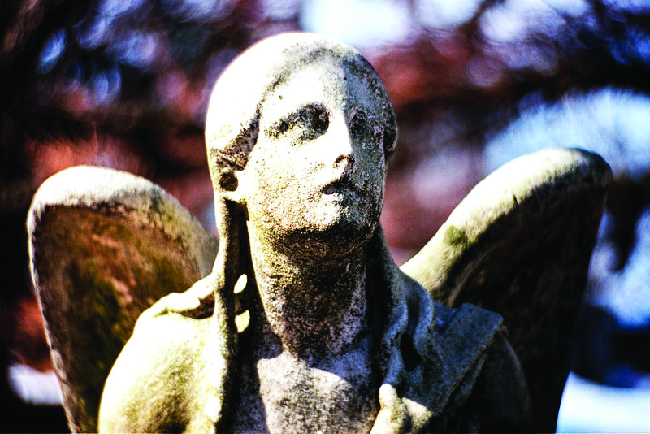
OpenStax, Rice University, Chemistry 2e. Original caption credit: (credit: James P Fisher III) Source work: Charlotte Canda Memorial (Angel).jpg · CC BY 3.0 · Source出典

Figure 12.7図 12.7
Statues made from carbonate compounds such as limestone and marble typically weather slowly over time due to the actions of water, and thermal expansion and contraction. However, pollutants like sulfur dioxide can accelerate weathering. As the concentration of air pollutants increases, deterioration of limestone occurs more rapidly. (credit: James P Fisher III)
石灰岩や大理石のような炭酸塩化合物から作られた彫像は、通常、水の作用や熱膨張・収縮により、時間とともにゆっくり風化する。しかし、二酸化硫黄などの汚染物質は風化を速める。大気汚染物質の濃度が上がると、石灰岩の劣化はより速く起こる。(出典:James P Fisher III)