第12章反応速度
12.5 Collision Theory12.5 衝突理論
Learning Objectives学習目標
By the end of this section, you will be able to:
この節を終えると、次のことができるようになる。
- Use the postulates of collision theory to explain the effects of physical state, temperature, and concentration on reaction rates衝突理論の仮定を使い、物理的状態、温度、濃度が反応速度に与える影響を説明する。
- Define the concepts of activation energy and transition state活性化エネルギーと遷移状態の概念を定義する。
- Use the Arrhenius equation in calculations relating rate constants to temperatureアレニウスの式を使い、速度定数と温度を関係づける計算を行う。
We should not be surprised that atoms, molecules, or ions must collide before they can react with each other. Atoms must be close together to form chemical bonds. This simple premise is the basis for a very powerful theory that explains many observations regarding chemical kinetics, including factors affecting reaction rates.
英語のヒント
原子、分子、イオンが互いに反応する前に衝突しなければならないことは、驚くには当たらない。化学結合を作るには、原子どうしが近づく必要がある。この単純な前提は、反応速度に影響する要因など、化学反応速度論についての多くの観測を説明する、非常に有力な理論の基礎である。
Collision theory is based on the following postulates:
英語のヒント
衝突理論は、次の仮定に基づく。
- The rate of a reaction is proportional to the rate of reactant collisions:反応速度は、反応物の衝突の頻度に比例する。
- The reacting species must collide in an orientation that allows contact between the atoms that will become bonded together in the product.
英語のヒント
反応する化学種は、生成物中で結合することになる原子どうしが接触できる向きで、衝突しなければならない。 - The collision must occur with adequate energy to permit mutual penetration of the reacting species’ valence shells so that the electrons can rearrange and form new bonds (and new chemical species).
英語のヒント
衝突は、反応する化学種の価電子殻が互いに入り込み、電子が再配置されて新しい結合と新しい化学種を作れるだけの、十分なエネルギーで起こらなければならない。
We can see the importance of the two physical factors noted in postulates 2 and 3, the orientation and energy of collisions, when we consider the reaction of carbon monoxide with oxygen:
一酸化炭素と酸素の反応を考えると、仮定2、3にある衝突の向きとエネルギーという二つの物理的要因の重要性が分かる。
Carbon monoxide is a pollutant produced by the combustion of hydrocarbon fuels. To reduce this pollutant, automobiles have catalytic converters that use a catalyst to carry out this reaction. It is also a side reaction of the combustion of gunpowder that results in muzzle flash for many firearms. If carbon monoxide and oxygen are present in sufficient amounts, the reaction will occur at high temperature and pressure.
英語のヒント
一酸化炭素は、炭化水素燃料の燃焼で生じる汚染物質である。自動車には、この汚染物質を減らすため、触媒を使ってこの反応を進める触媒コンバーターが備わっている。この反応は火薬の燃焼の副反応でもあり、多くの銃器でマズルフラッシュを生じさせる。一酸化炭素と酸素が十分な量あれば、高温・高圧で反応が起こる。
The first step in the gas-phase reaction between carbon monoxide and oxygen is a collision between the two molecules:
一酸化炭素と酸素の気相反応の最初の段階は、二つの分子の衝突である。
Although there are many different possible orientations the two molecules can have relative to each other, consider the two presented in Figure 12.13. In the first case, the oxygen side of the carbon monoxide molecule collides with the oxygen molecule. In the second case, the carbon side of the carbon monoxide molecule collides with the oxygen molecule. The second case is clearly more likely to result in the formation of carbon dioxide, which has a central carbon atom bonded to two oxygen atoms This is a rather simple example of how important the orientation of the collision is in terms of creating the desired product of the reaction.
英語のヒント
二つの分子の互いに対する向きはさまざまであるが、図12.13に示す二つを考えよう。最初は一酸化炭素分子の酸素側が酸素分子に衝突し、二つ目は炭素側が酸素分子に衝突する。中央の炭素原子が二つの酸素原子と結合した二酸化炭素を生じやすいのは、明らかに二つ目の場合である。これは、反応で望む生成物を作るうえで衝突の向きがいかに重要かを示す、比較的単純な例である。
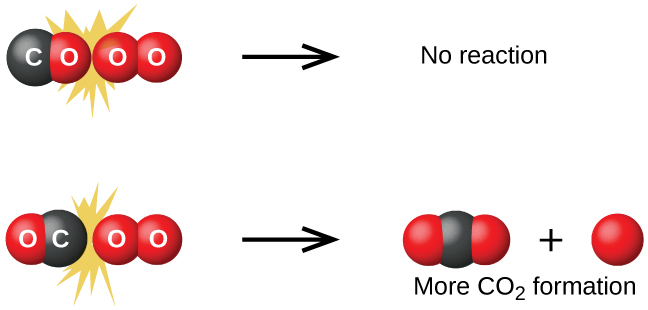
Figure 12.13図 12.13
Illustrated are two collisions that might take place between carbon monoxide and oxygen molecules. The orientation of the colliding molecules partially determines whether a reaction between the two molecules will occur.
一酸化炭素分子と酸素分子の間で起こり得る二つの衝突。衝突する分子の向きは、その二分子が反応するかどうかを決める要因の一つである。
If the collision does take place with the correct orientation, there is still no guarantee that the reaction will proceed to form carbon dioxide. In addition to a proper orientation, the collision must also occur with sufficient energy to result in product formation. When reactant species collide with both proper orientation and adequate energy, they combine to form an unstable species called an activated complex or a transition state. These species are very short lived and usually undetectable by most analytical instruments. In some cases, sophisticated spectral measurements have been used to observe transition states.
英語のヒント
適切な向きで衝突しても、反応が進んで二酸化炭素を生じる保証はまだない。向きに加え、生成物ができるだけの十分なエネルギーで衝突する必要がある。反応物の化学種が適切な向きと十分なエネルギーの両方を満たして衝突すると、結びついて活性錯体、または遷移状態と呼ばれる不安定な化学種を作る。その寿命は非常に短く、通常はほとんどの分析装置で検出できない。一部では、高度な分光測定によって遷移状態が観測されている。
Collision theory explains why most reaction rates increase as concentrations increase. With an increase in the concentration of any reacting substance, the chances for collisions between molecules are increased because there are more molecules per unit of volume. More collisions mean a faster reaction rate, assuming the energy of the collisions is adequate.
英語のヒント
衝突理論は、濃度を上げると多くの反応が速くなる理由を説明する。反応する物質の濃度が上がると、単位体積中の分子が増えるため、分子どうしの衝突の機会が増える。衝突のエネルギーが十分なら、衝突が増えるほど反応速度も大きくなる。
Activation Energy and the Arrhenius Equation活性化エネルギーとアレニウスの式
The minimum energy necessary to form a product during a collision between reactants is called the activation energy (Ea). How this energy compares to the kinetic energy provided by colliding reactant molecules is a primary factor affecting the rate of a chemical reaction. If the activation energy is much larger than the average kinetic energy of the molecules, the reaction will occur slowly since only a few fast-moving molecules will have enough energy to react. If the activation energy is much smaller than the average kinetic energy of the molecules, a large fraction of molecules will be adequately energetic and the reaction will proceed rapidly.
英語のヒント
反応物どうしの衝突で生成物を作るために必要な最小のエネルギーを、活性化エネルギー(Ea)と呼ぶ。このエネルギーが、衝突する反応物分子のもつ運動エネルギーと比べてどれほど大きいかは、化学反応速度に影響する主要な要因である。活性化エネルギーが分子の平均運動エネルギーよりはるかに大きければ、十分なエネルギーをもつ高速の分子はごく一部なので、反応はゆっくり起こる。活性化エネルギーが平均運動エネルギーよりはるかに小さければ、多くの分子が十分なエネルギーをもち、反応は速く進む。
Figure 12.14 shows how the energy of a chemical system changes as it undergoes a reaction converting reactants to products according to the equation
図12.14は、次の式に従って反応物が生成物へ変わる反応で、化学系のエネルギーがどう変化するかを示す。
These reaction diagrams are widely used in chemical kinetics to illustrate various properties of the reaction of interest. Viewing the diagram from left to right, the system initially comprises reactants only, A + B. Reactant molecules with sufficient energy can collide to form a high-energy activated complex or transition state. The unstable transition state can then subsequently decay to yield stable products, C + D. The diagram depicts the reaction's activation energy, Ea, as the energy difference between the reactants and the transition state. Using a specific energy, the enthalpy (see chapter on thermochemistry), the enthalpy change of the reaction, ΔH, is estimated as the energy difference between the reactants and products. In this case, the reaction is exothermic (ΔH < 0) since it yields a decrease in system enthalpy.
英語のヒント
このような反応図は、注目する反応のさまざまな性質を示すため、化学反応速度論で広く使われる。図を左から右へ見ると、系は初め、反応物A + Bだけからなる。十分なエネルギーをもつ反応物分子は、衝突して高エネルギーの活性錯体、すなわち遷移状態を作れる。その後、不安定な遷移状態が崩れ、安定な生成物C + Dが生じる。図は、活性化エネルギーEaを、反応物と遷移状態のエネルギー差として示している。エネルギーの一種であるエンタルピー(熱化学の章参照)を使うと、反応のエンタルピー変化ΔHは、反応物と生成物のエネルギー差として見積もれる。この場合、系のエンタルピーが減るので、発熱反応(ΔH < 0)である。
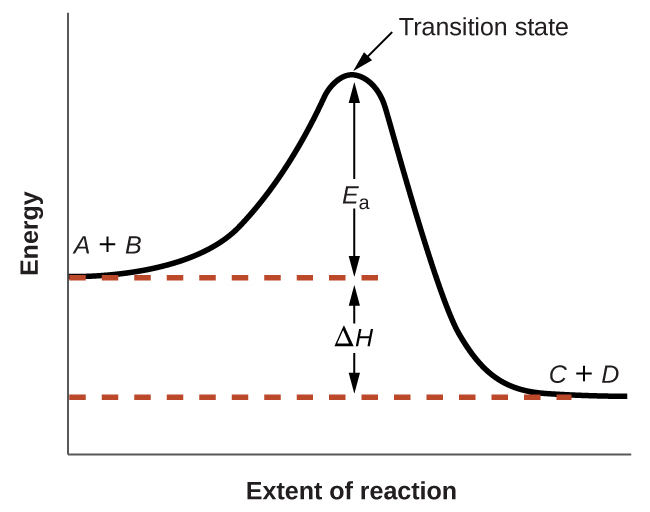
Figure 12.14図 12.14
Reaction diagram for the exothermic reaction
発熱反応の反応図。
The Arrhenius equation relates the activation energy and the rate constant, k, for many chemical reactions:
アレニウスの式は、多くの化学反応の活性化エネルギーと速度定数kを関係づける。
In this equation, R is the ideal gas constant, which has a value 8.314 J/mol/K, T is temperature on the Kelvin scale, Ea is the activation energy in joules per mole, e is the constant 2.7183, and A is a constant called the frequency factor, which is related to the frequency of collisions and the orientation of the reacting molecules.
英語のヒント
この式で、Rは理想気体定数で8.314 J/mol/K、Tはケルビン尺度での温度、EaはJ/molで表した活性化エネルギー、eは定数2.7183である。Aは頻度因子という定数で、衝突の頻度と反応分子の向きに関係する。
Postulates of collision theory are nicely accommodated by the Arrhenius equation. The frequency factor, A, reflects how well the reaction conditions favor properly oriented collisions between reactant molecules. An increased probability of effectively oriented collisions results in larger values for A and faster reaction rates.
英語のヒント
アレニウスの式は、衝突理論の仮定によく対応している。頻度因子Aは、反応条件が、反応物分子どうしの適切な向きでの衝突にどれほど有利かを反映する。有効な向きで衝突する確率が高いほど、Aは大きく、反応も速くなる。
The exponential term, e−Ea/RT, describes the effect of activation energy on reaction rate. According to kinetic molecular theory (see chapter on gases), the temperature of matter is a measure of the average kinetic energy of its constituent atoms or molecules. The distribution of energies among the molecules composing a sample of matter at any given temperature is described by the plot shown in Figure 12.15(a). Two shaded areas under the curve represent the numbers of molecules possessing adequate energy (RT) to overcome the activation barriers (Ea). A lower activation energy results in a greater fraction of adequately energized molecules and a faster reaction.
英語のヒント
指数項e−Ea/RTは、活性化エネルギーが反応速度に与える影響を表す。気体分子運動論(気体の章参照)によると、物質の温度は、構成する原子や分子の平均運動エネルギーの尺度である。ある温度での物質試料を構成する分子のエネルギー分布を、図12.15(a)に示す。曲線の下の二つの着色部分は、活性化障壁(Ea)を越える十分なエネルギー(RT)をもつ分子の数を表す。活性化エネルギーが低いほど、十分なエネルギーをもつ分子の割合が大きく、反応も速くなる。
The exponential term also describes the effect of temperature on reaction rate. A higher temperature represents a correspondingly greater fraction of molecules possessing sufficient energy (RT) to overcome the activation barrier (Ea), as shown in Figure 12.15(b). This yields a greater value for the rate constant and a correspondingly faster reaction rate.
英語のヒント
指数項は、温度が反応速度に与える影響も表す。図12.15(b)のように、温度が高いほど、活性化障壁(Ea)を越える十分なエネルギー(RT)をもつ分子の割合が大きくなる。その結果、速度定数が大きくなり、反応速度もそれに対応して大きくなる。
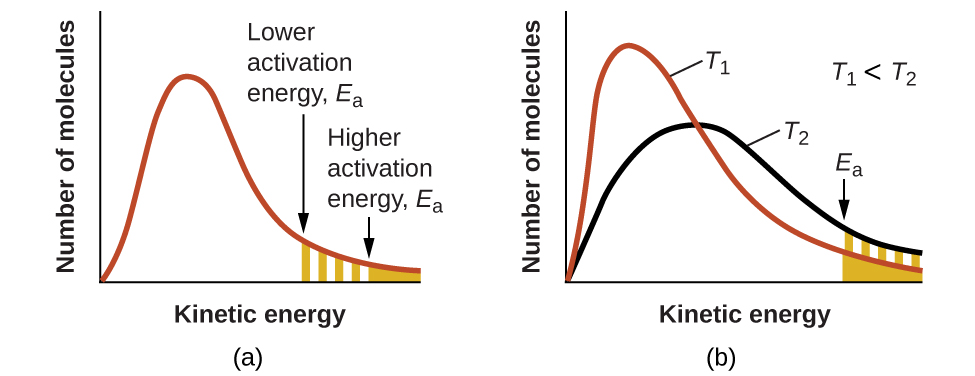
Figure 12.15図 12.15
Molecular energy distributions showing numbers of molecules with energies exceeding (a) two different activation energies at a given temperature, and (b) a given activation energy at two different temperatures.
(a) 一定の温度で、異なる二つの活性化エネルギーを超える分子の数、(b) 異なる二つの温度で、一定の活性化エネルギーを超える分子の数を示す、分子のエネルギー分布。
A convenient approach for determining Ea for a reaction involves the measurement of k at two or more different temperatures and using an alternate version of the Arrhenius equation that takes the form of a linear equation
英語のヒント
反応のEaを求める便利な方法は、二つ以上の異なる温度でkを測り、直線の式の形にしたアレニウスの式を使うことである。
A plot of ln k versus is linear with a slope equal to and a y-intercept equal to ln A.
ln kをに対してプロットすると、傾き、縦軸切片ln Aの直線になる。
Example 12.13例題 12.13
Determination of EaEaを求める
The variation of the rate constant with temperature for the decomposition of HI(g) to H2(g) and I2(g) is given here. What is the activation energy for the reaction?
HI(g)がH2(g)とI2(g)に分解する反応について、速度定数の温度変化を示す。この反応の活性化エネルギーはいくらか。
T (K) |
k (L/mol/s) |
|---|---|
555 |
3.52 10−7 |
575 |
1.22 10−6 |
645 |
8.59 10−5 |
700 |
1.16 10−3 |
781 |
3.95 10−2 |
Solution解答
Use the provided data to derive values of and ln k:
与えられたデータを使って、とln kを求める。
ln k |
|
|---|---|
1.80 10−3 |
−14.860 |
1.74 10−3 |
−13.617 |
1.55 10−3 |
−9.362 |
1.43 10−3 |
−6.759 |
1.28 10−3 |
−3.231 |
Figure 12.16 is a graph of ln k versus In practice, the equation of the line (slope and y-intercept) that best fits these plotted data points would be derived using a statistical process called regression. This is helpful for most experimental data because a perfect fit of each data point with the line is rarely encountered. For the data here, the fit is nearly perfect and the slope may be estimated using any two of the provided data pairs. Using the first and last data points permits estimation of the slope.
英語のヒント
図12.16はln kをに対して描いたグラフである。実際には、これらのデータ点に最もよく合う直線の式、すなわち傾きと縦軸切片を、回帰という統計的手法で求める。すべてのデータ点が直線に完全に一致することはめったにないため、多くの実験データに有用である。ここでのデータはほぼ完全に直線に合うので、どの二組のデータからでも傾きを見積もれる。最初と最後のデータ点を使って、傾きを見積もる。
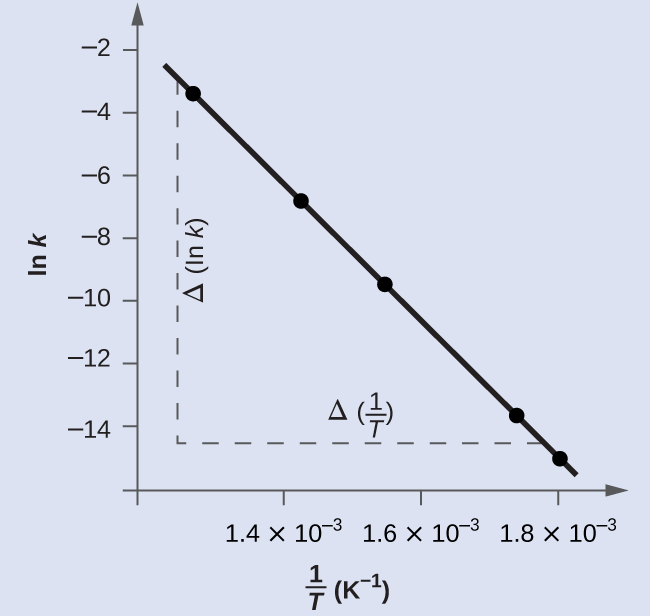


Figure 12.16図 12.16
This graph shows the linear relationship between ln k and for the reaction according to the Arrhenius equation.
アレニウスの式に従う反応について、ln kとの直線関係を示すグラフ。
Alternative approach: A more expedient approach involves deriving activation energy from measurements of the rate constant at just two temperatures. In this approach, the Arrhenius equation is rearranged to a convenient two-point form:
英語のヒント
別の方法:より手早い方法は、二つの温度だけで測定した速度定数から、活性化エネルギーを求めることである。この方法では、アレニウスの式を、便利な二点形式へ変形する。
Rearranging this equation to isolate activation energy yields:
この式を活性化エネルギーについて解く形に変形すると、
Any two data pairs may be substituted into this equation—for example, the first and last entries from the above data table:
この式には、任意の二組のデータを代入できる。たとえば、上の表の最初と最後の値を使うと、
and the result is Ea = 1.8 105 J mol−1 or 180 kJ mol−1
結果はEa = 1.8 105 J mol−1、すなわち180 kJ mol−1である。
This approach yields the same result as the more rigorous graphical approach used above, as expected. In practice, the graphical approach typically provides more reliable results when working with actual experimental data.
英語のヒント
予想どおり、この方法でも、先ほどのより厳密なグラフによる方法と同じ結果が得られる。実際の実験データを扱う場合、通常はグラフによる方法のほうが信頼性の高い結果を与える。
Check Your Learning理解度を確認
The rate constant for the rate of decomposition of N2O5 to NO and O2 in the gas phase is 1.66 L/mol/s at 650 K and 7.39 L/mol/s at 700 K:
N2O5が気相でNOとO2に分解する速度定数は、650 Kで1.66 L/mol/s、700 Kで7.39 L/mol/sである。
Assuming the kinetics of this reaction are consistent with the Arrhenius equation, calculate the activation energy for this decomposition.
この反応の速度論がアレニウスの式に従うと仮定し、分解の活性化エネルギーを計算しなさい。