第6章電子構造と元素の周期的性質
6.5 Periodic Variations in Element Properties6.5 元素の性質の周期的変化
Learning Objectives学習目標
By the end of this section, you will be able to:
この節を終えると、次のことができるようになる。
- Describe and explain the observed trends in atomic size, ionization energy, and electron affinity of the elements元素の原子の大きさ、イオン化エネルギー、電子親和力に見られる傾向を記述し、その理由を説明する。
The elements in groups (vertical columns) of the periodic table exhibit similar chemical behavior. This similarity occurs because the members of a group have the same number and distribution of electrons in their valence shells. However, there are also other patterns in chemical properties on the periodic table. For example, as we move down a group, the metallic character of the atoms increases. Oxygen, at the top of group 16 (6A), is a colorless gas; in the middle of the group, selenium is a semiconducting solid; and, toward the bottom, polonium is a silver-grey solid that conducts electricity.
英語のヒント
周期表の同じ族、すなわち縦列にある元素は、似た化学的な振る舞いを示す。価電子殻の電子数と分布が同じためである。しかし、周期表の化学的性質には、ほかにも規則性がある。たとえば、族を下へ進むほど原子の金属的性質が強くなる。16族(6A)の最上部にある酸素は無色の気体、中ほどのセレンは半導体の固体、下方のポロニウムは電気を通す銀灰色の固体である。
As we go across a period from left to right, we add a proton to the nucleus and an electron to the valence shell with each successive element. As we go down the elements in a group, the number of electrons in the valence shell remains constant, but the principal quantum number increases by one each time. An understanding of the electronic structure of the elements allows us to examine some of the properties that govern their chemical behavior. These properties vary periodically as the electronic structure of the elements changes. They are (1) size (radius) of atoms and ions, (2) ionization energies, and (3) electron affinities.
周期を左から右へ進むと、元素が1つ進むごとに原子核に陽子1個、価電子殻に電子1個が加わる。同じ族を下へ進むと、価電子殻の電子数は一定のまま、主量子数が1つずつ増える。元素の電子構造を理解すると、化学的な振る舞いを支配するいくつかの性質を調べられる。これらは、電子構造の変化とともに周期的に変化する。(1) 原子やイオンの大きさ(半径)、(2) イオン化エネルギー、(3) 電子親和力である。
Variation in Covalent Radius共有結合半径の変化
The quantum mechanical picture makes it difficult to establish a definite size of an atom. However, there are several practical ways to define the radius of atoms and, thus, to determine their relative sizes that give roughly similar values. We will use the covalent radius (Figure 6.30), which is defined as one-half the distance between the nuclei of two identical atoms when they are joined by a covalent bond (this measurement is possible because atoms within molecules still retain much of their atomic identity). We know that as we scan down a group, the principal quantum number, n, increases by one for each element. Thus, the electrons are being added to a region of space that is increasingly distant from the nucleus. Consequently, the size of the atom (and its covalent radius) must increase as we increase the distance of the outermost electrons from the nucleus. This trend is illustrated for the covalent radii of the halogens in Table 6.2 and Figure 6.30. The trends for the entire periodic table can be seen in Figure 6.30.
英語のヒント
量子力学的な原子像では、原子の明確な大きさを決めることは難しい。しかし、原子半径を定義し、相対的な大きさを求める実用的な方法はいくつかあり、おおむね似た値が得られる。ここでは共有結合半径を使う(図6.30)。これは、同じ種類の原子2個が共有結合で結ばれたときの、原子核間距離の半分として定義される。分子内でも原子はその原子としての性質をかなり保つため、この測定が可能である。同じ族を下へたどると、元素ごとに主量子数nが1つ増える。そのため、電子は原子核から次第に遠い空間領域に加わる。したがって、最外殻電子と原子核の距離が増すにつれ、原子の大きさと共有結合半径は増大するはずである。ハロゲンの共有結合半径について、この傾向を表6.2と図6.30に示す。周期表全体の傾向も、図6.30で見ることができる。
Covalent Radii of the Halogen Group Elements ハロゲン族元素の共有結合半径 |
||
|---|---|---|
Atom 原子 |
Covalent radius (pm) 共有結合半径(pm) |
Nuclear charge 核電荷 |
F |
64 |
+9 |
Cl |
99 |
+17 |
Br |
114 |
+35 |
I |
133 |
+53 |
At |
148 |
+85 |
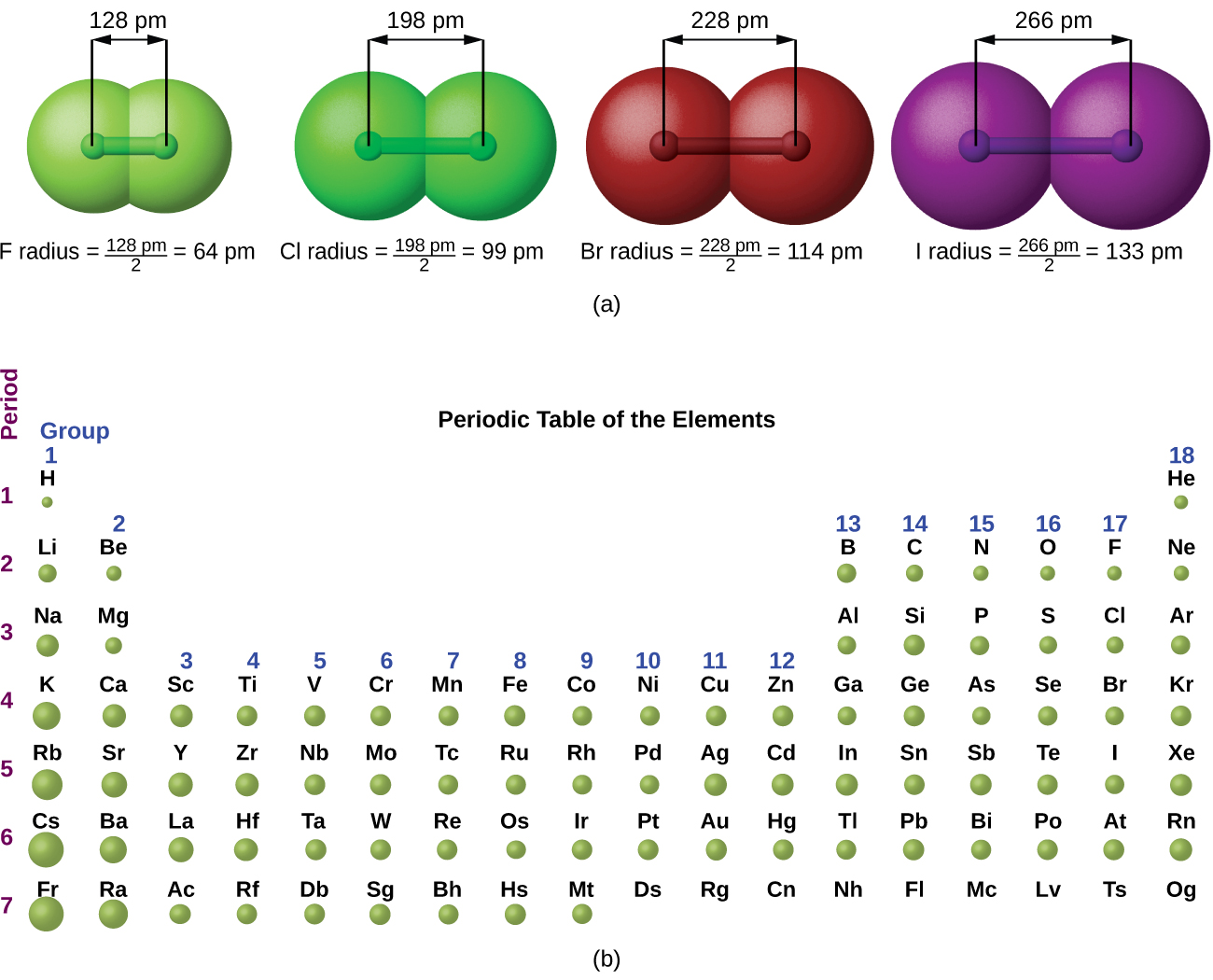
Figure 6.30図 6.30
(a) The radius of an atom is defined as one-half the distance between the nuclei in a molecule consisting of two identical atoms joined by a covalent bond. The atomic radius for the halogens increases down the group as n increases. (b) Covalent radii of the elements are shown to scale. The general trend is that radii increase down a group and decrease across a period.
(a) 同種の原子2個を共有結合で結んだ分子において、原子半径は核間距離の半分として定義される。ハロゲンの原子半径は、族を下へ進んでnが増えるほど大きくなる。(b) 元素の共有結合半径を、互いの大きさの比率に合わせて示す。一般に半径は、族を下へ進むと増加し、周期を横へ進むと減少する。
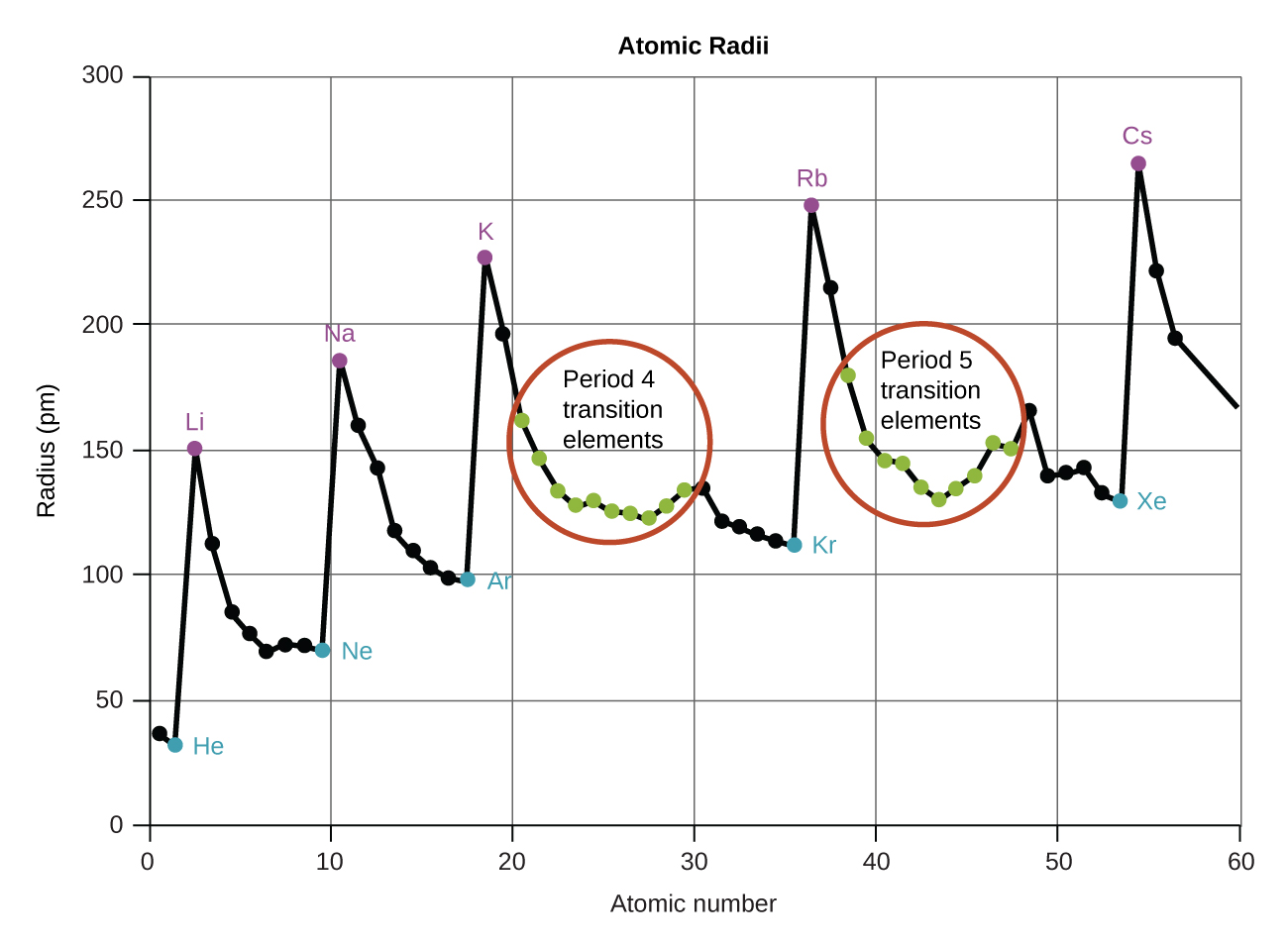


Figure 6.31図 6.31
Within each period, the trend in atomic radius decreases as Z increases; for example, from K to Kr. Within each group (e.g., the alkali metals shown in purple), the trend is that atomic radius increases as Z increases.
各周期では、たとえばKからKrのように、Zが増えるにつれて原子半径は小さくなる傾向がある。同じ族では、紫で示したアルカリ金属のように、Zが増えるほど原子半径が大きくなる傾向がある。
As shown in Figure 6.31, as we move across a period from left to right, we generally find that each element has a smaller covalent radius than the element preceding it. This might seem counterintuitive because it implies that atoms with more electrons have a smaller atomic radius. This can be explained with the concept of effective nuclear charge, Zeff. This is the pull exerted on a specific electron by the nucleus, taking into account any electron–electron repulsions. For hydrogen, there is only one electron and so the nuclear charge (Z) and the effective nuclear charge (Zeff) are equal. For all other atoms, the inner electrons partially shield the outer electrons from the pull of the nucleus, and thus:
英語のヒント
図6.31に示すように、周期を左から右へ進むと、一般に各元素の共有結合半径は1つ前の元素より小さくなる。電子が多い原子ほど原子半径が小さいということなので、直感に反するように思えるかもしれない。これは、有効核電荷Zeffという概念で説明できる。電子間反発を考慮したうえで、原子核が特定の電子に及ぼす引力である。水素の電子は1個だけなので、核電荷Zと有効核電荷Zeffは等しい。それ以外の原子では、内側の電子が、外側の電子に働く原子核の引力を部分的に遮蔽する。そのため、次のようになる。
Shielding is determined by the probability of another electron being between the electron of interest and the nucleus, as well as by the electron–electron repulsions the electron of interest encounters. Core electrons are adept at shielding, while electrons in the same valence shell do not block the nuclear attraction experienced by each other as efficiently. Thus, each time we move from one element to the next across a period, Z increases by one, but the shielding increases only slightly. Thus, Zeff increases as we move from left to right across a period. The stronger pull (higher effective nuclear charge) experienced by electrons on the right side of the periodic table draws them closer to the nucleus, making the covalent radii smaller.
英語のヒント
遮蔽は、注目する電子と原子核の間に別の電子が存在する確率と、その電子が受ける電子間反発によって決まる。内殻電子は効果的に遮蔽するが、同じ価電子殻にある電子同士は、互いが受ける核の引力を、それほど効率よく遮らない。したがって、周期を横に進んで元素が1つ変わるごとにZは1増えるが、遮蔽はわずかにしか増えない。このため、周期を左から右へ進むほどZeffが増加する。周期表の右側の電子が受ける強い引力、すなわち大きい有効核電荷は、電子を原子核の近くへ引き寄せ、共有結合半径を小さくする。
Thus, as we would expect, the outermost or valence electrons are easiest to remove because they have the highest energies, are shielded more, and are farthest from the nucleus. As a general rule, when the representative elements form cations, they do so by the loss of the ns or np electrons that were added last in the Aufbau process. The transition elements, on the other hand, lose the ns electrons before they begin to lose the (n – 1)d electrons, even though the ns electrons are added first, according to the Aufbau principle.
英語のヒント
したがって、予想されるとおり、最外殻の価電子が最も取り除きやすい。エネルギーが最も高く、遮蔽を強く受け、原子核から最も遠いためである。原則として、典型元素は、構成原理で最後に加わったnsまたはnp電子を失って陽イオンを作る。これに対し遷移元素では、構成原理ではns電子が先に加わるにもかかわらず、(n − 1)d電子を失う前にns電子を失う。
Example 6.12例題 6.12
Sorting Atomic Radii原子半径を大きさ順に並べる
Predict the order of increasing covalent radius for Ge, Fl, Br, Kr.
Ge、Fl、Br、Krを、共有結合半径が小さい順に並べなさい。
Solution解法
Radius increases as we move down a group, so Ge < Fl (Note: Fl is the symbol for flerovium, element 114, NOT fluorine). Radius decreases as we move across a period, so Kr < Br < Ge. Putting the trends together, we obtain Kr < Br < Ge < Fl.
同じ族では下へ進むほど半径が大きいので、Ge < Flとなる。Flは元素114のフレロビウムの記号であり、フッ素ではないことに注意。同じ周期では横へ進むほど小さいので、Kr < Br < Geとなる。これらを合わせると、Kr < Br < Ge < Flである。
Check Your Learning理解を確かめよう
Give an example of an atom whose size is smaller than fluorine.
フッ素より小さい原子を1つ挙げなさい。