第6章電子構造と元素の周期的性質
6.1 Electromagnetic Energy6.1 電磁エネルギー
Learning Objectives学習目標
By the end of this section, you will be able to:
この節を終えると、次のことができるようになる。
- Explain the basic behavior of waves, including travelling waves and standing waves進行波と定常波を含む、波の基本的な振る舞いを説明する。
- Describe the wave nature of light光の波としての性質を説明する。
- Use appropriate equations to calculate related light-wave properties such as frequency, wavelength, and energy適切な式を使い、振動数、波長、エネルギーなど、光の波としての関連する性質を計算する。
- Distinguish between line and continuous emission spectra発光の線スペクトルと連続スペクトルを区別する。
- Describe the particle nature of light光の粒子としての性質を説明する。
The nature of light has been a subject of inquiry since antiquity. In the seventeenth century, Isaac Newton performed experiments with lenses and prisms and was able to demonstrate that white light consists of the individual colors of the rainbow combined together. Newton explained his optics findings in terms of a "corpuscular" view of light, in which light was composed of streams of extremely tiny particles travelling at high speeds according to Newton's laws of motion. Others in the seventeenth century, such as Christiaan Huygens, had shown that optical phenomena such as reflection and refraction could be equally well explained in terms of light as waves travelling at high speed through a medium called "luminiferous aether" that was thought to permeate all space. Early in the nineteenth century, Thomas Young demonstrated that light passing through narrow, closely spaced slits produced interference patterns that could not be explained in terms of Newtonian particles but could be easily explained in terms of waves. Later in the nineteenth century, after James Clerk Maxwell developed his theory of electromagnetic radiation and showed that light was the visible part of a vast spectrum of electromagnetic waves, the particle view of light became thoroughly discredited. By the end of the nineteenth century, scientists viewed the physical universe as roughly comprising two separate domains: matter composed of particles moving according to Newton's laws of motion, and electromagnetic radiation consisting of waves governed by Maxwell's equations. Today, these domains are referred to as classical mechanics and classical electrodynamics (or classical electromagnetism). Although there were a few physical phenomena that could not be explained within this framework, scientists at that time were so confident of the overall soundness of this framework that they viewed these aberrations as puzzling paradoxes that would ultimately be resolved somehow within this framework. As we shall see, these paradoxes led to a contemporary framework that intimately connects particles and waves at a fundamental level called wave-particle duality, which has superseded the classical view.
英語のヒント
光の本性は、古代から探究の対象だった。17世紀、アイザック・ニュートンはレンズやプリズムを使って実験し、白色光が虹の各色を組み合わせたものであることを示した。ニュートンは、光を微小な粒子の流れとみなす「粒子説」によって光学上の発見を説明した。この見方では、光はニュートンの運動法則に従い、高速で進む非常に小さな粒子からなる。同じ17世紀には、クリスティアーン・ホイヘンスらが、反射や屈折などの光学現象は、光を高速で進む波と考えても同じように説明できることを示した。その波が伝わる媒質は「光を運ぶエーテル」と呼ばれ、全空間に満ちていると考えられた。19世紀初め、トマス・ヤングは、狭く接近したスリットを通った光が干渉縞を生じることを示した。干渉縞はニュートン的な粒子では説明できず、波としてなら容易に説明できた。同世紀の後半、ジェームズ・クラーク・マクスウェルが電磁放射の理論をつくり、光が広大な電磁波のスペクトルのうち目に見える部分だと示すと、光の粒子説はまったく信用されなくなった。19世紀末までには、科学者は物理的な宇宙を、おおまかに2つの別々の領域からなると考えていた。1つは、ニュートンの運動法則に従う粒子からなる物質。もう1つは、マクスウェル方程式に従う波からなる電磁放射である。現在、これらは古典力学と古典電気力学(古典電磁気学)と呼ばれる。この枠組みで説明できない物理現象もいくつかあったが、当時の科学者は枠組み全体の確かさに大きな自信をもっていた。そのため、説明から外れる現象を、いずれ何らかの方法で同じ枠組みの中で解決される不可解な逆説と見ていた。これから見るように、こうした逆説は、根本的な水準で粒子と波を密接に結ぶ「波動と粒子の二重性」という現代的な枠組みへつながり、古典的な見方に取って代わった。
Visible light and other forms of electromagnetic radiation play important roles in chemistry, since they can be used to infer the energies of electrons within atoms and molecules. Much of modern technology is based on electromagnetic radiation. For example, radio waves from a mobile phone, X-rays used by dentists, the energy used to cook food in your microwave, the radiant heat from red-hot objects, and the light from your television screen are forms of electromagnetic radiation that all exhibit wavelike behavior.
英語のヒント
可視光をはじめとする電磁放射は、原子や分子内の電子のエネルギーを推測するのに使えるため、化学で重要な役割を果たす。現代技術の多くは電磁放射を基礎としている。たとえば、携帯電話からの電波、歯科医が使うX線、電子レンジで調理するエネルギー、赤熱した物体からの放射熱、テレビ画面からの光は、いずれも電磁放射であり、波のような振る舞いを示す。
Waves波
A wave is an oscillation or periodic movement that can transport energy from one point in space to another. Common examples of waves are all around us. Shaking the end of a rope transfers energy from your hand to the other end of the rope, dropping a pebble into a pond causes waves to ripple outward along the water's surface, and the expansion of air that accompanies a lightning strike generates sound waves (thunder) that can travel outward for several miles. In each of these cases, kinetic energy is transferred through matter (the rope, water, or air) while the matter remains essentially in place. An insightful example of a wave occurs in sports stadiums when fans in a narrow region of seats rise simultaneously and stand with their arms raised up for a few seconds before sitting down again while the fans in neighboring sections likewise stand up and sit down in sequence. While this wave can quickly encircle a large stadium in a few seconds, none of the fans actually travel with the wave-they all stay in or above their seats.
英語のヒント
波とは、空間のある点から別の点へエネルギーを運べる振動、または周期的な運動である。身の回りには波の例が多くある。ロープの端を揺らすと、手からロープの反対側へエネルギーが伝わる。池に小石を落とすと、水面を外側へ波紋が広がる。落雷に伴う空気の膨張は音波、すなわち雷鳴を生み、それが数マイル先まで伝わることもある。どの場合も、運動エネルギーは物質(ロープ、水、空気)を通じて伝わるが、物質自体は基本的にその場にとどまる。波のわかりやすい例が、スタジアムの観客によるウェーブである。狭い範囲の席の観客が一斉に立ち、数秒間腕を上げてから座る。隣の区域の観客も順番に同じ動作を繰り返す。このウェーブは数秒で大きなスタジアムを一周できるが、観客が波とともに移動しているわけではない。全員、自分の席に座るか、その場に立っている。
Waves need not be restricted to travel through matter. As Maxwell showed, electromagnetic waves consist of an electric field oscillating in step with a perpendicular magnetic field, both of which are perpendicular to the direction of travel. These waves can travel through a vacuum at a constant speed of 2.998 108 m/s, the speed of light (denoted by c).
英語のヒント
波が伝わるのは物質中だけとは限らない。マクスウェルが示したように、電磁波は、互いに直交する電場と磁場が歩調を合わせて振動するもので、どちらも進行方向に直交する。この波は真空中を一定の速さ2.998 108 m/sで進む。これが光速であり、cで表す。
All waves, including forms of electromagnetic radiation, are characterized by, a wavelength (denoted by λ, the lowercase Greek letter lambda), a frequency (denoted by ν, the lowercase Greek letter nu), and an amplitude. As can be seen in Figure 6.2, the wavelength is the distance between two consecutive peaks or troughs in a wave (measured in meters in the SI system). Electromagnetic waves have wavelengths that fall within an enormous range-wavelengths of kilometers (103 m) to picometers (10−12 m) have been observed. The frequency is the number of wave cycles that pass a specified point in space in a specified amount of time (in the SI system, this is measured in seconds). A cycle corresponds to one complete wavelength. The unit for frequency, expressed as cycles per second [s−1], is the hertz (Hz). Common multiples of this unit are megahertz, (1 MHz = 1 106 Hz) and gigahertz (1 GHz = 1 109 Hz). The amplitude corresponds to the magnitude of the wave's displacement and so, in Figure 6.2, this corresponds to one-half the height between the peaks and troughs. The amplitude is related to the intensity of the wave, which for light is the brightness, and for sound is the loudness.
英語のヒント
電磁放射を含むすべての波は、波長(ギリシャ小文字ラムダλ)、振動数(ギリシャ小文字ニューν)、振幅によって特徴付けられる。図6.2に示すように、波長は波の隣り合う山どうし、または谷どうしの距離であり、SI単位系ではメートルで測る。電磁波の波長は非常に広い範囲に及び、キロメートル(103 m)からピコメートル(10−12 m)まで観測されている。振動数は、空間内のある点を一定時間に通過する波の周期数である。SI単位系では、その時間を秒で測る。1周期は完全な1波長に対応する。振動数の単位は1秒あたりの周期数[s−1]で、ヘルツ(Hz)という。よく使う倍量単位に、メガヘルツ(1 MHz = 1 106 Hz)とギガヘルツ(1 GHz = 1 109 Hz)がある。振幅は波の変位の大きさに対応し、図6.2では山から谷までの高さの半分に当たる。振幅は波の強度に関係し、光では明るさ、音では音の大きさに関わる。
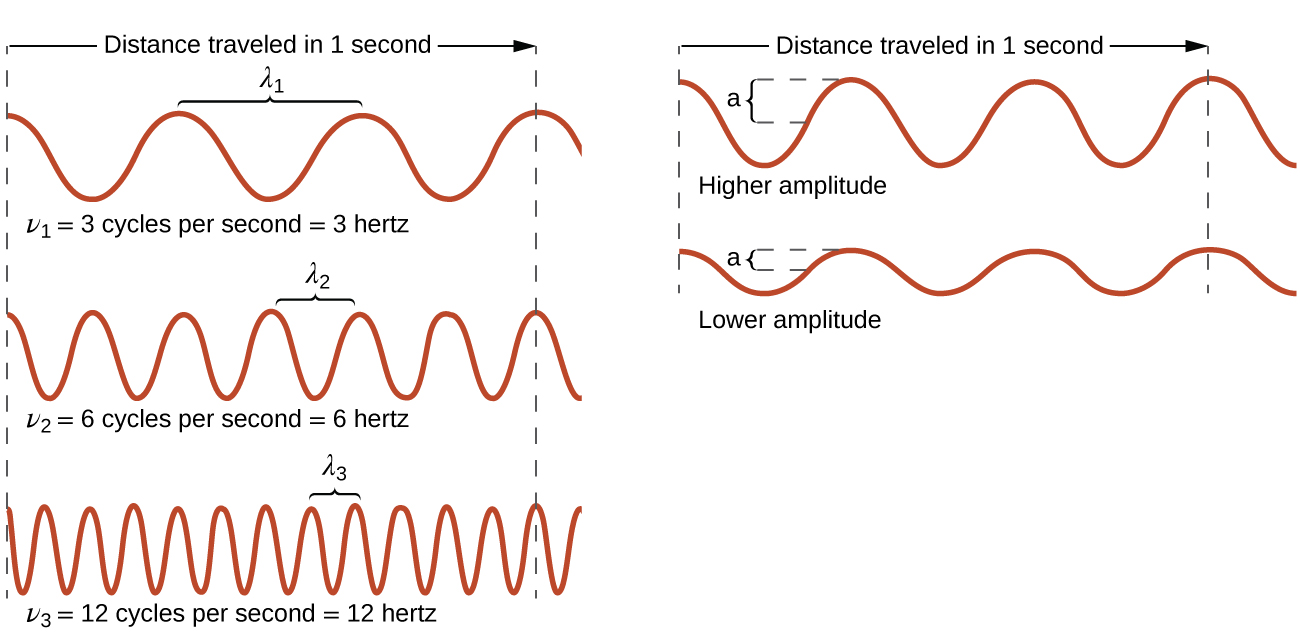
Figure 6.2図 6.2
One-dimensional sinusoidal waves show the relationship among wavelength, frequency, and speed. The wave with the shortest wavelength has the highest frequency. Amplitude is one-half the height of the wave from peak to trough.
英語のヒント
一次元の正弦波は、波長、振動数、速さの関係を示す。波長が最も短い波は、振動数が最も高い。振幅は、山から谷までの波の高さの半分である。
The product of a wave's wavelength (λ) and its frequency (ν), λν, is the speed of the wave. Thus, for electromagnetic radiation in a vacuum, speed is equal to the fundamental constant, c:
英語のヒント
波長λと振動数νの積λνは、波の速さに等しい。したがって、真空中の電磁放射では、その速さは基本定数cに等しい。
Wavelength and frequency are inversely proportional: As the wavelength increases, the frequency decreases. The inverse proportionality is illustrated in Figure 6.3. This figure also shows the electromagnetic spectrum, the range of all types of electromagnetic radiation. Each of the various colors of visible light has specific frequencies and wavelengths associated with them, and you can see that visible light makes up only a small portion of the electromagnetic spectrum. Because the technologies developed to work in various parts of the electromagnetic spectrum are different, for reasons of convenience and historical legacies, different units are typically used for different parts of the spectrum. For example, radio waves are usually specified as frequencies (typically in units of MHz), while the visible region is usually specified in wavelengths (typically in units of nm or angstroms).
英語のヒント
波長と振動数は反比例する。波長が長くなると、振動数は低くなる。この反比例の関係を図6.3に示す。同図は、あらゆる種類の電磁放射の範囲である電磁スペクトルも示している。可視光の各色にはそれぞれ特定の振動数と波長が対応し、可視光が電磁スペクトルのごく一部にすぎないことがわかる。電磁スペクトルの各領域では、それぞれ異なる技術が発展したため、利便性や歴史的な経緯から、領域ごとに異なる単位を使うのが普通である。たとえば、電波は通常、振動数(主にMHz)で示すが、可視光領域は通常、波長(主にnmまたはオングストローム)で示す。
Image omitted because its reuse rights could not be verified.権利の確認ができないため画像を割愛。
Figure 6.3図 6.3
Portions of the electromagnetic spectrum are shown in order of decreasing frequency and increasing wavelength. (credit “Cosmic ray": modification of work by NASA; credit “PET scan": modification of work by the National Institute of Health; credit “X-ray": modification of work by Dr. Jochen Lengerke; credit “Dental curing": modification of work by the Department of the Navy; credit “Night vision": modification of work by the Department of the Army; credit “Remote": modification of work by Emilian Robert Vicol; credit “Cell phone": modification of work by Brett Jordan; credit “Microwave oven": modification of work by Billy Mabray; credit “AM radio": modification of work by Dave Clausen)
電磁スペクトルの各領域を、振動数が低くなり、波長が長くなる順に示す。出典:宇宙線はNASA、PET画像は米国国立衛生研究所、X線はDr. Jochen Lengerke、歯科の光硬化は米海軍省、暗視画像は米陸軍省、リモコンはEmilian Robert Vicol、携帯電話はBrett Jordan、電子レンジはBilly Mabray、AMラジオはDave Clausenの作品を、それぞれ改変。
Example 6.1例題 6.1
Determining the Frequency and Wavelength of Radiation電磁波の振動数と波長を求める
A sodium streetlight gives off yellow light that has a wavelength of 589 nm (1 nm = 1 10−9 m). What is the frequency of this light?
ナトリウム街灯は、波長589 nmの黄色い光を放つ(1 nm = 1 10−9 m)。この光の振動数はいくつか。
Solution解法
We can rearrange the equation c = λν to solve for the frequency:
式c = λνを変形して、振動数について解く。
Since c is expressed in meters per second, we must also convert 589 nm to meters.
cはメートル毎秒で表されるので、589 nmもメートルに換算しなければならない。
Check Your Learning理解を確かめよう
One of the frequencies used to transmit and receive cellular telephone signals in the United States is 850 MHz. What is the wavelength in meters of these radio waves?
米国で携帯電話の信号の送受信に用いられる振動数の1つは850 MHzである。この電波の波長をメートルで求めなさい。
One particularly characteristic phenomenon of waves results when two or more waves come into contact: They interfere with each other. Figure 6.6 shows the interference patterns that arise when light passes through narrow slits closely spaced about a wavelength apart. The fringe patterns produced depend on the wavelength, with the fringes being more closely spaced for shorter wavelength light passing through a given set of slits. When the light passes through the two slits, each slit effectively acts as a new source, resulting in two closely spaced waves coming into contact at the detector (the camera in this case). The dark regions in Figure 6.6 correspond to regions where the peaks for the wave from one slit happen to coincide with the troughs for the wave from the other slit (destructive interference), while the brightest regions correspond to the regions where the peaks for the two waves (or their two troughs) happen to coincide (constructive interference). Likewise, when two stones are tossed close together into a pond, interference patterns are visible in the interactions between the waves produced by the stones. Such interference patterns cannot be explained by particles moving according to the laws of classical mechanics.
英語のヒント
2つ以上の波が重なると、波に特有の現象の1つである干渉が生じる。図6.6は、波長ほどの間隔で近接した狭いスリットを光が通るときの干渉縞を示す。生じる縞の模様は波長に依存し、同じスリットを通る光では、波長が短いほど縞の間隔も狭い。光が2つのスリットを通ると、各スリットは事実上、新たな光源として働く。その結果、近接した2つの波が検出器、この場合はカメラの位置で重なる。図6.6の暗い部分は、一方のスリットからの波の山が、他方からの波の谷と重なる領域である。これを弱め合う干渉という。最も明るい部分は、2つの波の山どうし、または谷どうしが重なる領域で、強め合う干渉である。同様に、池の近接した場所へ石を2つ投げ込むと、石がつくる波の相互作用に干渉模様が見える。このような干渉模様は、古典力学の法則に従って動く粒子では説明できない。
Image omitted because its reuse rights could not be verified.権利の確認ができないため画像を割愛。
Figure 6.6図 6.6
Interference fringe patterns are shown for light passing through two closely spaced, narrow slits. The spacing of the fringes depends on the wavelength, with the fringes being more closely spaced for the shorter-wavelength blue light. (credit: PASCO)
近接した2つの狭いスリットを通る光の干渉縞。縞の間隔は波長に依存し、波長が短い青色光では縞の間隔が狭くなる。出典:PASCO。
Not all waves are travelling waves. Standing waves (also known as stationary waves) remain constrained within some region of space. As we shall see, standing waves play an important role in our understanding of the electronic structure of atoms and molecules. The simplest example of a standing wave is a one-dimensional wave associated with a vibrating string that is held fixed at its two end points. Figure 6.7 shows the four lowest-energy standing waves (the fundamental wave and the lowest three harmonics) for a vibrating string at a particular amplitude. Although the string's motion lies mostly within a plane, the wave itself is considered to be one dimensional, since it lies along the length of the string. The motion of string segments in a direction perpendicular to the string length generates the waves and so the amplitude of the waves is visible as the maximum displacement of the curves seen in Figure 6.7. The key observation from the figure is that only those waves having an integer number, n, of half-wavelengths between the end points can form. A system with fixed end points such as this restricts the number and type of the possible waveforms. This is an example of quantization, in which only discrete values from a more general set of continuous values of some property are observed. Another important observation is that the harmonic waves (those waves displaying more than one-half wavelength) all have one or more points between the two end points that are not in motion. These special points are nodes. The energies of the standing waves with a given amplitude in a vibrating string increase with the number of half-wavelengths n. Since the number of nodes is n – 1, the energy can also be said to depend on the number of nodes, generally increasing as the number of nodes increases.
英語のヒント
すべての波が進行波というわけではない。定常波(定在波ともいう)は、空間のある領域内にとどまる。これから見るように、定常波は原子や分子の電子構造の理解で重要な役割を果たす。最も単純な定常波の例は、両端を固定した振動する弦の一次元の波である。図6.7は、一定の振幅で振動する弦の、エネルギーの低い順に4つの定常波(基本波と、それに続く低い3つの倍音)を示す。弦の運動はほぼ1つの平面内にあるが、波自体は弦の長さに沿って存在するため、一次元と考える。弦の各部分が弦の長さ方向に垂直に動くことで波が生じる。そのため、波の振幅は、図6.7の曲線の最大変位として見える。この図で重要なのは、両端の間に半波長が整数n個入る波だけが存在できることである。このように両端が固定された系では、可能な波形の数と種類が制限される。これは量子化の例である。ある性質について一般には連続的な値を考えられる場合に、そのうち特定のとびとびの値だけが観測される。もう1つ重要なのは、倍音の波、つまり半波長より長い波形には、両端の間に動かない点が1つ以上あることである。この特別な点を節という。振動する弦で振幅を一定にした定常波のエネルギーは、半波長の数nとともに増える。節の数はn − 1なので、エネルギーは節の数にも依存し、一般に節の数が増えるほど大きくなるといえる。
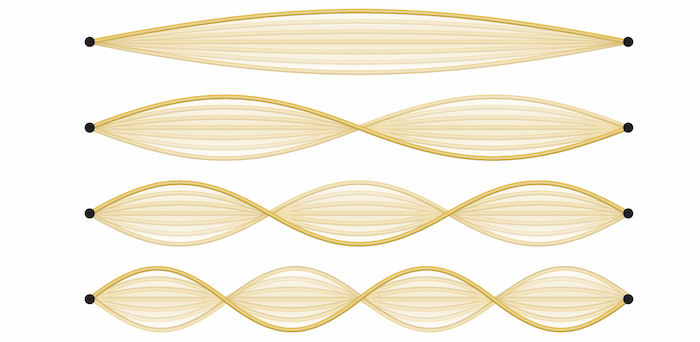
Figure 6.7図 6.7
A vibrating string shows some one-dimensional standing waves. Since the two end points of the string are held fixed, only waves having an integer number of half-wavelengths can form. The points on the string between the end points that are not moving are called the nodes.
振動する弦に生じる、いくつかの1次元の定常波。弦の両端が固定されているため、半波長が整数個だけ収まる波しか形成できない。両端の間にある、弦上の動かない点を節という。
An example of two-dimensional standing waves is shown in Figure 6.8, which shows the vibrational patterns on a flat surface. Although the vibrational amplitudes cannot be seen like they could in the vibrating string, the nodes have been made visible by sprinkling the drum surface with a powder that collects on the areas of the surface that have minimal displacement. For one-dimensional standing waves, the nodes were points on the line, but for two-dimensional standing waves, the nodes are lines on the surface (for three-dimensional standing waves, the nodes are two-dimensional surfaces within the three-dimensional volume).
英語のヒント
2次元の定常波の例を図6.8に示す。この図は、平らな面に生じる振動の模様を示している。振動する弦の場合のように振幅を見ることはできないが、太鼓の表面に粉を振りかけると、変位が最小となる部分に粉が集まり、節が見えるようになる。1次元の定常波では節は線上の点であったが、2次元の定常波では面上の線となる。3次元の定常波では、節は3次元の体積の内部にある2次元の面となる。
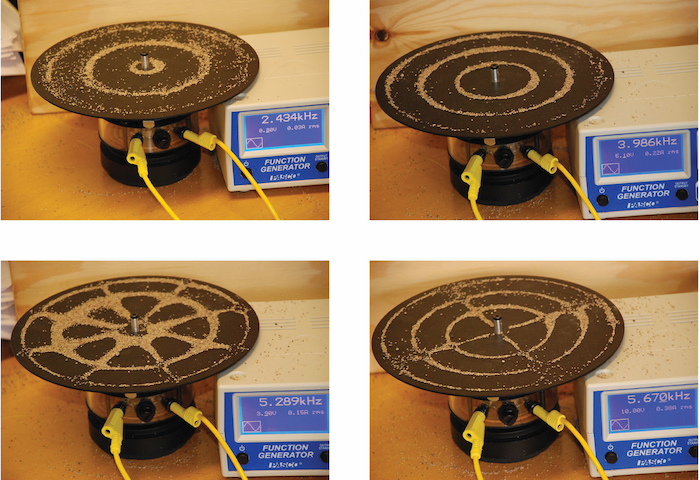


Figure 6.8図 6.8
Two-dimensional standing waves can be visualized on a vibrating surface. The surface has been sprinkled with a powder that collects near the nodal lines. There are two types of nodes visible: radial nodes (circles) and angular nodes (radii).
2次元の定常波は、振動する面の上で可視化できる。面に振りかけた粉が節線の近くに集まっている。動径方向の節(円)と角度方向の節(半径)という、2種類の節が見える。