第6章電子構造と元素の周期的性質
The Quantum–Mechanical Model of an Atom原子の量子力学的モデル
Shortly after de Broglie published his ideas that the electron in a hydrogen atom could be better thought of as being a circular standing wave instead of a particle moving in quantized circular orbits, Erwin Schrödinger extended de Broglie’s work by deriving what is today known as the Schrödinger equation. When Schrödinger applied his equation to hydrogen-like atoms, he was able to reproduce Bohr’s expression for the energy and, thus, the Rydberg formula governing hydrogen spectra. Schrödinger described electrons as three-dimensional stationary waves, or wavefunctions, represented by the Greek letter psi, ψ. A few years later, Max Born proposed an interpretation of the wavefunction ψ that is still accepted today: Electrons are still particles, and so the waves represented by ψ are not physical waves but, instead, are complex probability amplitudes. The square of the magnitude of a wavefunction describes the probability of the quantum particle being present near a certain location in space. This means that wavefunctions can be used to determine the distribution of the electron’s density with respect to the nucleus in an atom. In the most general form, the Schrödinger equation can be written as:
英語のヒント
ド・ブロイは、水素原子内の電子を、量子化された円軌道を動く粒子ではなく、円形の定常波として考える方がよいと発表した。それから間もなく、エルヴィン・シュレーディンガーはその研究を発展させ、現在シュレーディンガー方程式と呼ばれる式を導いた。これを水素様原子に適用すると、ボーアのエネルギー式を再現でき、したがって水素のスペクトルを支配するリュードベリの式も再現できた。シュレーディンガーは電子を、ギリシャ文字のプサイψで表す、3次元の定常波、すなわち波動関数として記述した。数年後、マックス・ボルンは、今日でも受け入れられている波動関数ψの解釈を提案した。電子は依然として粒子であり、ψが表す波は物理的な波ではなく、複素数の確率振幅である、という解釈である。波動関数の大きさの2乗は、空間内の特定の位置の付近に量子粒子が存在する確率を表す。つまり、波動関数を使うと、原子内で原子核に対して電子の密度がどのように分布するかを決められる。シュレーディンガー方程式の最も一般的な形は、次のように書ける。
is the Hamiltonian operator, a set of mathematical operations representing the total energy of the quantum particle (such as an electron in an atom), ψ is the wavefunction of this particle that can be used to find the special distribution of the probability of finding the particle, and is the actual value of the total energy of the particle.
英語のヒント
はハミルトン演算子で、原子内の電子などの量子粒子の全エネルギーを表す、一連の数学的操作である。ψは粒子の波動関数で、粒子を見いだす確率の分布を求めるのに使える。は粒子の全エネルギーの実際の値である。
Schrödinger’s work, as well as that of Heisenberg and many other scientists following in their footsteps, is generally referred to as quantum mechanics.
英語のヒント
シュレーディンガーやハイゼンベルク、そして彼らの足跡をたどった多くの科学者による研究は、一般に量子力学と呼ばれる。
Understanding Quantum Theory of Electrons in Atoms原子内の電子についての量子論を理解する
The goal of this section is to understand the electron orbitals (location of electrons in atoms), their different energies, and other properties. The use of quantum theory provides the best understanding to these topics. This knowledge is a precursor to chemical bonding.
英語のヒント
この節では、電子の軌道、つまり原子内の電子の位置と、その異なるエネルギーやその他の性質を理解することを目標とする。これらを最もよく理解するには、量子論を使う。この知識は、化学結合を学ぶための準備となる。
As was described previously, electrons in atoms can exist only on discrete energy levels but not between them. It is said that the energy of an electron in an atom is quantized, that is, it can be equal only to certain specific values and can jump from one energy level to another but not transition smoothly or stay between these levels.
すでに述べたように、原子内の電子は離散的なエネルギー準位にしか存在できず、その間には存在できない。原子内の電子のエネルギーは量子化されているという。つまり、特定の値だけをとることができ、あるエネルギー準位から別の準位へ跳ぶことはできるが、滑らかに移行したり、準位の間にとどまったりはできない。
The energy levels are labeled with an n value, where n = 1, 2, 3, …. Generally speaking, the energy of an electron in an atom is greater for greater values of n. This number, n, is referred to as the principal quantum number. The principal quantum number defines the location of the energy level. It is essentially the same concept as the n in the Bohr atom description. Another name for the principal quantum number is the shell number. The shells of an atom can be thought of concentric circles radiating out from the nucleus. The electrons that belong to a specific shell are most likely to be found within the corresponding circular area. The further we proceed from the nucleus, the higher the shell number, and so the higher the energy level (Figure 6.19). The positively charged protons in the nucleus stabilize the electronic orbitals by electrostatic attraction between the positive charges of the protons and the negative charges of the electrons. So the further away the electron is from the nucleus, the greater the energy it has.
英語のヒント
エネルギー準位にはn = 1、2、3、…という値を付ける。一般に、原子内の電子のエネルギーはnが大きいほど高い。このnを主量子数と呼ぶ。主量子数はエネルギー準位の位置を定め、ボーアの原子の記述におけるnと本質的に同じ概念である。主量子数は殻番号とも呼ばれる。原子の電子殻は、原子核から外向きに広がる同心円と考えられる。特定の殻に属する電子は、対応する円形の領域内で見つかる可能性が最も高い。原子核から遠くなるほど殻番号は大きくなり、エネルギー準位も高くなる(図6.19)。原子核内の正に帯電した陽子は、その正電荷と電子の負電荷の間の静電引力によって、電子軌道を安定化する。そのため、電子が原子核から遠いほど、もつエネルギーは大きい。
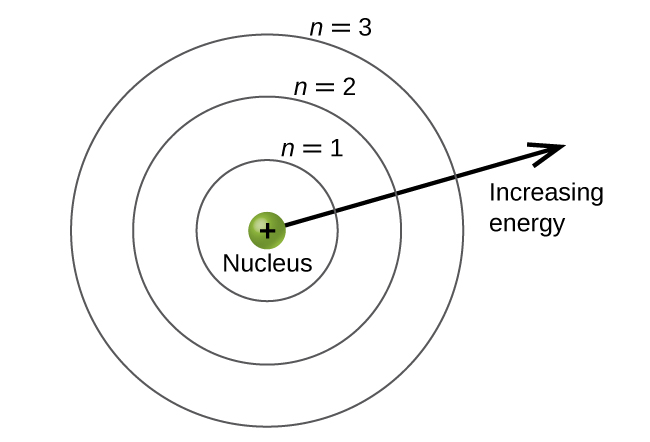
Figure 6.19図 6.19
Different shells are numbered by principal quantum numbers.
異なる電子殻には、主量子数によって番号が付けられる。
This quantum mechanical model for where electrons reside in an atom can be used to look at electronic transitions, the events when an electron moves from one energy level to another. If the transition is to a higher energy level, energy is absorbed, and the energy change has a positive value. To obtain the amount of energy necessary for the transition to a higher energy level, a photon is absorbed by the atom. A transition to a lower energy level involves a release of energy, and the energy change is negative. This process is accompanied by emission of a photon by the atom. The following equation summarizes these relationships and is based on the hydrogen atom:
英語のヒント
原子内で電子がどこに存在するかを表すこの量子力学的模型は、電子があるエネルギー準位から別の準位へ移る、電子遷移を調べるのに使える。高いエネルギー準位への遷移ではエネルギーが吸収され、エネルギー変化は正になる。必要なエネルギーを得るため、原子が光子を吸収する。低いエネルギー準位への遷移ではエネルギーが放出され、エネルギー変化は負になる。この過程には、原子による光子の放出が伴う。水素原子に基づく次の式が、これらの関係をまとめている。
The values nf and ni are the final and initial energy states of the electron. Example 6.5 in the previous section of the chapter demonstrates calculations of such energy changes.
nfとniは、電子の最後と最初のエネルギー状態を表す。この章の前の節にある例題6.5で、このようなエネルギー変化の計算を示している。
The principal quantum number is one of three quantum numbers used to characterize an orbital. An atomic orbital is a general region in an atom within which an electron is most probable to reside. The quantum mechanical model specifies the probability of finding an electron in the three-dimensional space around the nucleus and is based on solutions of the Schrödinger equation. In addition, the principal quantum number defines the energy of an electron in a hydrogen or hydrogen-like atom or an ion (an atom or an ion with only one electron) and the general region in which discrete energy levels of electrons in a multi-electron atoms and ions are located.
主量子数は、軌道を特徴づける3つの量子数の1つである。原子軌道とは、原子内で電子が存在する可能性が最も高い、おおよその領域である。量子力学的模型は、シュレーディンガー方程式の解に基づき、原子核の周囲の3次元空間で電子が見つかる確率を指定する。さらに主量子数は、水素または水素様の原子やイオン、すなわち電子が1個だけの原子やイオンでは電子のエネルギーを定める。また、多電子原子やイオンでは、電子の離散的なエネルギー準位が位置するおおよその領域を定める。
Another quantum number is l, the secondary (angular momentum) quantum number. It is an integer that may take the values, l = 0, 1, 2, …, n – 1. This means that an orbital with n = 1 can have only one value of l, l = 0, whereas n = 2 permits l = 0 and l = 1, and so on. Whereas the principal quantum number, n, defines the general size and energy of the orbital, the secondary quantum number l specifies the shape of the orbital. Orbitals with the same value of l define a subshell.
英語のヒント
もう1つの量子数lは、副量子数(角運動量量子数)である。l = 0、1、2、…、n − 1の値をとる整数である。したがって、n = 1の軌道がもてるlの値は0だけだが、n = 2ではl = 0とl = 1が許される。以下も同様である。主量子数nが軌道のおおよその大きさとエネルギーを定めるのに対し、副量子数lは軌道の形を指定する。lが同じ軌道は、1つの副殻をなす。
Orbitals with l = 0 are called s orbitals and they make up the s subshells. The value l = 1 corresponds to the p orbitals. For a given n, p orbitals constitute a p subshell (e.g., 3p if n = 3). The orbitals with l = 2 are called the d orbitals, followed by the f-, g-, and h-orbitals for l = 3, 4, and 5.
英語のヒント
l = 0の軌道をs軌道と呼び、s副殻を構成する。l = 1はp軌道に対応する。一定のnに対して、p軌道はp副殻を構成する。たとえばn = 3なら3pである。l = 2の軌道はd軌道と呼ばれ、その後はl = 3、4、5に対して、それぞれf軌道、g軌道、h軌道となる。
There are certain distances from the nucleus at which the probability density of finding an electron located at a particular orbital is zero. In other words, the value of the wavefunction ψ is zero at this distance for this orbital. Such a value of radius r is called a radial node. The number of radial nodes in an orbital is n – l – 1.
英語のヒント
原子核からある特定の距離では、特定の軌道の電子が見つかる確率密度が0となる。言い換えると、その軌道の波動関数ψの値は、その距離で0となる。このような半径rの値を動径方向の節という。軌道の動径方向の節の数はn − l − 1である。
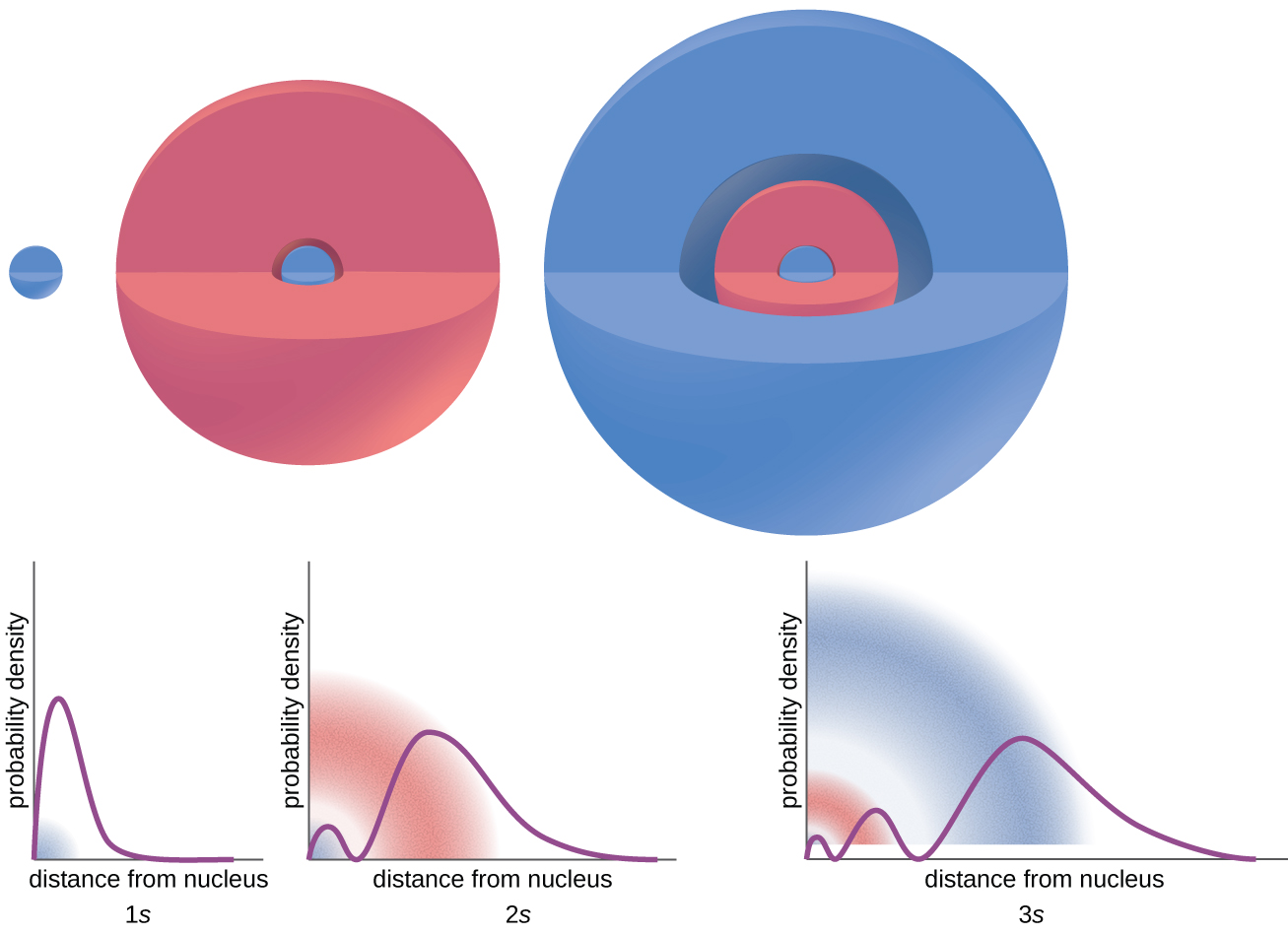
Figure 6.20図 6.20
The graphs show the probability (y axis) of finding an electron for the 1s, 2s, 3s orbitals as a function of distance from the nucleus.
1s、2s、3s軌道で電子を見いだす確率(縦軸)を、原子核からの距離の関数として示したグラフ。
Consider the examples in Figure 6.20. The orbitals depicted are of the s type, thus l = 0 for all of them. It can be seen from the graphs of the probability densities that there are 1 – 0 – 1 = 0 places where the density is zero (nodes) for 1s (n = 1), 2 – 0 – 1 = 1 node for 2s, and 3 – 0 – 1 = 2 nodes for the 3s orbitals.
図6.20の例を考えよう。描かれている軌道はすべてs型なので、いずれもl = 0である。確率密度のグラフから、密度が0になる場所、すなわち節は、1s(n = 1)では1 − 0 − 1 = 0個、2sでは2 − 0 − 1 = 1個、3sでは3 − 0 − 1 = 2個あるとわかる。
The s subshell electron density distribution is spherical and the p subshell has a dumbbell shape. The d and f orbitals are more complex. These shapes represent the three-dimensional regions within which the electron is likely to be found.
s副殻の電子密度分布は球形で、p副殻はダンベル形である。d軌道とf軌道は、より複雑な形をしている。これらの形は、電子が見つかる可能性の高い3次元領域を表す。
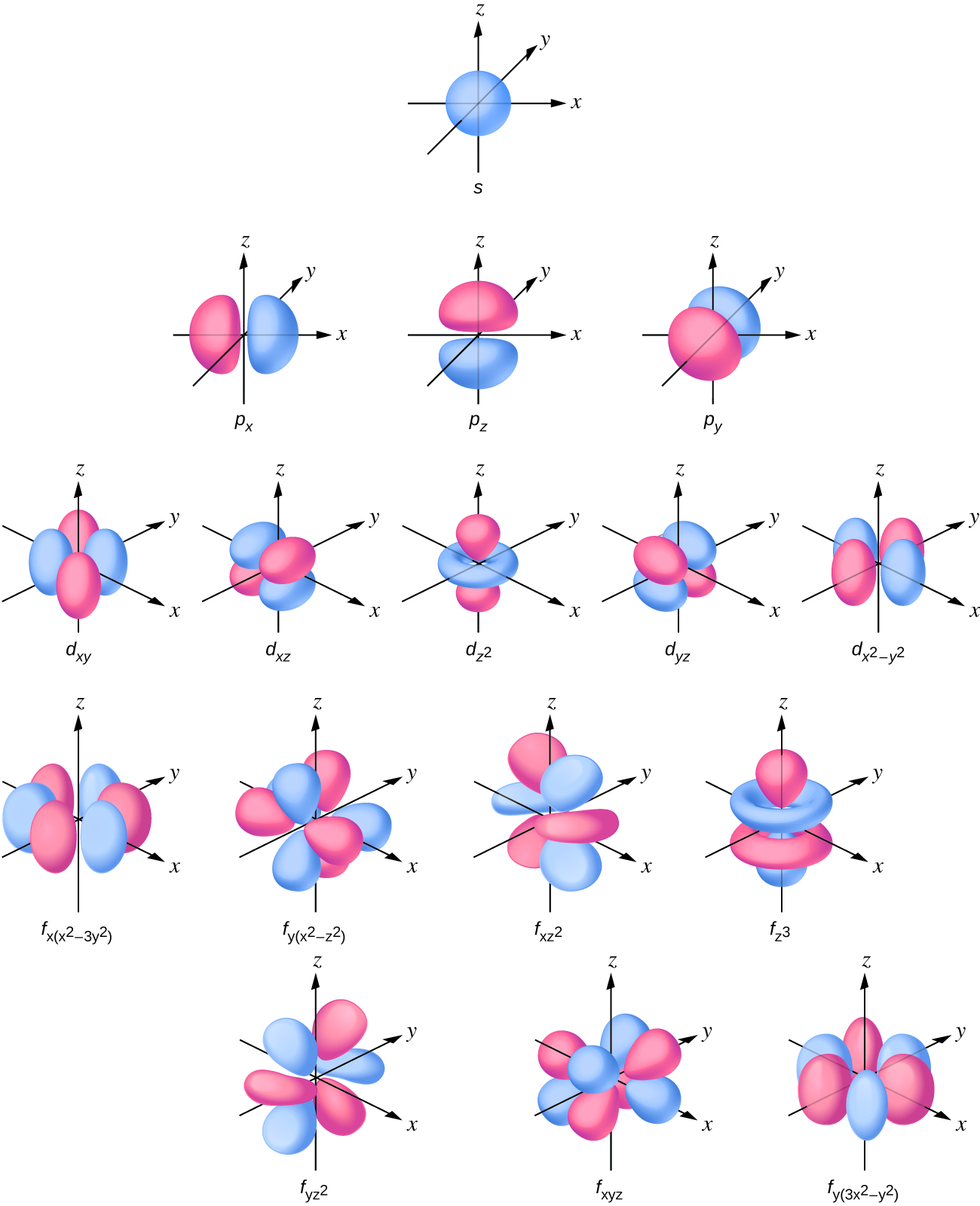
Figure 6.21図 6.21
Shapes of s, p, d, and f orbitals.
s、p、d、f軌道の形。
The magnetic quantum number, ml, specifies the relative spatial orientation of a particular orbital. Generally speaking, ml can be equal to –l, –(l – 1), …, 0, …, (l – 1), l. The total number of possible orbitals with the same value of l (that is, in the same subshell) is 2l + 1. Thus, there is one s-orbital in an s subshell (l = 0), there are three p-orbitals in a p subshell (l = 1), five d-orbitals in a d subshell (l = 2), seven f-orbitals in an f subshell (l = 3), and so forth. The principal quantum number defines the general value of the electronic energy. The angular momentum quantum number determines the shape of the orbital. And the magnetic quantum number specifies orientation of the orbital in space, as can be seen in Figure 6.21.
英語のヒント
磁気量子数mlは、特定の軌道の空間内での相対的な向きを指定する。一般に、mlは−l、−(l − 1)、…、0、…、(l − 1)、lの値をとる。同じlの値をもつ、つまり同じ副殻に属する軌道の総数は2l + 1である。したがって、s副殻(l = 0)にはs軌道が1個、p副殻(l = 1)にはp軌道が3個、d副殻(l = 2)にはd軌道が5個、f副殻(l = 3)にはf軌道が7個あり、以下も同様である。主量子数は電子のエネルギーのおおよその値を定める。角運動量量子数は軌道の形を定める。そして、図6.21に見られるように、磁気量子数は空間内での軌道の向きを指定する。
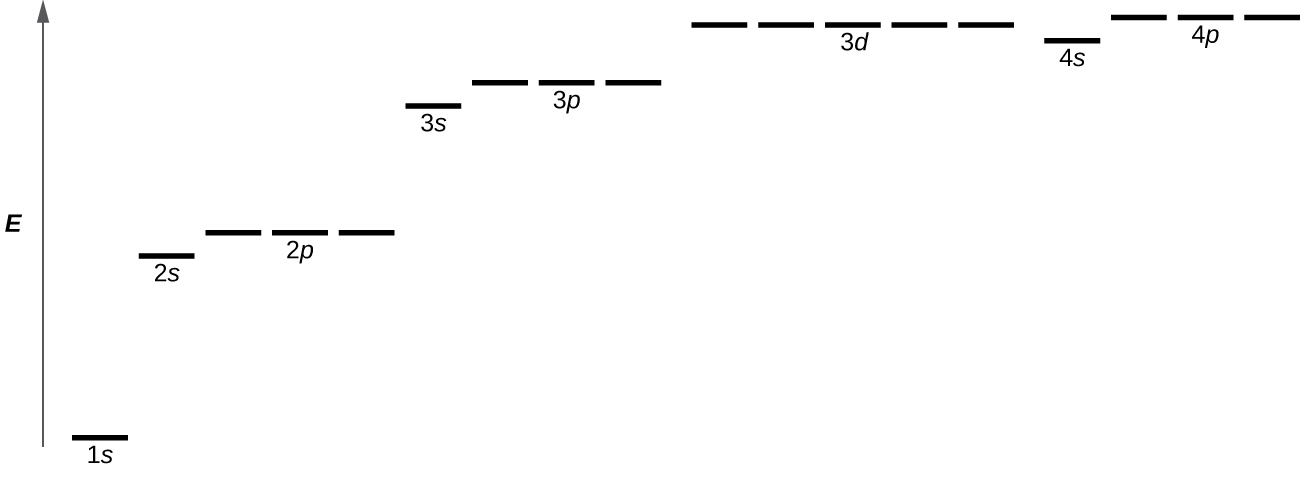
Figure 6.22図 6.22
The chart shows the energies of electron orbitals in a multi-electron atom.
多電子原子における電子軌道のエネルギー。
Figure 6.22 illustrates the energy levels for various orbitals. The number before the orbital name (such as 2s, 3p, and so forth) stands for the principal quantum number, n. The letter in the orbital name defines the subshell with a specific angular momentum quantum number l = 0 for s orbitals, 1 for p orbitals, 2 for d orbitals. Finally, there are more than one possible orbitals for l ≥ 1, each corresponding to a specific value of ml. In the case of a hydrogen atom or a one-electron ion (such as He+, Li2+, and so on), energies of all the orbitals with the same n are the same. This is called a degeneracy, and the energy levels for the same principal quantum number, n, are called degenerate orbitals. However, in atoms with more than one electron, this degeneracy is eliminated by the electron–electron interactions, and orbitals that belong to different subshells have different energies, as shown on Figure 6.22. Orbitals within the same subshell are still degenerate and have the same energy.
英語のヒント
図6.22は、さまざまな軌道のエネルギー準位を示している。2s、3pなど、軌道名の前の数字は主量子数nを表す。文字は、特定の角運動量量子数lをもつ副殻を表す。s軌道ではl = 0、p軌道では1、d軌道では2である。また、l ≥ 1では可能な軌道が複数あり、それぞれが特定のmlの値に対応する。水素原子や、He+、Li2+などの電子1個のイオンでは、nが同じすべての軌道のエネルギーは等しい。これを縮退と呼び、主量子数nが同じエネルギー準位を、縮退した軌道という。しかし、電子が2個以上の原子では、電子間相互作用によってこの縮退が解け、図6.22のように、異なる副殻に属する軌道は異なるエネルギーをもつ。同じ副殻の中の軌道は、依然として縮退しており、エネルギーが等しい。
While the three quantum numbers discussed in the previous paragraphs work well for describing electron orbitals, some experiments showed that they were not sufficient to explain all observed results. It was demonstrated in the 1920s that when hydrogen-line spectra are examined at extremely high resolution, some lines are actually not single peaks but, rather, pairs of closely spaced lines. This is the so-called fine structure of the spectrum, and it implies that there are additional small differences in energies of electrons even when they are located in the same orbital. These observations led Samuel Goudsmit and George Uhlenbeck to propose that electrons have a fourth quantum number. They called this the spin quantum number, or ms.
英語のヒント
これまでの段落で説明した3つの量子数は、電子軌道を記述するのには適しているが、観測結果のすべてを説明するには不十分であることが、いくつかの実験から示された。1920年代、水素の線スペクトルを非常に高い分解能で調べると、一部の線は実際には単一のピークではなく、非常に近接した2本の線であることが実証された。これはスペクトルのいわゆる微細構造であり、電子が同じ軌道にある場合でも、エネルギーにさらに小さな差があることを意味する。これらの観測により、サミュエル・ハウトスミットとジョージ・ウーレンベックは、電子には第4の量子数があると提案した。彼らはこれを、スピン量子数msと呼んだ。
The other three quantum numbers, n, l, and ml, are properties of specific atomic orbitals that also define in what part of the space an electron is most likely to be located. Orbitals are a result of solving the Schrödinger equation for electrons in atoms. The electron spin is a different kind of property. It is a completely quantum phenomenon with no analogues in the classical realm. In addition, it cannot be derived from solving the Schrödinger equation and is not related to the normal spatial coordinates (such as the Cartesian x, y, and z). Electron spin describes an intrinsic electron "rotation" or "spinning." Each electron acts as a tiny magnet or a tiny rotating object with an angular momentum, or as a loop with an electric current, even though this rotation or current cannot be observed in terms of spatial coordinates.
英語のヒント
ほかの3つの量子数n、l、mlは、特定の原子軌道の性質であり、電子が空間のどの部分に存在する可能性が最も高いかも定める。軌道は、原子内の電子についてシュレーディンガー方程式を解くことで得られる。電子スピンは、これとは異なる種類の性質である。古典的な領域には対応物がない、完全に量子的な現象である。また、シュレーディンガー方程式を解くことからは導けず、直交座標x、y、zなどの通常の空間座標とも関係しない。電子スピンは、電子に固有の「回転」や「自転」を記述する。各電子は、小さな磁石や、角運動量をもつ小さな回転物体、あるいは電流の流れる輪のように働く。ただし、その回転や電流を空間座標によって観測することはできない。
The magnitude of the overall electron spin can only have one value, and an electron can only “spin” in one of two quantized states. One is termed the α state, with the z component of the spin being in the positive direction of the z axis. This corresponds to the spin quantum number The other is called the β state, with the z component of the spin being negative and Any electron, regardless of the atomic orbital it is located in, can only have one of those two values of the spin quantum number. The energies of electrons having and are different if an external magnetic field is applied.
英語のヒント
電子スピン全体の大きさがとれる値は1つだけであり、電子の「スピン」は2つの量子化された状態のどちらかに限られる。一方はα状態と呼ばれ、スピンのz成分がz軸の正の向きにあり、スピン量子数に対応する。他方はβ状態と呼ばれ、スピンのz成分が負で、である。電子は、どの原子軌道にあるかにかかわらず、この2つのスピン量子数のどちらかしかもてない。外部磁場を加えると、の電子との電子はエネルギーが異なる。
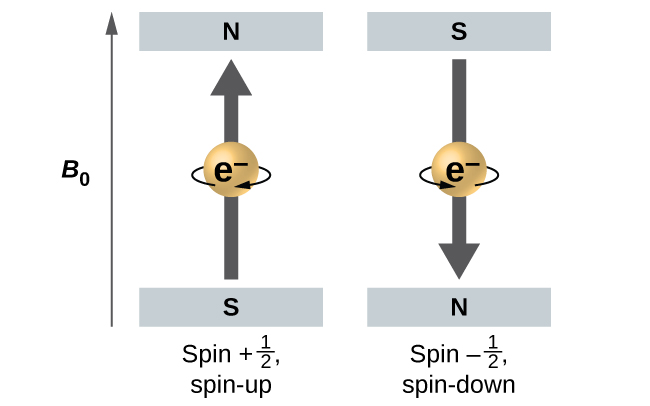


Figure 6.23図 6.23
Electrons with spin values in an external magnetic field.
外部磁場中にある、スピンの値がの電子。
Figure 6.23 illustrates this phenomenon. An electron acts like a tiny magnet. Its moment is directed up (in the positive direction of the z axis) for the spin quantum number and down (in the negative z direction) for the spin quantum number of A magnet has a lower energy if its magnetic moment is aligned with the external magnetic field (the left electron on Figure 6.23) and a higher energy for the magnetic moment being opposite to the applied field. This is why an electron with has a slightly lower energy in an external field in the positive z direction, and an electron with has a slightly higher energy in the same field. This is true even for an electron occupying the same orbital in an atom. A spectral line corresponding to a transition for electrons from the same orbital but with different spin quantum numbers has two possible values of energy; thus, the line in the spectrum will show a fine structure splitting.
英語のヒント
図6.23は、この現象を示す。電子は小さな磁石のように働く。そのモーメントは、スピン量子数では上向き、すなわちz軸の正の向きにあり、では下向き、すなわちz軸の負の向きにある。磁石は、その磁気モーメントが外部磁場と同じ向きのときにエネルギーが低くなり(図6.23の左の電子)、加えた磁場と逆向きのときには高くなる。このため、z軸の正の向きの外部磁場では、の電子のエネルギーはわずかに低く、の電子のエネルギーはわずかに高くなる。これは、原子内の同じ軌道を占める電子にも当てはまる。同じ軌道でスピン量子数が異なる電子の遷移に対応するスペクトル線には、2つのエネルギー値がありうる。そのため、スペクトル線には微細構造による分裂が現れる。