第6章電子構造と元素の周期的性質
Variation in Ionic Radiiイオン半径の変化
Ionic radius is the measure used to describe the size of an ion. A cation always has fewer electrons and the same number of protons as the parent atom; it is smaller than the atom from which it is derived (Figure 6.32). For example, the covalent radius of an aluminum atom (1s22s22p63s23p1) is 118 pm, whereas the ionic radius of an Al3+ (1s22s22p6) is 68 pm. As electrons are removed from the outer valence shell, the remaining core electrons occupying smaller shells experience a greater effective nuclear charge Zeff (as discussed) and are drawn even closer to the nucleus.
英語のヒント
イオン半径は、イオンの大きさを記述する尺度である。陽イオンは、もとの原子より電子数が少なく、陽子数は同じであり、その原子より小さい(図6.32)。たとえば、アルミニウム原子1s22s22p63s23p1の共有結合半径は118 pmだが、Al3+イオン1s22s22p6の半径は68 pmである。外側の価電子殻から電子を取り除くと、小さな殻を占める残りの内殻電子は、すでに説明したように、より大きな有効核電荷Zeffを受け、原子核にさらに近づく。

Figure 6.32図 6.32
The radius for a cation is smaller than the parent atom (Al), due to the lost electrons; the radius for an anion is larger than the parent (S), due to the gained electrons.
陽イオンは電子を失うため、もとの原子Alより半径が小さい。陰イオンは電子を得るため、もとの原子Sより半径が大きい。
Cations with larger charges are smaller than cations with smaller charges (e.g., V2+ has an ionic radius of 79 pm, while that of V3+ is 64 pm). Proceeding down the groups of the periodic table, we find that cations of successive elements with the same charge generally have larger radii, corresponding to an increase in the principal quantum number, n.
電荷の大きい陽イオンは、電荷の小さい陽イオンより小さい。たとえば、V2+のイオン半径は79 pm、V3+は64 pmである。周期表の同じ族を下へ進むと、同じ電荷をもつ陽イオンの半径は、一般に主量子数nの増加に伴って大きくなる。
An anion (negative ion) is formed by the addition of one or more electrons to the valence shell of an atom. This results in a greater repulsion among the electrons and a decrease in Zeff per electron. Both effects (the increased number of electrons and the decreased Zeff) cause the radius of an anion to be larger than that of the parent atom (Figure 6.32). For example, a sulfur atom ([Ne]3s23p4) has a covalent radius of 104 pm, whereas the ionic radius of the sulfide anion ([Ne]3s23p6) is 170 pm. For consecutive elements proceeding down any group, anions have larger principal quantum numbers and, thus, larger radii.
原子の価電子殻に電子が1個以上加わると、陰イオンが生じる。電子間反発が大きくなり、電子1個当たりのZeffが小さくなる。電子数の増加とZeffの減少の両方によって、陰イオンの半径はもとの原子より大きくなる(図6.32)。たとえば、硫黄原子[Ne]3s23p4の共有結合半径は104 pmだが、硫化物イオン[Ne]3s23p6のイオン半径は170 pmである。同じ族を下へ進むと、陰イオンの主量子数が大きくなり、半径も大きくなる。
Atoms and ions that have the same electron configuration are said to be isoelectronic. Examples of isoelectronic species are N3–, O2–, F–, Ne, Na+, Mg2+, and Al3+ (1s22s22p6). Another isoelectronic series is P3–, S2–, Cl–, Ar, K+, Ca2+, and Sc3+ ([Ne]3s23p6). For atoms or ions that are isoelectronic, the number of protons determines the size. The greater the nuclear charge, the smaller the radius in a series of isoelectronic ions and atoms.
英語のヒント
同じ電子配置をもつ原子やイオンを、等電子的であるという。たとえばN3–、O2–、F–、Ne、Na+、Mg2+、Al3+は、1s22s22p6という等電子的な化学種である。別の等電子系列には、[Ne]3s23p6の配置をもつP3–、S2–、Cl–、Ar、K+、Ca2+、Sc3+がある。等電子的な原子やイオンでは、陽子数が大きさを決める。同じ等電子系列のイオンや原子では、核電荷が大きいほど半径が小さい。
Variation in Ionization Energiesイオン化エネルギーの変化
The amount of energy required to remove the most loosely bound electron from a gaseous atom in its ground state is called its first ionization energy (IE1). The first ionization energy for an element, X, is the energy required to form a cation with +1 charge:
英語のヒント
基底状態の気体原子から、最も弱く束縛された電子を取り除くのに必要なエネルギーを、第1イオン化エネルギーIE1という。元素Xの第1イオン化エネルギーは、電荷+1の陽イオンを作るために必要なエネルギーである。
The energy required to remove the second most loosely bound electron is called the second ionization energy (IE2).
2番目に弱く束縛された電子を取り除くのに必要なエネルギーを、第2イオン化エネルギーIE2という。
The energy required to remove the third electron is the third ionization energy, and so on. Energy is always required to remove electrons from atoms or ions, so ionization processes are endothermic and IE values are always positive. For larger atoms, the most loosely bound electron is located farther from the nucleus and so is easier to remove. Thus, as size (atomic radius) increases, the ionization energy should decrease. Relating this logic to what we have just learned about radii, we would expect first ionization energies to decrease down a group and to increase across a period.
3個目の電子を取り除くのに必要なエネルギーを第3イオン化エネルギーといい、以下も同様である。原子やイオンから電子を取り除くには必ずエネルギーが必要なので、イオン化は吸熱過程であり、IEは常に正である。大きな原子では、最も弱く束縛された電子が原子核から遠く、取り除きやすい。したがって、原子の大きさ、すなわち原子半径が増えるほど、イオン化エネルギーは小さくなるはずである。これを先ほど学んだ半径の知識と結びつけると、第1イオン化エネルギーは同じ族を下へ進むほど減少し、周期を横へ進むほど増加すると予想できる。
Figure 6.33 graphs the relationship between the first ionization energy and the atomic number of several elements. The values of first ionization energy for the elements are given in Figure 6.34. Within a period, the IE1 generally increases with increasing Z. Down a group, the IE1 value generally decreases with increasing Z. There are some systematic deviations from this trend, however. Note that the ionization energy of boron (atomic number 5) is less than that of beryllium (atomic number 4) even though the nuclear charge of boron is greater by one proton. This can be explained because the energy of the subshells increases as l increases, due to penetration and shielding (as discussed previously in this chapter). Within any one shell, the s electrons are lower in energy than the p electrons. This means that an s electron is harder to remove from an atom than a p electron in the same shell. The electron removed during the ionization of beryllium ([He]2s2) is an s electron, whereas the electron removed during the ionization of boron ([He]2s22p1) is a p electron; this results in a lower first ionization energy for boron, even though its nuclear charge is greater by one proton. Thus, we see a small deviation from the predicted trend occurring each time a new subshell begins.
英語のヒント
図6.33は、いくつかの元素の第1イオン化エネルギーと原子番号の関係をグラフにしたものである。各元素の値は図6.34に示す。同じ周期では、Zの増加とともにIE1は一般に増加し、同じ族を下へ進むと、Zの増加とともにIE1は一般に減少する。しかし、この傾向には系統的なずれもある。ホウ素(原子番号5)の核電荷はベリリウム(原子番号4)より陽子1個分大きいのに、イオン化エネルギーは小さい。これは、すでに述べた浸透と遮蔽によって、lが増えるほど副殻のエネルギーが高くなるためと説明できる。同じ殻のs電子はp電子より低エネルギーであり、取り除くのが難しい。ベリリウム[He]2s2のイオン化で取り除くのはs電子だが、ホウ素[He]2s22p1ではp電子である。このためホウ素は、核電荷が陽子1個分大きいにもかかわらず、第1イオン化エネルギーが小さくなる。このように、新しい副殻が始まるたびに、予測した傾向から小さなずれが生じる。
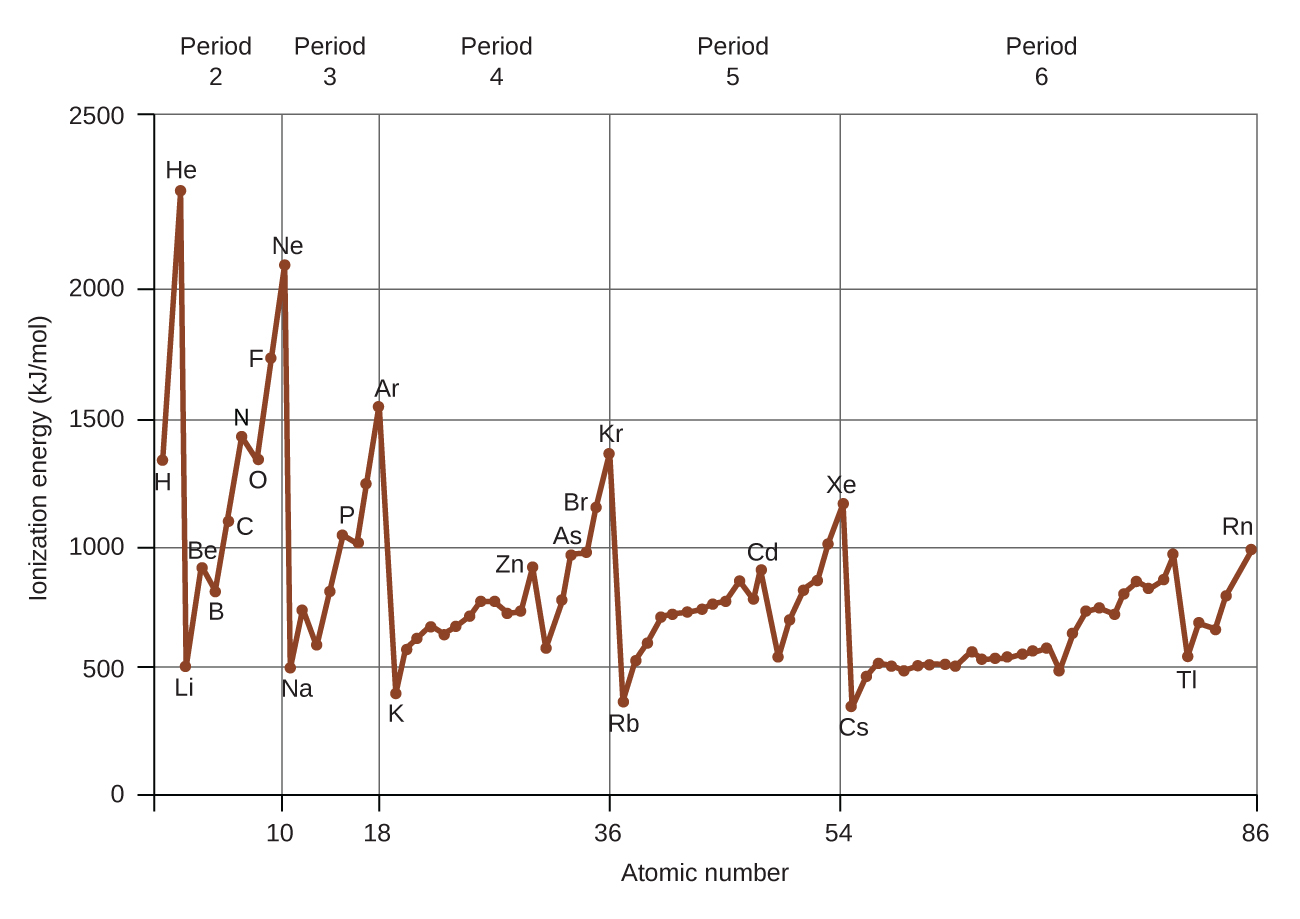
Figure 6.33図 6.33
The first ionization energy of the elements in the first six periods are plotted against their atomic number.
第1〜第6周期の元素について、第1イオン化エネルギーを原子番号に対してプロットしたグラフ。
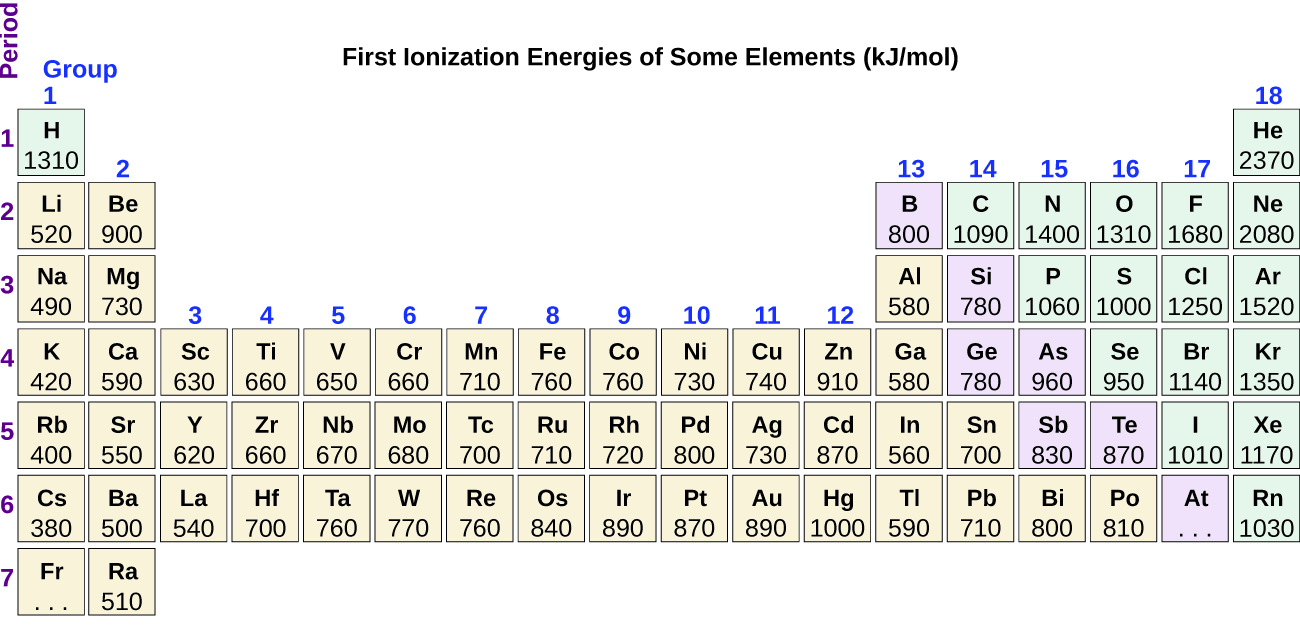
Figure 6.34図 6.34
This version of the periodic table shows the first ionization energy (IE1), in kJ/mol, of selected elements.
いくつかの元素の第1イオン化エネルギーIE1を、kJ/molで示した周期表。
Another deviation occurs as orbitals become more than one-half filled. The first ionization energy for oxygen is slightly less than that for nitrogen, despite the trend in increasing IE1 values across a period. Looking at the orbital diagram of oxygen, we can see that removing one electron will eliminate the electron–electron repulsion caused by pairing the electrons in the 2p orbital and will result in a half-filled orbital (which is energetically favorable). Analogous changes occur in succeeding periods (note the dip for sulfur after phosphorus in Figure 6.34).
英語のヒント
軌道が半分を超えて埋まるときにも、別のずれが生じる。同じ周期ではIE1が増加する傾向にあるが、酸素の第1イオン化エネルギーは窒素よりわずかに小さい。酸素の軌道図を見ると、電子を1個取り除くことで、2p軌道で対を作っている電子同士の反発がなくなり、エネルギー的に有利な、半分埋まった軌道になるとわかる。後の周期でも同様の変化が起こる。図6.34で、リンの後の硫黄で値が下がることに注目しよう。



Removing an electron from a cation is more difficult than removing an electron from a neutral atom because of the greater electrostatic attraction to the cation. Likewise, removing an electron from a cation with a higher positive charge is more difficult than removing an electron from an ion with a lower charge. Thus, successive ionization energies for one element always increase. As seen in Table 6.3, there is a large increase in the ionization energies for each element. This jump corresponds to removal of the core electrons, which are harder to remove than the valence electrons. For example, Sc and Ga both have three valence electrons, so the rapid increase in ionization energy occurs after the third ionization.
陽イオンから電子を取り除くのは、中性原子から取り除くより難しい。陽イオンへの静電引力が強いためである。同様に、正電荷の大きい陽イオンから電子を取り除く方が、電荷の小さいイオンから取り除くより難しい。そのため、同じ元素から電子を順次取り除くと、イオン化エネルギーは必ず増加する。表6.3に見られるように、各元素にはイオン化エネルギーが大きく増加する箇所がある。これは、価電子より取り除きにくい内殻電子を取り除く段階に対応する。たとえばScとGaの価電子はいずれも3個なので、第3段階のイオン化の後に急増する。
Successive Ionization Energies for Selected Elements (kJ/mol) いくつかの元素の逐次イオン化エネルギー(kJ/mol) |
|||||||
|---|---|---|---|---|---|---|---|
Element 元素 |
IE1 |
IE2 |
IE3 |
IE4 |
IE5 |
IE6 |
IE7 |
K |
418.8 |
3051.8 |
4419.6 |
5876.9 |
7975.5 |
9590.6 |
11343 |
Ca |
589.8 |
1145.4 |
4912.4 |
6490.6 |
8153.0 |
10495.7 |
12272.9 |
Sc |
633.1 |
1235.0 |
2388.7 |
7090.6 |
8842.9 |
10679.0 |
13315.0 |
Ga |
578.8 |
1979.4 |
2964.6 |
6180 |
8298.7 |
10873.9 |
13594.8 |
Ge |
762.2 |
1537.5 |
3302.1 |
4410.6 |
9021.4 |
Not available データなし |
Not available データなし |
As |
944.5 |
1793.6 |
2735.5 |
4836.8 |
6042.9 |
12311.5 |
Not available データなし |
Example 6.13例題 6.13
Ranking Ionization Energiesイオン化エネルギーを大きさ順に並べる
Predict the order of increasing energy for the following processes: IE1 for Al, IE1 for In, IE2 for Na, IE3 for Al.
AlのIE1、InのIE1、NaのIE2、AlのIE3を、エネルギーが小さい順に並べなさい。
Solution解法
Removing the 5p1 electron from In is easier than removing the 3p1 electron from Al because the higher n orbital is farther from the nucleus, so IE1(In) < IE1(Al). Ionizing the third electron from requires more energy because the cation Al2+ exerts a stronger pull on the electron than the neutral Al atom, so IE1(Al) < IE3(Al). The second ionization energy for sodium removes a core electron, which is a much higher energy process than removing valence electrons. Putting this all together, we obtain: IE1(In) < IE1(Al) < IE3(Al) < IE2(Na).
nが大きい軌道は原子核から遠いので、Inから5p1電子を取り除く方が、Alから3p1電子を取り除くより容易である。したがってIE1(In) < IE1(Al)。から3個目の電子を取り除くには、Al2+陽イオンの方が中性のAl原子より電子を強く引くため、さらにエネルギーが必要である。よってIE1(Al) < IE3(Al)。ナトリウムの第2イオン化では内殻電子を取り除くため、価電子を取り除くよりはるかに大きなエネルギーが必要になる。以上より、IE1(In) < IE1(Al) < IE3(Al) < IE2(Na)となる。
Check Your Learning理解を確かめよう
Which has the lowest value for IE1: O, Po, Pb, or Ba?
O、Po、Pb、Baのうち、IE1が最も小さいものはどれか。