第6章電子構造と元素の周期的性質
6.4 Electronic Structure of Atoms (Electron Configurations)6.4 原子の電子構造(電子配置)
Learning Objectives学習目標
By the end of this section, you will be able to:
この節を終えると、次のことができるようになる。
- Derive the predicted ground-state electron configurations of atoms原子の基底状態の電子配置を予測して導く。
- Identify and explain exceptions to predicted electron configurations for atoms and ions原子やイオンについて、予測した電子配置からの例外を見いだし、説明する。
- Relate electron configurations to element classifications in the periodic table電子配置と、周期表における元素の分類を結びつける。
Having introduced the basics of atomic structure and quantum mechanics, we can use our understanding of quantum numbers to determine how atomic orbitals relate to one another. This allows us to determine which orbitals are occupied by electrons in each atom. The specific arrangement of electrons in orbitals of an atom determines many of the chemical properties of that atom.
英語のヒント
原子構造と量子力学の基礎を学んだので、量子数の知識を使って、原子軌道同士がどのように関係するかを調べられる。これにより、各原子のどの軌道に電子が入るかを決められる。原子の軌道に電子がどのように配置されるかによって、その原子の化学的性質の多くが決まる。
Orbital Energies and Atomic Structure軌道エネルギーと原子構造
The energy of atomic orbitals increases as the principal quantum number, n, increases. In any atom with two or more electrons, the repulsion between the electrons makes energies of subshells with different values of l differ so that the energy of the orbitals increases within a shell in the order s < p < d < f. Figure 6.24 depicts how these two trends in increasing energy relate. The 1s orbital at the bottom of the diagram is the orbital with electrons of lowest energy. The energy increases as we move up to the 2s and then 2p, 3s, and 3p orbitals, showing that the increasing n value has more influence on energy than the increasing l value for small atoms. However, this pattern does not hold for larger atoms. The 3d orbital is higher in energy than the 4s orbital. Such overlaps continue to occur frequently as we move up the chart.
英語のヒント
原子軌道のエネルギーは、主量子数nが大きくなるほど増加する。電子を2個以上もつ原子では、電子同士の反発によって、lの値が異なる副殻のエネルギーが異なる。その結果、同じ電子殻内の軌道のエネルギーはs < p < d < fの順に増加する。図6.24は、この2つのエネルギー増加の傾向がどう関係するかを示している。図の最下部にある1s軌道は、電子のエネルギーが最も低い軌道である。上へ進んで2s、2p、3s、3pとなるにつれ、エネルギーは増加する。小さな原子では、nの増加の方がlの増加よりもエネルギーに大きく影響することがわかる。しかし、大きな原子ではこの規則性は成り立たない。3d軌道は4s軌道よりエネルギーが高い。このような重なりは、図を上へ進むにつれて頻繁に現れる。
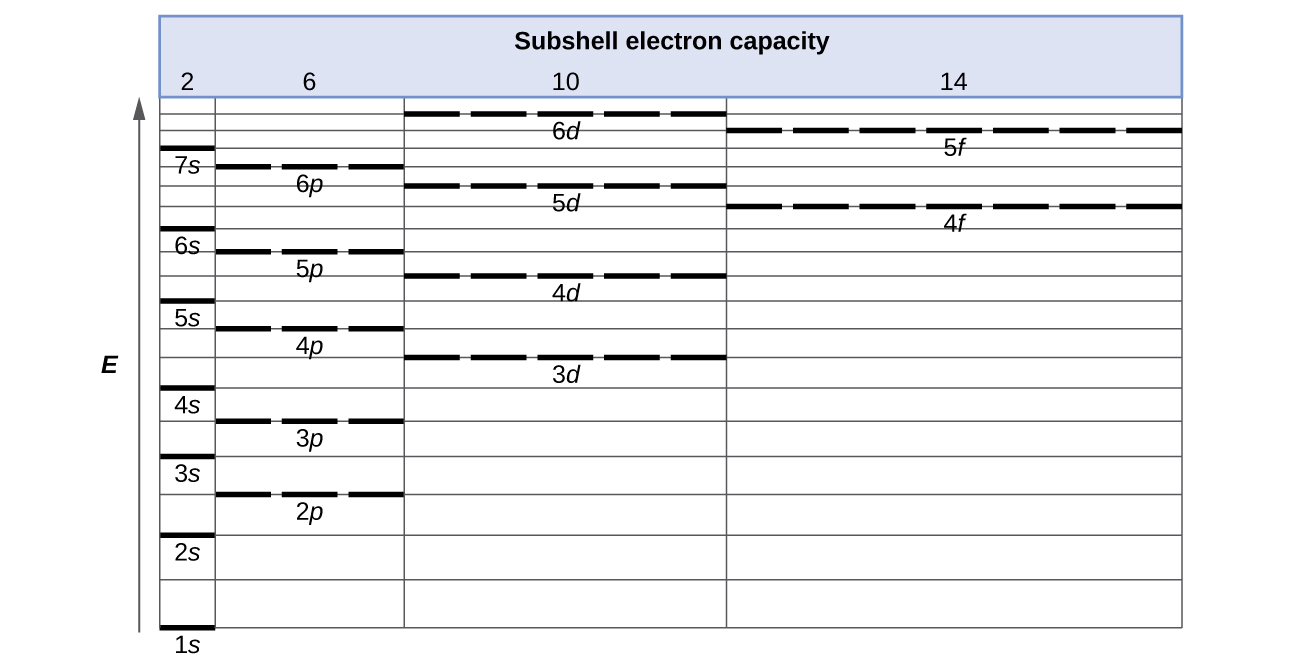
Figure 6.24図 6.24
Generalized energy-level diagram for atomic orbitals in an atom with two or more electrons (not to scale).
電子を2個以上もつ原子の原子軌道について、一般的なエネルギー準位の関係を示す図。実際のエネルギー差の比率どおりではない。
Electrons in successive atoms on the periodic table tend to fill low-energy orbitals first. Thus, many students find it confusing that, for example, the 5p orbitals fill immediately after the 4d, and immediately before the 6s. The filling order is based on observed experimental results, and has been confirmed by theoretical calculations. As the principal quantum number, n, increases, the size of the orbital increases and the electrons spend more time farther from the nucleus. Thus, the attraction to the nucleus is weaker and the energy associated with the orbital is higher (less stabilized). But this is not the only effect we have to take into account. Within each shell, as the value of l increases, the electrons are less penetrating (meaning there is less electron density found close to the nucleus), in the order s > p > d > f. Electrons that are closer to the nucleus slightly repel electrons that are farther out, offsetting the more dominant electron–nucleus attractions slightly (recall that all electrons have −1 charges, but nuclei have +Z charges). This phenomenon is called shielding and will be discussed in more detail in the next section. Electrons in orbitals that experience more shielding are less stabilized and thus higher in energy. For small orbitals (1s through 3p), the increase in energy due to n is more significant than the increase due to l; however, for larger orbitals the two trends are comparable and cannot be simply predicted. We will discuss methods for remembering the observed order.
英語のヒント
周期表の原子を順に見ると、電子は低エネルギーの軌道から先に入る傾向がある。そのため、たとえば5p軌道が4dの直後、6sの直前に埋まることを、多くの学生はわかりにくく感じる。電子が入る順序は実験の観測結果に基づき、理論計算でも確認されている。主量子数nが大きくなると軌道が広がり、電子は原子核から遠い場所でより多くの時間を過ごす。そのため原子核による引力は弱く、軌道のエネルギーは高くなる、つまり安定化の程度は小さくなる。ただし、考慮すべき効果はこれだけではない。各電子殻の中では、lが増えると、s > p > d > fの順に電子の浸透性が低くなる。これは、原子核の近くで見られる電子密度が低くなるという意味である。原子核に近い電子は、外側の電子をわずかに反発し、より支配的な電子と原子核の引力を少し弱める。電子の電荷はすべて−1だが、原子核の電荷は+Zであることを思い出そう。この現象を遮蔽といい、次の節で詳しく扱う。遮蔽を強く受ける軌道の電子は安定化が小さく、エネルギーが高くなる。小さな軌道、すなわち1sから3pでは、nによるエネルギー増加の方がlによる増加より大きい。しかし大きな軌道では、両者の効果は同程度になり、単純には予測できない。ここでは、観測された順序を覚える方法を説明する。
The arrangement of electrons in the orbitals of an atom is called the electron configuration of the atom. We describe an electron configuration with a symbol that contains three pieces of information (Figure 6.25):
原子の軌道内での電子の並び方を、その原子の電子配置という。電子配置は、3つの情報を含む記号で表す(図6.25)。
- The number of the principal quantum shell, n,主電子殻の番号n。
- The letter that designates the orbital type (the subshell, l), and軌道の種類、すなわち副殻lを指定する文字。
- A superscript number that designates the number of electrons in that particular subshell.その副殻にある電子数を示す上付きの数。
For example, the notation 2p4 (read "two–p–four") indicates four electrons in a p subshell (l = 1) with a principal quantum number (n) of 2. The notation 3d8 (read "three–d–eight") indicates eight electrons in the d subshell (i.e., l = 2) of the principal shell for which n = 3.
英語のヒント
たとえば2p4という表記は、英語で「トゥー・ピー・フォー」と読み、主量子数n = 2のp副殻(l = 1)に電子が4個あることを示す。3d8は「スリー・ディー・エイト」と読み、n = 3の主電子殻のd副殻(l = 2)に電子が8個あることを示す。



Figure 6.25図 6.25
The diagram of an electron configuration specifies the subshell (n and l value, with letter symbol) and superscript number of electrons.
電子配置の表記は、副殻(nとlの値を文字記号で表したもの)と、上付きの電子数を指定する。