第6章電子構造と元素の周期的性質
Key Concepts and Summary重要な概念とまとめ
Bohr incorporated Planck’s and Einstein’s quantization ideas into a model of the hydrogen atom that resolved the paradox of atom stability and discrete spectra. The Bohr model of the hydrogen atom explains the connection between the quantization of photons and the quantized emission from atoms. Bohr described the hydrogen atom in terms of an electron moving in a circular orbit about a nucleus. He postulated that the electron was restricted to certain orbits characterized by discrete energies. Transitions between these allowed orbits result in the absorption or emission of photons. When an electron moves from a higher-energy orbit to a more stable one, energy is emitted in the form of a photon. To move an electron from a stable orbit to a more excited one, a photon of energy must be absorbed. Using the Bohr model, we can calculate the energy of an electron and the radius of its orbit in any one-electron system.
ボーアはプランクとアインシュタインの量子化の考えを水素原子の模型に取り入れ、原子の安定性と離散スペクトルの矛盾を解決した。水素原子のボーア模型は、光子の量子化と、原子からの量子化された放出とのつながりを説明する。ボーアは水素原子を、原子核の周囲の円軌道を電子が動くものとして記述した。電子は、離散的なエネルギーをもつ特定の軌道に限られると仮定した。許された軌道間の遷移によって、光子が吸収または放出される。電子が高エネルギーの軌道から、より安定な軌道へ移ると、エネルギーが光子として放出される。電子を安定な軌道から、より高い励起軌道へ移すには、エネルギーをもつ光子を吸収する必要がある。ボーア模型を使うと、電子1個のどのような系についても、電子のエネルギーと軌道半径を計算できる。
Key Equations重要な式
Chemistry End of Chapter Exercises章末問題
Exercises 16–30練習問題 16–30
Exercise 16問題 16
Why is the electron in a Bohr hydrogen atom bound less tightly when it has a quantum number of 3 than when it has a quantum number of 1?
ボーアの水素原子で、量子数が3の電子は、量子数が1のときより弱く束縛されるのはなぜか。
Exercise 17問題 17
What does it mean to say that the energy of the electrons in an atom is quantized?
原子内の電子のエネルギーが量子化されているとは、どういう意味か。
Solution解き方
Quantized energy means that the electrons can possess only certain discrete energy values; values between those quantized values are not permitted.
エネルギーが量子化されているとは、電子が特定の離散的なエネルギー値しかもてず、その間の値は許されないという意味である。
Exercise 18問題 18
Using the Bohr model, determine the energy, in joules, necessary to ionize a ground-state hydrogen atom. Show your calculations.
英語のヒント
ボーア模型を使い、基底状態の水素原子をイオン化するのに必要なエネルギーをジュールで求めなさい。計算過程も示しなさい。
Exercise 19問題 19
The electron volt (eV) is a convenient unit of energy for expressing atomic-scale energies. It is the amount of energy that an electron gains when subjected to a potential of 1 volt; 1 eV = 1.602 10–19 J. Using the Bohr model, determine the energy, in electron volts, of the photon produced when an electron in a hydrogen atom moves from the orbit with n = 5 to the orbit with n = 2. Show your calculations.
英語のヒント
電子ボルト(eV)は、原子の尺度のエネルギーを表すのに便利な単位である。電子が1ボルトの電位差を受けたときに得るエネルギー量であり、1 eV = 1.602 10–19 Jである。ボーア模型を使い、水素原子の電子がn = 5の軌道からn = 2の軌道へ移るときに生じる光子のエネルギーを、電子ボルトで求めなさい。計算過程も示しなさい。
Solution解き方
Exercise 20問題 20
Using the Bohr model, determine the lowest possible energy, in joules, for the electron in the Li2+ ion.
ボーア模型を使い、Li2+イオンの電子がとりうる最低エネルギーをジュールで求めなさい。
Exercise 21問題 21
Using the Bohr model, determine the lowest possible energy for the electron in the He+ ion.
ボーア模型を使い、He+イオンの電子がとりうる最低エネルギーを求めなさい。
Solution解き方
−8.716 10−18 J
−8.716 10−18 J
Exercise 22問題 22
Using the Bohr model, determine the energy of an electron with n = 6 in a hydrogen atom.
ボーア模型を使い、水素原子のn = 6の電子のエネルギーを求めなさい。
Exercise 23問題 23
Using the Bohr model, determine the energy of an electron with n = 8 in a hydrogen atom.
ボーア模型を使い、水素原子のn = 8の電子のエネルギーを求めなさい。
Solution解き方
−3.405 10−20 J
−3.405 10−20 J
Exercise 24問題 24
How far from the nucleus in angstroms (1 angstrom = 1 10–10 m) is the electron in a hydrogen atom if it has an energy of –8.72 10–20 J?
水素原子の電子のエネルギーが−8.72 10–20 Jであるとき、原子核からの距離は何オングストロームか(1オングストローム = 1 10–10 m)。
Exercise 25問題 25
What is the radius, in angstroms, of the orbital of an electron with n = 8 in a hydrogen atom?
水素原子で、n = 8の電子の軌道半径は何オングストロームか。
Solution解き方
33.9 Å
33.9 Å
Exercise 26問題 26
Using the Bohr model, determine the energy in joules of the photon produced when an electron in a He+ ion moves from the orbit with n = 5 to the orbit with n = 2.
ボーア模型を使い、He+イオンの電子がn = 5の軌道からn = 2の軌道へ移るときに生じる光子のエネルギーをジュールで求めなさい。
Exercise 27問題 27
Using the Bohr model, determine the energy in joules of the photon produced when an electron in a Li2+ ion moves from the orbit with n = 2 to the orbit with n = 1.
ボーア模型を使い、Li2+イオンの電子がn = 2の軌道からn = 1の軌道へ移るときに生じる光子のエネルギーをジュールで求めなさい。
Solution解き方
1.471 10−17 J
1.471 10−17 J
Exercise 28問題 28
Consider a large number of hydrogen atoms with electrons randomly distributed in the n = 1, 2, 3, and 4 orbits.
多数の水素原子があり、その電子がn = 1、2、3、4の各軌道に無作為に分布しているとする。
(a) How many different wavelengths of light are emitted by these atoms as the electrons fall into lower-energy orbits?
(a) 電子がより低エネルギーの軌道に移るとき、これらの原子は何種類の波長の光を放出するか。
(b) Calculate the lowest and highest energies of light produced by the transitions described in part (a).
(b) (a)で述べた遷移によって生じる光のエネルギーの最小値と最大値を求めなさい。
(c) Calculate the frequencies and wavelengths of the light produced by the transitions described in part (b).
(c) (b)で述べた遷移によって生じる光の振動数と波長を求めなさい。
Exercise 29問題 29
How are the Bohr model and the Rutherford model of the atom similar? How are they different?
原子のボーア模型とラザフォード模型の共通点と相違点を説明しなさい。
Solution解き方
Both involve a relatively heavy nucleus with electrons moving around it, although strictly speaking, the Bohr model works only for one-electron atoms or ions. According to classical mechanics, the Rutherford model predicts a miniature “solar system” with electrons moving about the nucleus in circular or elliptical orbits that are confined to planes. If the requirements of classical electromagnetic theory that electrons in such orbits would emit electromagnetic radiation are ignored, such atoms would be stable, having constant energy and angular momentum, but would not emit any visible light (contrary to observation). If classical electromagnetic theory is applied, then the Rutherford atom would emit electromagnetic radiation of continually increasing frequency (contrary to the observed discrete spectra), thereby losing energy until the atom collapsed in an absurdly short time (contrary to the observed long-term stability of atoms). The Bohr model retains the classical mechanics view of circular orbits confined to planes having constant energy and angular momentum, but restricts these to quantized values dependent on a single quantum number, n. The orbiting electron in Bohr’s model is assumed not to emit any electromagnetic radiation while moving about the nucleus in its stationary orbits, but the atom can emit or absorb electromagnetic radiation when the electron changes from one orbit to another. Because of the quantized orbits, such “quantum jumps” will produce discrete spectra, in agreement with observations.
英語のヒント
どちらも比較的重い原子核の周囲を電子が動く。ただし厳密には、ボーア模型が成り立つのは電子1個の原子やイオンだけである。古典力学によれば、ラザフォード模型は、平面内の円または楕円軌道を電子が原子核の周りに回る、小型の「太陽系」を予測する。そのような軌道の電子は電磁放射を放つはずだという古典電磁気理論の要請を無視すると、その原子は一定のエネルギーと角運動量をもち、安定である。しかし可視光を放出しないため、観測と矛盾する。古典電磁気理論を適用すると、ラザフォード原子は振動数が絶えず増加する電磁放射を放つことになる。これは観測される離散スペクトルと矛盾する。さらに、エネルギーを失って極端に短い時間で崩壊することになり、観測される原子の長期的な安定性とも矛盾する。ボーア模型は、平面内の円軌道が一定のエネルギーと角運動量をもつという古典力学の見方を残しながら、これらを1つの量子数nに依存する量子化された値に制限する。ボーア模型の電子は、定常軌道上で原子核の周囲を動く間は電磁放射を放出しないと仮定される。しかし、電子が別の軌道に移るとき、原子は電磁放射を放出または吸収できる。軌道が量子化されているため、このような「量子跳躍」は観測と一致する離散スペクトルを生じる。
Exercise 30問題 30
The spectra of hydrogen and of calcium are shown here.
水素とカルシウムのスペクトルを以下に示す。
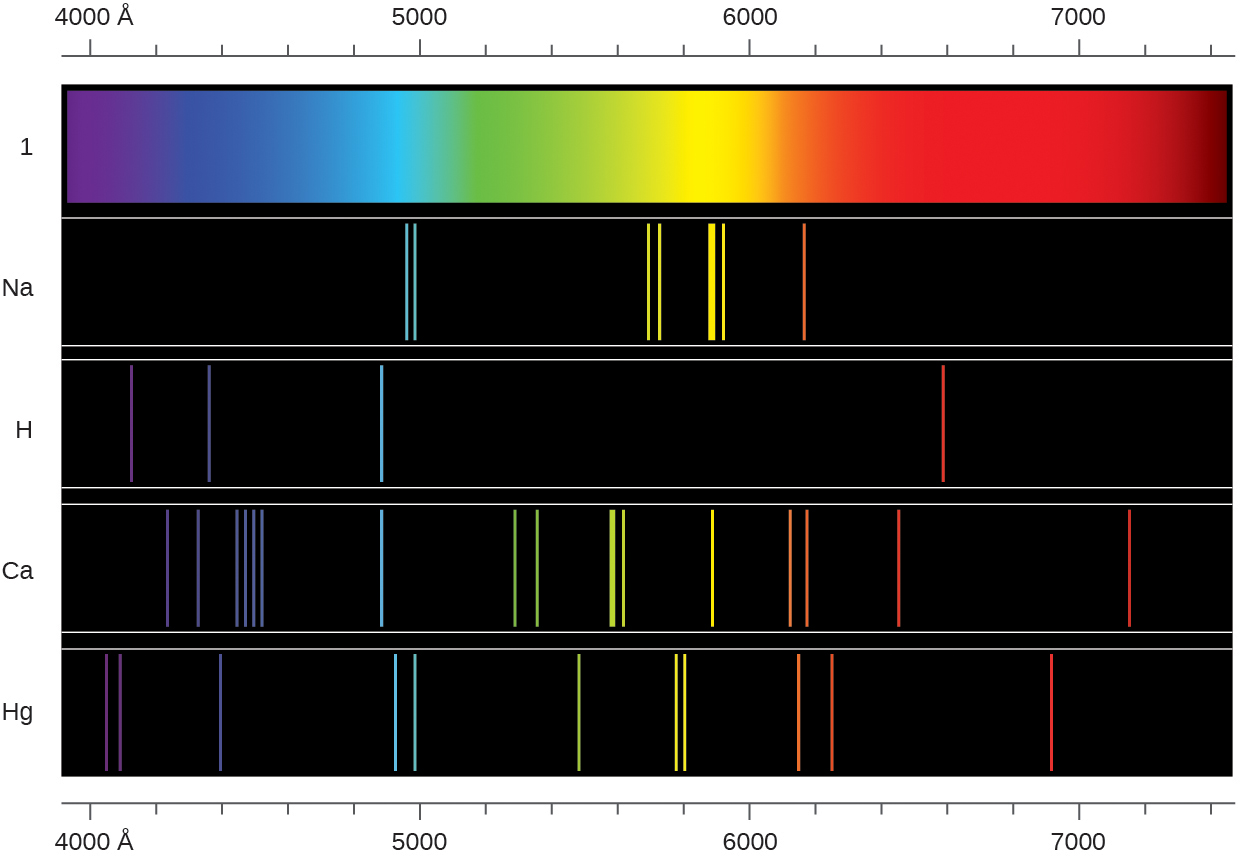

What causes the lines in these spectra? Why are the colors of the lines different? Suggest a reason for the observation that the spectrum of calcium is more complicated than the spectrum of hydrogen.
これらのスペクトル線は何によって生じるか。線の色が異なるのはなぜか。カルシウムのスペクトルが水素より複雑である理由を考えなさい。
Bohr’s model of the hydrogen atom
ボーアの水素原子モデル
structural model in which an electron moves around the nucleus only in circular orbits, each with a specific allowed radius
電子が原子核の周りを、特定の許された半径をもつ円軌道に沿ってのみ運動するという構造モデル。
excited state
励起状態
state having an energy greater than the ground-state energy
基底状態より高いエネルギーをもつ状態。
ground state
基底状態
state in which the electrons in an atom, ion, or molecule have the lowest energy possible
原子、イオン、分子内の電子が、可能な最小のエネルギーをもつ状態。
quantum number
量子数
number having only specific allowed values and used to characterize the arrangement of electrons in an atom
特定の許された値だけをとり、原子内の電子の配置を特徴付けるために用いる数。