第6章電子構造と元素の周期的性質
6.3 Development of Quantum Theory6.3 量子論の発展
Learning Objectives学習目標
By the end of this section, you will be able to:
この節を終えると、次のことができるようになる。
- Extend the concept of wave–particle duality that was observed in electromagnetic radiation to matter as well電磁放射で観測された波動粒子二重性の概念を、物質にも拡張する。
- Understand the general idea of the quantum mechanical description of electrons in an atom, and that it uses the notion of three-dimensional wave functions, or orbitals, that define the distribution of probability to find an electron in a particular part of space原子内の電子の量子力学的な記述の基本的な考え方を理解する。また、この記述が3次元の波動関数、すなわち軌道を用い、空間の特定の部分で電子が見つかる確率の分布を定めることを理解する。
- List and describe traits of the four quantum numbers that form the basis for completely specifying the state of an electron in an atom原子内の電子の状態を完全に指定する基礎となる4つの量子数を挙げ、それぞれの特徴を説明する。
Bohr’s model explained the experimental data for the hydrogen atom and was widely accepted, but it also raised many questions. Why did electrons orbit at only fixed distances defined by a single quantum number n = 1, 2, 3, and so on, but never in between? Why did the model work so well describing hydrogen and one-electron ions, but could not correctly predict the emission spectrum for helium or any larger atoms? To answer these questions, scientists needed to completely revise the way they thought about matter.
英語のヒント
ボーア模型は水素原子の実験データを説明し、広く受け入れられたが、多くの疑問も生んだ。電子はなぜ、1つの量子数n = 1、2、3、…で決まる一定の距離だけを周回し、その間には決して存在しないのか。なぜ水素や電子1個のイオンはうまく記述できるのに、ヘリウムや、それより大きな原子の発光スペクトルは正しく予測できないのか。これらに答えるには、科学者たちは物質についての考え方を根本から改める必要があった。
Behavior in the Microscopic World微視的な世界での振る舞い
We know how matter behaves in the macroscopic world—objects that are large enough to be seen by the naked eye follow the rules of classical physics. A billiard ball moving on a table will behave like a particle: It will continue in a straight line unless it collides with another ball or the table cushion, or is acted on by some other force (such as friction). The ball has a well-defined position and velocity (or a well-defined momentum, p = mv, defined by mass m and velocity v) at any given moment. In other words, the ball is moving in a classical trajectory. This is the typical behavior of a classical object.
英語のヒント
私たちは、巨視的な世界で物質がどう振る舞うかを知っている。肉眼で見えるほど大きい物体は、古典物理学の法則に従う。台の上を動くビリヤードの球は、粒子として振る舞う。別の球や台のクッションに衝突したり、摩擦などの別の力を受けたりしなければ、直線に沿って進み続ける。球はどの瞬間にも、はっきり定まった位置と速度をもつ。あるいは、質量mと速度vによってp = mvで定まる、はっきりした運動量をもつ。つまり、球は古典的な軌道に沿って動く。これが古典的な物体の典型的な振る舞いである。
When waves interact with each other, they show interference patterns that are not displayed by macroscopic particles such as the billiard ball. For example, interacting waves on the surface of water can produce interference patterns similar to those shown on Figure 6.16. This is a case of wave behavior on the macroscopic scale, and it is clear that particles and waves are very different phenomena in the macroscopic realm.
英語のヒント
波が互いに相互作用すると、ビリヤードの球のような巨視的な粒子には見られない干渉模様を示す。たとえば、水面の波が相互作用すると、図6.16のような干渉模様ができる。これは巨視的な尺度での波の振る舞いの例であり、巨視的な領域では粒子と波がまったく異なる現象であることは明らかである。

Figure 6.16図 6.16
An interference pattern on the water surface is formed by interacting waves. The waves are caused by reflection of water from the rocks. (credit: modification of work by Sukanto Debnath)
波の相互作用により、水面に干渉模様ができている。波は、水が岩から反射することで生じる。(出典:Sukanto Debnathの作品を改変)
As technological improvements allowed scientists to probe the microscopic world in greater detail, it became increasingly clear by the 1920s that very small pieces of matter follow a different set of rules from those we observe for large objects. The unquestionable separation of waves and particles was no longer the case for the microscopic world.
英語のヒント
技術の進歩によって科学者が微視的な世界を詳しく調べられるようになると、1920年代までには、非常に小さな物質のかけらは、大きな物体で観測されるものとは別の法則に従うことが、ますます明らかになった。波と粒子を疑いなく区別できるという事情は、微視的な世界ではもはや成り立たなかった。
One of the first people to pay attention to the special behavior of the microscopic world was Louis de Broglie. He asked the question: If electromagnetic radiation can have particle-like character, can electrons and other submicroscopic particles exhibit wavelike character? In his 1925 doctoral dissertation, de Broglie extended the wave–particle duality of light that Einstein used to resolve the photoelectric-effect paradox to material particles. He predicted that a particle with mass m and velocity v (that is, with linear momentum p) should also exhibit the behavior of a wave with a wavelength value λ, given by this expression in which h is the familiar Planck’s constant:
英語のヒント
微視的な世界の特殊な振る舞いに、いち早く注目した人物の1人がルイ・ド・ブロイである。彼は、電磁放射が粒子のような性質をもつのなら、電子などの極微小な粒子も波のような性質を示すのではないか、と考えた。1925年の博士論文で、ド・ブロイは、アインシュタインが光電効果の矛盾の解決に使った光の波動粒子二重性を、物質の粒子にまで拡張した。質量m、速度v、すなわち運動量pの粒子も、次の式で与えられる波長λの波の振る舞いを示すはずだと予測した。hは、すでに学んだプランク定数である。
This is called the de Broglie wavelength. Unlike the other values of λ discussed in this chapter, the de Broglie wavelength is a characteristic of particles and other bodies, not electromagnetic radiation (note that this equation involves velocity [v, m/s], not frequency [ν, Hz]. Although these two symbols appear nearly identical, they mean very different things). Where Bohr had postulated the electron as being a particle orbiting the nucleus in quantized orbits, de Broglie argued that Bohr’s assumption of quantization can be explained if the electron is considered not as a particle, but rather as a circular standing wave such that only an integer number of wavelengths could fit exactly within the orbit (Figure 6.17).
英語のヒント
これをド・ブロイ波長という。この章で扱うほかのλと異なり、ド・ブロイ波長は電磁放射ではなく、粒子などの物体の性質である。この式に現れるのは振動数ν(Hz)ではなく、速度v(m/s)であることに注意しよう。2つの記号はほとんど同じに見えるが、意味は大きく異なる。ボーアは電子を、量子化された軌道上を原子核の周りに回る粒子と仮定した。これに対しド・ブロイは、電子を粒子ではなく円形の定常波と考え、整数個の波長だけが軌道にぴったり収まるとすれば、ボーアの量子化の仮定を説明できると主張した(図6.17)。
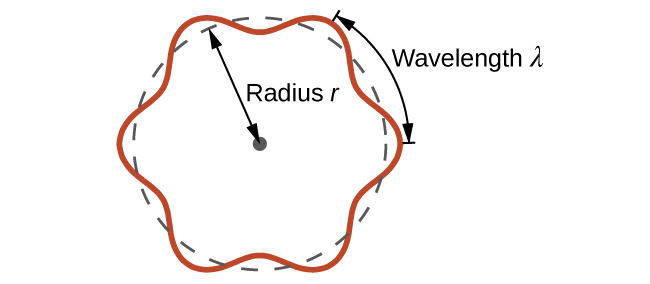
Figure 6.17図 6.17
If an electron is viewed as a wave circling around the nucleus, an integer number of wavelengths must fit into the orbit for this standing wave behavior to be possible.
電子を原子核の周りを巡る波と捉えると、定常波として振る舞うためには、整数個の波長が軌道に収まらなければならない。
For a circular orbit of radius r, the circumference is 2πr, and so de Broglie’s condition is:
半径rの円軌道の円周は2πrなので、ド・ブロイの条件は次のようになる。
Shortly after de Broglie proposed the wave nature of matter, two scientists at Bell Laboratories, C. J. Davisson and L. H. Germer, demonstrated experimentally that electrons can exhibit wavelike behavior by showing an interference pattern for electrons travelling through a regular atomic pattern in a crystal. The regularly spaced atomic layers served as slits, as used in other interference experiments. Since the spacing between the layers serving as slits needs to be similar in size to the wavelength of the tested wave for an interference pattern to form, Davisson and Germer used a crystalline nickel target for their “slits,” since the spacing of the atoms within the lattice was approximately the same as the de Broglie wavelengths of the electrons that they used. Figure 6.18 shows an interference pattern. It is strikingly similar to the interference patterns for light shown in Electromagnetic Energy for light passing through two closely spaced, narrow slits. The wave–particle duality of matter can be seen in Figure 6.18 by observing what happens if electron collisions are recorded over a long period of time. Initially, when only a few electrons have been recorded, they show clear particle-like behavior, having arrived in small localized packets that appear to be random. As more and more electrons arrived and were recorded, a clear interference pattern that is the hallmark of wavelike behavior emerged. Thus, it appears that while electrons are small localized particles, their motion does not follow the equations of motion implied by classical mechanics, but instead it is governed by some type of a wave equation. Thus the wave–particle duality first observed with photons is actually a fundamental behavior intrinsic to all quantum particles.
英語のヒント
ド・ブロイが物質の波動性を提案して間もなく、ベル研究所のC・J・デイヴィソンとL・H・ガーマーは、結晶中の規則正しい原子配列を通る電子の干渉模様を示し、電子が波のように振る舞うことを実験的に実証した。等間隔に並ぶ原子層は、ほかの干渉実験で使うスリットの役割を果たした。干渉模様を生じさせるには、スリットとなる層の間隔が、調べる波の波長と同程度である必要がある。そこで2人は、用いた電子のド・ブロイ波長と格子内の原子間隔がほぼ同じであるニッケル結晶を、「スリット」の標的に用いた。図6.18に干渉模様を示す。これは「電磁エネルギー」で示した、互いに近接する細い2本のスリットを光が通るときの干渉模様と驚くほどよく似ている。電子の衝突を長時間記録するとどうなるかを見れば、図6.18から物質の波動粒子二重性を確認できる。初めに少数の電子だけが記録された段階では、電子は一見無作為な、小さく局在したまとまりとして到着し、明らかに粒子のように振る舞う。到着して記録される電子が増えるにつれて、波の振る舞いの特徴である、明瞭な干渉模様が現れる。したがって、電子は小さな局在した粒子でありながら、その運動は古典力学の運動方程式には従わず、ある種の波動方程式に支配されるように見える。光子で最初に観測された波動粒子二重性は、実はすべての量子粒子に固有の基本的な振る舞いなのである。
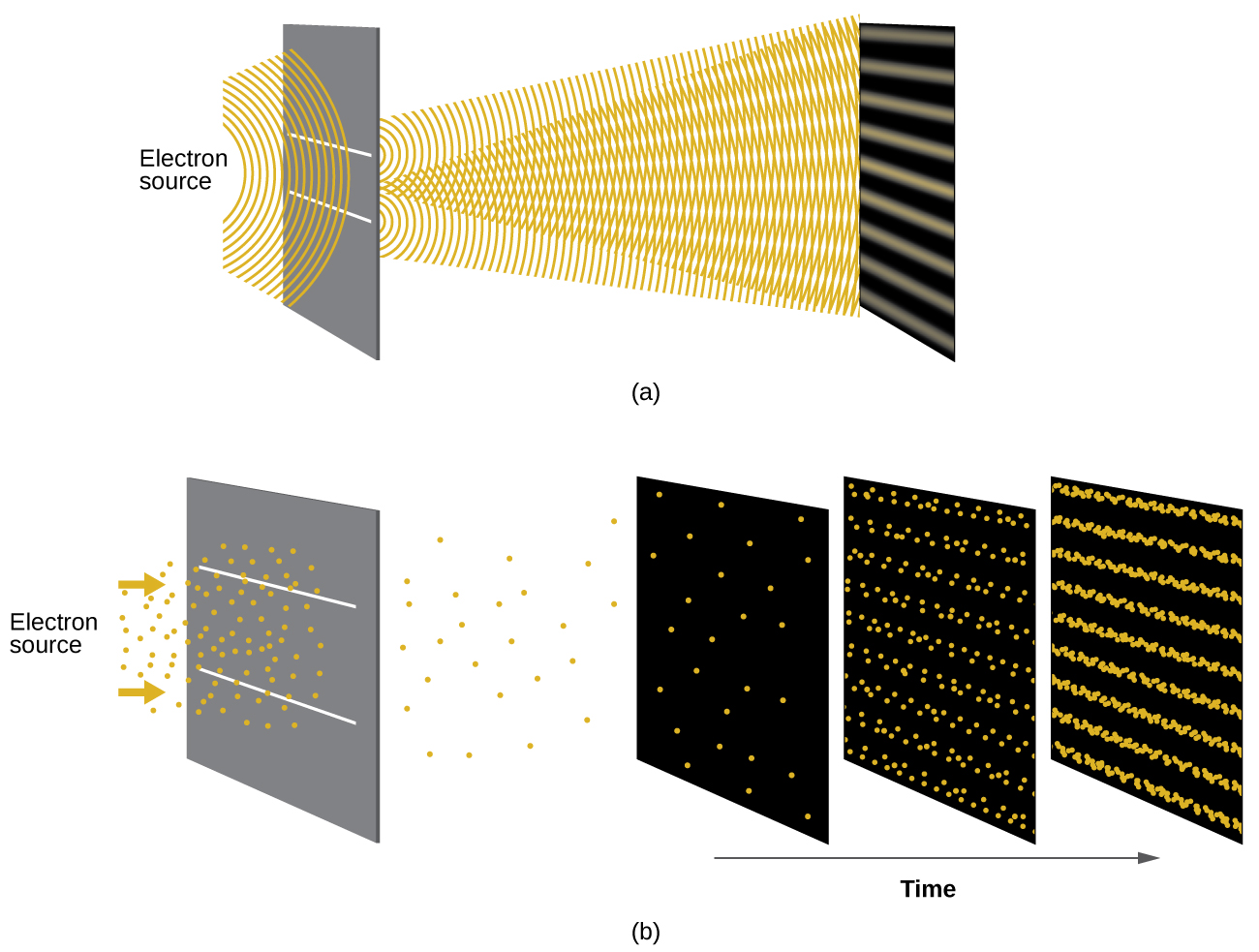


Figure 6.18図 6.18
(a) The interference pattern for electrons passing through very closely spaced slits demonstrates that quantum particles such as electrons can exhibit wavelike behavior. (b) The experimental results illustrated here demonstrate the wave–particle duality in electrons.
(a) 非常に近接したスリットを通る電子の干渉模様は、電子などの量子粒子が波の振る舞いを示しうることを実証する。(b) ここに示した実験結果は、電子の波動粒子二重性を示している。
Example 6.6例題 6.6
Calculating the Wavelength of a Particle粒子の波長を計算する
If an electron travels at a velocity of 1.000 107 m s–1 and has a mass of 9.109 10–28 g, what is its wavelength?
質量9.109 10–28 gの電子が、速度1.000 107 m s–1で進んでいる。この電子の波長はいくらか。
Solution解法
We can use de Broglie’s equation to solve this problem, but we first must do a unit conversion of Planck’s constant. You learned earlier that 1 J = 1 kg m2/s2. Thus, we can write h = 6.626 10–34 J s as 6.626 10–34 kg m2/s.
ド・ブロイの式を使って解けるが、まずプランク定数の単位を換算する必要がある。すでに学んだように、1 J = 1 kg m2/s2である。したがって、h = 6.626 10–34 J sは、6.626 10–34 kg m2/sと書ける。
This is a small value, but it is significantly larger than the size of an electron in the classical (particle) view. This size is the same order of magnitude as the size of an atom. This means that electron wavelike behavior is going to be noticeable in an atom.
英語のヒント
これは小さい値だが、古典的な粒子として考えた電子の大きさよりは、かなり大きい。原子の大きさと同じ桁の大きさである。このことは、原子内では電子の波としての振る舞いが目立つことを意味する。
Check Your Learning理解を確かめよう
Calculate the wavelength of a softball with a mass of 100 g traveling at a velocity of 35 m s–1, assuming that it can be modeled as a single particle.
質量100 gのソフトボールが35 m s–1で飛んでいる。1つの粒子としてモデル化できると仮定し、その波長を求めなさい。
Werner Heisenberg considered the limits of how accurately we can measure properties of an electron or other microscopic particles. He determined that there is a fundamental limit to how accurately one can measure both a particle’s position and its momentum simultaneously. The more accurately we measure the momentum of a particle, the less accurately we can determine its position at that time, and vice versa. This is summed up in what we now call the Heisenberg uncertainty principle: It is fundamentally impossible to determine simultaneously and exactly both the momentum and the position of a particle. For a particle of mass m moving with velocity vx in the x direction (or equivalently with momentum px), the product of the uncertainty in the position, Δx, and the uncertainty in the momentum, Δpx , must be greater than or equal to (where the value of Planck’s constant divided by 2π).
英語のヒント
ヴェルナー・ハイゼンベルクは、電子などの微視的な粒子の性質を、どこまで正確に測定できるかを考えた。その結果、粒子の位置と運動量の両方を同時に測定する精度には、根本的な限界があると突き止めた。粒子の運動量を正確に測定するほど、その時点の位置を決める精度は低下し、その逆も成り立つ。これは、現在ハイゼンベルクの不確定性原理と呼ぶ原理にまとめられる。すなわち、粒子の運動量と位置の両方を、同時に正確に決めることは原理的に不可能である。質量mの粒子がx方向に速度vx、すなわち運動量pxで動くとき、位置の不確定性Δxと運動量の不確定性Δpxの積は、以上でなければならない。ここでは、プランク定数を2πで割った値である。
This equation allows us to calculate the limit to how precisely we can know both the simultaneous position of an object and its momentum. For example, if we improve our measurement of an electron’s position so that the uncertainty in the position (Δx) has a value of, say, 1 pm (10–12 m, about 1% of the diameter of a hydrogen atom), then our determination of its momentum must have an uncertainty with a value of at least
英語のヒント
この式から、物体の位置と運動量を同時に知る精度の限界を計算できる。たとえば、電子の位置の測定を改善し、位置の不確定性Δxを1 pm(10–12 m、水素原子の直径の約1%)にしたとしよう。このとき、運動量の測定には、少なくとも次の大きさの不確定性がなければならない。
The value of ħ is not large, so the uncertainty in the position or momentum of a macroscopic object like a baseball is too insignificant to observe. However, the mass of a microscopic object such as an electron is small enough that the uncertainty can be large and significant.
英語のヒント
ħの値は大きくないため、野球のボールのような巨視的な物体では、位置や運動量の不確定性は観測できないほど小さい。しかし、電子のような微視的な物体の質量は十分に小さいので、不確定性が大きく、無視できないものとなりうる。
It should be noted that Heisenberg’s uncertainty principle is not just limited to uncertainties in position and momentum, but it also links other dynamical variables. For example, when an atom absorbs a photon and makes a transition from one energy state to another, the uncertainty in the energy and the uncertainty in the time required for the transition are similarly related, as ΔE Δt ≥
ハイゼンベルクの不確定性原理は、位置と運動量の不確定性だけに限らず、ほかの力学変数同士も結びつけることに注意しよう。たとえば、原子が光子を吸収してあるエネルギー状態から別の状態へ遷移するとき、エネルギーの不確定性と、遷移に必要な時間の不確定性にも、同様にΔE Δt ≥ という関係がある。
Heisenberg’s principle imposes ultimate limits on what is knowable in science. The uncertainty principle can be shown to be a consequence of wave–particle duality, which lies at the heart of what distinguishes modern quantum theory from classical mechanics.
英語のヒント
ハイゼンベルクの原理は、科学において知りうることに究極の限界を課す。不確定性原理は、現代量子論と古典力学を区別する核心にある波動粒子二重性の帰結であることを示せる。