第6章電子構造と元素の周期的性質
Line Spectra線スペクトル
Another paradox within the classical electromagnetic theory that scientists in the late nineteenth century struggled with concerned the light emitted from atoms and molecules. When solids, liquids, or condensed gases are heated sufficiently, they radiate some of the excess energy as light. Photons produced in this manner have a range of energies, and thereby produce a continuous spectrum in which an unbroken series of wavelengths is present. Most of the light generated from stars (including our sun) is produced in this fashion. You can see all the visible wavelengths of light present in sunlight by using a prism to separate them. As can be seen in Figure 6.9, sunlight also contains UV light (shorter wavelengths) and IR light (longer wavelengths) that can be detected using instruments but that are invisible to the human eye. Incandescent (glowing) solids such as tungsten filaments in incandescent lights also give off light that contains all wavelengths of visible light. These continuous spectra can often be approximated by blackbody radiation curves at some appropriate temperature, such as those shown in Figure 6.10.
英語のヒント
19世紀末の科学者たちを悩ませた、古典電磁気理論のもう1つの矛盾は、原子や分子から放出される光に関するものであった。固体、液体、あるいは凝縮した気体を十分に加熱すると、余分なエネルギーの一部が光として放射される。このようにして生じる光子にはさまざまなエネルギーがあり、途切れのない一連の波長からなる連続スペクトルが生じる。太陽を含む恒星から出る光の大部分は、この仕組みで発生する。プリズムで光を分けると、太陽光に含まれるすべての可視光の波長を見ることができる。図6.9に示すように、太陽光には、装置で検出できるが人の目には見えない、短波長の紫外線と長波長の赤外線も含まれる。白熱電球のタングステンフィラメントなど、白熱して光る固体も、可視光の全波長を含む光を放つ。このような連続スペクトルは、多くの場合、図6.10のような、適切な温度の黒体放射曲線で近似できる。
In contrast to continuous spectra, light can also occur as discrete or line spectra having very narrow line widths interspersed throughout the spectral regions such as those shown in Figure 6.13. Exciting a gas at low partial pressure using an electrical current, or heating it, will produce line spectra. Fluorescent light bulbs and neon signs operate in this way (Figure 6.12). Each element displays its own characteristic set of lines, as do molecules, although their spectra are generally much more complicated.
英語のヒント
Image omitted because its reuse rights could not be verified.権利の確認ができないため画像を割愛。
Figure 6.12図 6.12
Neon signs operate by exciting a gas at low partial pressure using an electrical current. This sign shows the elaborate artistic effects that can be achieved. (credit: Dave Shaver)
ネオンサインは、分圧の低い気体を電流で励起して発光させる。この看板は、それによって実現できる手の込んだ芸術的な効果を示している。(出典:Dave Shaver)
Each emission line consists of a single wavelength of light, which implies that the light emitted by a gas consists of a set of discrete energies. For example, when an electric discharge passes through a tube containing hydrogen gas at low pressure, the H2 molecules are broken apart into separate H atoms and we see a blue-pink color. Passing the light through a prism produces a line spectrum, indicating that this light is composed of photons of four visible wavelengths, as shown in Figure 6.13.
英語のヒント
発光線はそれぞれ単一の波長の光からなる。これは、気体が放つ光が、離散的なエネルギーの組からなることを意味する。たとえば、低圧の水素ガスを入れた管内で放電すると、H2分子が個々のH原子に分かれ、青みがかったピンク色の光が見える。この光をプリズムに通すと、図6.13のような線スペクトルが生じる。このことから、光が可視領域の4つの波長の光子からなるとわかる。
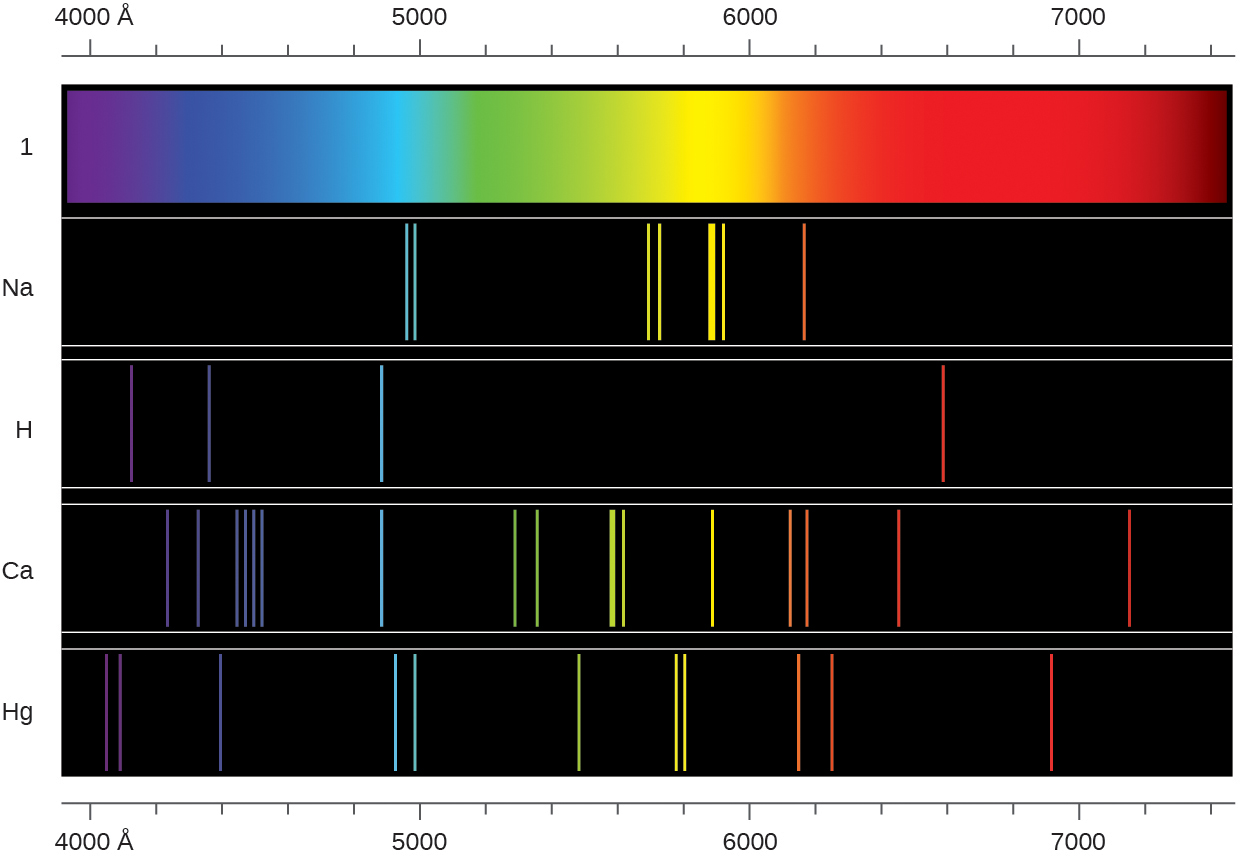

Figure 6.13図 6.13
Compare the two types of emission spectra: continuous spectrum of white light (top) and the line spectra of the light from excited sodium, hydrogen, calcium, and mercury atoms. Note: The wavelength axis of these spectra use the angstrom length unit (1 Å = 0.1 nm).
2種類の発光スペクトルを比べよう。上は白色光の連続スペクトル、下は励起されたナトリウム、水素、カルシウム、水銀原子が放つ光の線スペクトルである。注:波長軸には長さの単位オングストロームを用いている(1 Å = 0.1 nm)。
The origin of discrete spectra in atoms and molecules was extremely puzzling to scientists in the late nineteenth century, since according to classical electromagnetic theory, only continuous spectra should be observed. Even more puzzling, in 1885, Johann Balmer was able to derive an empirical equation that related the four visible wavelengths of light emitted by hydrogen atoms to whole integers. That equation is the following one, in which k is a constant:
英語のヒント
原子や分子の離散的なスペクトルがどこから生じるのかは、19世紀末の科学者にとって非常に不可解であった。古典電磁気理論によれば、観測されるはずなのは連続スペクトルだけだったからである。さらに不可解なことに、1885年、ヨハン・バルマーは、水素原子が放つ可視光の4つの波長を整数と関連づける経験式を導いた。それが次の式であり、kは定数である。
Other discrete lines for the hydrogen atom were found in the UV and IR regions. Johannes Rydberg generalized Balmer's work and developed an empirical formula that predicted all of hydrogen's emission lines, not just those restricted to the visible range, where, n1 and n2 are integers, n1 < n2, and is the Rydberg constant (1.097 107 m−1).
英語のヒント
水素原子のほかの離散的なスペクトル線は、紫外領域と赤外領域にも見つかった。ヨハネス・リュードベリはバルマーの研究を一般化し、可視領域に限らず、水素のすべての発光線を予測する経験式を導いた。ここでn1とn2は整数で、n1 < n2である。また、はリュードベリ定数(1.097 107 m−1)である。
Even in the late nineteenth century, spectroscopy was a very precise science, and so the wavelengths of hydrogen were measured to very high accuracy, which implied that the Rydberg constant could be determined very precisely as well. That such a simple formula as the Rydberg formula could account for such precise measurements seemed astounding at the time, but it was the eventual explanation for emission spectra by Neils Bohr in 1913 that ultimately convinced scientists to abandon classical physics and spurred the development of modern quantum mechanics.
英語のヒント
19世紀末の時点ですでに、分光学は非常に精密な科学であった。そのため、水素の波長は非常に高い精度で測定されており、リュードベリ定数も極めて精密に決められることを意味していた。リュードベリの式ほど単純な式で、それほど精密な測定結果を説明できることは、当時驚くべきことに思われた。しかし、科学者たちを最終的に納得させて古典物理学を放棄させ、現代の量子力学の発展を促したのは、1913年にニールス・ボーアがついに発光スペクトルに与えた説明であった。
Key Concepts and Summary重要な概念とまとめ
Light and other forms of electromagnetic radiation move through a vacuum with a constant speed, c, of 2.998 108 m s−1. This radiation shows wavelike behavior, which can be characterized by a frequency, ν, and a wavelength, λ, such that c = λν. Light is an example of a travelling wave. Other important wave phenomena include standing waves, periodic oscillations, and vibrations. Standing waves exhibit quantization, since their wavelengths are limited to discrete integer multiples of some characteristic lengths. Electromagnetic radiation that passes through two closely spaced narrow slits having dimensions roughly similar to the wavelength will show an interference pattern that is a result of constructive and destructive interference of the waves. Electromagnetic radiation also demonstrates properties of particles called photons. The energy of a photon is related to the frequency (or alternatively, the wavelength) of the radiation as E = hν (or ), where h is Planck's constant. That light demonstrates both wavelike and particle-like behavior is known as wave-particle duality. All forms of electromagnetic radiation share these properties, although various forms including X-rays, visible light, microwaves, and radio waves interact differently with matter and have very different practical applications. Electromagnetic radiation can be generated by exciting matter to higher energies, such as by heating it. The emitted light can be either continuous (incandescent sources like the sun) or discrete (from specific types of excited atoms). Continuous spectra often have distributions that can be approximated as blackbody radiation at some appropriate temperature. The line spectrum of hydrogen can be obtained by passing the light from an electrified tube of hydrogen gas through a prism. This line spectrum was simple enough that an empirical formula called the Rydberg formula could be derived from the spectrum. Three historically important paradoxes from the late 19th and early 20th centuries that could not be explained within the existing framework of classical mechanics and classical electromagnetism were the blackbody problem, the photoelectric effect, and the discrete spectra of atoms. The resolution of these paradoxes ultimately led to quantum theories that superseded the classical theories.
英語のヒント
光をはじめとする電磁放射は、真空中を一定の速さc = 2.998 108 m s−1で進む。この放射は波のような振る舞いを示し、c = λνを満たす振動数νと波長λで特徴づけられる。光は進行波の一例である。ほかにも、定常波、周期的な振動などが重要な波の現象である。定常波の波長は、ある特性長の離散的な整数倍に限られるため、量子化を示す。波長とほぼ同じ寸法の、互いに近接した2本の細いスリットを電磁放射が通ると、波の強め合う干渉と弱め合う干渉による干渉模様が現れる。電磁放射は、光子と呼ばれる粒子の性質も示す。光子のエネルギーは、放射の振動数、または波長と、E = hν(または)という関係にあり、hはプランク定数である。光が波と粒子の両方の振る舞いを示すことを、波動粒子二重性という。すべての電磁放射はこれらの性質を共有するが、X線、可視光、マイクロ波、電波などは、それぞれ物質との相互作用が異なり、実際の用途も大きく異なる。物質を加熱するなどして高いエネルギーに励起すると、電磁放射を発生させることができる。放出される光は、太陽のような白熱光源では連続的で、特定の種類の励起原子では離散的である。連続スペクトルの分布は、多くの場合、適切な温度の黒体放射で近似できる。放電させた水素ガスの管から出る光をプリズムに通すと、水素の線スペクトルが得られる。この線スペクトルは十分に単純であり、そこからリュードベリの式という経験式を導くことができた。19世紀末から20世紀初めにかけての、歴史的に重要な3つの矛盾は、黒体の問題、光電効果、原子の離散スペクトルであった。これらは、それまでの古典力学と古典電磁気学の枠組みでは説明できなかった。これらの矛盾の解決は、やがて古典理論に代わる量子論へとつながった。