第6章電子構造と元素の周期的性質
Key Concepts and Summary重要な概念とまとめ
Macroscopic objects act as particles. Microscopic objects (such as electrons) have properties of both a particle and a wave. Their exact trajectories cannot be determined. The quantum mechanical model of atoms describes the three-dimensional position of the electron in a probabilistic manner according to a mathematical function called a wavefunction, often denoted as ψ. Atomic wavefunctions are also called orbitals. The squared magnitude of the wavefunction describes the distribution of the probability of finding the electron in a particular region in space. Therefore, atomic orbitals describe the areas in an atom where electrons are most likely to be found.
巨視的な物体は粒子として振る舞う。電子のような微視的な物体は、粒子と波の両方の性質をもち、その正確な軌道を決めることはできない。原子の量子力学的模型は、通常ψと記す波動関数という数学的な関数に従って、電子の3次元の位置を確率的に記述する。原子の波動関数は軌道とも呼ばれる。波動関数の大きさの2乗は、空間の特定の領域で電子が見つかる確率の分布を表す。したがって原子軌道は、原子内で電子が見つかる可能性が最も高い領域を記述する。
An atomic orbital is characterized by three quantum numbers. The principal quantum number, n, can be any positive integer. The general region for value of energy of the orbital and the average distance of an electron from the nucleus are related to n. Orbitals having the same value of n are said to be in the same shell. The secondary (angular momentum) quantum number, l, can have any integer value from 0 to n – 1. This quantum number describes the shape or type of the orbital. Orbitals with the same principal quantum number and the same l value belong to the same subshell. The magnetic quantum number, ml, with 2l + 1 values ranging from –l to +l, describes the orientation of the orbital in space. In addition, each electron has a spin quantum number, ms, that can be equal to No two electrons in the same atom can have the same set of values for all the four quantum numbers.
原子軌道は3つの量子数によって特徴づけられる。主量子数nは、任意の正の整数をとれる。軌道のエネルギー値のおおよその領域と、原子核から電子までの平均距離はnに関係する。nが同じ軌道は、同じ電子殻にあるという。副量子数(角運動量量子数)lは、0からn − 1までの整数をとり、軌道の形や種類を表す。主量子数とlの値が同じ軌道は、同じ副殻に属する。磁気量子数mlは、−lから+lまでの2l + 1個の値をもち、空間内の軌道の向きを表す。さらに各電子には、の値をとるスピン量子数msがある。同じ原子内の2つの電子が、4つすべての量子数について同じ値の組をもつことはできない。
Chemistry End of Chapter Exercises章末問題
Exercises 31–45練習問題 31–45
Exercise 31問題 31
How are the Bohr model and the quantum mechanical model of the hydrogen atom similar? How are they different?
水素原子のボーア模型と量子力学的模型の共通点と相違点を説明しなさい。
Solution解き方
Both models have a central positively charged nucleus with electrons moving about the nucleus in accordance with the Coulomb electrostatic potential. The Bohr model assumes that the electrons move in circular orbits that have quantized energies, angular momentum, and radii that are specified by a single quantum number, n = 1, 2, 3, …, but this quantization is an ad hoc assumption made by Bohr to incorporate quantization into an essentially classical mechanics description of the atom. Bohr also assumed that electrons orbiting the nucleus normally do not emit or absorb electromagnetic radiation, but do so when the electron switches to a different orbit. In the quantum mechanical model, the electrons do not move in precise orbits (such orbits violate the Heisenberg uncertainty principle) and, instead, a probabilistic interpretation of the electron’s position at any given instant is used, with a mathematical function ψ called a wavefunction that can be used to determine the electron’s spatial probability distribution. These wavefunctions, or orbitals, are three-dimensional stationary waves that can be specified by three quantum numbers that arise naturally from their underlying mathematics (no ad hoc assumptions required): the principal quantum number, n (the same one used by Bohr), which specifies shells such that orbitals having the same n all have the same energy and approximately the same spatial extent; the angular momentum quantum number l, which is a measure of the orbital’s angular momentum and corresponds to the orbitals’ general shapes, as well as specifying subshells such that orbitals having the same l (and n) all have the same energy; and the orientation quantum number m, which is a measure of the z component of the angular momentum and corresponds to the orientations of the orbitals. The Bohr model gives the same expression for the energy as the quantum mechanical expression and, hence, both properly account for hydrogen’s discrete spectrum (an example of getting the right answers for the wrong reasons, something that many chemistry students can sympathize with), but gives the wrong expression for the angular momentum (Bohr orbits necessarily all have non-zero angular momentum, but some quantum orbitals [s orbitals] can have zero angular momentum).
英語のヒント
どちらの模型にも、中心に正電荷をもつ原子核があり、電子はクーロン静電ポテンシャルに従ってその周りを動く。ボーア模型では、電子は円軌道を動き、そのエネルギー、角運動量、半径は量子化され、1つの量子数n = 1、2、3、…で指定されると仮定する。しかし、この量子化は、本質的には古典力学に基づく原子の記述に量子化を取り込むため、ボーアがその目的に合わせて置いた仮定である。ボーアはさらに、原子核を周回する電子は通常は電磁放射を放出も吸収もしないが、別の軌道へ移るときには放出または吸収すると仮定した。量子力学的模型では、電子は正確に定まった軌道を動かない。そのような軌道はハイゼンベルクの不確定性原理に反するからである。その代わりに、波動関数と呼ばれる数学的な関数ψを用いて、ある瞬間の電子の位置を確率的に解釈し、電子の空間的な確率分布を決める。波動関数、すなわち軌道は3次元の定常波であり、その基礎となる数学から自然に現れる3つの量子数で指定できる。場当たり的な仮定は必要ない。主量子数nはボーアが使ったものと同じで、電子殻を指定する。同じnの軌道はすべてエネルギーが等しく、空間的な広がりもほぼ同じである。角運動量量子数lは軌道の角運動量の尺度であり、軌道のおおよその形に対応する。また副殻を指定し、lとnが同じ軌道はすべて同じエネルギーをもつ。向きを表す量子数mは角運動量のz成分の尺度で、軌道の向きに対応する。ボーア模型のエネルギー式は量子力学的な式と同じであり、どちらも水素の離散スペクトルを正しく説明する。これは、誤った理由から正しい答えを得た例であり、多くの化学の学生には身に覚えがあるだろう。しかし、ボーア模型の角運動量の式は誤っている。ボーア軌道は必ず0でない角運動量をもつが、量子軌道の一部、すなわちs軌道の角運動量は0になりうる。
Exercise 32問題 32
What are the allowed values for each of the four quantum numbers: n, l, ml, and ms?
4つの量子数n、l、ml、msについて、それぞれ許される値を答えなさい。
Exercise 33問題 33
Describe the properties of an electron associated with each of the following four quantum numbers: n, l, ml, and ms.
4つの量子数n、l、ml、msが、それぞれ電子のどの性質に関係するかを説明しなさい。
Solution解き方
n determines the general range for the value of energy and the probable distances that the electron can be from the nucleus. l determines the shape of the orbital. m1 determines the orientation of the orbitals of the same l value with respect to one another. ms determines the spin of an electron.
nは、エネルギー値のおおよその範囲と、原子核から電子までの距離として考えられる範囲を定める。lは軌道の形を定める。m1は、同じlをもつ軌道同士の相対的な向きを定める。msは電子のスピンを定める。
Exercise 34問題 34
Answer the following questions:
次の問いに答えなさい。
(a) Without using quantum numbers, describe the differences between the shells, subshells, and orbitals of an atom.
(a) 量子数を使わずに、原子の電子殻、副殻、軌道の違いを説明しなさい。
(b) How do the quantum numbers of the shells, subshells, and orbitals of an atom differ?
(b) 原子の電子殻、副殻、軌道では、量子数にどのような違いがあるか。
Exercise 35問題 35
Identify the subshell in which electrons with the following quantum numbers are found:
次の量子数をもつ電子が入る副殻を答えなさい。
(a) n = 2, l = 1
(a) n = 2, l = 1
(b) n = 4, l = 2
(b) n = 4, l = 2
(c) n = 6, l = 0
(c) n = 6, l = 0
Solution解き方
(a) 2p; (b) 4d; (c) 6s
(a) 2p; (b) 4d; (c) 6s
Exercise 36問題 36
Which of the subshells described in the previous question contain degenerate orbitals? How many degenerate orbitals are in each?
前の問題で述べた副殻のうち、縮退した軌道を含むものはどれか。それぞれに縮退した軌道が何個あるか。
Exercise 37問題 37
Identify the subshell in which electrons with the following quantum numbers are found:
次の量子数をもつ電子が入る副殻を答えなさい。
(a) n = 3, l = 2
(a) n = 3, l = 2
(b) n = 1, l = 0
(b) n = 1, l = 0
(c) n = 4, l = 3
(c) n = 4, l = 3
Solution解き方
(a) 3d; (b) 1s; (c) 4f
(a) 3d; (b) 1s; (c) 4f
Exercise 38問題 38
Which of the subshells described in the previous question contain degenerate orbitals? How many degenerate orbitals are in each?
前の問題で述べた副殻のうち、縮退した軌道を含むものはどれか。それぞれに縮退した軌道が何個あるか。
Exercise 39問題 39
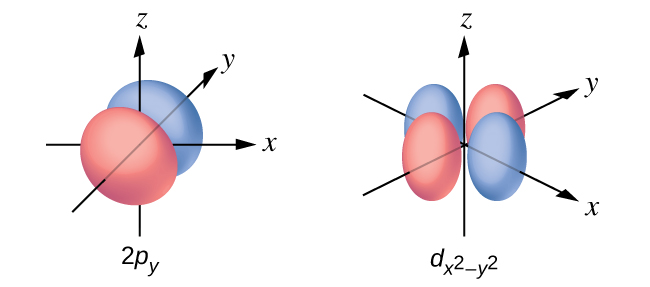
Sketch the boundary surface of a and a py orbital. Be sure to show and label the axes.
軌道とpy軌道の境界面を描きなさい。座標軸を必ず描き、その名称を付けること。
Exercise 40問題 40
Sketch the px and dxz orbitals. Be sure to show and label the coordinates.
px軌道とdxz軌道を描きなさい。座標を必ず示し、名称を付けること。
Exercise 41問題 41
Consider the orbitals shown here in outline.
以下に輪郭を示した軌道について考えなさい。
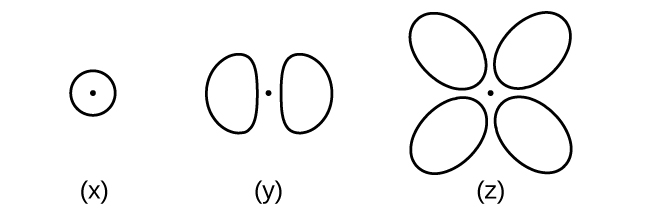


(a) What is the maximum number of electrons contained in an orbital of type (x)? Of type (y)? Of type (z)?
(a) x型の軌道に入る電子の最大数はいくつか。y型、z型についても答えなさい。
(b) How many orbitals of type (x) are found in a shell with n = 2? How many of type (y)? How many of type (z)?
(b) n = 2の電子殻には、x型の軌道が何個あるか。y型、z型についても答えなさい。
(c) Write a set of quantum numbers for an electron in an orbital of type (x) in a shell with n = 4. Of an orbital of type (y) in a shell with n = 2. Of an orbital of type (z) in a shell with n = 3.
(c) n = 4の電子殻のx型軌道にある電子について、量子数の組を1つ書きなさい。n = 2の電子殻のy型軌道、n = 3の電子殻のz型軌道についても答えなさい。
(d) What is the smallest possible n value for an orbital of type (x)? Of type (y)? Of type (z)?
(d) x型の軌道に許されるnの最小値はいくらか。y型、z型についても答えなさい。
(e) What are the possible l and ml values for an orbital of type (x)? Of type (y)? Of type (z)?
(e) x型の軌道に許されるlとmlの値は何か。y型、z型についても答えなさい。
Solution解き方
(a) x. 2, y. 2, z. 2; (b) x. 1, y. 3, z. 0; (c) x. 4 0 0 y. 2 1 0 z. 3 2 0 (d) x. 1, y. 2, z. 3; (e) x. l = 0, ml = 0, y. l = 1, ml = –1, 0, or +1, z. l = 2, ml = –2, –1, 0, +1, +2
(a) x:2、y:2、z:2。(b) x:1、y:3、z:0。(c) x:4、0、0、。y:2、1、0、。z:3、2、0、。(d) x:1、y:2、z:3。(e) x:l = 0、ml = 0。y:l = 1、ml = −1、0、または+1。z:l = 2、ml = −2、−1、0、+1、+2。
Exercise 42問題 42
State the Heisenberg uncertainty principle. Describe briefly what the principle implies.
ハイゼンベルクの不確定性原理を述べなさい。また、その原理が何を意味するかを簡潔に説明しなさい。
Exercise 43問題 43
How many electrons could be held in the second shell of an atom if the spin quantum number ms could have three values instead of just two? (Hint: Consider the Pauli exclusion principle.)
スピン量子数msが2つではなく3つの値をとれるとすると、原子の第2殻には何個の電子を入れられるか。ヒント:パウリの排他原理を考えること。
Solution解き方
12
12
Exercise 44問題 44
Which of the following equations describe particle-like behavior? Which describe wavelike behavior? Do any involve both types of behavior? Describe the reasons for your choices.
次の式のうち、粒子としての振る舞いを記述するものはどれか。波としての振る舞いを記述するものはどれか。両方の振る舞いに関係するものはあるか。選んだ理由を説明しなさい。
(a) c = λν
(a) c = λν
(b)
(b)
(c)
(c)
(d) E = hν
(d) E = hν
(e)
(e)
Exercise 45問題 45
Write a set of quantum numbers for each of the electrons with an n of 4 in a Se atom.
Se原子内のn = 4の電子について、電子ごとに量子数の組を書きなさい。
Solution解き方
n |
l |
ml |
s |
|---|---|---|---|
4 |
0 |
0 |
|
4 |
0 |
0 |
|
4 |
1 |
−1 |
|
4 |
1 |
0 |
|
4 |
1 |
+1 |
|
4 |
1 |
−1 |
secondary (angular momentum) quantum number (l)
副量子数(角運動量量子数)(l)
quantum number distinguishing the different shapes of orbitals; it is also a measure of the orbital angular momentum
軌道の形を区別する量子数。軌道角運動量の尺度でもある。
atomic orbital
原子軌道
mathematical function that describes the behavior of an electron in an atom (also called the wavefunction)
原子内の電子の振る舞いを記述する数学的な関数。波動関数ともいう。
d orbital
d軌道
region of space with high electron density that is either four lobed or contains a dumbbell and torus shape; describes orbitals with l = 2.
電子密度の高い空間領域で、4つの葉状部分をもつか、ダンベル形とドーナツ形を組み合わせた形をもつ。l = 2の軌道を表す。
degenerate orbitals
縮退した軌道
orbitals that have the same energy
同じエネルギーをもつ軌道。
electron density
電子密度
a measure of the probability of locating an electron in a particular region of space, it is equal to the squared absolute value of the wave function ψ
ある空間領域に電子を見いだす確率の尺度で、波動関数ψの絶対値の2乗に等しい。
f orbital
f軌道
multilobed region of space with high electron density, describes orbitals with l = 3
複数の葉状部分をもつ、電子密度の高い空間領域。l = 3の軌道を表す。
Heisenberg uncertainty principle
ハイゼンベルクの不確定性原理
rule stating that it is impossible to exactly determine both certain conjugate dynamical properties such as the momentum and the position of a particle at the same time. The uncertainty principle is a consequence of quantum particles exhibiting wave–particle duality
粒子の運動量と位置など、特定の共役な力学量の両方を、同時に厳密に決めることは不可能だとする原理。不確定性原理は、量子的な粒子が波動と粒子の二重性を示すことから生じる。
magnetic quantum number (ml)
磁気量子数(ml)
quantum number signifying the orientation of an atomic orbital around the nucleus
原子核の周りでの原子軌道の向きを表す量子数。
p orbital
p軌道
dumbbell-shaped region of space with high electron density, describes orbitals with l = 1
ダンベル形をした、電子密度の高い空間領域。l = 1の軌道を表す。
Pauli exclusion principle
パウリの排他原理
specifies that no two electrons in an atom can have the same value for all four quantum numbers
1つの原子内で、4つの量子数がすべて同じ値となる電子は2個存在できないという原理。
principal quantum number (n)
主量子数(n)
quantum number specifying the shell an electron occupies in an atom
原子内で電子が占める電子殻を指定する量子数。
quantum mechanics
量子力学
field of study that includes quantization of energy, wave-particle duality, and the Heisenberg uncertainty principle to describe matter
エネルギーの量子化、波動と粒子の二重性、ハイゼンベルクの不確定性原理を取り入れ、物質を記述する学問分野。
s orbital
s軌道
spherical region of space with high electron density, describes orbitals with l = 0
球形をした、電子密度の高い空間領域。l = 0の軌道を表す。
shell
電子殻
atomic orbitals with the same principal quantum number, n
主量子数nが同じ原子軌道の集まり。
spin quantum number (ms)
スピン量子数(ms)
number specifying the electron spin direction, either or
電子のスピンの向きを指定する数で、またはの値をとる。
subshell
副殻
atomic orbitals with the same values of n and l
nとlの値が同じ原子軌道の集まり。
wavefunction (ψ)
波動関数(ψ)
mathematical description of an atomic orbital that describes the shape of the orbital; it can be used to calculate the probability of finding the electron at any given location in the orbital, as well as dynamical variables such as the energy and the angular momentum
原子軌道の形を記述する数学的な表現。軌道内の任意の位置に電子を見いだす確率や、エネルギー、角運動量などの力学変数を計算できる。