第6章電子構造と元素の周期的性質
Variation in Electron Affinities電子親和力の変化
The electron affinity (EA) is the energy change for the process of adding an electron to a gaseous atom to form an anion (negative ion).
電子親和力EAは、気体原子に電子を1個加えて陰イオンを作る過程のエネルギー変化である。
This process can be either endothermic or exothermic, depending on the element. The EA of some of the elements is given in Figure 6.35. You can see that many of these elements have negative values of EA, which means that energy is released when the gaseous atom accepts an electron. However, for some elements, energy is required for the atom to become negatively charged and the value of their EA is positive. Just as with ionization energy, subsequent EA values are associated with forming ions with more charge. The second EA is the energy associated with adding an electron to an anion to form a –2 ion, and so on.
英語のヒント
この過程は、元素によって吸熱にも発熱にもなる。いくつかの元素のEAを図6.35に示す。多くの元素はEAが負であり、気体原子が電子を受け取るとエネルギーが放出されることを意味する。しかし一部の元素では、原子を負に帯電させるのにエネルギーが必要で、EAは正となる。イオン化エネルギーと同じく、2段階目以降のEAは、より大きな電荷をもつイオンを作ることに関係する。第2電子親和力は、陰イオンにさらに電子を1個加えて−2のイオンを作る際のエネルギーであり、以下も同様である。
As we might predict, it becomes easier to add an electron across a series of atoms as the effective nuclear charge of the atoms increases. We find, as we go from left to right across a period, EAs tend to become more negative. The exceptions found among the elements of group 2 (2A), group 15 (5A), and group 18 (8A) can be understood based on the electronic structure of these groups. The noble gases, group 18 (8A), have a completely filled shell and the incoming electron must be added to a higher n level, which is more difficult to do. Group 2 (2A) has a filled ns subshell, and so the next electron added goes into the higher energy np, so, again, the observed EA value is not as the trend would predict. Finally, group 15 (5A) has a half-filled np subshell and the next electron must be paired with an existing np electron. In all of these cases, the initial relative stability of the electron configuration disrupts the trend in EA.
英語のヒント
予想されるように、原子の有効核電荷が増えるほど電子を加えやすくなる。周期を左から右へ進むと、EAは負の方向に大きくなる傾向がある。2族(2A)、15族(5A)、18族(8A)の例外は、各族の電子構造から理解できる。18族の希ガスは電子殻が完全に埋まっているため、入ってくる電子はより高いnの準位に加わる必要があり、これは難しい。2族はns副殻が埋まっており、次の電子は高エネルギーのnpへ入るので、やはり観測されるEAは一般的な傾向から予想される値と異なる。15族はnp副殻が半分埋まっており、次の電子は、すでに存在するnp電子と対にならなければならない。いずれも、もとの電子配置が比較的安定なため、EAの一般的な傾向が崩れる。
We also might expect the atom at the top of each group to have the most negative EA; their first ionization potentials suggest that these atoms have the largest effective nuclear charges. However, as we move down a group, we see that the second element in the group most often has the most negative EA. This can be attributed to the small size of the n = 2 shell and the resulting large electron–electron repulsions. For example, chlorine, with an EA value of –348 kJ/mol, has the highest value of any element in the periodic table. The EA of fluorine is –322 kJ/mol. When we add an electron to a fluorine atom to form a fluoride anion (F–), we add an electron to the n = 2 shell. The electron is attracted to the nucleus, but there is also significant repulsion from the other electrons already present in this small valence shell. The chlorine atom has the same electron configuration in the valence shell, but because the entering electron is going into the n = 3 shell, it occupies a considerably larger region of space and the electron–electron repulsions are reduced. The entering electron does not experience as much repulsion and the chlorine atom accepts an additional electron more readily, resulting in a more negative EA.
英語のヒント
各族の最上部の原子が、最も負のEAをもつとも予想できる。第1イオン化ポテンシャルから、これらの原子の有効核電荷が最も大きいと考えられるためである。しかし実際に同じ族を下へ見ると、上から2番目の元素が最も負のEAをもつことが多い。これは、n = 2の電子殻が小さく、電子間反発が大きくなるためと考えられる。たとえば塩素のEAは−348 kJ/molで、周期表の元素の中で最大である。フッ素のEAは−322 kJ/molである。フッ素原子に電子を加えてF–にするとき、電子はn = 2の殻に入る。原子核に引かれるが、この小さな価電子殻にすでにいる電子からも、かなり強い反発を受ける。塩素原子の価電子殻の配置は同じだが、入る電子はn = 3の殻に入り、かなり広い空間を占めるため、電子間反発は弱くなる。入る電子が受ける反発が小さいので、塩素は電子をさらに1個受け取りやすく、EAはより負になる。
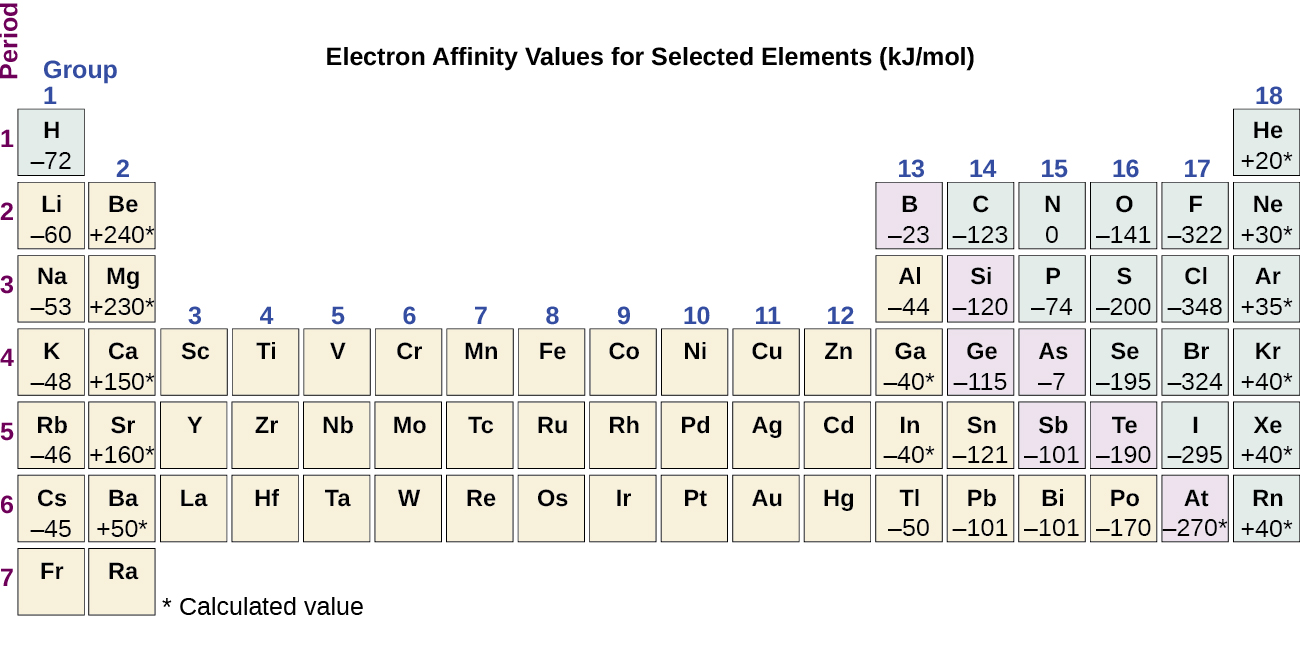

Figure 6.35図 6.35
This version of the periodic table displays the electron affinity values (in kJ/mol) for selected elements.
いくつかの元素の電子親和力を、kJ/molで示した周期表。
The properties discussed in this section (size of atoms and ions, effective nuclear charge, ionization energies, and electron affinities) are central to understanding chemical reactivity. For example, because fluorine has an energetically favorable EA and a large energy barrier to ionization (IE), it is much easier to form fluorine anions than cations. Metallic properties including conductivity and malleability (the ability to be formed into sheets) depend on having electrons that can be removed easily. Thus, metallic character increases as we move down a group and decreases across a period in the same trend observed for atomic size because it is easier to remove an electron that is farther away from the nucleus.
英語のヒント
この節で扱った原子やイオンの大きさ、有効核電荷、イオン化エネルギー、電子親和力は、化学反応性を理解するうえで中心となる。たとえばフッ素は、電子親和力がエネルギー的に有利で、イオン化エネルギーIEという障壁が高いため、陽イオンより陰イオンをはるかに作りやすい。電気伝導性や、薄い板に加工できる性質である展性などの金属的性質は、取り除きやすい電子をもつことに依存する。原子核から遠い電子ほど取り除きやすいため、金属的性質は原子の大きさと同じ傾向を示し、族を下へ進むほど増し、周期を横へ進むほど弱まる。