第6章電子構造と元素の周期的性質
6.2 The Bohr Model6.2 ボーアモデル
Learning Objectives学習目標
By the end of this section, you will be able to:
この節を終えると、次のことができるようになる。
- Describe the Bohr model of the hydrogen atom水素原子のボーア模型を説明する。
- Use the Rydberg equation to calculate energies of light emitted or absorbed by hydrogen atomsリュードベリの式を使い、水素原子が放出または吸収する光のエネルギーを計算する。
Following the work of Ernest Rutherford and his colleagues in the early twentieth century, the picture of atoms consisting of tiny dense nuclei surrounded by lighter and even tinier electrons continually moving about the nucleus was well established. This picture was called the planetary model, since it pictured the atom as a miniature “solar system” with the electrons orbiting the nucleus like planets orbiting the sun. The simplest atom is hydrogen, consisting of a single proton as the nucleus about which a single electron moves. The electrostatic force attracting the electron to the proton depends only on the distance between the two particles. This classical mechanics description of the atom is incomplete, however, since an electron moving in an elliptical orbit would be accelerating (by changing direction) and, according to classical electromagnetism, it should continuously emit electromagnetic radiation. This loss in orbital energy should result in the electron’s orbit getting continually smaller until it spirals into the nucleus, implying that atoms are inherently unstable.
英語のヒント
20世紀初めのアーネスト・ラザフォードと共同研究者たちの研究により、原子について次のような像が確立された。原子は小さく密度の高い原子核からなり、その周囲を、より軽くさらに小さい電子が絶えず動き回っている。この原子像は、電子が原子核の周りを回る様子を、惑星が太陽の周りを回る小型の「太陽系」として描いたため、惑星模型と呼ばれた。最も単純な原子である水素は、原子核となる陽子1個と、その周りを動く電子1個からなる。電子を陽子へ引きつける静電気力は、2つの粒子間の距離だけで決まる。しかし、この古典力学による原子の記述は不完全である。楕円軌道を動く電子は進行方向が変わるため加速されており、古典電磁気学によれば、電磁放射を絶えず放出するはずだからである。軌道運動のエネルギーが失われると、電子の軌道は縮み続け、ついには螺旋を描いて原子核に落ち込むはずである。これでは、原子は本来不安定だということになる。
In 1913, Niels Bohr attempted to resolve the atomic paradox by ignoring classical electromagnetism’s prediction that the orbiting electron in hydrogen would continuously emit light. Instead, he incorporated into the classical mechanics description of the atom Planck’s ideas of quantization and Einstein’s finding that light consists of photons whose energy is proportional to their frequency. Bohr assumed that the electron orbiting the nucleus would not normally emit any radiation (the stationary state hypothesis), but it would emit or absorb a photon if it moved to a different orbit. The energy absorbed or emitted would reflect differences in the orbital energies according to this equation:
英語のヒント
1913年、ニールス・ボーアは、水素内を周回する電子は絶えず光を放つはずだという古典電磁気学の予測を採用せず、原子の矛盾を解決しようとした。その代わり、古典力学による原子の記述に、プランクの量子化の考えと、光は振動数に比例したエネルギーをもつ光子からなるというアインシュタインの発見を取り入れた。ボーアは、原子核を周回する電子は通常は放射をまったく放出しないが(定常状態の仮説)、別の軌道に移るときには光子を放出または吸収すると仮定した。吸収または放出されるエネルギーは、次の式に従って軌道のエネルギー差を反映する。
In this equation, h is Planck’s constant and Ei and Ef are the initial and final orbital energies, respectively. The absolute value of the energy difference is used, since frequencies and wavelengths are always positive. Instead of allowing for continuous values of energy, Bohr assumed the energies of these electron orbitals were quantized:
この式で、hはプランク定数、EiとEfはそれぞれ最初と最後の軌道のエネルギーである。振動数と波長は常に正なので、エネルギー差には絶対値を用いる。ボーアは、エネルギーが連続的な値をとれるとする代わりに、電子の軌道のエネルギーは次のように量子化されていると仮定した。
In this expression, k is a constant comprising fundamental constants such as the electron mass and charge and Planck’s constant. Inserting the expression for the orbit energies into the equation for ΔE gives
英語のヒント
この式で、kは電子の質量や電荷、プランク定数などの基本定数からなる定数である。軌道のエネルギーの式をΔEの式に代入すると、次のようになる。
or
または、
which is identical to the Rydberg equation in which When Bohr calculated his theoretical value for the Rydberg constant, and compared it with the experimentally accepted value, he got excellent agreement. Since the Rydberg constant was one of the most precisely measured constants at that time, this level of agreement was astonishing and meant that Bohr’s model was taken seriously, despite the many assumptions that Bohr needed to derive it.
英語のヒント
これはリュードベリの式と同一であり、である。ボーアがリュードベリ定数の理論値を計算し、実験で認められていた値と比較すると、非常によく一致した。当時、リュードベリ定数は最も精密に測定された定数の1つだったため、この一致の良さは驚くべきものであった。ボーア模型を導くには多くの仮定が必要だったにもかかわらず、この一致により、その模型は真剣に受け止められた。
The lowest few energy levels are shown in Figure 6.14. One of the fundamental laws of physics is that matter is most stable with the lowest possible energy. Thus, the electron in a hydrogen atom usually moves in the n = 1 orbit, the orbit in which it has the lowest energy. When the electron is in this lowest energy orbit, the atom is said to be in its ground electronic state (or simply ground state). If the atom receives energy from an outside source, it is possible for the electron to move to an orbit with a higher n value and the atom is now in an excited electronic state (or simply an excited state) with a higher energy. When an electron transitions from an excited state (higher energy orbit) to a less excited state, or ground state, the difference in energy is emitted as a photon. Similarly, if a photon is absorbed by an atom, the energy of the photon moves an electron from a lower energy orbit up to a more excited one. We can relate the energy of electrons in atoms to what we learned previously about energy. The law of conservation of energy says that we can neither create nor destroy energy. Thus, if a certain amount of external energy is required to excite an electron from one energy level to another, that same amount of energy will be liberated when the electron returns to its initial state (Figure 6.15).
英語のヒント
低い方からいくつかのエネルギー準位を図6.14に示す。物質は可能な限りエネルギーの低い状態で最も安定になる、というのが物理学の基本法則の1つである。そのため、水素原子の電子は通常、エネルギーが最も低いn = 1の軌道を動く。この最低エネルギーの軌道に電子があるとき、原子は電子の基底状態、または単に基底状態にあるという。原子が外部からエネルギーを受け取ると、電子はnの値が大きい軌道へ移ることができる。このとき原子は、エネルギーの高い電子の励起状態、または単に励起状態にある。電子が励起状態の高エネルギー軌道から、より低い励起状態や基底状態へ遷移すると、エネルギーの差が光子として放出される。同様に、原子が光子を吸収すると、そのエネルギーによって電子は低エネルギー軌道から、より高い励起軌道へ移る。原子内の電子のエネルギーは、これまでに学んだエネルギーの知識と結びつけられる。エネルギー保存則によれば、エネルギーを作り出すことも消滅させることもできない。したがって、あるエネルギー準位から別の準位へ電子を励起するのに一定量の外部エネルギーが必要なら、電子がもとの状態に戻るときには、同じ量のエネルギーが放出される(図6.15)。
Since Bohr’s model involved only a single electron, it could also be applied to the single electron ions He+, Li2+, Be3+, and so forth, which differ from hydrogen only in their nuclear charges, and so one-electron atoms and ions are collectively referred to as hydrogen-like atoms. The energy expression for hydrogen-like atoms is a generalization of the hydrogen atom energy, in which Z is the nuclear charge (+1 for hydrogen, +2 for He, +3 for Li, and so on) and k has a value of 2.179 10–18 J.
英語のヒント
ボーア模型が扱うのは電子1個だけなので、He+、Li2+、Be3+など、電子が1個のイオンにも適用できる。これらが水素と異なるのは核電荷だけである。このため、電子1個をもつ原子やイオンをまとめて水素様原子と呼ぶ。水素様原子のエネルギーの式は、水素原子のエネルギーの一般化である。Zは核電荷で、水素では+1、Heでは+2、Liでは+3などとなる。kの値は2.179 10–18 Jである。
The sizes of the circular orbits for hydrogen-like atoms are given in terms of their radii by the following expression, in which is a constant called the Bohr radius, with a value of 5.292 10−11 m:
水素様原子の円軌道の大きさは、半径を用いて次の式で与えられる。ここではボーア半径と呼ばれる定数で、値は5.292 10−11 mである。
The equation also shows us that as the electron’s energy increases (as n increases), the electron is found at greater distances from the nucleus. This is implied by the inverse dependence of electrostatic attraction on distance, since, as the electron moves away from the nucleus, the electrostatic attraction between it and the nucleus decreases and it is held less tightly in the atom. Note that as n gets larger and the orbits get larger, their energies get closer to zero, and so the limits and imply that E = 0 corresponds to the ionization limit where the electron is completely removed from the nucleus. Thus, for hydrogen in the ground state n = 1, the ionization energy would be:
英語のヒント
この式から、電子のエネルギーが増加する、つまりnが増加するほど、電子は原子核から遠い位置にあることもわかる。これは、静電引力が距離に対して逆向きに依存することから理解できる。電子が原子核から遠ざかるほど両者の静電引力は弱くなり、電子は原子内に弱く束縛されるようになる。nが大きくなって軌道が広がるほど、そのエネルギーは0に近づく。したがって、との極限は、E = 0が、電子を原子核から完全に引き離したイオン化限界に対応することを意味する。よって、基底状態n = 1にある水素のイオン化エネルギーは次のようになる。
With three extremely puzzling paradoxes now solved (blackbody radiation, the photoelectric effect, and the hydrogen atom), and all involving Planck’s constant in a fundamental manner, it became clear to most physicists at that time that the classical theories that worked so well in the macroscopic world were fundamentally flawed and could not be extended down into the microscopic domain of atoms and molecules. Unfortunately, despite Bohr’s remarkable achievement in deriving a theoretical expression for the Rydberg constant, he was unable to extend his theory to the next simplest atom, He, which only has two electrons. Bohr’s model was severely flawed, since it was still based on the classical mechanics notion of precise orbits, a concept that was later found to be untenable in the microscopic domain, when a proper model of quantum mechanics was developed to supersede classical mechanics.
英語のヒント
黒体放射、光電効果、水素原子という、極めて不可解だった3つの矛盾が解決され、そのすべてにプランク定数が本質的に関わっていた。このことから当時の大多数の物理学者にとって、巨視的な世界ではうまく働く古典理論には根本的な欠陥があり、原子や分子という微視的な領域にまで拡張できないことが明らかになった。残念ながら、ボーアはリュードベリ定数の理論式を導くという目覚ましい成果を上げながら、その理論を、水素の次に単純な原子であり電子が2個しかないHeへ拡張することはできなかった。ボーア模型には重大な欠陥があった。依然として、古典力学における明確な軌道という概念に基づいていたからである。この概念は後に、古典力学に代わる適切な量子力学の模型が発展した際、微視的な領域では成り立たないとわかった。
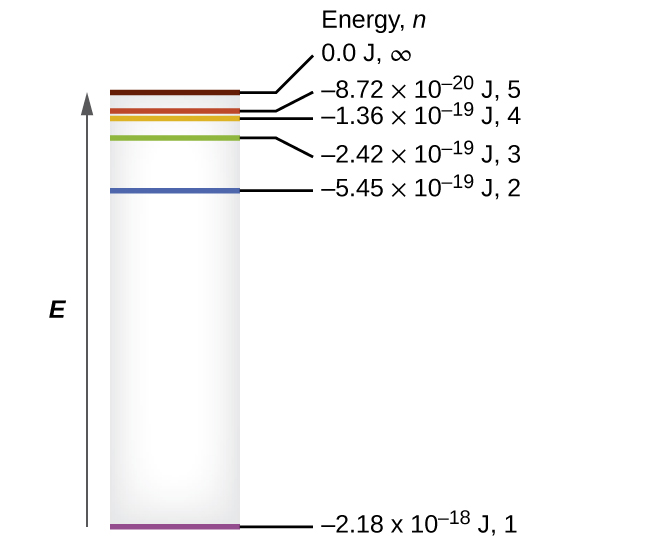
Figure 6.14図 6.14
Quantum numbers and energy levels in a hydrogen atom. The more negative the calculated value, the lower the energy.
水素原子の量子数とエネルギー準位。計算値が負の方向に大きいほど、エネルギーは低い。
Example 6.4例題 6.4
Calculating the Energy of an Electron in a Bohr Orbitボーア軌道の電子のエネルギーを計算する
Early researchers were very excited when they were able to predict the energy of an electron at a particular distance from the nucleus in a hydrogen atom. If a spark promotes the electron in a hydrogen atom into an orbit with n = 3, what is the calculated energy, in joules, of the electron?
英語のヒント
初期の研究者たちは、水素原子の原子核から特定の距離にある電子のエネルギーを予測できたことに、大いに興奮した。火花によって水素原子の電子がn = 3の軌道に励起されたとき、その電子のエネルギーは何ジュールと計算されるか。
Solution解法
The energy of the electron is given by this equation:
電子のエネルギーは次の式で与えられる。
The atomic number, Z, of hydrogen is 1; k = 2.179 10–18 J; and the electron is characterized by an n value of 3. Thus,
水素の原子番号Zは1、k = 2.179 10–18 Jであり、電子のnの値は3である。したがって、
Check Your Learning理解を確かめよう
The electron in Figure 6.15 is promoted even further to an orbit with n = 6. What is its new energy?
図6.15の電子を、さらにn = 6の軌道へ励起する。新たなエネルギーはいくらか。
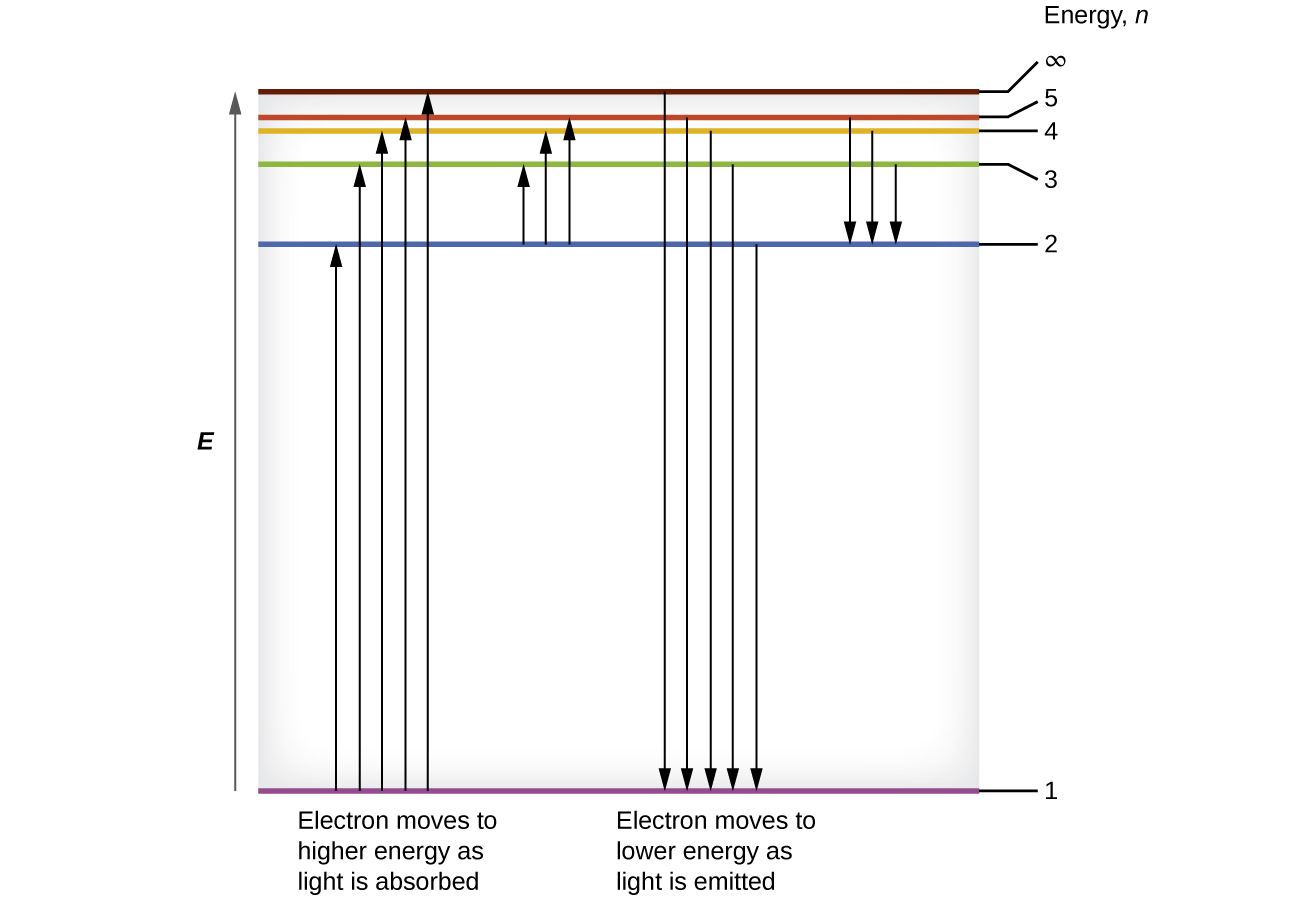


Figure 6.15図 6.15
The horizontal lines show the relative energy of orbits in the Bohr model of the hydrogen atom, and the vertical arrows depict the energy of photons absorbed (left) or emitted (right) as electrons move between these orbits.
水平線は、水素原子のボーア模型における各軌道の相対的なエネルギーを示す。縦の矢印は、電子がこれらの軌道間を移るときに吸収される光子(左)と放出される光子(右)のエネルギーを表す。
Example 6.5例題 6.5
Calculating the Energy and Wavelength of Electron Transitions in a One–electron (Bohr) System一電子系(ボーア系)の電子遷移に伴うエネルギーと波長を計算する
What is the energy (in joules) and the wavelength (in meters) of the line in the spectrum of hydrogen that represents the movement of an electron from Bohr orbit with n = 4 to the orbit with n = 6? In what part of the electromagnetic spectrum do we find this radiation?
水素のスペクトルで、電子がn = 4のボーア軌道からn = 6の軌道へ移ることに対応する線のエネルギーは何ジュール、波長は何メートルか。この放射は電磁スペクトルのどの領域にあるか。
Solution解法
In this case, the electron starts out with n = 4, so n1 = 4. It comes to rest in the n = 6 orbit, so n2 = 6. The difference in energy between the two states is given by this expression:
英語のヒント
この場合、電子はn = 4から出発するのでn1 = 4である。最終的にはn = 6の軌道に落ち着くのでn2 = 6となる。2つの状態のエネルギー差は次の式で与えられる。
This energy difference is positive, indicating a photon enters the system (is absorbed) to excite the electron from the n = 4 orbit up to the n = 6 orbit. The wavelength of a photon with this energy is found by the expression Rearrangement gives:
このエネルギー差は正であり、光子が系に入る、つまり吸収されて、電子をn = 4の軌道からn = 6の軌道へ励起することを示している。このエネルギーの光子の波長は、式から求められる。式を変形すると、
From the illustration of the electromagnetic spectrum in Electromagnetic Energy, we can see that this wavelength is found in the infrared portion of the electromagnetic spectrum.
「電磁エネルギー」にある電磁スペクトルの図から、この波長は電磁スペクトルの赤外領域にあるとわかる。
Check Your Learning理解を確かめよう
What is the energy in joules and the wavelength in meters of the photon produced when an electron falls from the n = 5 to the n = 3 level in a He+ ion (Z = 2 for He+)?
He+イオン内の電子がn = 5からn = 3の準位へ移るときに生じる光子のエネルギーは何ジュール、波長は何メートルか(He+ではZ = 2)。
Bohr’s model of the hydrogen atom provides insight into the behavior of matter at the microscopic level, but it does not account for electron–electron interactions in atoms with more than one electron. It does introduce several important features of all models used to describe the distribution of electrons in an atom. These features include the following:
英語のヒント
ボーアの水素原子模型は、微視的な物質の振る舞いを理解する手がかりを与えるが、電子が2個以上ある原子内の電子間相互作用は説明できない。それでも、原子内の電子の分布を記述するすべての模型に共通する、いくつかの重要な特徴を導入している。その特徴には次のものがある。
- The energies of electrons (energy levels) in an atom are quantized, described by quantum numbers: integer numbers having only specific allowed value and used to characterize the arrangement of electrons in an atom.原子内の電子のエネルギー(エネルギー準位)は量子化されており、量子数で記述される。量子数は、許された特定の値だけをとる整数で、原子内の電子の配置を特徴づけるために用いられる。
- An electron’s energy increases with increasing distance from the nucleus.電子のエネルギーは、原子核からの距離が増すほど増加する。
- The discrete energies (lines) in the spectra of the elements result from quantized electronic energies.元素のスペクトルに現れる離散的なエネルギー(線)は、量子化された電子のエネルギーから生じる。
Of these features, the most important is the postulate of quantized energy levels for an electron in an atom. As a consequence, the model laid the foundation for the quantum mechanical model of the atom. Bohr won a Nobel Prize in Physics for his contributions to our understanding of the structure of atoms and how that is related to line spectra emissions.
英語のヒント
これらの特徴のうち最も重要なのは、原子内の電子のエネルギー準位が量子化されているという仮定である。その結果、この模型は原子の量子力学的模型の基礎を築いた。ボーアは、原子の構造と、それが線スペクトルの放出とどう関係するかの理解に貢献し、ノーベル物理学賞を受賞した。