第6章電子構造と元素の周期的性質
The Aufbau Principle構成原理
To determine the electron configuration for any particular atom, we can “build” the structures in the order of atomic numbers. Beginning with hydrogen, and continuing across the periods of the periodic table, we add one proton at a time to the nucleus and one electron to the proper subshell until we have described the electron configurations of all the elements. This procedure is called the Aufbau principle, from the German word Aufbau (“to build up”). Each added electron occupies the subshell of lowest energy available (in the order shown in Figure 6.24), subject to the limitations imposed by the allowed quantum numbers according to the Pauli exclusion principle. Electrons enter higher-energy subshells only after lower-energy subshells have been filled to capacity. Figure 6.26 illustrates the traditional way to remember the filling order for atomic orbitals. Since the arrangement of the periodic table is based on the electron configurations, Figure 6.27 provides an alternative method for determining the electron configuration. The filling order simply begins at hydrogen and includes each subshell as you proceed in increasing Z order. For example, after filling the 3p block up to Ar, we see the orbital will be 4s (K, Ca), followed by the 3d orbitals.
英語のヒント
ある原子の電子配置を求めるには、原子番号の順に構造を「組み立てる」とよい。水素から始めて周期表の周期を横に進み、原子核に陽子を1個、適切な副殻に電子を1個ずつ加えていく。これをすべての元素の電子配置を記述するまで続ける。この手順を、ドイツ語のAufbau(組み立てる)に由来する構成原理という。追加される電子はそれぞれ、空きのある最も低エネルギーの副殻を、図6.24の順に占める。ただし、パウリの排他原理に従い、許される量子数が課す制約を受ける。高エネルギーの副殻に電子が入るのは、低エネルギーの副殻が満杯になった後だけである。図6.26は、原子軌道に電子が入る順序を覚える伝統的な方法を示している。周期表の配列は電子配置に基づくため、図6.27からも別の方法で電子配置を求められる。水素から始め、Zが増す順に進みながら各副殻をたどればよい。たとえば3pブロックをArまで埋めた後には、4s(K、Ca)、次いで3d軌道が現れる。
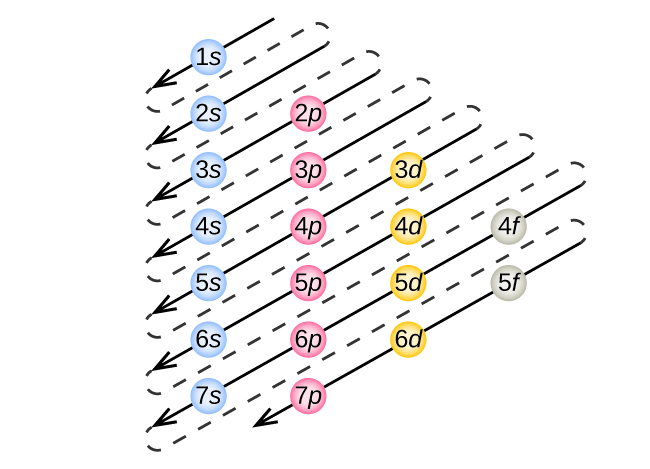
Figure 6.26図 6.26
This diagram depicts the energy order for atomic orbitals and is useful for deriving ground-state electron configurations.
原子軌道のエネルギー順序を示す図。基底状態の電子配置を導くのに役立つ。
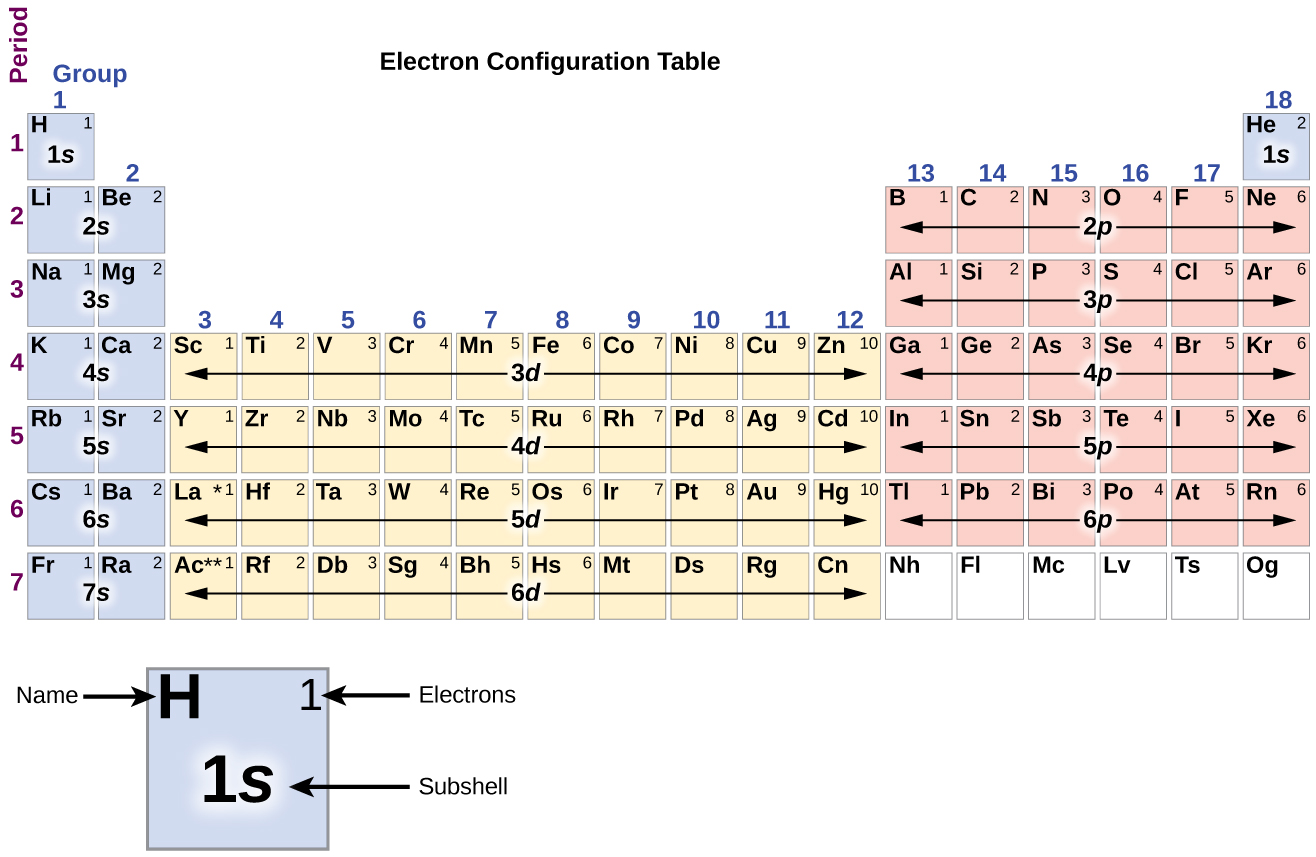
Figure 6.27図 6.27
This partial periodic table shows electron configurations for the valence subshells of atoms. By “building up” from hydrogen, this table can be used to determine the electron configuration for atoms of most elements in the periodic table. (Electron configurations of the lanthanides and actinides are not accurately predicted by this simple approach. See Figure 6.29.)
この部分的な周期表は、原子の価電子が入る副殻の電子配置を示す。水素から「組み立てる」ことで、周期表の大部分の元素の電子配置を求められる。ランタノイドとアクチノイドの電子配置は、この単純な方法では正確に予測できない。図6.29を参照。
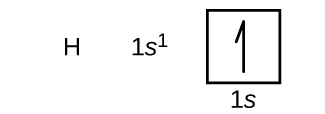
We will now construct the ground-state electron configuration and orbital diagram for a selection of atoms in the first and second periods of the periodic table. Orbital diagrams are pictorial representations of the electron configuration, showing the individual orbitals and the pairing arrangement of electrons. We start with a single hydrogen atom (atomic number 1), which consists of one proton and one electron. Referring to Figure 6.26 or Figure 6.27, we would expect to find the electron in the 1s orbital. By convention, the value is usually filled first. The electron configuration and the orbital diagram are:
英語のヒント
Following hydrogen is the noble gas helium, which has an atomic number of 2. The helium atom contains two protons and two electrons. The first electron has the same four quantum numbers as the hydrogen atom electron (n = 1, l = 0, ml = 0, ). The second electron also goes into the 1s orbital and fills that orbital. The second electron has the same n, l, and ml quantum numbers, but must have the opposite spin quantum number, This is in accord with the Pauli exclusion principle: No two electrons in the same atom can have the same set of four quantum numbers. For orbital diagrams, this means two arrows go in each box (representing two electrons in each orbital) and the arrows must point in opposite directions (representing paired spins). The electron configuration and orbital diagram of helium are:
英語のヒント
水素に続くのは、原子番号2の希ガス、ヘリウムである。ヘリウム原子は陽子2個と電子2個を含む。最初の電子の4つの量子数は、水素原子の電子と同じn = 1、l = 0、ml = 0、である。2個目の電子も1s軌道に入り、これで軌道が埋まる。2個目の電子のn、l、mlは同じだが、スピン量子数は逆のでなければならない。これは、同じ原子内の2つの電子が同じ4つの量子数の組をもつことはできないという、パウリの排他原理に一致する。軌道図では、各箱に2本の矢印を入れて各軌道の2個の電子を示し、その向きを逆にして対をなすスピンを表す。ヘリウムの電子配置と軌道図は次のとおりである。
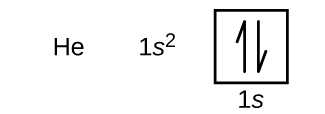
The n = 1 shell is completely filled in a helium atom.
ヘリウム原子では、n = 1の電子殻が完全に埋まっている。
The next atom is the alkali metal lithium with an atomic number of 3. The first two electrons in lithium fill the 1s orbital and have the same sets of four quantum numbers as the two electrons in helium. The remaining electron must occupy the orbital of next lowest energy, the 2s orbital (Figure 6.26 or Figure 6.27). Thus, the electron configuration and orbital diagram of lithium are:

An atom of the alkaline earth metal beryllium, with an atomic number of 4, contains four protons in the nucleus and four electrons surrounding the nucleus. The fourth electron fills the remaining space in the 2s orbital.
原子番号4のアルカリ土類金属、ベリリウムの原子は、原子核内に陽子4個、その周囲に電子4個をもつ。4個目の電子が、2s軌道に残る空きを埋める。

An atom of boron (atomic number 5) contains five electrons. The n = 1 shell is filled with two electrons and three electrons will occupy the n = 2 shell. Because any s subshell can contain only two electrons, the fifth electron must occupy the next energy level, which will be a 2p orbital. There are three degenerate 2p orbitals (ml = −1, 0, +1) and the electron can occupy any one of these p orbitals. When drawing orbital diagrams, we include empty boxes to depict any empty orbitals in the same subshell that we are filling.
ホウ素原子(原子番号5)は5個の電子をもつ。n = 1の電子殻は2個で埋まり、残る3個はn = 2の電子殻に入る。s副殻には2個しか電子が入れないため、5個目は次のエネルギー準位である2p軌道に入る。縮退した2p軌道は3個(ml = −1、0、+1)あり、電子はそのどれに入ってもよい。軌道図を描くときは、埋めている副殻に空の軌道があれば、それも空の箱として描く。

Carbon (atomic number 6) has six electrons. Four of them fill the 1s and 2s orbitals. The remaining two electrons occupy the 2p subshell. We now have a choice of filling one of the 2p orbitals and pairing the electrons or of leaving the electrons unpaired in two different, but degenerate, p orbitals. The orbitals are filled as described by Hund’s rule: the lowest-energy configuration for an atom with electrons within a set of degenerate orbitals is that having the maximum number of unpaired electrons. Thus, the two electrons in the carbon 2p orbitals have identical n, l, and ms quantum numbers and differ in their ml quantum number (in accord with the Pauli exclusion principle). The electron configuration and orbital diagram for carbon are:
英語のヒント
炭素(原子番号6)は6個の電子をもつ。そのうち4個が1sと2s軌道を埋め、残る2個が2p副殻に入る。ここで、2p軌道の1つを埋めて電子を対にするか、縮退した異なる2つのp軌道に不対電子として入れるか、という選択が生じる。軌道はフントの規則に従って埋まる。すなわち、縮退した軌道の組に電子をもつ原子の最低エネルギー配置は、不対電子の数が最大となる配置である。したがって、炭素の2p軌道にある2個の電子はn、l、msが等しく、mlが異なる。これはパウリの排他原理に一致する。炭素の電子配置と軌道図は次のようになる。

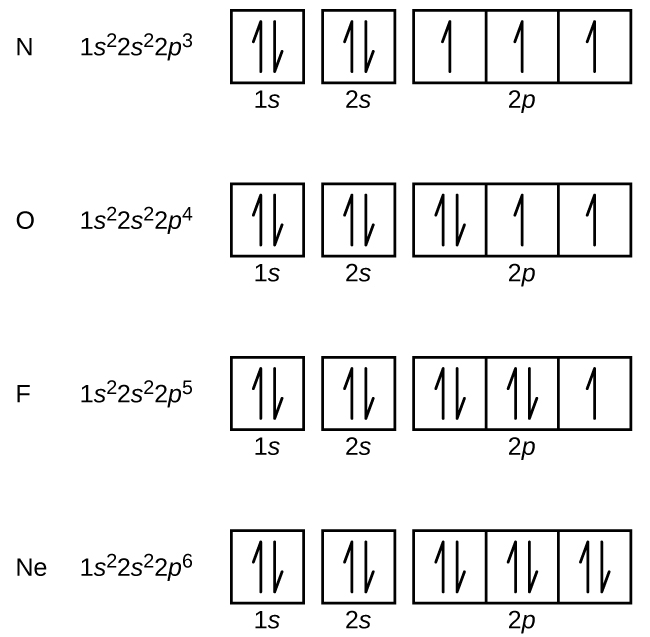
Nitrogen (atomic number 7) fills the 1s and 2s subshells and has one electron in each of the three 2p orbitals, in accordance with Hund’s rule. These three electrons have unpaired spins. Oxygen (atomic number 8) has a pair of electrons in any one of the 2p orbitals (the electrons have opposite spins) and a single electron in each of the other two. Fluorine (atomic number 9) has only one 2p orbital containing an unpaired electron. All of the electrons in the noble gas neon (atomic number 10) are paired, and all of the orbitals in the n = 1 and the n = 2 shells are filled. The electron configurations and orbital diagrams of these four elements are:
窒素(原子番号7)では1sと2s副殻が埋まり、フントの規則に従って3個の2p軌道に電子が1個ずつ入る。これら3個の電子のスピンは対になっていない。酸素(原子番号8)では、2p軌道の1つに逆向きのスピンをもつ電子の対が入り、ほかの2つには電子が1個ずつ入る。フッ素(原子番号9)では、不対電子を含む2p軌道は1つだけとなる。希ガスのネオン(原子番号10)ではすべての電子が対になり、n = 1とn = 2の電子殻の全軌道が埋まる。これら4元素の電子配置と軌道図は次のとおりである。
The alkali metal sodium (atomic number 11) has one more electron than the neon atom. This electron must go into the lowest-energy subshell available, the 3s orbital, giving a 1s22s22p63s1 configuration. The electrons occupying the outermost shell orbital(s) (highest value of n) are called valence electrons, and those occupying the inner shell orbitals are called core electrons (Figure 6.28). Since the core electron shells correspond to noble gas electron configurations, we can abbreviate electron configurations by writing the noble gas that matches the core electron configuration, along with the valence electrons in a condensed format. For our sodium example, the symbol [Ne] represents core electrons, (1s22s22p6) and our abbreviated or condensed configuration is [Ne]3s1.
英語のヒント
アルカリ金属のナトリウム(原子番号11)は、ネオンより電子が1個多い。この電子は、空いている中で最も低エネルギーの3s軌道に入り、電子配置は1s22s22p63s1となる。nが最大となる最外殻の軌道を占める電子を価電子、内側の電子殻の軌道を占める電子を内殻電子という(図6.28)。内殻の電子配置は希ガスの電子配置に対応するため、それに一致する希ガスの記号と価電子を書けば、電子配置を短く表せる。ナトリウムの例では、[Ne]が内殻電子1s22s22p6を表し、省略表記は[Ne]3s1となる。

Figure 6.28図 6.28
A core-abbreviated electron configuration (right) replaces the core electrons with the noble gas symbol whose configuration matches the core electron configuration of the other element.
内殻を省略した電子配置(右)では、内殻電子を、その電子配置が一致する希ガスの記号に置き換える。
Similarly, the abbreviated configuration of lithium can be represented as [He]2s1, where [He] represents the configuration of the helium atom, which is identical to that of the filled inner shell of lithium. Writing the configurations in this way emphasizes the similarity of the configurations of lithium and sodium. Both atoms, which are in the alkali metal family, have only one electron in a valence s subshell outside a filled set of inner shells.
同様に、リチウムの省略した電子配置は[He]2s1と表せる。[He]はヘリウム原子の電子配置を表し、これはリチウムの埋まった内殻の配置と同じである。この書き方は、リチウムとナトリウムの電子配置の類似性を強調する。どちらもアルカリ金属族に属し、埋まった内殻の外側のs副殻に、価電子を1個だけもつ。
The alkaline earth metal magnesium (atomic number 12), with its 12 electrons in a [Ne]3s2 configuration, is analogous to its family member beryllium, [He]2s2. Both atoms have a filled s subshell outside their filled inner shells. Aluminum (atomic number 13), with 13 electrons and the electron configuration [Ne]3s23p1, is analogous to its family member boron, [He]2s22p1.
英語のヒント
アルカリ土類金属のマグネシウム(原子番号12)は、12個の電子が[Ne]3s2という配置をとり、同族のベリリウム[He]2s2と類似している。どちらも、埋まった内殻の外側に、完全に埋まったs副殻をもつ。13個の電子をもち、[Ne]3s23p1という電子配置をとるアルミニウム(原子番号13)も、同族のホウ素[He]2s22p1と類似している。
The electron configurations of silicon (14 electrons), phosphorus (15 electrons), sulfur (16 electrons), chlorine (17 electrons), and argon (18 electrons) are analogous in the electron configurations of their outer shells to their corresponding family members carbon, nitrogen, oxygen, fluorine, and neon, respectively, except that the principal quantum number of the outer shell of the heavier elements has increased by one to n = 3. Figure 6.29 shows the lowest energy, or ground-state, electron configuration for these elements as well as that for atoms of each of the known elements.
ケイ素(電子14個)、リン(15個)、硫黄(16個)、塩素(17個)、アルゴン(18個)の最外殻の電子配置は、それぞれ同族の炭素、窒素、酸素、フッ素、ネオンと類似している。違いは、重い方の元素では最外殻の主量子数が1つ増え、n = 3となる点だけである。図6.29は、これらの元素と、既知の各元素の原子について、最低エネルギー、すなわち基底状態の電子配置を示している。
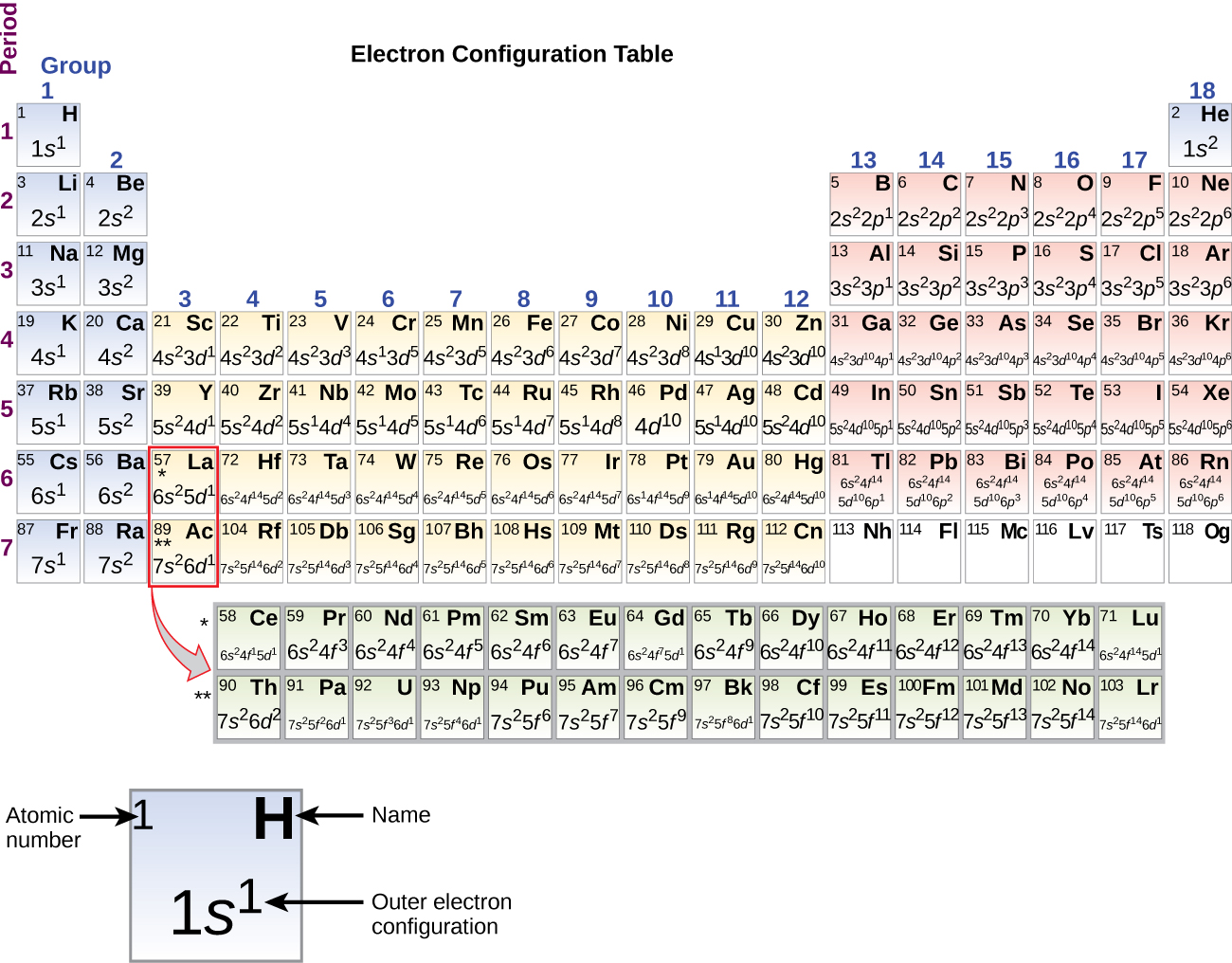
Figure 6.29図 6.29
This version of the periodic table shows the outer-shell electron configuration of each element. Note that down each group, the configuration is often similar.
各元素の最外殻の電子配置を示した周期表。同じ族を下へたどると、電子配置は多くの場合、互いに似ている。
When we come to the next element in the periodic table, the alkali metal potassium (atomic number 19), we might expect that we would begin to add electrons to the 3d subshell. However, all available chemical and physical evidence indicates that potassium is like lithium and sodium, and that the next electron is not added to the 3d level but is, instead, added to the 4s level (Figure 6.29). As discussed previously, the 3d orbital with no radial nodes is higher in energy because it is less penetrating and more shielded from the nucleus than the 4s, which has three radial nodes. Thus, potassium has an electron configuration of [Ar]4s1. Hence, potassium corresponds to Li and Na in its valence shell configuration. The next electron is added to complete the 4s subshell and calcium has an electron configuration of [Ar]4s2. This gives calcium an outer-shell electron configuration corresponding to that of beryllium and magnesium.
周期表の次の元素、アルカリ金属のカリウム(原子番号19)では、3d副殻に電子を入れ始めると思うかもしれない。しかし、得られている化学的・物理的証拠はすべて、カリウムはリチウムやナトリウムに似ており、次の電子は3dではなく4s準位に入ることを示す(図6.29)。すでに述べたように、動径方向の節がない3d軌道は、節が3個ある4sより浸透性が低く、原子核から強く遮蔽されるため、エネルギーが高い。したがって、カリウムの電子配置は[Ar]4s1となり、価電子殻の配置はLiやNaに対応する。次の電子が4s副殻を埋めると、カルシウムの電子配置[Ar]4s2となる。その最外殻の電子配置は、ベリリウムやマグネシウムに対応する。
Beginning with the transition metal scandium (atomic number 21), additional electrons are added successively to the 3d subshell. This subshell is filled to its capacity with 10 electrons (remember that for l = 2 [d orbitals], there are 2l + 1 = 5 values of ml, meaning that there are five d orbitals that have a combined capacity of 10 electrons). The 4p subshell fills next. Note that for three series of elements, scandium (Sc) through copper (Cu), yttrium (Y) through silver (Ag), and lanthanum (La) through gold (Au), a total of 10 d electrons are successively added to the (n – 1) shell next to the n shell to bring that (n – 1) shell from 8 to 18 electrons. For two series, lanthanum (La) through lutetium (Lu) and actinium (Ac) through lawrencium (Lr), 14 f electrons (l = 3, 2l + 1 = 7 ml values; thus, seven orbitals with a combined capacity of 14 electrons) are successively added to the (n – 2) shell to bring that shell from 18 electrons to a total of 32 electrons.
英語のヒント
遷移金属のスカンジウム(原子番号21)からは、追加の電子が3d副殻へ順次入る。この副殻は10個で満杯になる。l = 2のd軌道ではmlが2l + 1 = 5個の値をとり、5つのd軌道に合計10個の電子を入れられることを思い出そう。次に4p副殻が埋まる。スカンジウム(Sc)から銅(Cu)、イットリウム(Y)から銀(Ag)、ランタン(La)から金(Au)という3つの元素系列では、n殻のすぐ内側のn − 1殻に、d電子が合計10個順次加わり、その殻の電子数は8個から18個になる。ランタン(La)からルテチウム(Lu)、アクチニウム(Ac)からローレンシウム(Lr)という2つの系列では、n − 2殻にf電子が14個順次加わり、電子数は18個から32個になる。l = 3ではmlの値が2l + 1 = 7個あり、7つの軌道に合計14個の電子を入れられる。
Example 6.10例題 6.10
Quantum Numbers and Electron Configurations量子数と電子配置
What is the electron configuration and orbital diagram for a phosphorus atom? What are the four quantum numbers for the last electron added?
リン原子の電子配置と軌道図を示しなさい。最後に加わる電子の4つの量子数は何か。
Solution解法
The atomic number of phosphorus is 15. Thus, a phosphorus atom contains 15 electrons. The order of filling of the energy levels is 1s, 2s, 2p, 3s, 3p, 4s, . . . The 15 electrons of the phosphorus atom will fill up to the 3p orbital, which will contain three electrons:
リンの原子番号は15なので、リン原子には電子が15個ある。エネルギー準位を埋める順序は1s、2s、2p、3s、3p、4s、…である。15個の電子は3p軌道まで入り、3pには3個の電子が入る。



The last electron added is a 3p electron. Therefore, n = 3 and, for a p-type orbital, l = 1. The ml value could be –1, 0, or +1. The three p orbitals are degenerate, so any of these ml values is correct. For unpaired electrons, convention assigns the value of for the spin quantum number; thus,
最後に加わるのは3p電子なのでn = 3であり、p型軌道だからl = 1である。mlの値は−1、0、+1のどれでもよい。3個のp軌道は縮退しているので、mlはどの値でも正しい。不対電子のスピン量子数には、慣例としてを割り当てる。したがって、である。
Check Your Learning理解を確かめよう
Identify the atoms from the electron configurations given:
次の電子配置から、原子を特定しなさい。
(a) [Ar]4s23d5
(a) [Ar]4s23d5
(b) [Kr]5s24d105p6
(b) [Kr]5s24d105p6
The periodic table can be a powerful tool in predicting the electron configuration of an element. However, we do find exceptions to the order of filling of orbitals that are shown in Figure 6.26 or Figure 6.27. For instance, the electron configurations (shown in Figure 6.29) of the transition metals chromium (Cr; atomic number 24) and copper (Cu; atomic number 29), among others, are not those we would expect. In general, such exceptions involve subshells with very similar energy, and small effects can lead to changes in the order of filling.
In the case of Cr and Cu, we find that half-filled and completely filled subshells apparently represent conditions of preferred stability. This stability is such that an electron shifts from the 4s into the 3d orbital to gain the extra stability of a half-filled 3d subshell (in Cr) or a filled 3d subshell (in Cu). Other exceptions also occur. For example, niobium (Nb, atomic number 41) is predicted to have the electron configuration [Kr]5s24d3. Experimentally, we observe that its ground-state electron configuration is actually [Kr]5s14d4. We can rationalize this observation by saying that the electron–electron repulsions experienced by pairing the electrons in the 5s orbital are larger than the gap in energy between the 5s and 4d orbitals. There is no simple method to predict the exceptions for atoms where the magnitude of the repulsions between electrons is greater than the small differences in energy between subshells.
英語のヒント
CrとCuでは、半分だけ埋まった副殻や完全に埋まった副殻が、より安定な状態を表すように見える。この安定化のため、電子1個が4sから3dへ移り、Crでは半分埋まった3d副殻、Cuでは完全に埋まった3d副殻による安定性を得る。ほかの例外もある。たとえば、ニオブ(Nb、原子番号41)の電子配置は[Kr]5s24d3と予測されるが、実験で観測される基底状態は[Kr]5s14d4である。これは、5s軌道内で電子を対にするときの電子間反発が、5sと4dのエネルギー差より大きい、と考えれば説明できる。副殻間の小さなエネルギー差より電子間反発が大きくなる原子について、例外を予測する単純な方法はない。