第6章電子構造と元素の周期的性質
The Photoelectric Effect光電効果
The next paradox in the classical theory to be resolved concerned the photoelectric effect (Figure 6.11). It had been observed that electrons could be ejected from the clean surface of a metal when light having a frequency greater than some threshold frequency was shone on it. Surprisingly, the kinetic energy of the ejected electrons did not depend on the brightness of the light, but increased with increasing frequency of the light. Since the electrons in the metal had a certain amount of binding energy keeping them there, the incident light needed to have more energy to free the electrons. According to classical wave theory, a wave's energy depends on its intensity (which depends on its amplitude), not its frequency. One part of these observations was that the number of electrons ejected within in a given time period was seen to increase as the brightness increased. In 1905, Albert Einstein was able to resolve the paradox by incorporating Planck's quantization findings into the discredited particle view of light (Einstein actually won his Nobel prize for this work, and not for his theories of relativity for which he is most famous).
英語のヒント
古典理論における次の矛盾は、光電効果に関するものであった(図6.11)。あるしきい値の振動数より高い振動数の光を金属の清浄な表面に当てると、電子が放出されることが観測されていた。驚くことに、放出された電子の運動エネルギーは光の明るさによらず、光の振動数が高くなるほど増加した。金属中の電子は、ある大きさの結合エネルギーによって金属内にとどめられているため、電子を自由にするには、入射光がそれより大きなエネルギーをもつ必要があった。古典的な波動理論によると、波のエネルギーは振動数ではなく、振幅によって決まる強度に依存する。観測では、一定の時間内に放出される電子の数が、明るさとともに増加することもわかっていた。1905年、アルベルト・アインシュタインは、プランクの量子化に関する発見を、すでに支持を失っていた光の粒子説に取り入れることで、この矛盾を解決した。実際、アインシュタインがノーベル賞を受賞したのはこの研究によってであり、彼の名が最もよく知られる理由である相対性理論によってではなかった。
Einstein argued that the quantized energies that Planck had postulated in his treatment of blackbody radiation could be applied to the light in the photoelectric effect so that the light striking the metal surface should not be viewed as a wave, but instead as a stream of particles (later called photons) whose energy depended on their frequency, according to Planck's formula, E = hν (or, in terms of wavelength using c = νλ, ). Electrons were ejected when hit by photons having sufficient energy (a frequency greater than the threshold). The greater the frequency, the greater the kinetic energy imparted to the escaping electrons by the collisions. Einstein also argued that the light intensity did not depend on the amplitude of the incoming wave, but instead corresponded to the number of photons striking the surface within a given time period. This explains why the number of ejected electrons increased with increasing brightness, since the greater the number of incoming photons, the greater the likelihood that they would collide with some of the electrons.
英語のヒント
アインシュタインは、プランクが黒体放射の扱いで仮定した量子化エネルギーを、光電効果の光にも適用できると考えた。したがって、金属表面に当たる光は波としてではなく、粒子の流れとして捉えるべきであり、その粒子(後に光子と呼ばれる)のエネルギーは、プランクの式E = hνに従って振動数で決まる。c = νλを使って波長で表すと、となる。十分なエネルギーをもつ、つまりしきい値より高い振動数の光子が当たると、電子は放出された。振動数が高いほど、衝突によって飛び出す電子に与えられる運動エネルギーは大きくなった。アインシュタインはまた、光の強度は入射する波の振幅によるのではなく、一定の時間内に表面に当たる光子の数に対応すると考えた。これにより、明るさが増すほど放出される電子の数が増える理由を説明できる。入射する光子の数が多いほど、それらがいずれかの電子に衝突する可能性が高くなるからである。
With Einstein's findings, the nature of light took on a new air of mystery. Although many light phenomena could be explained either in terms of waves or particles, certain phenomena, such as the interference patterns obtained when light passed through a double slit, were completely contrary to a particle view of light, while other phenomena, such as the photoelectric effect, were completely contrary to a wave view of light. Somehow, at a deep fundamental level still not fully understood, light is both wavelike and particle-like. This is known as wave-particle duality.
英語のヒント
アインシュタインの発見により、光の本性は新たな謎を帯びることになった。多くの光の現象は波か粒子のどちらかで説明できたが、二重スリットを通った光による干渉縞など、光を粒子とする見方とまったく相いれない現象があった。他方、光電効果などは、光を波とする見方とまったく相いれなかった。いまだ十分には理解されていない、深い根本的な意味において、光は波のようでもあり粒子のようでもある。これを波動粒子二重性という。
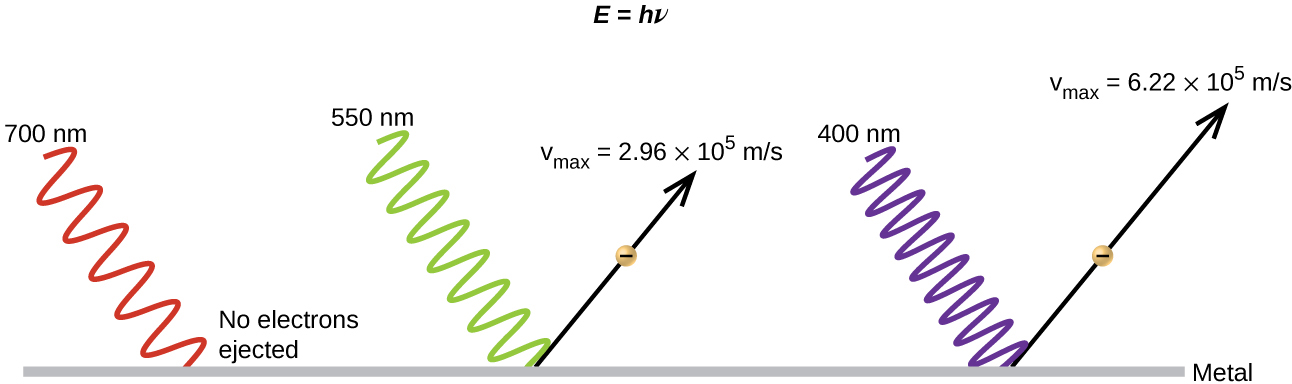

Figure 6.11図 6.11
Photons with low frequencies do not have enough energy to cause electrons to be ejected via the photoelectric effect. For any frequency of light above the threshold frequency, the kinetic energy of an ejected electron will increase linearly with the energy of the incoming photon.
振動数の低い光子には、光電効果によって電子を放出させるだけのエネルギーがない。光の振動数がしきい値を超えていれば、放出される電子の運動エネルギーは、入射光子のエネルギーに対して直線的に増加する。
Example 6.2例題 6.2
Calculating the Energy of Radiation電磁波のエネルギーを計算する
When we see light from a neon sign, we are observing radiation from excited neon atoms. If this radiation has a wavelength of 640 nm, what is the energy of the photon being emitted?
英語のヒント
ネオンサインの光を見るとき、私たちは励起されたネオン原子からの放射を観測している。この放射の波長が640 nmなら、放出される光子のエネルギーはいくらか。
Solution解法
We use the part of Planck's equation that includes the wavelength, λ, and convert units of nanometers to meters so that the units of λ and c are the same.
プランクの式のうち、波長λを含む形を使う。λとcの単位をそろえるため、ナノメートルをメートルに換算する。
Check Your Learning理解を確かめよう
The microwaves in an oven are of a specific frequency that will heat the water molecules contained in food. (This is why most plastics and glass do not become hot in a microwave oven-they do not contain water molecules.) This frequency is about 3 109 Hz. What is the energy of one photon in these microwaves?
電子レンジのマイクロ波は、食品中の水分子を加熱する特定の振動数をもつ。ほとんどのプラスチックやガラスが電子レンジで熱くならないのは、水分子を含まないためである。この振動数は約3 109 Hzである。このマイクロ波の光子1個のエネルギーはいくらか。
Example 6.3例題 6.3
Photoelectric Effect光電効果
Identify which of the following statements are false and, where necessary, change the italicized word or phrase to make them true, consistent with Einstein's explanation of the photoelectric effect.
英語のヒント
次の記述のうち誤っているものを選び、必要に応じて斜体の語句を変更して、アインシュタインによる光電効果の説明と一致する正しい記述にしなさい。
(a) Increasing the brightness of incoming light increases the kinetic energy of the ejected electrons.
(a) 入射光を明るくすると、放出される電子の運動エネルギーが増加する。
(b) Increasing the wavelength of incoming light increases the kinetic energy of the ejected electrons.
(b) 入射光の波長を長くすると、放出される電子の運動エネルギーが増加する。
(c) Increasing the brightness of incoming light increases the number of ejected electrons.
(c) 入射光を明るくすると、放出される電子の数が増加する。
(d) Increasing the frequency of incoming light can increase the number of ejected electrons.
(d) 入射光の振動数を高くすると、放出される電子の数が増加する場合がある。
Solution解法
(a) False. Increasing the brightness of incoming light has no effect on the kinetic energy of the ejected electrons. Only energy, not the number or amplitude, of the photons influences the kinetic energy of the electrons.
(a) 誤り。入射光を明るくしても、放出される電子の運動エネルギーには影響しない。電子の運動エネルギーに影響するのは光子のエネルギーだけであり、光子の数や振幅ではない。
(b) False. Increasing the frequency of incoming light increases the kinetic energy of the ejected electrons. Frequency is proportional to energy and inversely proportional to wavelength. Frequencies above the threshold value transfer the excess energy into the kinetic energy of the electrons.
(b) 誤り。入射光の振動数を高くすると、放出される電子の運動エネルギーが増加する。振動数はエネルギーに比例し、波長に反比例する。しきい値を超える振動数では、余分なエネルギーが電子の運動エネルギーへ移される。
(c) True. Because the number of collisions with photons increases with brighter light, the number of ejected electrons increases.
(c) 正しい。光が明るいほど光子との衝突回数が増えるため、放出される電子の数が増加する。
(d) True with regard to the threshold energy binding the electrons to the metal. Below this threshold, electrons are not emitted and above it they are. Once over the threshold value, further increasing the frequency does not increase the number of ejected electrons
英語のヒント
(d) 電子を金属につなぎとめるしきいエネルギーに関しては正しい。このしきい値より下では電子は放出されず、上では放出される。いったんしきい値を超えれば、さらに振動数を高くしても、放出される電子の数は増加しない。
Check Your Learning理解を確かめよう
Calculate the threshold energy in kJ/mol of electrons in aluminum, given that the lowest frequency photon for which the photoelectric effect is observed is 9.87 1014 Hz.
アルミニウムで光電効果が観測される光子の最低振動数が9.87 1014 Hzであるとき、電子のしきいエネルギーをkJ/molで求めなさい。