第11章パーソナリティ
11.9 Personality Assessment11.9 パーソナリティの評価
Learning Objectives学習目標
By the end of this section, you will be able to:
この節を学び終えると、次のことができるようになる。
- Discuss the Minnesota Multiphasic Personality Inventoryミネソタ多面人格目録について論じる
- Recognize and describe common projective tests used in personality assessmentパーソナリティ評価で用いられる代表的な投影法検査を見分け、説明する
Roberto, Mikhail, and Nat are college friends and all want to be police officers. Roberto is quiet and shy, lacks self-confidence, and usually follows others. He is a kind person, but lacks motivation. Mikhail is loud and boisterous, a leader. He works hard, but is impulsive and drinks too much on the weekends. Nat is thoughtful and well liked. They are trustworthy, but very methodical and therefore have difficulty making quick decisions. Of these three, who would make the best police officer? What qualities and personality factors make someone a good police officer? What makes someone a bad or dangerous police officer?
英語のヒント
ロベルト、ミハイル、ナットは大学の友人どうしで、3人とも警察官になりたいと思っている。ロベルトは物静かで内気で、自信がなく、たいていは人の後についていく。親切な人柄だが、意欲に欠ける。ミハイルは声が大きくにぎやかで、リーダー格である。努力家だが、衝動的で、週末には酒を飲みすぎる。ナットは思慮深く、周りから好かれている。信頼できる人物だが、とても几帳面なので、すばやく決断するのが苦手である。この3人のうち、最もよい警察官になるのは誰だろうか。どのような資質やパーソナリティの要因が、人をよい警察官にするのだろうか。何が人を、悪い警察官や危険な警察官にするのだろうか。
A police officer’s job is very high in stress, and law enforcement agencies want to make sure they hire the right people. Personality testing is often used for this purpose—to screen applicants for employment and job training. Personality tests are also used in criminal cases and custody battles, and to assess psychological disorders. This section explores the best known among the many different types of personality tests.
英語のヒント
警察官の仕事は非常にストレスが大きく、法執行機関は適切な人材を確実に採用したいと考えている。この目的のため、すなわち就職や職業訓練の応募者を選別するために、パーソナリティ検査がよく用いられる。パーソナリティ検査はまた、刑事事件や親権争いでも用いられるほか、心理的障害の評価にも使われる。この節では、数多くあるさまざまな種類のパーソナリティ検査のうち、最もよく知られたものを取り上げる。
Self-Report Inventories自己報告式質問紙
Self-report inventories are a kind of objective test used to assess personality. They typically use multiple-choice items or numbered scales, which represent a range from 1 (strongly disagree) to 5 (strongly agree). They are often called Likert scales after their developer, Rensis Likert (1932) (Figure 11.16). Self-report inventories are generally easy to administer and cost effective. There is also an increased likelihood of test takers being inclined to answer in ways that are intentionally or unintentionally more socially desirable, exaggerated, biased, or misleading. For example, someone applying for a job will likely try to present themselves in a positive light, perhaps as an even better candidate than they actually are.
英語のヒント
自己報告式質問紙は、パーソナリティを評価するために用いられる客観式検査の一種である。通常は、多肢選択式の項目や、数字の付いた尺度を用いる。尺度は、1(まったくそう思わない)から5(とてもそう思う)までの幅を表す。こうした尺度は、開発者のレンシス・リッカート(1932)にちなんで、リッカート尺度と呼ばれることが多い(図11.16)。自己報告式質問紙は、一般に実施が簡単で、費用対効果も高い。また、受検者が、意図的に、あるいは意図せずに、社会的により望ましい答え方や、誇張した、偏った、誤解を招くような答え方をしがちになる可能性も高くなる。たとえば、仕事に応募している人は、おそらく自分を好ましく見せようとするだろう。ことによると、実際よりもさらに優れた候補者として自分を示そうとするかもしれない。
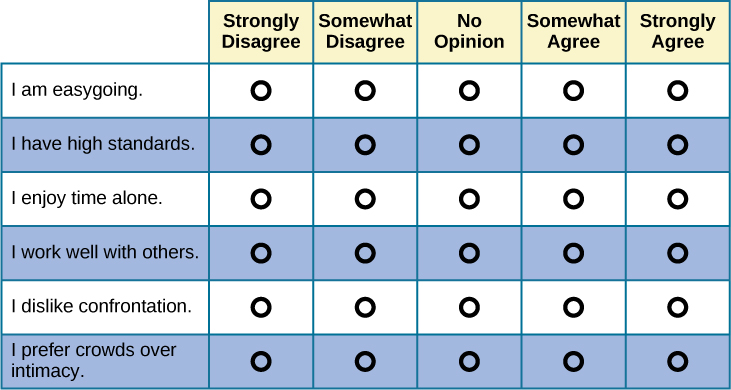
Figure 11.16図 11.16
If you’ve ever taken a survey, you are probably familiar with Likert-type scale questions. Most personality inventories employ these types of response scales.
調査に答えたことがあれば、リッカート型の尺度の質問にはおそらくなじみがあるだろう。ほとんどのパーソナリティ質問紙は、この種の回答尺度を用いている。
One of the most widely used personality inventories is the Minnesota Multiphasic Personality Inventory (MMPI), first published in 1943, with 504 true/false questions, and updated to the MMPI-2 in 1989, with 567 questions. The original MMPI was based on a small, limited sample, composed mostly of Minnesota farmers and psychiatric patients; the revised inventory was based on a more representative, national sample to allow for better standardization. The MMPI-2 takes 1–2 hours to complete. Responses are scored to produce a clinical profile composed of 10 scales: hypochondriasis, depression, hysteria, psychopathic deviance (social deviance), masculinity versus femininity, paranoia, psychasthenia (obsessive/compulsive qualities), schizophrenia, hypomania, and social introversion. There is also a scale to ascertain risk factors for alcohol abuse. In 2008, the test was again revised, using more advanced methods, to the MMPI-2-RF. This version takes about one-half the time to complete and has only 338 questions (Figure 11.17). Despite the new test’s advantages, the MMPI-2 is more established and is still more widely used. Typically, the tests are administered by computer. Although the MMPI was originally developed to assist in the clinical diagnosis of psychological disorders, it is now also used for occupational screening, such as in law enforcement, and in college, career, and marital counseling (Ben-Porath & Tellegen, 2008).
英語のヒント
最も広く用いられているパーソナリティ質問紙の一つが、ミネソタ多面人格目録(MMPI)である。MMPIは1943年に、504問の正誤式の質問から成る検査として初めて出版され、1989年には567問から成るMMPI-2に改訂された。もとのMMPIは、主にミネソタ州の農民と精神科の患者から成る、小規模で限られた標本に基づいていた。改訂版は、よりよい標準化を可能にするために、より代表性の高い全国規模の標本に基づいている。MMPI-2は、回答し終えるまでに1〜2時間かかる。回答は採点され、10の尺度から成る臨床プロフィールがつくられる。心気症、抑うつ、ヒステリー、精神病質的偏倚(社会的逸脱)、男性性対女性性、パラノイア、精神衰弱(強迫観念的・強迫行為的な特徴)、統合失調症、軽躁病、社会的内向性の10尺度である。アルコール乱用の危険因子を確かめるための尺度もある。2008年には、より高度な手法を用いて検査が再び改訂され、MMPI-2-RFとなった。この版は、回答にかかる時間がおよそ半分で、質問も338問しかない(図11.17)。この新しい検査には利点があるものの、MMPI-2のほうが定着しており、今でもより広く使われている。通常、これらの検査はコンピューターで実施される。MMPIはもともと心理的障害の臨床診断を助けるために開発されたが、現在では、法執行機関などでの職業上の選別や、大学でのカウンセリング、キャリア・カウンセリング、結婚カウンセリングにも用いられている(Ben-Porath & Tellegen, 2008)。
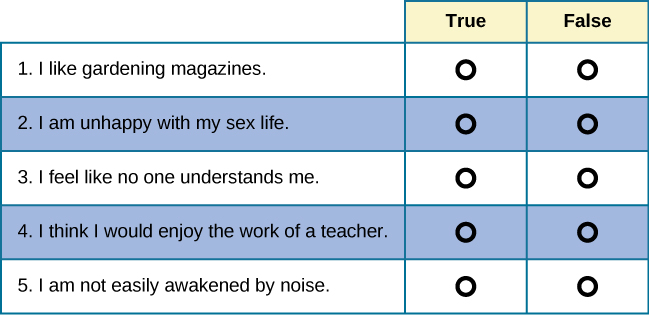


Figure 11.17図 11.17
These true/false questions resemble the kinds of questions you would find on the MMPI.
これらの正誤式の質問は、MMPIに出てくるような種類の質問に似ている。
In addition to clinical scales, the tests also have validity and reliability scales. (Recall the concepts of reliability and validity from your study of psychological research.) One of the validity scales, the Lie Scale (or “L” Scale), consists of 15 items and is used to ascertain whether the respondent is “faking good” (underreporting psychological problems to appear healthier). For example, if someone responds “yes” to a number of unrealistically positive items such as “I have never told a lie,” they may be trying to “fake good” or appear better than they actually are.
英語のヒント
これらの検査には、臨床尺度に加えて、妥当性尺度と信頼性尺度もある。(心理学の研究について学んだときの、信頼性と妥当性の概念を思い出そう。)妥当性尺度の一つである虚偽尺度(L尺度)は15項目から成り、回答者が「よく見せかけて」いないか(より健康に見えるように、心理的な問題を実際より少なく報告していないか)を確かめるために使われる。たとえば、「私は一度もうそをついたことがない」のような、非現実的なほど好ましい項目のいくつにも「はい」と答える人は、「よく見せかけ」ようとしている、あるいは実際よりもよく見せようとしているのかもしれない。
Reliability scales test an instrument’s consistency over time, assuring that if you take the MMPI-2-RF today and then again 5 years later, your two scores will be similar. Beutler, Nussbaum, and Meredith (1988) gave the MMPI to newly recruited police officers and then to the same police officers 2 years later. After 2 years on the job, police officers’ responses indicated an increased vulnerability to alcoholism, somatic symptoms (vague, unexplained physical complaints), and anxiety. When the test was given an additional 2 years later (4 years after starting on the job), the results suggested high risk for alcohol-related difficulties.
英語のヒント
信頼性尺度は、測定用具の時間を通じた一貫性を調べる。それによって、今日MMPI-2-RFを受け、5年後にもう一度受けた場合に、2回の得点が似たものになることが保証される。ボイトラー、ヌスバウム、メレディス(1988)は、新たに採用された警察官にMMPIを実施し、2年後に同じ警察官たちに再び実施した。勤務して2年たつと、警察官たちの回答は、アルコール依存症、身体症状(あいまいで説明のつかない身体の不調)、不安への脆弱性が高まったことを示していた。さらに2年後(勤務を始めてから4年後)に検査を実施すると、結果は、アルコールに関連した問題の危険性が高いことを示唆していた。