第11章パーソナリティ
11.7 Trait Theorists11.7 特性論者
Learning Objectives学習目標
By the end of this section, you will be able to:
この節を学び終えると、次のことができるようになる。
- Discuss early trait theories of Cattell and Eysenckキャッテルとアイゼンクの初期の特性論について論じる
- Discuss the Big Five factors and describe someone who is high and low on each of the five factorsビッグファイブの因子について論じ、五つの因子それぞれについて、それが高い人と低い人を説明する
Trait theorists believe personality can be understood via the approach that all people have certain traits, or characteristic ways of behaving. Do you tend to be sociable or shy? Passive or aggressive? Optimistic or pessimistic? Moody or even-tempered? Early trait theorists tried to describe all human personality traits. For example, one trait theorist, Gordon Allport (Allport & Odbert, 1936), found 4,500 words in the English language that could describe people. He organized these personality traits into three categories: cardinal traits, central traits, and secondary traits. A cardinal trait is one that dominates your entire personality, and hence your life—such as Ebenezer Scrooge’s greed and Mother Theresa’s altruism. Cardinal traits are not very common: Few people have personalities dominated by a single trait. Instead, our personalities typically are composed of multiple traits. Central traits are those that make up our personalities (such as loyal, kind, agreeable, friendly, sneaky, wild, and grouchy). Secondary traits are those that are not quite as obvious or as consistent as central traits. They are present under specific circumstances and include preferences and attitudes. For example, one person gets angry when people try to tickle him; another can only sleep on the left side of the bed; and yet another always orders her salad dressing on the side. And you—although not normally an anxious person—feel nervous before making a speech in front of your English class.
英語のヒント
特性論者は、すべての人が一定の特性、すなわち特徴的な行動の仕方を持っているという考え方によって、パーソナリティを理解できると考える。あなたは社交的なほうだろうか、それとも内気なほうだろうか。受け身だろうか、攻撃的だろうか。楽観的だろうか、悲観的だろうか。気分屋だろうか、それとも穏やかだろうか。初期の特性論者は、人間のパーソナリティ特性をすべて記述しようとした。たとえば特性論者の一人ゴードン・オールポート(Allport & Odbert, 1936)は、英語の中に、人を記述しうる語を4500語見いだした。オールポートは、これらのパーソナリティ特性を、主特性、中心特性、二次特性の三つのカテゴリーに整理した。主特性とは、パーソナリティ全体を、したがって人生そのものを支配する特性である。たとえば、エベニーザー・スクルージの強欲や、マザー・テレサの利他性がそうである。主特性はあまり一般的ではない。一つの特性に支配されたパーソナリティを持つ人はほとんどいないのである。むしろ、私たちのパーソナリティは、たいてい複数の特性で構成されている。中心特性とは、私たちのパーソナリティを形づくる特性である(たとえば、忠実、親切、協調的、友好的、ずる賢い、奔放、気難しい、など)。二次特性とは、中心特性ほどには目立たず、中心特性ほど一貫してもいない特性である。二次特性は特定の状況のもとで現れ、好みや態度を含む。たとえば、ある人は、誰かにくすぐられそうになると怒る。別の人は、ベッドの左側でしか眠れない。さらに別の人は、サラダのドレッシングをいつも別添えで注文する。そしてあなたは、ふだんは不安を感じやすい人ではないのに、英語の授業でクラスのみんなの前でスピーチをする前には緊張する。
In an effort to make the list of traits more manageable, Raymond Cattell (1946, 1957) narrowed down the list to about 171 traits. However, saying that a trait is either present or absent does not accurately reflect a person’s uniqueness, because all of our personalities are actually made up of the same traits; we differ only in the degree to which each trait is expressed. Cattell (1957) identified 16 factors or dimensions of personality: warmth, reasoning, emotional stability, dominance, liveliness, rule-consciousness, social boldness, sensitivity, vigilance, abstractedness, privateness, apprehension, openness to change, self-reliance, perfectionism, and tension (Table 11.5). He developed a personality assessment based on these 16 factors, called the 16PF. Instead of a trait being present or absent, each dimension is scored over a continuum, from high to low. For example, your level of warmth describes how warm, caring, and nice to others you are. If you score low on this index, you tend to be more distant and cold. A high score on this index signifies you are supportive and comforting.
英語のヒント
特性のリストをもっと扱いやすいものにしようとして、レイモンド・キャッテル(1946, 1957)は、リストを約171の特性に絞り込んだ。しかし、ある特性があるかないかという言い方では、その人の独自性を正確に反映できない。実際には、私たちのパーソナリティはみな同じ特性からできており、違うのは、それぞれの特性がどの程度表れているかだけだからである。キャッテル(1957)は、パーソナリティの16の因子、すなわち次元を特定した。温かさ、推論、情緒安定性、支配性、快活さ、規則意識、社会的大胆さ、感受性、警戒心、抽象性、秘密性、懸念、変化への開放性、自己充足性、完全主義、緊張である(表11.5)。キャッテルは、この16の因子に基づいて、16PFと呼ばれるパーソナリティ検査を開発した。特性があるかないかではなく、それぞれの次元が、高から低までの連続体の上で得点化される。たとえば、温かさの水準は、あなたが他者に対してどれだけ温かく、思いやりがあり、親切であるかを表す。この指標で得点が低ければ、あなたはどちらかといえばよそよそしく、冷たい傾向がある。この指標の得点が高いことは、あなたが人を支え、安心させる人であることを示す。
Personality Factors Measured by the 16PF Questionnaire 16PF質問紙で測定されるパーソナリティ因子 |
||
|---|---|---|
Factor 因子 |
Low Score 低得点 |
High Score 高得点 |
Warmth 温かさ |
Reserved, detached 控えめ、よそよそしい |
Outgoing, supportive 社交的、人を支える |
Intellect 知性 |
Concrete thinker 具体的に考える |
Analytical 分析的 |
Emotional stability 情緒安定性 |
Moody, irritable 気分屋、いらだちやすい |
Stable, calm 安定している、落ち着いている |
Aggressiveness 攻撃性 |
Docile, submissive 従順、服従的 |
Controlling, dominant 人を思いどおりにしたがる、支配的 |
Liveliness 快活さ |
Somber, prudent 陰気、慎重 |
Adventurous, spontaneous 冒険好き、気の向くままに動く |
Dutifulness 義務感 |
Unreliable 当てにならない |
Conscientious 誠実 |
Social assertiveness 社会的な自己主張 |
Shy, restrained 内気、抑制的 |
Uninhibited, bold 物おじしない、大胆 |
Sensitivity 感受性 |
Tough-minded 情に流されない |
Sensitive, caring 感じやすい、思いやりがある |
Paranoia 猜疑心 |
Trusting 人を信じる |
Suspicious 疑い深い |
Abstractness 抽象性 |
Conventional 慣習的 |
Imaginative 想像力が豊か |
Introversion 内向性 |
Open, straightforward 開けっぴろげ、率直 |
Private, shrewd 自分のことを明かさない、抜け目がない |
Anxiety 不安 |
Confident 自信がある |
Apprehensive 心配性 |
Openmindedness 開かれた心 |
Closeminded, traditional 閉鎖的、伝統的 |
Curious, experimental 好奇心が強い、試してみたがる |
Independence 独立性 |
Outgoing, social 社交的、人付き合いを好む |
Self-sufficient 自己充足的 |
Perfectionism 完全主義 |
Disorganized, casual まとまりがない、無頓着 |
Organized, precise きちんとしている、几帳面 |
Tension 緊張 |
Relaxed くつろいでいる |
Stressed ストレスを抱えている |
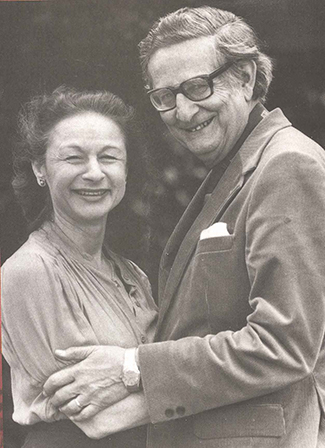
Psychologists Hans and Sybil Eysenck were personality theorists (Figure 11.12) who focused on temperament, the inborn, genetically based personality differences that you studied earlier in the chapter. They believed personality is largely governed by biology. The Eysencks (Eysenck, 1990, 1992; Eysenck & Eysenck, 1963) viewed people as having two specific personality dimensions: extroversion/introversion and neuroticism/stability.
英語のヒント
心理学者のハンス・アイゼンクとシビル・アイゼンクは、気質に焦点を当てたパーソナリティ理論家である(図11.12)。気質とは、この章の前のほうで学んだ、生まれつきの、遺伝に基づくパーソナリティの違いである。二人は、パーソナリティは大部分が生物学的な要因によって左右されると考えていた。アイゼンク夫妻(Eysenck, 1990, 1992; Eysenck & Eysenck, 1963)は、人には外向性/内向性と神経症傾向/安定性という二つの特定のパーソナリティ次元があるとみなした。
OpenStax, Rice University; Psychology 2e. (credit: "Sirswindon"/Wikimedia Commons) · CC BY 4.0 · Source出典
Figure 11.12図 11.12
Hans and Sybil Eysenck believed that our personality traits are influenced by our genetic inheritance. (credit: "Sirswindon"/Wikimedia Commons)
ハンス・アイゼンクとシビル・アイゼンクは、私たちのパーソナリティ特性は遺伝によって受け継いだものの影響を受けていると考えた。(出典:"Sirswindon"/Wikimedia Commons)
According to their theory, people high on the trait of extroversion are sociable and outgoing, and readily connect with others, whereas people high on the trait of introversion have a higher need to be alone, engage in solitary behaviors, and limit their interactions with others. In the neuroticism/stability dimension, people high on neuroticism tend to be anxious; they tend to have an overactive sympathetic nervous system and, even with low stress, their bodies and emotional state tend to go into a flight-or-fight reaction. In contrast, people high on stability tend to need more stimulation to activate their flight-or-fight reaction and are considered more emotionally stable. Based on these two dimensions, the Eysencks’ theory divides people into four quadrants. These quadrants are sometimes compared with the four temperaments described by the Greeks: melancholic, choleric, phlegmatic, and sanguine (Figure 11.13).
英語のヒント
二人の理論によれば、外向性の特性が高い人は社交的で人付き合いがよく、他者とすぐに打ち解ける。これに対して、内向性の特性が高い人は、一人でいたいという欲求がより強く、一人でする行動をとり、他者との交流を限られた範囲にとどめる。神経症傾向/安定性の次元では、神経症傾向が高い人は不安が強い傾向がある。そうした人は交感神経系が過剰に活動しがちで、ストレスが小さくても、体と感情の状態が闘争・逃走反応に入る傾向がある。これに対して、安定性が高い人は、闘争・逃走反応が作動するのにより多くの刺激を必要とする傾向があり、情緒的により安定しているとみなされる。この二つの次元に基づいて、アイゼンク夫妻の理論は人々を四つの象限に分ける。これらの象限は、ギリシャ人が記述した四つの気質、すなわち憂うつ質、胆汁質、粘液質、多血質と比べられることがある(図11.13)。
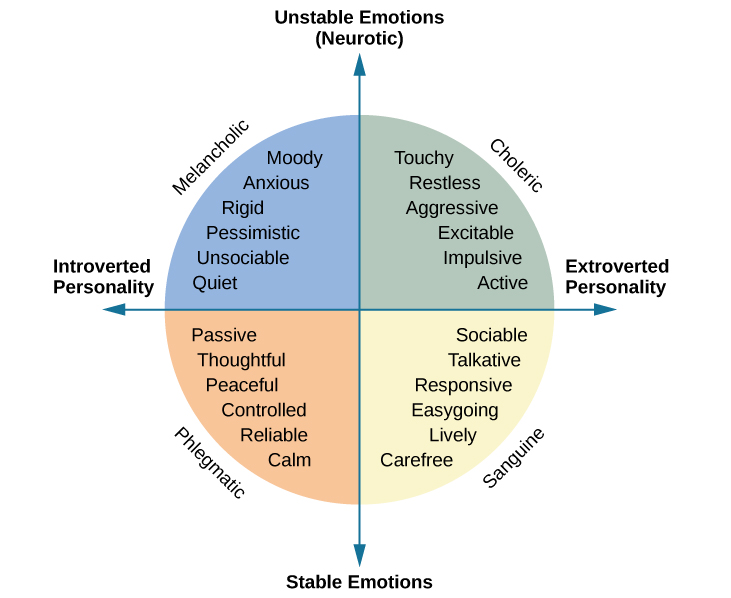
Figure 11.13図 11.13
The Eysencks described two factors to account for variations in our personalities: extroversion/introversion and emotional stability/instability.
アイゼンク夫妻は、私たちのパーソナリティの違いを説明するために、外向性/内向性と、情緒の安定性/不安定性という二つの因子を示した。
Later, the Eysencks added a third dimension: psychoticism versus superego control (Eysenck, Eysenck & Barrett, 1985). In this dimension, people who are high on psychoticism tend to be independent thinkers, cold, nonconformists, impulsive, antisocial, and hostile, whereas people who are high on superego control tend to have high impulse control—they are more altruistic, empathetic, cooperative, and conventional (Eysenck, Eysenck & Barrett, 1985).
英語のヒント
のちにアイゼンク夫妻は、第三の次元として、精神病傾向対超自我統制を加えた(Eysenck, Eysenck & Barrett, 1985)。この次元では、精神病傾向が高い人は、自分の頭で考え、冷たく、周囲に同調せず、衝動的で、反社会的で、敵意を持つ傾向がある。これに対して、超自我統制が高い人は、衝動を制御する力が高い傾向がある。つまり、より利他的で、共感的で、協力的で、慣習に従う(Eysenck, Eysenck & Barrett, 1985)。
While Cattell’s 16 factors may be too broad, the Eysenck’s two-factor system has been criticized for being too narrow. Another personality theory, called the Five Factor Model, effectively hits a middle ground, with its five factors referred to as the Big Five personality factors. It is the most popular theory in personality psychology today and the most accurate approximation of the basic personality dimensions (Funder, 2001). The five factors are openness to experience, conscientiousness, extroversion, agreeableness, and neuroticism (Figure 11.14). A helpful way to remember the factors is by using the mnemonic OCEAN.
英語のヒント
キャッテルの16因子は広すぎるかもしれない一方で、アイゼンク夫妻の二因子の体系は狭すぎると批判されてきた。5因子モデルと呼ばれる別のパーソナリティ理論は、両者の中間をうまく押さえており、その五つの因子はビッグファイブのパーソナリティ因子と呼ばれている。5因子モデルは、今日のパーソナリティ心理学で最も広く支持されている理論であり、基本的なパーソナリティ次元を最も正確に近似したものである(Funder, 2001)。五つの因子とは、経験への開放性、誠実性、外向性、協調性、神経症傾向である(図11.14)。これらの因子を覚えるのに役立つのが、OCEANという記憶術を使う方法である。
In the Five Factor Model, each person has each factor, but they occur along a spectrum. Openness to experience is characterized by imagination, feelings, actions, and ideas. People who score high on this factor tend to be curious and have a wide range of interests. Conscientiousness is characterized by competence, self-discipline, thoughtfulness, and achievement-striving (goal-directed behavior). People who score high on this factor are hardworking and dependable. Numerous studies have found a positive correlation between conscientiousness and academic success (Akomolafe, 2013; Chamorro-Premuzic & Furnham, 2008; Conrad & Patry, 2012; Noftle & Robins, 2007; Wagerman & Funder, 2007). Extroversion is characterized by sociability, assertiveness, excitement-seeking, and emotional expression. People who score high on this factor are usually described as outgoing and warm. Not surprisingly, people who score high on both extroversion and openness are more likely to participate in adventure and risky sports due to their curious and excitement-seeking nature (Tok, 2011). The fourth factor is agreeableness, which is the tendency to be pleasant, cooperative, trustworthy, and good-natured. People who score low on agreeableness tend to be described as rude and uncooperative, yet one recent study reported that men who scored low on this factor actually earned more money than men who were considered more agreeable (Judge, Livingston, & Hurst, 2012). The last of the Big Five factors is neuroticism, which is the tendency to experience negative emotions. People high on neuroticism tend to experience emotional instability and are characterized as angry, impulsive, and hostile. Watson and Clark (1984) found that people reporting high levels of neuroticism also tend to report feeling anxious and unhappy. In contrast, people who score low in neuroticism tend to be calm and even-tempered.
英語のヒント
5因子モデルでは、誰もがどの因子も持っているが、その程度はスペクトルに沿ってさまざまである。経験への開放性は、想像力、感情、行動、アイデアによって特徴づけられる。この因子で得点が高い人は、好奇心が強く、幅広い関心を持つ傾向がある。誠実性を特徴づけるのは、有能さ、自己規律、思慮深さ、達成追求(目標に向かう行動)である。この因子で得点が高い人は、勤勉で頼りになる。数多くの研究が、誠実性と学業上の成功とのあいだに正の相関を見いだしている(Akomolafe, 2013; Chamorro-Premuzic & Furnham, 2008; Conrad & Patry, 2012; Noftle & Robins, 2007; Wagerman & Funder, 2007)。外向性の特徴は、社交性、自己主張、刺激希求、感情表現である。この因子で得点が高い人は、ふつう社交的で温かいと評される。当然ながら、外向性と開放性の両方で得点が高い人は、好奇心が強く刺激を求める性質のために、冒険的なスポーツや危険を伴うスポーツに参加する可能性が高い(Tok, 2011)。第四の因子は協調性で、これは感じがよく、協力的で、信頼でき、気立てがよい傾向である。協調性の得点が低い人は、無礼で非協力的だと評される傾向がある。しかし最近のある研究は、この因子の得点が低かった男性のほうが、より協調的だとみなされた男性よりも、実際に多くの収入を得ていたと報告している(Judge, Livingston, & Hurst, 2012)。ビッグファイブの最後の因子は神経症傾向で、これは否定的な感情を経験する傾向である。神経症傾向が高い人は、情緒の不安定さを経験する傾向があり、怒りっぽい、衝動的、敵意があるといった特徴を持つ。ワトソンとクラーク(1984)は、神経症傾向が高い水準にあると報告した人は、不安や不幸せを感じていると報告する傾向もあることを見いだした。これに対して、神経症傾向の得点が低い人は、落ち着いていて穏やかな傾向がある。
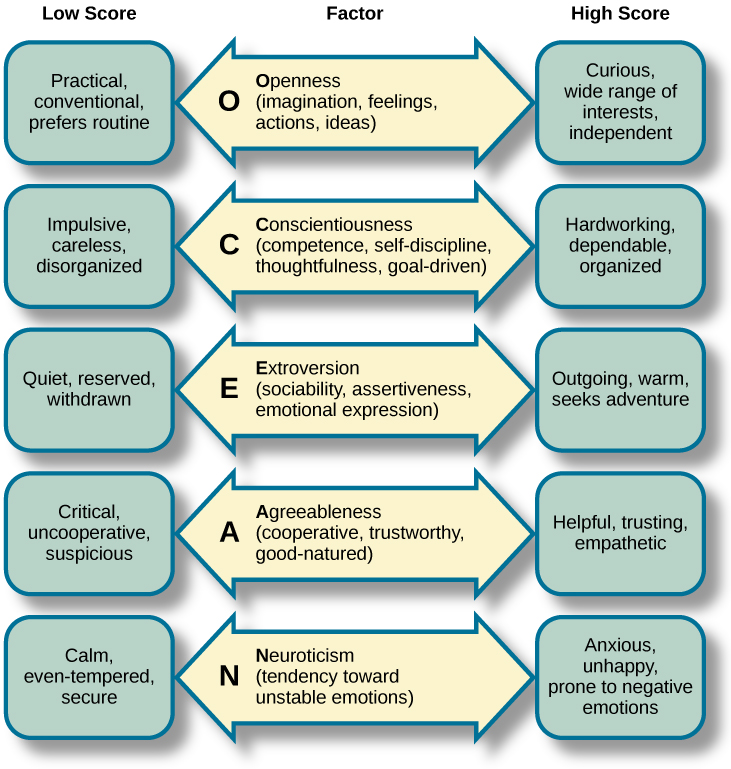


Figure 11.14図 11.14
In the Five Factor Model, each person has five factors, each scored on a continuum from high to low. In the center column, notice that the first letter of each factor spells the mnemonic OCEAN.
5因子モデルでは、誰もが五つの因子を持ち、そのそれぞれが高から低までの連続体の上で得点化される。中央の列で、各因子の頭文字を並べると、記憶術のOCEANになることに注目しよう。
The Big Five personality factors each represent a range between two extremes. In reality, most of us tend to lie somewhere midway along the continuum of each factor, rather than at polar ends. It’s important to note that the Big Five factors are relatively stable over our lifespan, with some tendency for the factors to increase or decrease slightly. Researchers have found that conscientiousness increases through young adulthood into middle age, as we become better able to manage our personal relationships and careers (Donnellan & Lucas, 2008). Agreeableness also increases with age, peaking between 50 to 70 years (Terracciano, McCrae, Brant, & Costa, 2005). Neuroticism and extroversion tend to decline slightly with age (Donnellan & Lucas; Terracciano et al.). Additionally, The Big Five factors have been shown to exist across ethnicities, cultures, and ages, and may have substantial biological and genetic components (Jang, Livesley, & Vernon, 1996; Jang et al., 2006; McCrae & Costa, 1997; Schmitt et al., 2007).
英語のヒント
ビッグファイブのパーソナリティ因子は、それぞれ両極のあいだの範囲を表している。実際には、私たちの多くは、各因子の連続体の両端ではなく、その途中のどこかに位置する傾向がある。ビッグファイブの因子は生涯を通じて比較的安定しているが、わずかに高まったり低下したりする傾向もいくらかある。この点に注意しておくことが重要である。研究者たちは、私たちが自分の人間関係やキャリアをよりうまく管理できるようになるにつれて、誠実性が成人前期から中年期にかけて高まることを見いだしている(Donnellan & Lucas, 2008)。協調性も年齢とともに高まり、50〜70歳のあいだで最も高くなる(Terracciano, McCrae, Brant, & Costa, 2005)。神経症傾向と外向性は、年齢とともにわずかに低下する傾向がある(Donnellan & Lucas; Terracciano et al.)。さらに、ビッグファイブの因子は、民族、文化、年齢を超えて存在することが示されており、かなりの生物学的・遺伝的な要素を持っている可能性がある(Jang, Livesley, & Vernon, 1996; Jang et al., 2006; McCrae & Costa, 1997; Schmitt et al., 2007)。
Another model of personality traits is the HEXACO model. HEXACO is an acronym for six broad traits: honesty-humility, emotionality, extraversion, agreeableness, conscientiousness, and openness to experience (Anglim & O’Connor, 2018). Table 11.6 provides a brief overview of each trait.
英語のヒント
パーソナリティ特性のもう一つのモデルに、HEXACOモデルがある。HEXACOは、六つの幅広い特性、すなわち正直さ-謙虚さ、情動性、外向性、協調性、誠実性、経験への開放性の頭文字をとった語である(Anglim & O’Connor, 2018)。表11.6に、各特性の簡単な概要を示す。
The HEXACO Traits HEXACOの特性 |
|
|---|---|
Trait 特性 |
Example Aspects of Trait 特性の側面の例 |
(H) Honesty-humility (H)正直さ-謙虚さ |
Sincerity, modesty, faithfulness 偽りのなさ、慎み深さ、忠実さ |
(E) Emotionality (E)情動性 |
Sentimentality, anxiety, sensitivity 感傷性、不安、感受性 |
(X) Extraversion (X)外向性 |
Sociability, talkativeness, boldness 社交性、話し好き、大胆さ |
(A) Agreeableness (A)協調性 |
Patience, tolerance, gentleness 忍耐強さ、寛容さ、穏やかさ |
(C) Conscientiousness (C)誠実性 |
Organization, thoroughness, precision 整理整頓、徹底性、正確さ |
(O) Openness (O)開放性 |
Creativity, inquisitiveness, innovativeness 創造性、探究心、革新性 |