第11章パーソナリティ
11.4 Learning Approaches11.4 学習論的アプローチ
Learning Objectives学習目標
By the end of this section, you will be able to:
この節を学び終えると、次のことができるようになる。
- Describe the behaviorist perspective on personalityパーソナリティについての行動主義的観点を説明する
- Describe the cognitive perspective on personalityパーソナリティについての認知的観点を説明する
- Describe the social cognitive perspective on personalityパーソナリティについての社会的認知の観点を説明する
In contrast to the psychodynamic approaches of Freud and the neo-Freudians, which relate personality to inner (and hidden) processes, the learning approaches focus only on observable behavior. This illustrates one significant advantage of the learning approaches over psychodynamics: Because learning approaches involve observable, measurable phenomena, they can be scientifically tested.
英語のヒント
フロイトと新フロイト派の精神力動的アプローチは、パーソナリティを内的な(そして隠れた)過程と結びつける。これとは対照的に、学習論的アプローチは観察可能な行動だけに焦点を当てる。ここに、精神力動論に対する学習論的アプローチの重要な利点の一つが表れている。学習論的アプローチは観察でき、測定できる現象を扱うので、科学的に検証できるのである。
The Behavioral Perspective行動主義的観点
Behaviorists do not believe in biological determinism: They do not see personality traits as inborn. Instead, they view personality as significantly shaped by the reinforcements and consequences outside of the organism. In other words, people behave in a consistent manner based on prior learning. B. F. Skinner, a strict behaviorist, believed that environment was solely responsible for all behavior, including the enduring, consistent behavior patterns studied by personality theorists.
英語のヒント
行動主義者は生物学的決定論を信じない。つまり、パーソナリティ特性を生まれつきのものとはみなさない。そうではなく、パーソナリティは、生物の外部にある強化と結果によって大きく形づくられると考える。言い換えれば、人は以前の学習に基づいて一貫したふるまいをするのである。厳格な行動主義者であったB・F・スキナーは、パーソナリティ理論家が研究する持続的で一貫した行動パターンも含めて、すべての行動の原因はもっぱら環境にあると考えた。
As you may recall from your study on the psychology of learning, Skinner proposed that we demonstrate consistent behavior patterns because we have developed certain response tendencies (Skinner, 1953). In other words, we learn to behave in particular ways. We increase the behaviors that lead to positive consequences, and we decrease the behaviors that lead to negative consequences. Skinner disagreed with Freud’s idea that personality is fixed in childhood. He argued that personality develops over our entire life, not only in the first few years. Our responses can change as we come across new situations; therefore, we can expect more variability over time in personality than Freud would anticipate. For example, consider a young woman, Greta, a risk taker. She drives fast and participates in dangerous sports such as hang gliding and kiteboarding. But after she gets married and has children, the system of reinforcements and punishments in her environment changes. Speeding and extreme sports are no longer reinforced, so she no longer engages in those behaviors. In fact, Greta now describes herself as a cautious person.
英語のヒント
学習の心理学で学んだことを覚えているかもしれないが、スキナーは、私たちが一貫した行動パターンを示すのは、特定の反応傾向を身につけてきたからだと提唱した(Skinner, 1953)。言い換えれば、私たちは特定のやり方でふるまうことを学習するのである。私たちは、好ましい結果につながる行動を増やし、好ましくない結果につながる行動を減らす。スキナーは、パーソナリティは子ども時代に固まるというフロイトの考えに反対した。パーソナリティは最初の数年間だけでなく、生涯全体を通じて発達する、と彼は論じた。私たちの反応は、新しい状況に出会うにつれて変わりうる。したがって、パーソナリティは時間の経過とともに、フロイトが見込むであろうよりも大きく変動すると予想できる。たとえば、危険をいとわない若い女性グレタを考えてみよう。彼女はスピードを出して車を運転し、ハンググライディングやカイトボーディングのような危険なスポーツに参加する。しかし、結婚して子どもができると、彼女の環境における強化と罰の仕組みが変わる。スピードの出しすぎや過激なスポーツはもはや強化されないので、彼女はそうした行動をしなくなる。実際、グレタは今では自分のことを慎重な人間だと言っている。
The Social-Cognitive Perspective社会的認知の観点
Albert Bandura agreed with Skinner that personality develops through learning. He disagreed, however, with Skinner’s strict behaviorist approach to personality development, because he felt that thinking and reasoning are important components of learning. He presented a social-cognitive theory of personality that emphasizes both learning and cognition as sources of individual differences in personality. In social-cognitive theory, the concepts of reciprocal determinism, observational learning, and self-efficacy all play a part in personality development.
英語のヒント
アルバート・バンデューラは、パーソナリティが学習を通じて発達するという点ではスキナーに同意した。しかし、パーソナリティの発達に対するスキナーの厳格な行動主義的アプローチには反対した。思考と推論が学習の重要な構成要素だと考えたからである。バンデューラは、パーソナリティの個人差の源として学習と認知の両方を重視する、パーソナリティの社会的認知理論を提示した。社会的認知理論では、相互決定論、観察学習、自己効力感という概念が、いずれもパーソナリティの発達にかかわっている。
Reciprocal Determinism相互決定論
In contrast to Skinner’s idea that the environment alone determines behavior, Bandura (1990) proposed the concept of reciprocal determinism, in which cognitive processes, behavior, and context all interact, each factor influencing and being influenced by the others simultaneously (Figure 11.10). Cognitive processes refer to all characteristics previously learned, including beliefs, expectations, and personality characteristics. Behavior refers to anything that we do that may be rewarded or punished. Finally, the context in which the behavior occurs refers to the environment or situation, which includes rewarding/punishing stimuli.
英語のヒント
環境だけが行動を決定するというスキナーの考えとは対照的に、バンデューラ(1990)は相互決定論という概念を提唱した。相互決定論では、認知過程、行動、文脈のすべてが相互に作用し合い、それぞれの要因が、ほかの要因に影響を与えると同時に、ほかの要因から影響を受ける(図11.10)。認知過程とは、信念、期待、パーソナリティの特徴など、以前に学習したあらゆる特徴を指す。行動とは、私たちが行うことのうち、報酬を与えられたり罰せられたりしうるものすべてを指す。最後に、行動が起こる文脈とは、環境や状況を指し、そこには報酬となる刺激や罰となる刺激が含まれる。
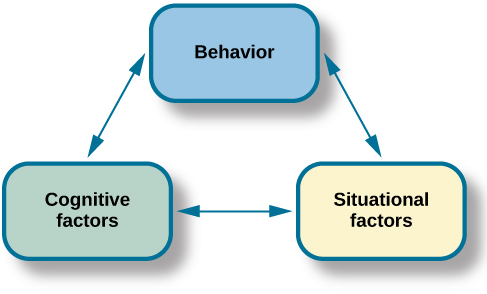

Figure 11.10図 11.10
Bandura proposed the idea of reciprocal determinism: Our behavior, cognitive processes, and situational context all influence each other.
バンデューラは相互決定論という考えを提唱した。私たちの行動、認知過程、状況的な文脈は、すべて互いに影響し合う。
Consider, for example, that you’re at a festival and one of the attractions is bungee jumping from a bridge. Do you do it? In this example, the behavior is bungee jumping. Cognitive factors that might influence this behavior include your beliefs and values, and your past experiences with similar behaviors. Finally, context refers to the reward structure for the behavior. According to reciprocal determinism, all of these factors are in play.
英語のヒント
たとえば、あなたがお祭りに来ていて、呼び物の一つに橋からのバンジージャンプがあるとしよう。あなたは跳ぶだろうか。この例では、行動とはバンジージャンプである。この行動に影響を与えうる認知的要因には、あなたの信念や価値観、そして似たような行動についての過去の経験がある。最後に、文脈とは、その行動に対する報酬の構造を指す。相互決定論によれば、これらの要因のすべてが働いている。
Observational Learning観察学習
Bandura’s key contribution to learning theory was the idea that much learning is vicarious. We learn by observing someone else’s behavior and its consequences, which Bandura called observational learning. He felt that this type of learning also plays a part in the development of our personality. Just as we learn individual behaviors, we learn new behavior patterns when we see them performed by other people or models. Drawing on the behaviorists’ ideas about reinforcement, Bandura suggested that whether we choose to imitate a model’s behavior depends on whether we see the model reinforced or punished. Through observational learning, we come to learn what behaviors are acceptable and rewarded in our culture, and we also learn to inhibit deviant or socially unacceptable behaviors by seeing what behaviors are punished.
英語のヒント
学習理論へのバンデューラの重要な貢献は、学習の多くは代理的なものだという考えだった。私たちは、他者の行動とその結果を観察することによって学ぶ。バンデューラはこれを観察学習と呼んだ。彼は、この種の学習がパーソナリティの発達にもかかわっていると考えた。個々の行動を学ぶのと同じように、私たちは、新しい行動パターンがほかの人々やモデルによって行われるのを見て、その行動パターンを学ぶ。行動主義者の強化についての考えに基づいて、バンデューラは、私たちがモデルの行動を模倣することを選ぶかどうかは、そのモデルが強化されるのを見るか、罰せられるのを見るかによって決まると示唆した。観察学習を通じて、私たちは、自分たちの文化の中でどのような行動が受け入れられ、報酬を与えられるのかを学ぶようになる。また、どのような行動が罰せられるのかを見ることで、逸脱した行動や社会的に受け入れられない行動を抑えることも学ぶ。
We can see the principles of reciprocal determinism at work in observational learning. For example, personal factors determine which behaviors in the environment a person chooses to imitate, and those environmental events in turn are processed cognitively according to other personal factors. One person may experience receiving attention as reinforcing, and that person may be more inclined to imitate behaviors such as boasting when a model has been reinforced. For others, boasting may be viewed negatively, despite the attention that might result—or receiving heightened attention may be perceived as being scrutinized. In either case, the person may be less likely to imitate those behaviors even though the reasons for not doing so would be different.
英語のヒント
観察学習では、相互決定論の原理が働いているのが見て取れる。たとえば、環境の中のどの行動を模倣するかを決めるのは個人要因であり、そうした環境内の出来事は、今度は別の個人要因に従って認知的に処理される。注目を浴びることを強化として経験する人もいるだろう。そういう人は、モデルが強化されたときに、自慢のような行動をいっそう模倣しようとするかもしれない。別の人にとっては、自慢は、それによって注目が得られるかもしれないにもかかわらず、否定的に見られることがある。あるいは、いっそう注目を浴びることが、詮索されることとして受け取られる場合もある。模倣しない理由はそれぞれ異なるとしても、どちらの場合も、その人がそうした行動を模倣する可能性は低くなるかもしれない。