第11章パーソナリティ
11.1 What Is Personality?11.1 パーソナリティとは何か
Learning Objectives学習目標
By the end of this section, you will be able to:
この節を学び終えると、次のことができるようになる。
- Define personalityパーソナリティを定義する
- Describe early theories about personality developmentパーソナリティの発達についての初期の理論を説明する
Personality refers to the long-standing traits and patterns that propel individuals to consistently think, feel, and behave in specific ways. Our personality is what makes us unique individuals. Each person has an idiosyncratic pattern of enduring, long-term characteristics and a manner in which they interact with other individuals and the world around them. Our personalities are thought to be long term, stable, and not easily changed. The word personality comes from the Latin word persona. In the ancient world, a persona was a mask worn by an actor. While we tend to think of a mask as being worn to conceal one’s identity, the theatrical mask was originally used to either represent or project a specific personality trait of a character (Figure 11.2).
英語のヒント
パーソナリティとは、個人を一貫して特定の仕方で考え、感じ、行動させる、長く続く特性とパターンを指す。私たち一人ひとりを独自の個人にしているのは、パーソナリティである。人はそれぞれ、長く持続する特徴の独特なパターンと、他者や周囲の世界とのその人なりのかかわり方を持っている。パーソナリティは長期的で安定しており、容易には変わらないと考えられている。パーソナリティという語は、ラテン語の「ペルソナ(persona)」に由来する。古代世界では、ペルソナとは役者がつける仮面のことだった。私たちは仮面を、素性を隠すためにつけるものと考えがちだが、演劇の仮面はもともと、登場人物の特定のパーソナリティ特性を表したり、外に打ち出したりするために使われていた(図11.2)。
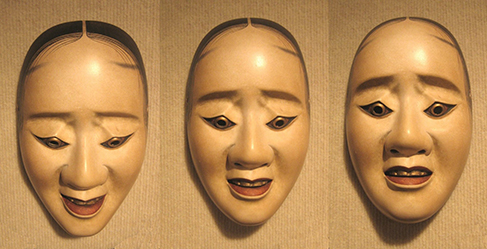
Figure 11.2図 11.2
Happy, sad, impatient, shy, fearful, curious, helpful. What characteristics describe your personality?
幸せ、悲しい、せっかち、内気、怖がり、好奇心が強い、協力的。あなたのパーソナリティを表すのは、どのような特徴だろうか。
Historical Perspectives歴史的な観点
The concept of personality has been studied for at least 2,000 years, beginning with Hippocrates in 370 BCE (Fazeli, 2012). Hippocrates theorized that personality traits and human behaviors are based on four separate temperaments associated with four fluids (“humors”) of the body: choleric temperament (yellow bile from the liver), melancholic temperament (black bile from the kidneys), sanguine temperament (red blood from the heart), and phlegmatic temperament (white phlegm from the lungs) (Clark & Watson, 2008; Eysenck & Eysenck, 1985; Lecci & Magnavita, 2013; Noga, 2007). Centuries later, the influential Greek physician and philosopher Galen built on Hippocrates’s theory, suggesting that both diseases and personality differences could be explained by imbalances in the humors and that each person exhibits one of the four temperaments. For example, the choleric person is passionate, ambitious, and bold; the melancholic person is reserved, anxious, and unhappy; the sanguine person is joyful, eager, and optimistic; and the phlegmatic person is calm, reliable, and thoughtful (Clark & Watson, 2008; Stelmack & Stalikas, 1991). Galen’s theory was prevalent for over 1,000 years and continued to be popular through the Middle Ages.
英語のヒント
パーソナリティという概念は、紀元前370年のヒポクラテスに始まり、少なくとも2000年にわたって研究されてきた(Fazeli, 2012)。ヒポクラテスは、パーソナリティ特性と人間の行動は、体内の四つの液体(「体液」)と結びついた四つの別々の気質に基づいていると理論化した。胆汁質(肝臓から出る黄胆汁)、憂うつ質(腎臓から出る黒胆汁)、多血質(心臓から出る赤い血液)、粘液質(肺から出る白い粘液)の四つである(Clark & Watson, 2008; Eysenck & Eysenck, 1985; Lecci & Magnavita, 2013; Noga, 2007)。数世紀後、影響力のあったギリシャの医師・哲学者ガレノスは、ヒポクラテスの理論を土台にして、病気もパーソナリティの違いも体液の不均衡によって説明しうること、そして人はそれぞれ四つの気質のうちの一つを示すことを唱えた。たとえば、胆汁質の人は情熱的で野心があり、大胆である。憂うつ質の人は控えめで不安が強く、不幸せである。多血質の人は陽気で熱心で、楽観的である。粘液質の人は穏やかで頼りになり、思慮深い(Clark & Watson, 2008; Stelmack & Stalikas, 1991)。ガレノスの理論は1000年以上にわたって広く行き渡り、中世を通じて人気を保ち続けた。
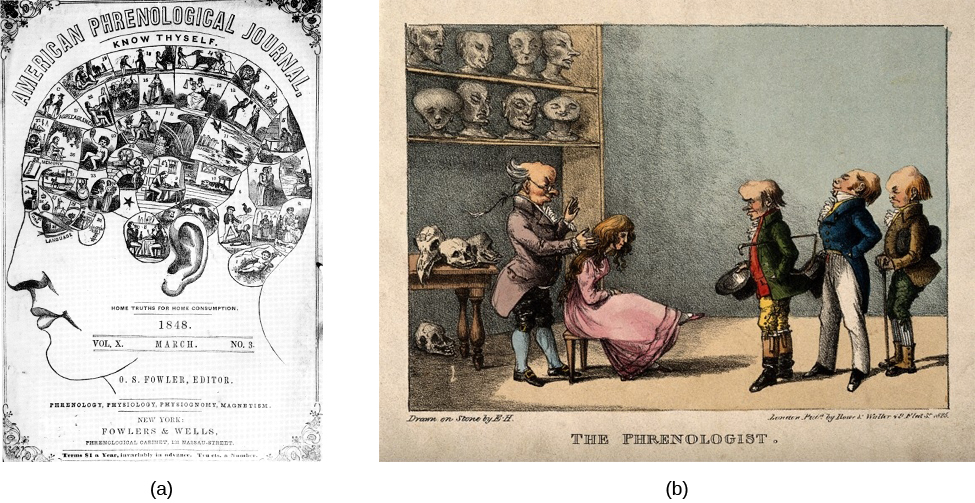
In 1780, Franz Gall, a German physician, proposed that the distances between bumps on the skull reveal a person’s personality traits, character, and mental abilities (Figure 11.3). According to Gall, measuring these distances revealed the sizes of the brain areas underneath, providing information that could be used to determine whether a person was friendly, prideful, murderous, kind, good with languages, and so on. Initially, phrenology was very popular; however, it was soon discredited for lack of empirical support and has long been relegated to the status of pseudoscience (Fancher, 1979).
英語のヒント
1780年、ドイツの医師フランツ・ガルは、頭蓋骨の隆起どうしの距離が、その人のパーソナリティ特性、性格、心的能力を示していると唱えた(図11.3)。ガルによれば、これらの距離を測ると、その下にある脳領域の大きさが分かる。そこから得られる情報を使えば、その人が友好的か、高慢か、人を殺しかねないか、親切か、言語が得意か、などを判断できるというのである。当初、骨相学はたいへんな人気を集めた。しかし、実証的な裏づけがないためにまもなく信用を失い、以来長く疑似科学の地位に追いやられている(Fancher, 1979)。
OpenStax, Rice University; Psychology 2e. (credit b: modification of work by Wellcome Library, London) · CC BY 4.0 · Source出典
Figure 11.3図 11.3
The pseudoscience of measuring the areas of a person’s skull is known as phrenology. (a) Gall developed a chart that depicted which areas of the skull corresponded to particular personality traits or characteristics (Hothersall, 1995). (b) An 1825 lithograph depicts Gall examining the skull of a young woman. (credit b: modification of work by Wellcome Library, London)
人の頭蓋骨の各領域を測定する疑似科学は、骨相学として知られる。(a)ガルは、頭蓋骨のどの領域が特定のパーソナリティ特性や特徴に対応するかを描いた図表を作成した(Hothersall, 1995)。(b)1825年の石版画には、若い女性の頭蓋骨を調べるガルが描かれている。(出典b:Wellcome Library, Londonの作品を改変)
In the centuries after Galen, other researchers contributed to the development of his four primary temperament types, most prominently Immanuel Kant (in the 18th century) and psychologist Wilhelm Wundt (in the 19th century) (Eysenck, 2009; Stelmack & Stalikas, 1991; Wundt, 1874/1886) (Figure 11.4). Kant agreed with Galen that everyone could be sorted into one of the four temperaments and that there was no overlap between the four categories (Eysenck, 2009). He developed a list of traits that could be used to describe the personality of a person from each of the four temperaments. However, Wundt suggested that a better description of personality could be achieved using two major axes: emotional/nonemotional and changeable/unchangeable. The first axis separated strong from weak emotions (the melancholic and choleric temperaments from the phlegmatic and sanguine). The second axis divided the changeable temperaments (choleric and sanguine) from the unchangeable ones (melancholic and phlegmatic) (Eysenck, 2009).
英語のヒント
ガレノス以後の数世紀のあいだに、ほかの研究者たちも、ガレノスの四つの基本的な気質類型の発展に貢献した。とりわけ目立つのが、イマヌエル・カント(18世紀)と心理学者ヴィルヘルム・ヴント(19世紀)である(Eysenck, 2009; Stelmack & Stalikas, 1991; Wundt, 1874/1886)(図11.4)。カントは、誰もが四つの気質のいずれか一つに分類でき、四つの区分のあいだに重なりはないという点で、ガレノスに同意した(Eysenck, 2009)。そして、四つの気質それぞれに属する人のパーソナリティを記述するのに使える特性のリストを作った。しかしヴントは、感情的/非感情的、可変的/不変的という二つの主要な軸を用いれば、パーソナリティをよりよく記述できると唱えた。第一の軸は、強い感情と弱い感情を分けた(憂うつ質と胆汁質を、粘液質と多血質から分ける)。第二の軸は、可変的な気質(胆汁質と多血質)と不変的な気質(憂うつ質と粘液質)を分けた(Eysenck, 2009)。
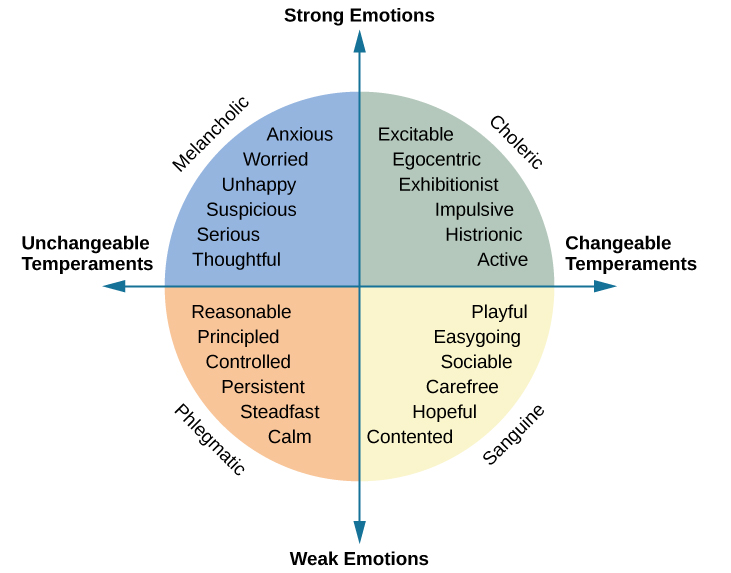


Figure 11.4図 11.4
Developed from Galen’s theory of the four temperaments, Kant proposed trait words to describe each temperament. Wundt later suggested the arrangement of the traits on two major axes.
カントは、ガレノスの四気質説をもとに、それぞれの気質を記述する特性語を提案した。のちにヴントは、それらの特性を二つの主要な軸の上に配置することを提案した。
Sigmund Freud’s psychodynamic perspective of personality was the first comprehensive theory of personality, explaining a wide variety of both normal and abnormal behaviors. According to Freud, unconscious drives influenced by sex and aggression, along with childhood sexuality, are the forces that influence our personality. Freud attracted many followers who modified his ideas to create new theories about personality. These theorists, referred to as neo-Freudians, generally agreed with Freud that childhood experiences matter, but they reduced the emphasis on sex and focused more on the social environment and effects of culture on personality. The perspective of personality proposed by Freud and his followers was the dominant theory of personality for the first half of the 20th century.
英語のヒント
ジークムント・フロイトによるパーソナリティの精神力動的観点は、パーソナリティについての最初の包括的な理論であり、正常な行動と異常な行動の両方を幅広く説明するものだった。フロイトによれば、性と攻撃の影響を受けた無意識の欲動が、幼少期の性欲とともに、私たちのパーソナリティに影響を与える力である。フロイトのもとには多くの追随者が集まり、彼らはフロイトの考えを修正して、パーソナリティについての新しい理論をつくった。新フロイト派と呼ばれるこれらの理論家は、幼少期の経験が重要だという点ではおおむねフロイトに同意したが、性の比重を下げ、社会環境や、文化がパーソナリティに及ぼす影響により大きな焦点を当てた。フロイトとその追随者たちが唱えたパーソナリティの観点は、20世紀前半を通じて、パーソナリティについての支配的な理論だった。
Other major theories then emerged, including the learning, humanistic, biological, evolutionary, trait, and cultural perspectives. In this chapter, we will explore these various perspectives on personality in depth.
英語のヒント
その後、学習の観点、人間性の観点、生物学的観点、進化の観点、特性の観点、文化の観点をはじめとする、ほかの主要な理論が現れた。この章では、パーソナリティについてのこうしたさまざまな観点を詳しく探っていく。