第11章パーソナリティ
11.8 Cultural Understandings of Personality11.8 パーソナリティの文化的理解
Learning Objectives学習目標
By the end of this section you should be able to:
この節を学び終えると、次のことができるようになる。
- Discuss personality differences of people from collectivist and individualist cultures集団主義文化と個人主義文化の人々のパーソナリティの違いについて論じる
- Discuss the three approaches to studying personality in a cultural context文化的な文脈の中でパーソナリティを研究する三つのアプローチについて論じる
As you have learned in this chapter, personality is shaped by both genetic and environmental factors. The culture in which you live is one of the most important environmental factors that shapes your personality (Triandis & Suh, 2002). The term culture refers to all of the beliefs, customs, art, and traditions of a particular society. Culture is transmitted to people through language as well as through the modeling of culturally acceptable and nonacceptable behaviors that are either rewarded or punished (Triandis & Suh, 2002). With these ideas in mind, personality psychologists have become interested in the role of culture in understanding personality. They ask whether personality traits are the same across cultures or if there are variations. It appears that there are both universal and culture-specific aspects that account for variation in people’s personalities.
英語のヒント
この章で学んできたように、パーソナリティは遺伝的要因と環境的要因の両方によって形づくられる。あなたが暮らしている文化は、あなたのパーソナリティを形づくる最も重要な環境的要因の一つである(Triandis & Suh, 2002)。文化という用語は、ある特定の社会の信念、慣習、芸術、伝統のすべてを指す。文化は言語を通して人々に伝えられるが、それだけでなく、文化的に受け入れられる行動と受け入れられない行動のモデリング(手本を示すこと)を通しても伝えられる。そうした行動には、報酬か罰のどちらかが与えられる(Triandis & Suh, 2002)。こうした考えを踏まえて、パーソナリティ心理学者たちは、パーソナリティを理解するうえで文化が果たす役割に関心を寄せるようになった。彼らは、パーソナリティ特性が文化を越えて同じなのか、それとも違いがあるのかを問う。人々のパーソナリティのばらつきを説明する側面には、普遍的なものと文化に特有のものの両方があるようである。
Why might it be important to consider cultural influences on personality? Western ideas about personality may not be applicable to other cultures (Benet-Martinez & Oishi, 2008). In fact, there is evidence that the strength of personality traits varies across cultures. Let’s take a look at some of the Big Five factors (conscientiousness, neuroticism, openness, and extroversion) across cultures. As you will learn when you study social psychology, Asian cultures are more collectivist, and people in these cultures tend to be less extroverted. People in Central and South American cultures tend to score higher on openness to experience, whereas Europeans score higher on neuroticism (Benet-Martinez & Karakitapoglu-Aygun, 2003).
英語のヒント
パーソナリティへの文化の影響を考慮することは、なぜ重要だと考えられるのだろうか。パーソナリティについての西洋の考え方は、ほかの文化には当てはまらないかもしれない(Benet-Martinez & Oishi, 2008)。実際、パーソナリティ特性の強さが文化によって異なるという証拠がある。ビッグファイブの因子のいくつか(誠実性、神経症傾向、開放性、外向性)を、文化ごとに見てみよう。社会心理学を学ぶと分かるように、アジアの文化はより集団主義的であり、こうした文化の人々は外向性がより低い傾向がある。中央アメリカと南アメリカの文化の人々は経験への開放性の得点がより高い傾向があり、一方、ヨーロッパの人々は神経症傾向の得点がより高い(Benet-Martinez & Karakitapoglu-Aygun, 2003)。
According to a study by Rentfrow and colleagues, there also seem to be regional personality differences within the United States (Figure 11.15). Researchers analyzed responses from over 1.5 million individuals in the United States and found that there are three distinct regional personality clusters: Cluster 1, which is in the Upper Midwest and Deep South, is dominated by people who fall into the “friendly and conventional” personality; Cluster 2, which includes the West, is dominated by people who are more relaxed, emotionally stable, calm, and creative; and Cluster 3, which includes the Northeast, has more people who are stressed, irritable, and depressed. People who live in Clusters 2 and 3 are also generally more open (Rentfrow et al., 2013).
英語のヒント
レントフローらの研究によれば、アメリカ国内にも、地域によるパーソナリティの違いがあるようである(図11.15)。研究者たちはアメリカに住む150万人以上の回答を分析し、はっきり区別される三つの地域的なパーソナリティのクラスター(まとまり)があることを見いだした。クラスター1は中西部北部とディープサウスにあり、「友好的で慣習的」なパーソナリティに当てはまる人々が大半を占める。クラスター2は西部を含み、よりくつろいでいて、情緒が安定し、穏やかで、創造的な人々が大半を占める。クラスター3は北東部を含み、ストレスを抱え、いらだちやすく、抑うつ的な人がより多い。また、クラスター2と3に住む人々は、一般により開放的である(Rentfrow et al., 2013)。
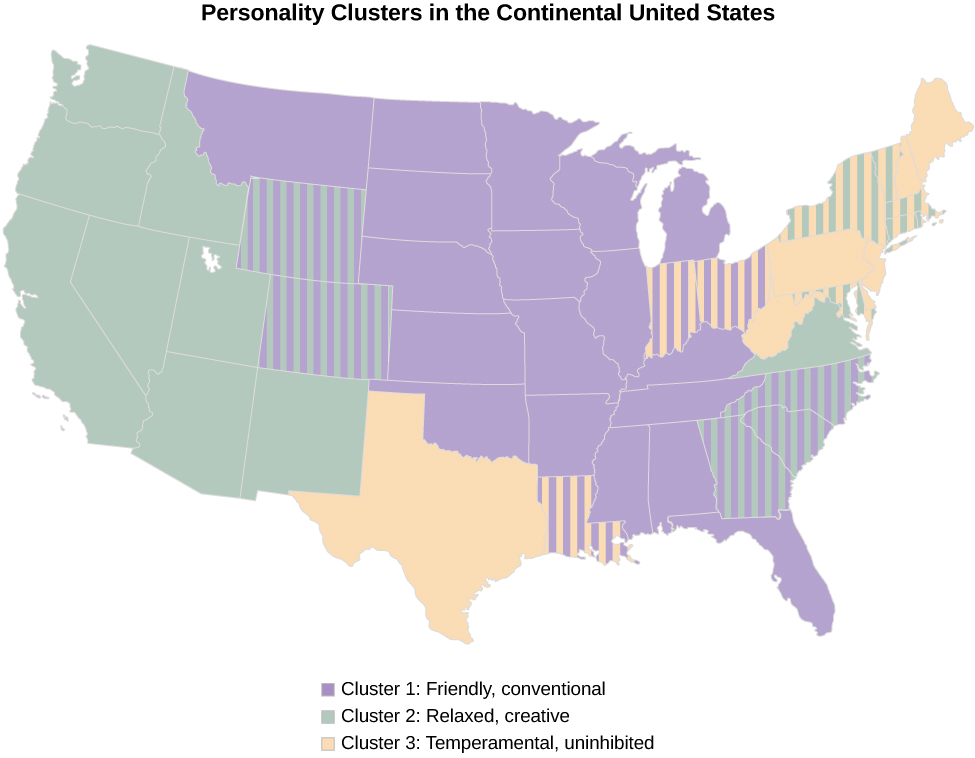

Figure 11.15図 11.15
Researchers found three distinct regional personality clusters in the United States. People tend to be friendly and conventional in the Upper Midwest and Deep South; relaxed, emotionally stable, and creative in the West; and stressed, irritable, and depressed in the Northeast (Rentfrow et al., 2013).
研究者たちは、アメリカ国内に、はっきり区別される三つの地域的なパーソナリティのクラスターを見いだした。人々は、中西部北部とディープサウスでは友好的で慣習的、西部ではくつろいでいて情緒が安定し創造的、北東部ではストレスを抱え、いらだちやすく、抑うつ的である傾向がある(Rentfrow et al., 2013)。
One explanation for the regional differences is selective migration (Rentfrow et al., 2013). Selective migration is the concept that people choose to move to places that are compatible with their personalities and needs. For example, a person high on the agreeable scale would likely want to live near family and friends, and would choose to settle or remain in such an area. In contrast, someone high on openness would prefer to settle in a place that is recognized as diverse and innovative (such as California). Further, Rentfrow, Jost, Gosling, & Potter (2009) noted an overlap between geographical regions and personality characteristics that goes beyond the often-used explanations of religion, racial diversity, and education. Their research suggests that the psychological profile of a region is closely related to that of its residents. They found that levels of openness and conscientiousness in a state may predict voting patterns, indicating that there are correlations between geographic regions and personality differences between liberals and conservatives relating to political views, levels of economic vitality, and entrepreneurial rates.
英語のヒント
地域による違いについての説明の一つが、選択的移住である(Rentfrow et al., 2013)。選択的移住とは、人は自分のパーソナリティや欲求に合った場所を選んで移り住む、という考え方である。たとえば、協調性の尺度で得点の高い人は、家族や友人の近くに住みたいと思う可能性が高く、そうした地域に落ち着くか、そこにとどまることを選ぶだろう。これに対して、開放性の高い人は、多様で革新的だと認められている場所(カリフォルニアなど)に落ち着くことを好むだろう。さらにレントフロー、ジョスト、ゴスリング、ポッター(2009)は、地理的な地域とパーソナリティの特徴とのあいだに、宗教、人種の多様性、教育というよく使われる説明を超えた重なりがあることを指摘した。彼らの研究は、ある地域の心理的なプロフィールが、その住民の心理的なプロフィールと密接に関連していることを示唆している。彼らは、ある州の開放性と誠実性の水準が投票パターンを予測しうることを見いだした。これは、地理的な地域と、リベラル派と保守派のパーソナリティの違いとのあいだに相関があることを示しており、その相関は政治的な見解、経済的な活力の水準、起業率にかかわっている。
Personality in Individualist and Collectivist Cultures個人主義文化と集団主義文化におけるパーソナリティ
Individualist cultures and collectivist cultures place emphasis on different basic values. People who live in individualist cultures tend to believe that independence, competition, and personal achievement are important. Individuals in Western nations such as the United States, England, and Australia score high on individualism (Oyserman, Coon, & Kemmelmier, 2002). People who live in collectivist cultures value social harmony, respectfulness, and group needs over individual needs. Individuals who live in countries in Asia, Africa, and South America score high on collectivism (Hofstede, 2001; Triandis, 1995). These values influence personality. For example, Yang (2006) found that people in individualist cultures displayed more personally oriented personality traits, whereas people in collectivist cultures displayed more socially oriented personality traits. Frewer and Bleus (1991) conducted a study of the Eysenck Personality Inventory in a collectivist culture using Papua New Guinean university students. They found that the results of the personality inventory were only relevant when analyzed within the context of a collectivist society. Similarly, Dana (1986) suggested that personality assessment services for Native Americans are often provided without a proper recognition of culture-specific responses and a tribe-specific frame of reference. Assessors need to have more than a general knowledge of history, tribal differences, contemporary culture on reservations, and levels of acculturation in order to interpret psychological test responses with a minimal bias.
英語のヒント
個人主義文化と集団主義文化は、それぞれ異なる基本的な価値観を重視する。個人主義文化に暮らす人々は、自立、競争、個人の達成が重要だと考える傾向がある。アメリカ、イングランド、オーストラリアのような西洋の国々の人々は、個人主義の得点が高い(Oyserman, Coon, & Kemmelmier, 2002)。集団主義文化に暮らす人々は、個人の欲求よりも、社会の調和、敬意を払うこと、集団の欲求を重んじる。アジア、アフリカ、南アメリカの国々に暮らす人々は、集団主義の得点が高い(Hofstede, 2001; Triandis, 1995)。こうした価値観は、パーソナリティに影響を与える。たとえばヤン(2006)は、個人主義文化の人々は個人志向のパーソナリティ特性をより多く示し、集団主義文化の人々は社会志向のパーソナリティ特性をより多く示すことを見いだした。フリューワーとブルース(1991)は、集団主義文化においてパプアニューギニアの大学生を対象に、アイゼンク人格目録の研究を行った。彼らは、この人格目録の結果が、集団主義社会という文脈の中で分析された場合にのみ意味を持つことを見いだした。同様にデイナ(1986)は、アメリカ先住民へのパーソナリティ評価のサービスが、文化に特有の反応や部族に特有の準拠枠を適切に認識しないまま提供されることが多いと示唆した。評価を行う者は、心理検査への反応を最小限のバイアスで解釈するために、歴史、部族間の違い、居留地の現代の文化、文化変容の程度について、一般的な知識以上のものを持っている必要がある。