第11章パーソナリティ
Projective Tests投影法検査
Another method for assessment of personality is projective testing. This kind of test relies on one of the defense mechanisms proposed by Freud—projection—as a way to assess unconscious processes. During this type of testing, a series of ambiguous cards is shown to the person being tested, who then is encouraged to project their feelings, impulses, and desires onto the cards—by telling a story, interpreting an image, or completing a sentence. Many projective tests have undergone standardization procedures (for example, Exner, 2002) and can be used to assess whether someone has unusual thoughts or a high level of anxiety, or is likely to become volatile. Some examples of projective tests are the Rorschach Inkblot Test, the Thematic Apperception Test (TAT), the Contemporized-Themes Concerning Blacks test, the TEMAS (Tell-Me-A-Story), and the Rotter Incomplete Sentence Blank (RISB). Projective tests are less subject to intentional distortion; it is hard to fake “good" because it is not obvious what a "good” answer is. Projective tests are more time consuming for the evaluator than self-report inventories. If an evaluator scores the Rorschach using the Exner scoring system, the test is considered a valid and reliable measure. However, the validity of the other projective tests is questionable, and the results are often not usable for court cases (Goldstein, n.d.).
英語のヒント
パーソナリティを評価するもう一つの方法は、投影法検査である。この種の検査は、無意識の過程を評価する手段として、フロイトが提唱した防衛機制の一つである投影を拠りどころとしている。この種の検査では、検査を受ける人に一連のあいまいなカードが示される。受検者は続いて、物語を語る、画像を解釈する、文を完成させるといった方法で、自分の感情、衝動、欲求をカードに投影するよう促される。多くの投影法検査は標準化の手続きを経ており(たとえば、Exner, 2002)、その人に普通でない考えや高い不安があるかどうか、あるいはその人が感情を爆発させるようになる可能性が高いかどうかを評価するのに使える。投影法検査の例としては、ロールシャッハ・インクブロット検査、主題統覚検査(TAT)、黒人に関する現代的主題検査、TEMAS(Tell-Me-A-Story)、ロッター文章完成法(RISB)がある。投影法検査は、意図的な歪曲の影響を受けにくい。何が「よい」答えなのかがはっきりしないので、「よく」見せかけるのが難しいのである。投影法検査は、自己報告式質問紙に比べて、評価者にとって時間がかかる。評価者がエクスナー方式の採点法を用いてロールシャッハ検査を採点するなら、この検査は妥当で信頼できる測定法とみなされる。しかし、ほかの投影法検査の妥当性は疑わしく、その結果は裁判では使えないことが多い(Goldstein, n.d.)。
The Rorschach Inkblot Test was developed in 1921 by a Swiss psychologist named Hermann Rorschach (pronounced “ROAR-shock”). It is a series of symmetrical inkblot cards that are presented to a client by a psychologist. Upon presentation of each card, the psychologist asks the client, “What might this be?” What the test-taker sees reveals unconscious feelings and struggles (Piotrowski, 1987; Weiner, 2003). The Rorschach has been standardized using the Exner system and is effective in measuring depression, psychosis, and anxiety.
英語のヒント
ロールシャッハ・インクブロット検査は、1921年に、ヘルマン・ロールシャッハ(発音は「ロア・ショック」)というスイスの心理学者によって開発された。この検査は、心理学者がクライエントに示す、左右対称のインクのしみが描かれた一連のカードから成る。カードを1枚示すたびに、心理学者はクライエントに「これは何に見えるでしょうか」と尋ねる。受検者に見えるものが、無意識の感情や葛藤を明らかにする(Piotrowski, 1987; Weiner, 2003)。ロールシャッハ検査はエクスナー方式を用いて標準化されており、抑うつ、精神病、不安を測定するのに有効である。
A second projective test is the Thematic Apperception Test (TAT), created in the 1930s by Henry Murray, an American psychologist, and a psychoanalyst named Christiana Morgan. A person taking the TAT is shown 8–12 ambiguous pictures and is asked to tell a story about each picture (Figure 11.18). The stories give insight into their social world, revealing hopes, fears, interests, and goals. The storytelling format helps to lower a person’s resistance divulging unconscious personal details (Cramer, 2004). The TAT has been used in clinical settings to evaluate psychological difficulties. Standardization of test administration is virtually nonexistent among clinicians, and the test tends to be modest to low on validity and reliability (Aronow, Weiss, & Rezinkoff, 2001; Lilienfeld, Wood, & Garb, 2000). Despite these shortcomings, the TAT has been one of the most widely used projective tests.
英語のヒント
2つ目の投影法検査は、主題統覚検査(TAT)である。1930年代に、アメリカの心理学者ヘンリー・マレーと、精神分析家のクリスティアナ・モーガンによってつくられた。TATを受ける人は、8〜12枚のあいまいな絵を見せられ、それぞれの絵について物語を語るよう求められる(図11.18)。その物語から、その人の社会的世界についての洞察が得られ、希望、恐れ、関心、目標が明らかになる。物語を語るという形式は、無意識の個人的な事柄を打ち明けることへの抵抗を弱めるのに役立つ(Cramer, 2004)。TATは、心理的な問題を評価するために臨床の場で用いられてきた。臨床家のあいだでは、検査の実施方法の標準化は事実上存在せず、この検査の妥当性と信頼性は中程度から低い傾向にある(Aronow, Weiss, & Rezinkoff, 2001; Lilienfeld, Wood, & Garb, 2000)。こうした欠点があるにもかかわらず、TATは最も広く用いられてきた投影法検査の一つである。
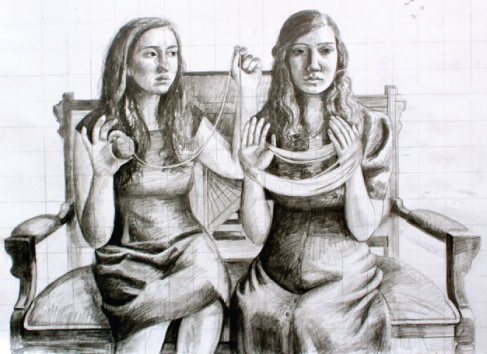
Figure 11.18図 11.18
This image is from the Thematic Apperception Tests (TAT).
この画像は主題統覚検査(TAT)のものである。
A third projective test is the Rotter Incomplete Sentence Blank (RISB) developed by Julian Rotter in 1950 (recall his theory of locus of control, covered earlier in this chapter). There are three forms of this test for use with different age groups: the school form, the college form, and the adult form. The tests include 40 incomplete sentences that people are asked to complete as quickly as possible (Figure 11.19). The average time for completing the test is approximately 20 minutes, as responses are only 1–2 words in length. This test is similar to a word association test, and like other types of projective tests, it is presumed that responses will reveal desires, fears, and struggles. The RISB is used in screening college students for adjustment problems and in career counseling (Holaday, Smith, & Sherry, 2010; Rotter & Rafferty 1950).
英語のヒント
3つ目の投影法検査は、1950年にジュリアン・ロッターが開発したロッター文章完成法(RISB)である(この章の前の方で取り上げた、ロッターの統制の所在の理論を思い出そう)。この検査には、年齢層に応じて使い分ける三つの版がある。学校用、大学用、成人用である。検査には40の未完成の文が含まれており、受検者はそれをできるだけすばやく完成させるよう求められる(図11.19)。回答は1〜2語の長さしかないので、検査を終えるまでの平均時間はおよそ20分である。この検査は言語連想検査に似ており、ほかの種類の投影法検査と同じく、回答から欲求、恐れ、葛藤が明らかになると想定されている。RISBは、大学生の適応上の問題を見つけるための選別や、キャリア・カウンセリングに用いられている(Holaday, Smith, & Sherry, 2010; Rotter & Rafferty 1950)。
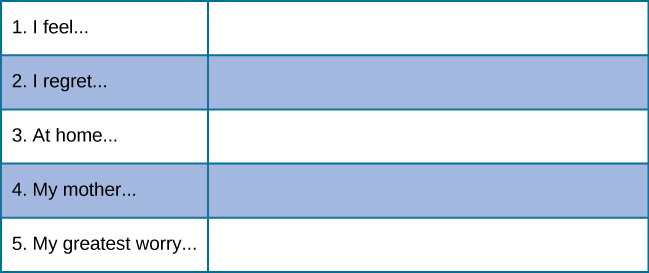


Figure 11.19図 11.19
These incomplete sentences resemble the types of questions on the RISB. How would you complete these sentences?
これらの未完成の文は、RISBの質問の種類に似ている。あなたなら、これらの文をどのように完成させるだろうか。
For many decades, these traditional projective tests have been used in cross-cultural personality assessments. However, it was found that test bias limited their usefulness (Hoy-Watkins & Jenkins-Moore, 2008). It is difficult to assess the personalities and lifestyles of members of widely divergent ethnic/cultural groups using personality instruments based on data from a single culture or race (Hoy-Watkins & Jenkins-Moore, 2008). For example, when the TAT was used with African-American test takers, the result was often shorter story length and low levels of cultural identification (Duzant, 2005). Therefore, it was vital to develop other personality assessments that explored factors such as race, language, and level of acculturation (Hoy-Watkins & Jenkins-Moore, 2008). To address this need, Robert Williams developed the first culturally specific projective test designed to reflect the everyday life experiences of African Americans (Hoy-Watkins & Jenkins-Moore, 2008). The updated version of the instrument is the Contemporized-Themes Concerning Blacks Test (C-TCB) (Williams, 1972). The C-TCB contains 20 color images that show scenes of African-American lifestyles. When the C-TCB was compared with the TAT for African Americans, it was found that use of the C-TCB led to increased story length, higher degrees of positive feelings, and stronger identification with the C-TCB (Hoy, 1997; Hoy-Watkins & Jenkins-Moore, 2008).
英語のヒント
何十年ものあいだ、こうした従来の投影法検査は、文化をまたいだパーソナリティ評価に用いられてきた。しかし、検査バイアスがその有用性を制限していることが分かった(Hoy-Watkins & Jenkins-Moore, 2008)。単一の文化や人種から得たデータに基づくパーソナリティ測定用具を使って、大きく異なる民族集団・文化集団の人々のパーソナリティや生活様式を評価するのは難しい(Hoy-Watkins & Jenkins-Moore, 2008)。たとえば、アフリカ系アメリカ人の受検者にTATを用いると、多くの場合、物語は短くなり、文化的な同一視の程度も低かった(Duzant, 2005)。そのため、人種、言語、文化変容の程度といった要因を探るような、別のパーソナリティ評価を開発することが不可欠だった(Hoy-Watkins & Jenkins-Moore, 2008)。この必要に応えるため、ロバート・ウィリアムズは、アフリカ系アメリカ人の日常生活の経験を反映するようにつくられた、文化に特化した最初の投影法検査を開発した(Hoy-Watkins & Jenkins-Moore, 2008)。この検査の改訂版が、黒人に関する現代的主題検査(C-TCB)である(Williams, 1972)。C-TCBには、アフリカ系アメリカ人の生活様式の場面を描いた20枚のカラー画像が含まれている。アフリカ系アメリカ人を対象にC-TCBとTATを比較したところ、C-TCBを用いると、物語が長くなり、肯定的な感情の度合いが高まり、C-TCBへの同一視も強まることが分かった(Hoy, 1997; Hoy-Watkins & Jenkins-Moore, 2008)。
The TEMAS Multicultural Thematic Apperception Test is another tool designed to be culturally relevant to minority groups, especially Hispanic youths. TEMAS—standing for “Tell Me a Story” but also a play on the Spanish word temas (themes)—uses images and storytelling cues that relate to minority culture (Constantino, 1982).
英語のヒント
TEMAS多文化主題統覚検査も、マイノリティ集団、とくにヒスパニックの若者にとって文化的に適切なものになるようにつくられたツールである。TEMASという名称は、「Tell Me a Story(お話を聞かせて)」を表すと同時に、スペイン語のtemas(テーマ)にかけた言葉遊びでもある。この検査では、マイノリティの文化にかかわる画像と、物語を語るための手がかりが用いられる(Constantino, 1982)。