第11章パーソナリティ
Defense Mechanisms防衛機制
Freud believed that feelings of anxiety result from the ego’s inability to mediate the conflict between the id and superego. When this happens, Freud believed that the ego seeks to restore balance through various protective measures known as defense mechanisms (Figure 11.7). When certain events, feelings, or yearnings cause an individual anxiety, the individual wishes to reduce that anxiety. To do that, the individual’s unconscious mind uses ego defense mechanisms, unconscious protective behaviors that aim to reduce anxiety. The ego, usually conscious, resorts to unconscious strivings to protect the ego from being overwhelmed by anxiety. When we use defense mechanisms, we are unaware that we are using them. Further, they operate in various ways that distort reality. According to Freud, we all use ego defense mechanisms.
英語のヒント
フロイトは、不安の感情は、イドと超自我のあいだの葛藤を自我が調停できないことから生じると考えた。そうなったとき、自我は、防衛機制として知られるさまざまな防護策によってバランスを取り戻そうとする、とフロイトは考えた(図11.7)。ある出来事や感情、切望が人に不安を引き起こすと、その人はその不安を減らしたいと願う。そのために、その人の無意識の心は、不安を減らすことを目的とした無意識の防衛的行動である自我防衛機制を用いる。自我はふだんは意識的なものだが、不安に圧倒されないよう自我を守るために、無意識的な働きに頼る。私たちは防衛機制を使っているとき、それを使っていることに気づいていない。さらに、防衛機制は、現実をゆがめるさまざまなやり方で働く。フロイトによれば、私たちは誰もが自我防衛機制を用いている。
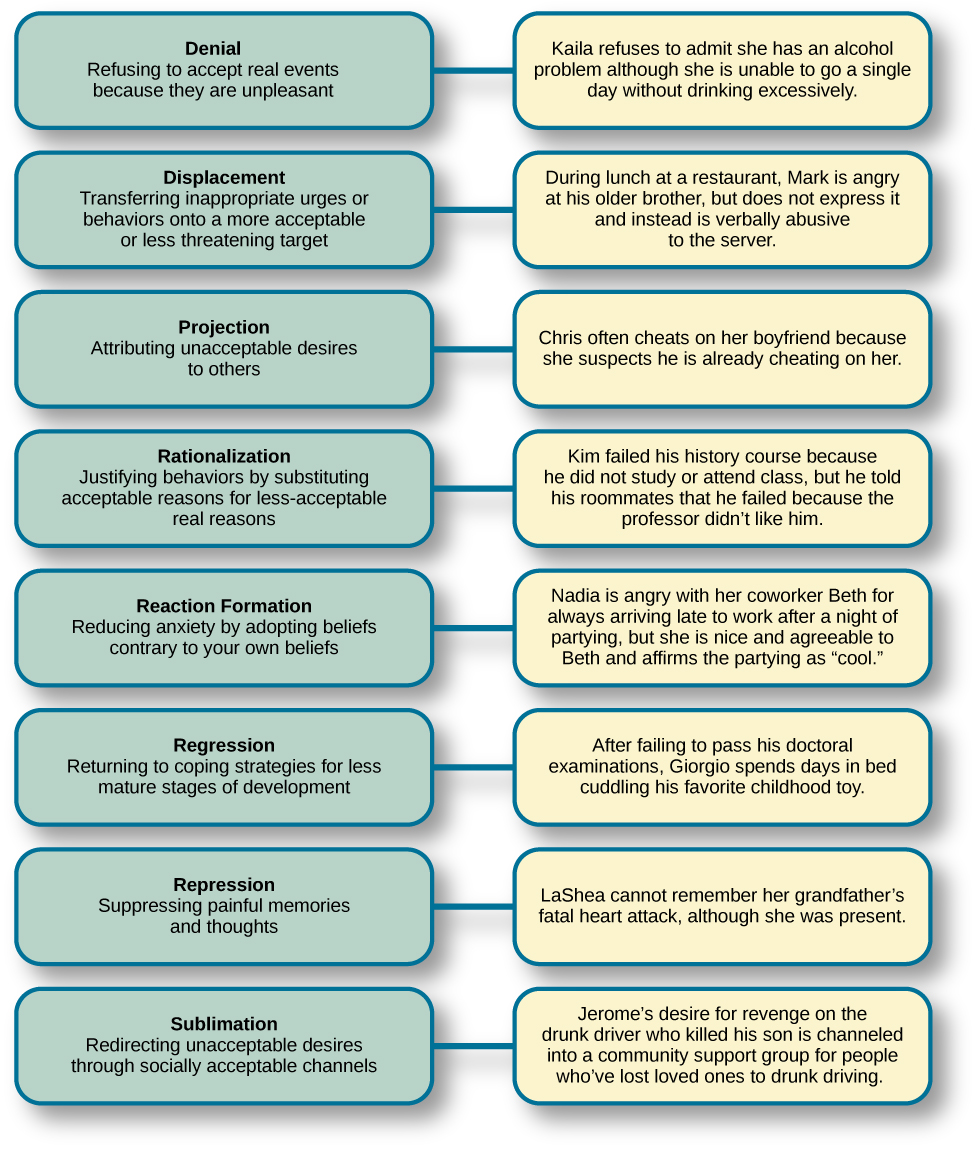

Figure 11.7図 11.7
Defense mechanisms are unconscious protective behaviors that work to reduce anxiety.
防衛機制とは、不安を減らすように働く、無意識の防衛的行動である。
While everyone uses defense mechanisms, Freud believed that overuse of them may be problematic. For example, let’s say Joe is a high school football player. Deep down, Joe feels sexually attracted to males. His conscious belief is that being gay is immoral and that if he were gay, his family would disown him and he would be ostracized by his peers. Therefore, there is a conflict between his conscious beliefs (being gay is wrong and will result in being ostracized) and his unconscious urges (attraction to males). The idea that he might be gay causes Joe to have feelings of anxiety. How can he decrease his anxiety? Joe may find himself acting very “macho,” making gay jokes, and picking on a school peer who is gay. This way, Joe’s unconscious impulses are further submerged.
英語のヒント
誰もが防衛機制を用いるが、フロイトは、防衛機制を使いすぎると問題になりうると考えた。たとえば、ジョーという高校のフットボール選手がいるとしよう。ジョーは心の奥底で、男性に性的に惹かれている。ジョーが意識のうえで信じているのは、ゲイであることは不道徳であり、もし自分がゲイだったら、家族には勘当され、仲間からは仲間はずれにされるだろう、ということである。したがって、ジョーの意識的な信念(ゲイであることは間違っており、仲間はずれにされる結果になる)と、無意識の衝動(男性に惹かれること)とのあいだには葛藤がある。自分はゲイかもしれないという考えが、ジョーに不安の感情を抱かせる。ジョーはどうすれば不安を減らせるだろうか。ジョーは、気がつくと、ひどく「マッチョ」にふるまい、ゲイをネタにした冗談を言い、学校のゲイの仲間をいじめているかもしれない。こうして、ジョーの無意識の衝動は、さらに深く沈められる。
There are several different types of defense mechanisms. For instance, in repression, anxiety-causing memories from consciousness are blocked. As an analogy, let’s say your car is making a strange noise, but because you do not have the money to get it fixed, you just turn up the radio so that you no longer hear the strange noise. Eventually you forget about it. Similarly, in the human psyche, if a memory is too overwhelming to deal with, it might be repressed and thus removed from conscious awareness (Freud, 1920). This repressed memory might cause symptoms in other areas.
英語のヒント
防衛機制にはいくつかの異なる種類がある。たとえば抑圧では、不安を引き起こす記憶が意識から締め出される。たとえ話をしよう。自分の車が妙な音を立てているが、修理に出すお金がないので、その妙な音がもう聞こえないようにラジオの音量を上げるだけにしておく、としよう。やがて、その音のことは忘れてしまう。同じように、人間の心においても、ある記憶があまりに圧倒的で向き合えない場合、その記憶は抑圧され、その結果、意識的な自覚から取り除かれるかもしれない(Freud, 1920)。この抑圧された記憶は、ほかの領域に症状を引き起こすかもしれない。
Another defense mechanism is reaction formation, in which someone expresses feelings, thoughts, and behaviors opposite to their inclinations. In the above example, Joe made fun of a gay peer while himself being attracted to males. In regression, an individual acts much younger than their age. For example, a four-year-old child who resents the arrival of a newborn sibling may act like a baby and revert to drinking out of a bottle. In projection, a person refuses to acknowledge her own unconscious feelings and instead sees those feelings in someone else. Other defense mechanisms include rationalization, displacement, and sublimation.
英語のヒント
もう一つの防衛機制は反動形成である。反動形成では、人は自分の本来の傾向とは反対の感情、思考、行動を表す。先ほどの例では、ジョーは自分自身が男性に惹かれていながら、ゲイの仲間をからかっていた。退行では、人は実際の年齢よりずっと幼くふるまう。たとえば、弟や妹が生まれたことを快く思わない4歳の子どもは、赤ちゃんのようにふるまい、哺乳瓶で飲むことに逆戻りするかもしれない。投影では、人は自分自身の無意識の感情を認めることを拒み、代わりにその感情を他者の中に見る。ほかの防衛機制には、合理化、置き換え、昇華がある。
Stages of Psychosexual Development心理性的発達の段階
Freud believed that personality develops during early childhood: Childhood experiences shape our personalities as well as our behavior as adults. He asserted that we develop via a series of stages during childhood. Each of us must pass through these childhood stages, and if we do not have the proper nurturing and parenting during a stage, we will be stuck, or fixated, in that stage, even as adults.
英語のヒント
フロイトは、パーソナリティは幼少期に発達すると考えた。子ども時代の経験が、私たちのパーソナリティを形づくり、大人になってからの行動も形づくるというのである。フロイトは、人は子ども時代に一連の段階を経て発達すると主張した。誰もがこうした子ども時代の段階を通過しなければならず、ある段階で適切な養育や子育てを受けられないと、大人になってからも、その段階にとどまったまま、すなわち固着したままになる。
In each psychosexual stage of development, the child’s pleasure-seeking urges, coming from the id, are focused on a different area of the body, called an erogenous zone. The stages are oral, anal, phallic, latency, and genital (Table 11.1).
英語のヒント
心理性的発達の各段階では、イドから生じる子どもの快楽を求める衝動が、段階ごとに異なる身体の部位に向けられる。その部位は性感帯と呼ばれる。段階は、口唇期、肛門期、男根期、潜伏期、性器期である(表11.1)。
Freud’s psychosexual development theory is quite controversial. To understand the origins of the theory, it is helpful to be familiar with the political, social, and cultural influences of Freud’s day in Vienna at the turn of the 20th century. During this era, a climate of sexual repression, combined with limited understanding and education surrounding human sexuality, heavily influenced Freud’s perspective. Given that sex was a taboo topic, Freud assumed that negative emotional states (neuroses) stemmed from suppression of unconscious sexual and aggressive urges. For Freud, his own recollections and interpretations of patients’ experiences and dreams were sufficient proof that psychosexual stages were universal events in early childhood.
英語のヒント
フロイトの心理性的発達理論には、かなり異論がある。この理論の起源を理解するには、フロイトの時代、すなわち20世紀への変わり目のウィーンにおける政治的・社会的・文化的な影響を知っておくと役に立つ。この時代には、性的な抑圧の風潮が、人間の性をめぐる限られた理解や教育と結びついて、フロイトの見方に大きな影響を与えた。性がタブーの話題だったことから、フロイトは、否定的な感情状態(神経症)は、無意識の性的衝動や攻撃的衝動が抑え込まれることから生じると想定した。フロイトにとっては、患者の経験や夢についての自分自身の回想と解釈が、心理性的段階が幼少期の普遍的な出来事であることの十分な証拠だった。
Freud’s Stages of Psychosexual Development フロイトの心理性的発達の段階 |
||||
|---|---|---|---|---|
Stage 段階 |
Age (years) 年齢(歳) |
Erogenous Zone 性感帯 |
Major Conflict 主な葛藤 |
Adult Fixation Example 大人における固着の例 |
Oral 口唇期 |
0–1 |
Mouth 口 |
Weaning off breast or bottle 乳房や哺乳瓶からの離乳 |
Smoking, overeating 喫煙、過食 |
Anal 肛門期 |
1–3 |
Anus 肛門 |
Toilet training トイレットトレーニング |
Neatness, messiness 几帳面さ、だらしなさ |
Phallic 男根期 |
3–6 |
Genitals 性器 |
Oedipus/Electra complex エディプス・コンプレックス/エレクトラ・コンプレックス |
Vanity, overambition 虚栄心、過剰な野心 |
Latency 潜伏期 |
6–12 |
None なし |
None なし |
None なし |
Genital 性器期 |
12+ |
Genitals 性器 |
None なし |
None なし |