第11章パーソナリティ
11.2 Freud and the Psychodynamic Perspective11.2 フロイトと精神力動的観点
Learning Objectives学習目標
By the end of this section, you will be able to:
この節を学び終えると、次のことができるようになる。
- Describe the assumptions of the psychodynamic perspective on personality developmentパーソナリティの発達についての精神力動的観点の前提を説明する
- Define and describe the nature and function of the id, ego, and superegoイド、自我、超自我の性質と機能を定義し、説明する
- Define and describe the defense mechanisms防衛機制を定義し、説明する
- Define and describe the psychosexual stages of personality developmentパーソナリティ発達の心理性的段階を定義し、説明する
Sigmund Freud (1856–1939) is probably the most controversial and misunderstood psychological theorist. When reading Freud’s theories, it is important to remember that he was a medical doctor, not a psychologist. There was no such thing as a degree in psychology at the time that he received his education, which can help us understand some of the controversy over his theories today. However, Freud was the first to systematically study and theorize the workings of the unconscious mind in the manner that we associate with modern psychology.
英語のヒント
ジークムント・フロイト(1856〜1939)は、おそらく最も議論を呼び、最も誤解されてきた心理学の理論家である。フロイトの理論を読むときには、彼が心理学者ではなく医師だったことを覚えておくことが大切である。フロイトが教育を受けた当時には、心理学の学位というものは存在しなかった。このことは、今日彼の理論をめぐって起きている論争の一部を理解する手がかりになりうる。しかし、無意識の心の働きを、私たちが現代の心理学と結びつけて考えるようなやり方で、体系的に研究し理論化したのは、フロイトが最初だった。
In the early years of his career, Freud worked with Josef Breuer, a Viennese physician. During this time, Freud became intrigued by the story of one of Breuer’s patients, Bertha Pappenheim, who was referred to by the pseudonym Anna O. (Launer, 2005). Anna O. had been caring for her dying father when she began to experience symptoms such as partial paralysis, headaches, blurred vision, amnesia, and hallucinations (Launer, 2005). In Freud’s day, these symptoms were commonly referred to as hysteria. Anna O. turned to Breuer for help. He spent 2 years (1880–1882) treating Anna O. and discovered that allowing her to talk about her experiences seemed to bring some relief of her symptoms. Anna O. called his treatment the “talking cure” (Launer, 2005). Despite the fact that Freud never met Anna O., her story served as the basis for the 1895 book, Studies on Hysteria, which he co-authored with Breuer. Based on Breuer’s description of Anna O.’s treatment, Freud concluded that hysteria was the result of sexual abuse in childhood and that these traumatic experiences had been hidden from consciousness. Breuer disagreed with Freud, which soon ended their work together. However, Freud continued to work to refine talk therapy and build his theory on personality.
英語のヒント
キャリアの初期に、フロイトはウィーンの医師ヨーゼフ・ブロイアーとともに仕事をした。この時期、フロイトは、ブロイアーの患者の一人ベルタ・パッペンハイムの話に強く興味を引かれた。彼女は「アンナ・O」という仮名で呼ばれていた(Launer, 2005)。アンナ・Oは死期の迫った父親を看病していたが、そのころ、部分的な麻痺、頭痛、かすみ目、健忘、幻覚といった症状を経験するようになった(Launer, 2005)。フロイトの時代には、こうした症状は一般にヒステリーと呼ばれていた。アンナ・Oはブロイアーに助けを求めた。ブロイアーは2年間(1880〜1882)をアンナ・Oの治療に費やし、自分の経験について彼女に話させると、症状がいくらか和らぐらしいことを発見した。アンナ・Oは彼の治療を「談話療法」と呼んだ(Launer, 2005)。フロイトはアンナ・Oに一度も会ったことがなかったが、彼女の話は、フロイトがブロイアーと共著で書いた1895年の本『ヒステリー研究』の土台となった。ブロイアーによるアンナ・Oの治療の記述に基づいて、フロイトは、ヒステリーは子ども時代の性的虐待の結果であり、そうした心的外傷となる経験が意識から隠されてきたのだと結論づけた。ブロイアーはフロイトに同意せず、そのために二人の共同研究はまもなく終わった。しかしフロイトは、その後も対話療法を洗練させ、パーソナリティについての自分の理論を築き上げることに取り組み続けた。
Levels of Consciousness意識の水準
To explain the concept of conscious versus unconscious experience, Freud compared the mind to an iceberg (Figure 11.5). He said that only about one-tenth of our mind is conscious, and the rest of our mind is unconscious. Our unconscious refers to that mental activity of which we are unaware and are unable to access (Freud, 1923). According to Freud, unacceptable urges and desires are kept in our unconscious through a process called repression. For example, we sometimes say things that we don’t intend to say by unintentionally substituting another word for the one we meant. You’ve probably heard of a Freudian slip, the term used to describe this. Freud suggested that slips of the tongue are actually sexual or aggressive urges, accidentally slipping out of our unconscious. Speech errors such as this are quite common. Seeing them as a reflection of unconscious desires, linguists today have found that slips of the tongue tend to occur when we are tired, nervous, or not at our optimal level of cognitive functioning (Motley, 2002).
英語のヒント
意識的な経験と無意識的な経験という概念を説明するために、フロイトは心を氷山にたとえた(図11.5)。彼は、私たちの心のうち意識されているのはおよそ10分の1にすぎず、残りは無意識だと述べた。無意識とは、私たちが自覚しておらず、接近することもできない心的活動を指す(Freud, 1923)。フロイトによれば、受け入れがたい衝動や欲望は、抑圧と呼ばれる過程を通して無意識の中にとどめられる。たとえば私たちは、言おうとしていた語の代わりにうっかり別の語を使ってしまい、言うつもりのなかったことを言うことがある。これを表す用語として、「フロイト的失言」という言葉を聞いたことがあるだろう。フロイトは、言い間違いとは、実は性的な衝動や攻撃的な衝動が無意識から誤って漏れ出たものだと示唆した。このような言い間違いはごくありふれている。今日の言語学者たちは、言い間違いを無意識の欲望の反映とみなしたうえで、言い間違いが、疲れているとき、緊張しているとき、あるいは認知機能が最適な水準にないときに起こる傾向があることを見いだしている(Motley, 2002)。
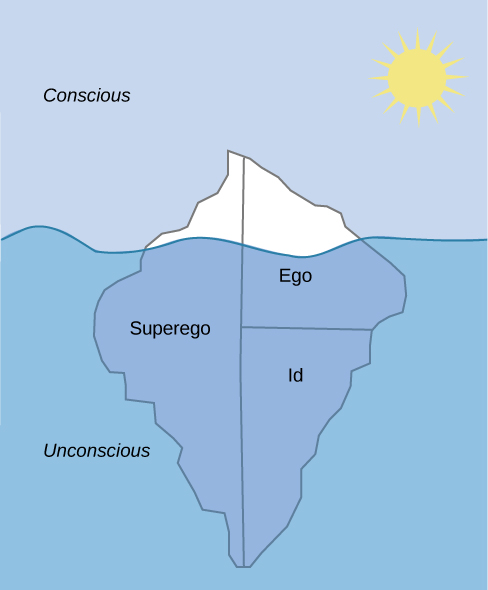
Figure 11.5図 11.5
Freud believed that we are only aware of a small amount of our mind’s activities and that most of it remains hidden from us in our unconscious. The information in our unconscious affects our behavior, although we are unaware of it.
フロイトは、私たちが自覚しているのは心の活動のごく一部にすぎず、その大部分は無意識の中に隠れたままだと考えた。無意識の中にある情報は、私たちがそれを自覚していなくても、私たちの行動に影響を与える。
According to Freud, our personality develops from a conflict between two forces: our biological aggressive and pleasure-seeking drives versus our internal (socialized) control over these drives. Our personality is the result of our efforts to balance these two competing forces. Freud suggested that we can understand this by imagining three interacting systems within our minds. He called them the id, ego, and superego (Figure 11.6).
英語のヒント
フロイトによれば、私たちのパーソナリティは、二つの力のあいだの葛藤から発達する。一方は攻撃や快楽を求める生物学的な欲動であり、もう一方はそうした欲動に対する私たちの内的な(社会化された)統制である。パーソナリティは、競合するこの二つの力のバランスを取ろうとする私たちの努力の結果である。フロイトは、心の中で互いに作用し合う三つのシステムを思い描けば、このことが理解できると示唆した。フロイトはそれらをイド、自我、超自我と呼んだ(図11.6)。
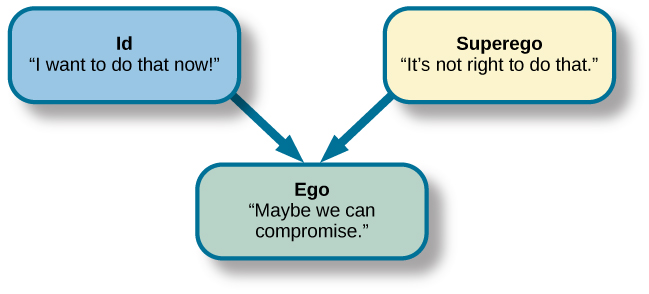


Figure 11.6図 11.6
The job of the ego, or self, is to balance the aggressive/pleasure-seeking drives of the id with the moral control of the superego.
自我、すなわち自己の仕事は、イドの攻撃的・快楽追求的な欲動と、超自我の道徳的な統制とのバランスを取ることである。
The unconscious id contains our most primitive drives or urges, and is present from birth. It directs impulses for hunger, thirst, and sex. Freud believed that the id operates on what he called the “pleasure principle,” in which the id seeks immediate gratification. Through social interactions with parents and others in a child’s environment, the ego and superego develop to help control the id. The superego develops as a child interacts with others, learning the social rules for right and wrong. The superego acts as our conscience; it is our moral compass that tells us how we should behave. It strives for perfection and judges our behavior, leading to feelings of pride or—when we fall short of the ideal—feelings of guilt. In contrast to the instinctual id and the rule-based superego, the ego is the rational part of our personality. It’s what Freud considered to be the self, and it is the part of our personality that is seen by others. Its job is to balance the demands of the id and superego in the context of reality; thus, it operates on what Freud called the “reality principle.” The ego helps the id satisfy its desires in a realistic way.
英語のヒント
無意識的なイドは、私たちの最も原始的な欲動や衝動を含み、生まれたときから存在している。イドは、飢え、渇き、性を求める衝動をつかさどる。フロイトは、イドは彼が「快楽原則」と呼んだものに従って働くと考えた。快楽原則のもとで、イドは即座の満足を求める。子どもの環境にいる親やほかの人々との社会的な相互作用を通して、自我と超自我が発達し、イドを制御するのを助ける。超自我は、子どもがほかの人々とかかわり、善悪についての社会的なルールを学んでいくにつれて発達する。超自我は私たちの良心として働く。つまり、私たちがどうふるまうべきかを教えてくれる道徳の羅針盤である。超自我は完全を目指して努め、私たちの行動を裁く。その結果、誇りの感情が生じたり、あるいは、私たちが理想に届かないときには罪悪感が生じたりする。本能的なイドや規則に基づく超自我とは対照的に、自我はパーソナリティの理性的な部分である。自我は、フロイトが自己とみなしたものであり、パーソナリティのうちで他者から見える部分である。自我の仕事は、現実という文脈の中でイドと超自我の要求のバランスを取ることである。したがって自我は、フロイトが「現実原則」と呼んだものに従って働く。自我は、イドが現実的なやり方で欲望を満たせるように助ける。
The id and superego are in constant conflict, because the id wants instant gratification regardless of the consequences, but the superego tells us that we must behave in socially acceptable ways. Thus, the ego’s job is to find the middle ground. It helps satisfy the id’s desires in a rational way that will not lead us to feelings of guilt. According to Freud, a person who has a strong ego, which can balance the demands of the id and the superego, has a healthy personality. Freud maintained that imbalances in the system can lead to neurosis (a tendency to experience negative emotions), anxiety disorders, or unhealthy behaviors. For example, a person who is dominated by their id might be narcissistic and impulsive. A person with a dominant superego might be controlled by feelings of guilt and deny themselves even socially acceptable pleasures; conversely, if the superego is weak or absent, a person might become a psychopath. An overly dominant superego might be seen in an over-controlled individual whose rational grasp on reality is so strong that they are unaware of their emotional needs, or, in a neurotic who is overly defensive (overusing ego defense mechanisms).
英語のヒント
イドと超自我は絶えず葛藤している。イドは結果にかかわらず即座の満足を求めるが、超自我は、社会的に受け入れられるやり方でふるまわなければならないと私たちに告げるからである。したがって、自我の仕事は妥協点を見つけることである。自我は、罪悪感につながらない理性的なやり方で、イドの欲望を満たす手助けをする。フロイトによれば、イドと超自我の要求のバランスを取ることのできる強い自我を持つ人は、健全なパーソナリティを持っている。フロイトは、このシステムの不均衡は、神経症(否定的な感情を経験する傾向)、不安障害、あるいは不健全な行動につながりうると主張した。たとえば、イドに支配されている人は、自己愛的で衝動的かもしれない。超自我が優位な人は、罪悪感に支配され、社会的に受け入れられる楽しみさえ自分に禁じるかもしれない。反対に、超自我が弱かったり欠けていたりすると、その人はサイコパスになるかもしれない。超自我が過度に優位な状態は、現実を理性的にとらえる力があまりに強いために自分の感情的な欲求に気づかない、統制の強すぎる人に見られるかもしれない。あるいは、過度に防衛的な(自我防衛機制を使いすぎる)神経症の人にも見られるかもしれない。