第9章生涯発達
Cognitive Development認知発達
More complex thinking abilities emerge during adolescence. Some researchers suggest this is due to increases in processing speed and efficiency rather than as the result of an increase in mental capacity—in other words, due to improvements in existing skills rather than development of new ones (Bjorkland, 1987; Case, 1985). During adolescence, teenagers move beyond concrete thinking and become capable of abstract thought. Recall that Piaget refers to this stage as formal operational thought. Teen thinking is also characterized by the ability to consider multiple points of view, imagine hypothetical situations, debate ideas and opinions (e.g., politics, religion, and justice), and form new ideas (Figure 9.17). In addition, it’s not uncommon for adolescents to question authority or challenge established societal norms.
英語のヒント
青年期には、より複雑な思考能力が現れる。これは、心的な容量が増えた結果というよりも、処理の速度と効率が高まることによる、と示唆する研究者もいる。言い換えれば、新しい技能が発達するからではなく、既存の技能が向上するからだというのである(Bjorkland, 1987; Case, 1985)。青年期に10代の若者は具体的な思考を超えて、抽象的な思考ができるようになる。ピアジェがこの段階を形式的操作的思考と呼んでいることを思い出そう。10代の思考には、複数の視点を考慮し、仮定の状況を想像し、考えや意見(たとえば政治、宗教、正義)について議論し、新しい考えを形づくる能力がある、という特徴もある(図9.17)。さらに、青年が権威に疑問を投げかけたり、確立された社会規範に異議を唱えたりすることも珍しくない。
Cognitive empathy, also known as theory-of-mind (which we discussed earlier with regard to egocentrism), relates to the ability to take the perspective of others and feel concern for others (Shamay-Tsoory, Tomer, & Aharon-Peretz, 2005). Cognitive empathy begins to increase in adolescence and is an important component of social problem solving and conflict avoidance. According to one longitudinal study, levels of cognitive empathy begin rising in girls around 13 years old, and around 15 years old in boys (Van der Graaff et al., 2013). Teens who reported having supportive fathers with whom they could discuss their worries were found to be better able to take the perspective of others (Miklikowska, Duriez, & Soenens, 2011).
英語のヒント
認知的共感は、心の理論(先に自己中心性に関連して論じた)とも呼ばれ、他者の視点に立ち、他者を思いやる能力にかかわる(Shamay-Tsoory, Tomer, & Aharon-Peretz, 2005)。認知的共感は青年期に高まりはじめ、社会的な問題解決や衝突の回避の重要な要素となる。ある縦断的研究によれば、認知的共感の水準は、女子では13歳ごろ、男子では15歳ごろに上がりはじめる(Van der Graaff et al., 2013)。悩みを話し合える、支えになってくれる父親がいると報告した10代の若者は、他者の視点に立つ力がより高いことが分かった(Miklikowska, Duriez, & Soenens, 2011)。
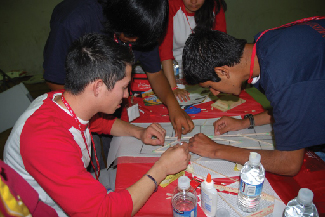

Figure 9.17図 9.17
Teenage thinking is characterized by the ability to reason logically and solve hypothetical problems such as how to design, plan, and build a structure. (credit: U.S. Army RDECOM)
10代の思考の特徴は、論理的に推論し、構造物をどう設計し、計画し、建てるかといった仮定の問題を解く能力である。(出典:U.S. Army RDECOM)
Psychosocial Development心理社会的発達
Adolescents continue to refine their sense of self as they relate to others. Erikson referred to the task of the adolescent as one of identity versus role confusion. Thus, in Erikson’s view, an adolescent’s main questions are “Who am I?” and “Who do I want to be?” Some adolescents adopt the values and roles that their parents expect for them. Other teens develop identities that are in opposition to their parents but align with a peer group. This is common as peer relationships become a central focus in adolescents’ lives.
英語のヒント
青年は、他者とかかわるなかで自己の感覚を磨き続ける。エリクソンは、青年期の課題を「アイデンティティ対役割の混乱」の課題と呼んだ。したがってエリクソンの見方では、青年の主な問いは「自分は何者か」と「自分は何者になりたいか」である。親が自分に期待する価値観や役割を受け入れる青年もいる。一方、親とは対立するが仲間集団とは一致するアイデンティティを発達させる10代の若者もいる。仲間との関係が青年の生活の中心になるため、これはよくあることである。
As adolescents work to form their identities, they pull away from their parents, and the peer group becomes very important (Shanahan, McHale, Osgood, & Crouter, 2007). Despite spending less time with their parents, most teens report positive feelings toward them (Moore, Guzman, Hair, Lippman, & Garrett, 2004). Warm and healthy parent-child relationships have been associated with positive child outcomes, such as better grades and fewer school behavior problems, in the United States as well as in other countries (Hair et al., 2005).
英語のヒント
青年はアイデンティティを形成しようと努めるなかで親から離れていき、仲間集団がとても重要になる(Shanahan, McHale, Osgood, & Crouter, 2007)。親と過ごす時間は少なくなるものの、ほとんどの10代の若者は親に対して肯定的な感情を抱いていると報告している(Moore, Guzman, Hair, Lippman, & Garrett, 2004)。温かく健全な親子関係は、アメリカでもほかの国々でも、より良い成績や学校での問題行動の少なさなど、子どもにとっての肯定的な結果と関連していることが分かっている(Hair et al., 2005)。
It appears that most teens don’t experience adolescent storm and stress to the degree once famously suggested by G. Stanley Hall, a pioneer in the study of adolescent development. Only small numbers of teens have major conflicts with their parents (Steinberg & Morris, 2001), and most disagreements are minor. For example, in a study of over 1,800 parents of adolescents from various cultural and ethnic groups, Barber (1994) found that conflicts occurred over day-to-day issues such as homework, money, curfews, clothing, chores, and friends. These types of arguments tend to decrease as teens develop (Galambos & Almeida, 1992). There is emerging research on the adolescent brain. Galvan, Hare, Voss, Glover and Casey (2007) examined its role in risk-taking behavior. They used fMRI to assess the readings’ relationship to risk-taking, risk perception, and impulsivity. The researchers found that there was no correlation between brain activity in the neural reward center and impulsivity and risk perception. However, activity in that part of the brain was correlated to risk taking. In other words, risk-taking adolescents experienced brain activity in the reward center. The idea that adolescents, however, are more impulsive than other demographics was challenged in their research, which included children and adults.
英語のヒント
ほとんどの10代の若者は、青年期の発達研究の先駆者であるG・スタンリー・ホールがかつて唱えて有名になったほどには、青年期の疾風怒濤を経験しないようである。親と大きな衝突をする10代の若者はごく少数にすぎず(Steinberg & Morris, 2001)、ほとんどの意見の不一致はささいなものである。たとえばバーバー(1994)は、さまざまな文化集団・民族集団に属する青年の親1,800人以上を対象とした研究で、衝突は宿題、お金、門限、服装、家事、友人といった日常的な問題をめぐって起こることを見いだした。この種の口論は、10代の若者が成長するにつれて減っていく傾向がある(Galambos & Almeida, 1992)。青年期の脳については、新しい研究が現れつつある。ガルバン、ヘア、ヴォス、グローヴァー、ケイシー(2007)は、リスクを冒す行動において脳が果たす役割を調べた。研究者たちはfMRIを用いて、その測定値と、リスクを冒すこと、リスク知覚、衝動性との関係を評価した。研究者たちは、神経の報酬中枢の脳活動と、衝動性やリスク知覚とのあいだに相関がないことを見いだした。しかし、脳のその部位の活動は、リスクを冒すことと相関していた。言い換えれば、リスクを冒す青年では、報酬中枢に脳活動が生じていた。とはいえ、青年はほかの人口集団よりも衝動的だという考えは、子どもと大人も対象に含めた彼らの研究によって疑問を投げかけられた。
Emerging Adulthood成人形成期
The next stage of development is emerging adulthood. This is a relatively newly defined period of lifespan development spanning from 18 years old to the mid-20s, characterized as an in-between time where identity exploration is focused on work and love.
英語のヒント
次の発達段階は成人形成期である。これは比較的新しく定義された生涯発達の時期で、18歳から20代半ばまでにわたり、アイデンティティの探索が仕事と恋愛に向けられる、どっちつかずの中間の時期として特徴づけられる。
When does a person become an adult? There are many ways to answer this question. In the United States, you are legally considered an adult at 18 years old. But other definitions of adulthood vary widely; in sociology, for example, a person may be considered an adult when they become self-supporting, choose a career, get married, or start a family. The ages at which we achieve these milestones vary from person to person as well as from culture to culture. For example, in the African country of Malawi, 15-year-old Njemile was married at 14 years old and had her first child at 15 years old. In her culture she is considered an adult. Children in Malawi take on adult responsibilities such as marriage and work (e.g., carrying water, tending babies, and working fields) as early as 10 years old. In stark contrast, independence in Western cultures is taking longer and longer, effectively delaying the onset of adult life.
英語のヒント
人はいつ大人になるのだろうか。この問いに答える方法はたくさんある。アメリカでは、18歳で法的に大人とみなされる。しかし、大人であることのほかの定義は大きく異なる。たとえば社会学では、自活する、職業を選ぶ、結婚する、家庭を築くといったときに、その人は大人とみなされうる。こうした節目を迎える年齢は、人によっても文化によっても異なる。たとえば、アフリカの国マラウイに住む15歳のンジェミレは、14歳で結婚し、15歳で最初の子どもを産んだ。彼女の文化では、彼女は大人とみなされている。マラウイの子どもたちは、早ければ10歳で、結婚や仕事(たとえば、水を運ぶ、赤ん坊の世話をする、畑で働く)といった大人の責任を担う。これとはまったく対照的に、西洋の文化では自立までにかかる時間がますます長くなっており、その結果、大人としての生活の始まりが事実上遅れている。
What factors are leading to these changes regarding financial and familial independence? It seems that emerging adulthood is a product of both Western culture and our current times (Arnett, 2000). People in higher income and more industrialized countries are living longer, allowing the freedom to take an extra decade to start a career and family. Changes in the workforce also play a role. For example, 50 years ago, a young adult with a high school diploma could immediately enter the work force and climb the economic ladder. That is no longer the case. Bachelor’s and even graduate degrees are required more and more often—even for entry-level jobs (Arnett, 2000). In addition, many students are taking longer (five or six years) to complete a college degree as a result of working and going to school at the same time. After graduation, many young adults return to the family home because they have difficulty finding a job. The term Boomerang Generation describes recent college graduates for whom lack of adequate employment upon college graduation often leads to a return to the parental home (Davidson, 2014). Changing cultural expectations may be the most important reason for the delay in entering adult roles. Young people are spending more time exploring their options, so they are delaying marriage and work as they change majors and jobs multiple times, putting them on a much later timetable than their parents (Arnett, 2000).
英語のヒント
経済面や家族面での自立をめぐるこうした変化は、どのような要因によってもたらされているのだろうか。成人形成期は、西洋文化と現代という時代の両方の産物であるようだ(Arnett, 2000)。所得が高く工業化の進んだ国々の人々は長生きになっており、そのおかげで、職業に就き家庭を築くまでにさらに10年をかける自由が生まれている。労働市場の変化も一役買っている。たとえば50年前には、高校卒業の資格を持つ若者は、すぐに働きはじめて経済的な階段を上っていくことができた。今はもうそうではない。学士号、さらには大学院の学位までもが、ますます頻繁に求められるようになっている。それも初級レベルの仕事でさえそうなのである(Arnett, 2000)。さらに、働きながら学校に通うために、大学の学位を取るのにより長い期間(5〜6年)をかける学生も多い。卒業後には、仕事を見つけるのに苦労するため実家に戻る若者も多い。ブーメラン世代という言葉は、大学卒業時に十分な職が得られないことから、しばしば親の家に戻ることになる最近の大卒者を表す(Davidson, 2014)。大人の役割に入るのが遅れる最も重要な理由は、文化的な期待の変化かもしれない。若者は自分の選択肢を探ることに多くの時間をかけているので、専攻や仕事を何度も変えるなかで結婚や就職を先延ばしにしており、その結果、親よりもはるかに遅い予定表で人生を歩むことになる(Arnett, 2000)。