第9章生涯発達
Infancy Through Childhood乳児期から児童期まで
The average newborn weighs approximately 7.5 pounds. Although small, newborns are not completely helpless because their reflexes and sensory capacities help them interact with the environment from the moment of birth. All healthy babies are born with newborn reflexes: inborn automatic responses to particular forms of stimulation. Reflexes help the newborn survive until it is capable of more complex behaviors—these reflexes are crucial to survival. They are present in babies whose brains are developing normally and usually disappear around 4–5 months old. Let’s take a look at some of these newborn reflexes. The rooting reflex is the newborn’s response to anything that touches their cheek: When you stroke a baby’s cheek, the baby naturally turns the head in that direction and begins to suck. The sucking reflex is the automatic, unlearned, sucking motions that infants do with their mouths. Several other interesting newborn reflexes can be observed. For instance, if you put your finger into a newborn’s hand, you will witness the grasping reflex, in which a baby automatically grasps anything that touches the palms. The Moro reflex is the newborn’s response to the sensation of falling. The baby spreads the arms, pulls them back in, and then (usually) cries. How do you think these reflexes promote survival in the first months of life?
英語のヒント
新生児の平均体重は約7.5ポンドである。新生児は小さいとはいえ、まったく無力なわけではない。反射と感覚の能力のおかげで、生まれた瞬間から環境とかかわることができるからである。健康な赤ちゃんはみな、新生児反射を持って生まれてくる。新生児反射とは、特定の形の刺激に対する生まれつきの自動的な反応である。反射は、新生児がより複雑な行動をとれるようになるまで生き延びるのを助ける。つまり、こうした反射は生存に欠かせない。反射は脳が正常に発達している赤ちゃんに見られ、通常は生後4〜5か月ごろに消える。こうした新生児反射のいくつかを見てみよう。探索反射は、頬に触れるものに対する新生児の反応である。赤ちゃんの頬をなでると、赤ちゃんは自然にその方向へ顔を向け、吸いはじめる。吸啜反射は、乳児が口で行う、自動的で学習によらない吸う動きである。ほかにも興味深い新生児反射がいくつか観察できる。たとえば、新生児の手に指を入れると、把握反射が見られる。赤ちゃんが、手のひらに触れるものを何でも自動的に握る反射である。モロー反射は、落ちる感覚に対する新生児の反応である。赤ちゃんは両腕を広げ、それを引き戻し、それから(たいていは)泣く。こうした反射は、生後数か月の生存をどのように助けていると思うか。
What can young infants see, hear, and smell? Newborn infants’ sensory abilities are significant, but their senses are not yet fully developed. Many of a newborn’s innate preferences facilitate interaction with caregivers and other humans. Although vision is their least developed sense, newborns already show a preference for faces. Babies who are just a few days old also prefer human voices, they will listen to voices longer than sounds that do not involve speech (Vouloumanos & Werker, 2004), and they seem to prefer their mother’s voice over a stranger’s voice (Mills & Melhuish, 1974). In an interesting experiment, 3-week-old babies were given pacifiers that played a recording of the infant’s mother’s voice and of a stranger’s voice. When the infants heard their mother’s voice, they sucked more strongly at the pacifier (Mills & Melhuish, 1974). Newborns also have a strong sense of smell. For instance, newborn babies can distinguish the smell of their own mother from that of others. In a study by MacFarlane (1978), 1-week-old babies who were being breastfed were placed between two gauze pads. One gauze pad was from the bra of a nursing mother who was a stranger, and the other gauze pad was from the bra of the infant’s own mother. More than two-thirds of the week-old babies turned toward the gauze pad with their mother’s scent.
英語のヒント
生まれて間もない乳児は、何を見たり、聞いたり、嗅いだりできるのだろうか。新生児の感覚能力は相当なものだが、感覚はまだ十分に発達していない。新生児の生まれつきの好みの多くは、養育者やほかの人間とのやりとりを促す。視覚は最も発達の遅れている感覚だが、新生児はすでに顔を好む傾向を示す。生後数日の赤ちゃんは人の声も好む。話し言葉を含まない音よりも声のほうを長く聞き(Vouloumanos & Werker, 2004)、見知らぬ人の声よりも母親の声を好むようである(Mills & Melhuish, 1974)。ある興味深い実験では、生後3週の赤ちゃんに、その乳児の母親の声と見知らぬ人の声の録音を流すおしゃぶりが与えられた。乳児は、母親の声が聞こえると、おしゃぶりをより強く吸った(Mills & Melhuish, 1974)。新生児は嗅覚も鋭い。たとえば、新生児は自分の母親のにおいをほかの人のにおいと区別できる。マクファーレン(1978)の研究では、母乳で育てられている生後1週の赤ちゃんが、2枚のガーゼパッドのあいだに寝かされた。一方のガーゼパッドは、見知らぬ授乳中の母親のブラジャーから取ったもので、もう一方は、その乳児自身の母親のブラジャーから取ったものだった。生後1週の赤ちゃんの3分の2以上が、母親のにおいのするガーゼパッドのほうを向いた。
Physical Development身体発達
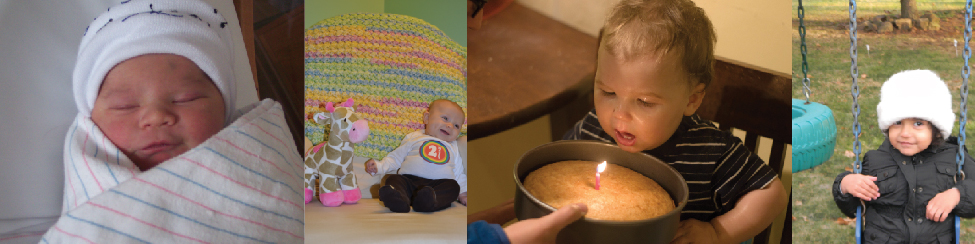
In infancy, toddlerhood, and early childhood, the body’s physical development is rapid (Figure 9.10). On average, newborns weigh between 5 and 10 pounds, and a newborn’s weight typically doubles in six months and triples in one year. By 2 years old the weight will have quadrupled, so we can expect that a 2 year old should weigh between 20 and 40 pounds. The average length of a newborn is 19.5 inches, increasing to 29.5 inches by 12 months and 34.4 inches by 2 years old (WHO Multicentre Growth Reference Study Group, 2006).
英語のヒント
乳児期、よちよち歩きの時期、幼児期には、身体発達が急速に進む(図9.10)。平均すると、新生児の体重は5〜10ポンドで、ふつうは6か月で2倍、1年で3倍になる。2歳までに体重は4倍になっているので、2歳児の体重は20〜40ポンドほどになると予想できる。新生児の平均身長は19.5インチで、12か月までに29.5インチ、2歳までに34.4インチに伸びる(WHO Multicentre Growth Reference Study Group, 2006)。
OpenStax, Rice University; Psychology 2e. (credit "left": modification of work by Kerry Ceszyk; credit "middle-left": modification of work by Kristi Fausel; credit "middle-right": modification of work by "devinf"/Flickr; credit "right": modification of work by Rose Spielman) · CC BY 4.0 · Source出典

Figure 9.10図 9.10
Children experience rapid physical changes through infancy and early childhood. (credit "left": modification of work by Kerry Ceszyk; credit "middle-left": modification of work by Kristi Fausel; credit "middle-right": modification of work by "devinf"/Flickr; credit "right": modification of work by Rose Spielman)
子どもは乳児期と幼児期を通じて、急速な身体的変化を経験する。(出典「左」:Kerry Ceszykの作品を改変、出典「中央左」:Kristi Fauselの作品を改変、出典「中央右」:“devinf”/Flickrの作品を改変、出典「右」:Rose Spielmanの作品を改変)
During infancy and childhood, growth does not occur at a steady rate (Carel, Lahlou, Roger, & Chaussain, 2004). Growth slows between 4 and 6 years old: During this time children gain 5–7 pounds and grow about 2–3 inches per year. Once females reach 8–9 years old, their growth rate outpaces that of males due to a pubertal growth spurt. This growth spurt continues until around 12 years old, coinciding with the start of the menstrual cycle. By 10 years old, the average female weighs 88 pounds, and the average male weighs 85 pounds.
英語のヒント
乳児期と児童期を通じて、成長は一定の速さで進むわけではない(Carel, Lahlou, Roger, & Chaussain, 2004)。4〜6歳のあいだは成長がゆるやかになり、この時期の子どもは1年に体重が5〜7ポンド増え、身長が約2〜3インチ伸びる。女子は8〜9歳になると、思春期の成長スパートによって、成長の速さが男子を上回る。この成長スパートは12歳ごろまで続き、月経周期の始まりと重なる。10歳までに、女子の平均体重は88ポンド、男子の平均体重は85ポンドになる。
It was previously believed that we are born with all of the brain cells we will ever have. More recent research suggests that neurogenesis (the formation of neurons) can continue through adulthood. However, the vast majority of neural connections and pathways occur during the first few years of a child’s life (National Institute of Neurological Disorders and Stroke, 2019). This period of rapid neural growth is called blooming. Neural pathways continue to develop through puberty. The blooming period of neural growth is then followed by a period of pruning, where neural connections are reduced. It is thought that pruning causes the brain to function more efficiently, allowing for mastery of more complex skills (Hutchinson, 2011). Blooming occurs during the first few years of life, and pruning continues through childhood and into adolescence in various areas of the brain.
英語のヒント
私たちは、生涯に持つことになる脳細胞をすべて持って生まれてくる、とかつては考えられていた。より最近の研究は、神経新生(ニューロンの形成)が成人期を通じて続きうることを示唆している。しかし、神経のつながりと経路の大部分は、子どもの人生の最初の数年間に生じる(National Institute of Neurological Disorders and Stroke, 2019)。この急速な神経成長の時期はブルーミングと呼ばれる。神経の経路は思春期を通じて発達し続ける。神経成長のブルーミングの時期の後には、刈り込み(プルーニング)の時期が続き、そこでは神経のつながりが減らされる。刈り込みによって脳はより効率的に機能するようになり、より複雑な技能の習得が可能になると考えられている(Hutchinson, 2011)。ブルーミングは人生の最初の数年間に起こり、刈り込みは脳のさまざまな領域で、児童期を通して青年期まで続く。
The size of our brains increases rapidly. For example, the brain of a 2-year-old is 55% of its adult size, and by 6 years old the brain is about 90% of its adult size (Tanner, 1978). During early childhood (ages 3–6), the frontal lobes grow rapidly. Recalling our discussion of the 4 lobes of the brain earlier in this book, the frontal lobes are associated with planning, reasoning, memory, and impulse control. Therefore, by the time children reach school age, they are developmentally capable of controlling their attention and behavior. Through the elementary school years, the frontal, temporal, occipital, and parietal lobes all grow in size. The brain growth spurts experienced in childhood tend to follow Piaget’s sequence of cognitive development, so that significant changes in neural functioning account for cognitive advances (Kolb & Whishaw, 2009; Overman, Bachevalier, Turner, & Peuster, 1992).
英語のヒント
私たちの脳は急速に大きくなる。たとえば、2歳児の脳は大人の大きさの55%であり、6歳までには大人の大きさの約90%になる(Tanner, 1978)。幼児期(3〜6歳)には、前頭葉が急速に成長する。本書の前のほうで扱った脳の四つの葉の話を思い出すと、前頭葉は計画、推論、記憶、衝動の制御と関連している。したがって、学齢期に達するころには、子どもは発達的に、自分の注意と行動を制御できるようになっている。小学校の時期を通じて、前頭葉、側頭葉、後頭葉、頭頂葉はいずれも大きくなる。児童期に経験される脳の成長スパートは、ピアジェの認知発達の順序に沿う傾向があり、そのため、神経機能の大きな変化によって認知の進歩が説明される(Kolb & Whishaw, 2009; Overman, Bachevalier, Turner, & Peuster, 1992)。
Motor development occurs in an orderly sequence as infants move from reflexive reactions (e.g., sucking and rooting) to more advanced motor functioning. For instance, babies first learn to hold their heads up, then to sit with assistance, and then to sit unassisted, followed later by crawling and then walking.
英語のヒント
運動の発達は、乳児が反射的な反応(たとえば吸啜や探索)から、より高度な運動機能へと進むにつれて、秩序立った順序で起こる。たとえば赤ちゃんは、まず頭を持ち上げておくことを覚え、次に支えられて座ること、それから支えなしで座ることを覚える。その後に、はいはい、そして歩行が続く。
Motor skills refer to our ability to move our bodies and manipulate objects. Fine motor skills focus on the muscles in our fingers, toes, and eyes, and enable coordination of small actions (e.g., grasping a toy, writing with a pencil, and using a spoon). Gross motor skills focus on large muscle groups that control our arms and legs and involve larger movements (e.g., balancing, running, and jumping).
英語のヒント
運動技能とは、体を動かしたり物を操作したりする能力を指す。微細運動技能は、手の指、足の指、目の筋肉を中心とする技能で、小さな動作の協調を可能にする(たとえば、おもちゃをつかむ、鉛筆で書く、スプーンを使う)。粗大運動技能は、腕や脚を制御する大きな筋肉群を中心とする技能で、より大きな動きを伴う(たとえば、バランスをとる、走る、跳ぶ)。
As motor skills develop, there are certain developmental milestones that young children should achieve (Table 9.4). For each milestone there is an average age, as well as a range of ages in which the milestone should be reached. An example of a developmental milestone is sitting. On average, most babies sit alone at 7 months old. Sitting involves both coordination and muscle strength, and 90% of babies achieve this milestone between 5 and 9 months old. In another example, babies on average are able to hold up their head at 6 weeks old, and 90% of babies achieve this between 3 weeks and 4 months old. If a baby is not holding up their head by 4 months old, they are showing a delay. If the child is displaying delays on several milestones, that is reason for concern, and the parent or caregiver should discuss this with the child’s pediatrician. Some developmental delays can be identified and addressed through early intervention.
英語のヒント
運動技能が発達するにつれて、幼い子どもが達成するはずの発達の節目がいくつかある(表9.4)。それぞれの節目には平均年齢があり、その節目に到達するはずの年齢の範囲もある。発達の節目の一例は、座ることである。平均すると、たいていの赤ちゃんは生後7か月で一人で座る。座ることには協調と筋力の両方が必要であり、90%の赤ちゃんは生後5〜9か月のあいだにこの節目を達成する。別の例を挙げると、赤ちゃんは平均して生後6週で頭を持ち上げていられるようになり、90%の赤ちゃんは生後3週から4か月のあいだにこれを達成する。生後4か月になっても頭を持ち上げていられない場合、その赤ちゃんには遅れが見られることになる。子どもがいくつもの節目で遅れを示しているなら、それは懸念すべき理由であり、親や養育者は子どもの小児科医と相談すべきである。発達の遅れの中には、早期介入によって発見し、対処できるものもある。
Developmental Milestones, Ages 2–5 Years 発達の節目(2〜5歳) |
||||
|---|---|---|---|---|
Age (years) 年齢(歳) |
Physical 身体 |
Personal/Social 個人・社会 |
Language 言語 |
Cognitive 認知 |
2 |
Kicks a ball; walks up and down stairs ボールをける、階段を上り下りする |
Plays alongside other children; copies adults ほかの子どもと並んで遊ぶ、大人のまねをする |
Points to objects when named; puts 2–4 words together in a sentence 名前を言われた物を指さす、2〜4語をつなげて文にする |
Sorts shapes and colors; follows 2-step instructions 形や色で分類する、2段階の指示に従う |
3 |
Climbs and runs; pedals tricycle よじ登ったり走ったりする、三輪車をこぐ |
Takes turns; expresses many emotions; dresses self 順番を守る、多くの感情を表す、自分で服を着る |
Names familiar things; uses pronouns 身近な物の名前を言う、代名詞を使う |
Plays make believe; works toys with parts (levers, handles) ごっこ遊びをする、部品のあるおもちゃ(レバー、取っ手)を動かす |
4 |
Catches balls; uses scissors ボールを受け止める、はさみを使う |
Prefers social play to solo play; knows likes and interests 一人遊びより人と一緒の遊びを好む、自分の好きなものや興味を知っている |
Knows songs and rhymes by memory 歌やわらべうたをそらで覚えている |
Names colors and numbers; begins writing letters 色や数の名前を言う、文字を書きはじめる |
5 |
Hops and swings; uses fork and spoon 片足で跳んだりブランコをこいだりする、フォークとスプーンを使う |
Distinguishes real from pretend; likes to please friends 現実と空想を区別する、友だちを喜ばせたがる |
Speaks clearly; uses full sentences はっきり話す、完全な文を使う |
Counts to 10 or higher; prints some letters and copies basic shapes 10以上まで数える、いくつかの文字を書き、基本的な図形を写す |