第9章生涯発達
Issues in Developmental Psychology発達心理学における論点
There are many different theoretical approaches regarding human development. As we evaluate them in this chapter, recall that developmental psychology focuses on how people change, and keep in mind that all the approaches that we present in this chapter address questions of change: Is the change smooth or uneven (continuous versus discontinuous)? Is this pattern of change the same for everyone, or are there many different patterns of change (one course of development versus many courses)? How do genetics and environment interact to influence development (nature versus nurture)?
英語のヒント
人間の発達については、さまざまな理論的アプローチがある。この章でそれらを評価していくにあたって、発達心理学は人がどのように変化するかに焦点を当てていることを思い出してほしい。そして、この章で紹介するアプローチはどれも、変化についての問いを扱っていることを心にとめておいてほしい。変化はなめらかなのか、それともでこぼこなのか(連続か非連続か)。この変化のパターンは誰にとっても同じなのか、それとも多くの異なる変化のパターンがあるのか(発達の道筋は一つか多数か)。遺伝と環境はどのように相互作用して発達に影響を与えるのか(生まれか育ちか)。
Is Development Continuous or Discontinuous?発達は連続的か、非連続的か
Continuous development views development as a cumulative process, gradually improving on existing skills (Figure 9.2). With this type of development, there is gradual change. Consider, for example, a child’s physical growth: adding inches to height year by year. In contrast, theorists who view development as discontinuous believe that development takes place in unique stages: It occurs at specific times or ages. With this type of development, the change is more sudden, such as an infant’s ability to conceive object permanence.
英語のヒント
連続的発達は、発達を、すでにある技能を少しずつ向上させていく累積的な過程とみなす(図9.2)。この種の発達では、変化は徐々に起こる。たとえば、子どもの身体の成長を考えてみよう。身長は1年ごとに何インチかずつ伸びていく。これに対して、発達を非連続的とみなす理論家は、発達は独自の段階を踏んで起こる、つまり特定の時期や年齢に起こると考える。この種の発達では、乳児が対象の永続性を理解できるようになることのように、変化はもっと突然に起こる。
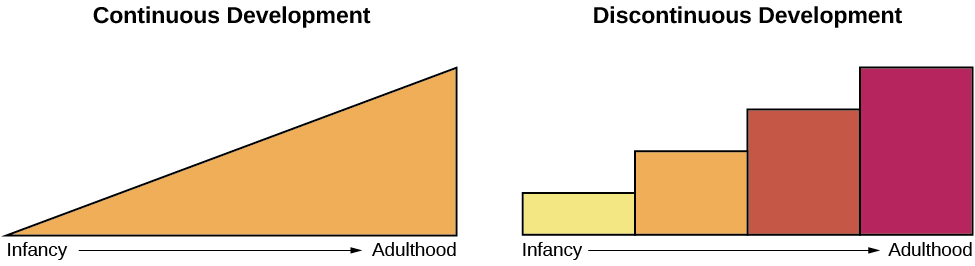

Figure 9.2図 9.2
The concept of continuous development can be visualized as a smooth slope of progression, whereas discontinuous development sees growth in more discrete stages.
連続的発達という考え方は、なめらかに進んでいく坂として思い描くことができる。これに対して非連続的発達は、成長を、よりはっきりと区切られた段階としてとらえる。
Is There One Course of Development or Many?発達の道筋は一つか、多数か
Is development essentially the same, or universal, for all children (i.e., there is one course of development) or does development follow a different course for each child, depending on the child’s specific genetics and environment (i.e., there are many courses of development)? Do people across the world share more similarities or more differences in their development? How much do culture and genetics influence a child’s behavior?
英語のヒント
発達は、すべての子どもにとって本質的に同じ、つまり普遍的なのだろうか(すなわち、発達の道筋は一つである)。それとも、発達は、その子どもに特有の遺伝と環境に応じて、子どもごとに異なる道筋をたどるのだろうか(すなわち、発達の道筋は多数ある)。世界中の人々の発達には、共通点のほうが多いのだろうか、それとも相違点のほうが多いのだろうか。文化と遺伝は、子どもの行動にどれほど影響を与えるのだろうか。
Stage theories hold that the sequence of development is universal. For example, in cross-cultural studies of language development, children from around the world reach language milestones in a similar sequence (Gleitman & Newport, 1995). Infants in all cultures coo before they babble. They begin babbling at about the same age and utter their first word around 12 months old. Yet we live in diverse contexts that have a unique effect on each of us. For example, researchers once believed that motor development follows one course for all children regardless of culture. However, child care practices vary by culture, and different practices have been found to accelerate or inhibit achievement of developmental milestones such as sitting, crawling, and walking (Karasik, Adolph, Tamis-LeMonda, & Bornstein, 2010).
英語のヒント
段階理論は、発達の順序は普遍的だと主張する。たとえば、言語発達についての比較文化研究では、世界中の子どもが似た順序で言語の節目に到達する(Gleitman & Newport, 1995)。どの文化の乳児も、喃語を発する前にクーイングをする。乳児はほぼ同じ年齢で喃語を発しはじめ、生後12か月ごろに最初の言葉を口にする。しかし私たちは、一人ひとりに独自の影響を及ぼす多様な状況の中で生きている。たとえば研究者たちは、かつて、運動発達は文化にかかわらずすべての子どもで一つの道筋をたどると考えていた。しかし、子育ての慣習は文化によって異なり、異なる慣習が、座る、はいはいする、歩くといった発達の節目の達成を早めたり妨げたりすることが分かっている(Karasik, Adolph, Tamis-LeMonda, & Bornstein, 2010)。
For instance, let’s look at the Aché society in Paraguay. They spend a significant amount of time foraging in forests. While foraging, Aché mothers carry their young children, rarely putting them down in order to protect them from getting hurt in the forest. Consequently, their children walk much later: They walk around 23–25 months old, in comparison to infants in Western cultures who begin to walk around 12 months old. However, as Aché children become older, they are allowed more freedom to move about, and by about age 9, their motor skills surpass those of U.S. children of the same age: Aché children are able to climb trees up to 25 feet tall and use machetes and other tools (Kaplan & Dove, 1987). As you can see, our development is influenced by multiple contexts, so the timing of basic motor functions may vary across cultures. However, the functions themselves are present in all societies (Figure 9.3).
英語のヒント
たとえば、パラグアイのアチェの社会を見てみよう。アチェの人々は、森の中での採集にかなりの時間を費やす。採集のあいだ、アチェの母親は幼い子どもを抱いて運び、森の中で子どもがけがをしないように、めったに下に降ろさない。その結果、アチェの子どもが歩きはじめるのはずっと遅い。西洋の文化の乳児が生後12か月ごろに歩きはじめるのに比べて、アチェの子どもは23〜25か月ごろに歩きはじめる。しかし、アチェの子どもは年長になるにつれて、より自由に動き回ることを許されるようになり、9歳ごろまでには、その運動技能は同じ年齢のアメリカの子どもを上回る。アチェの子どもは、高さ25フィートまでの木に登り、山刀やほかの道具を使うことができるのである(Kaplan & Dove, 1987)。このように、私たちの発達は複数の状況の影響を受けるので、基本的な運動機能が現れる時期は文化によって異なりうる。しかし、機能そのものはどの社会にも存在する(図9.3)。
OpenStax, Rice University; Psychology 2e. (credit a: modification of work by “Visit St. Pete/Clearwater”/Flickr; credit b: modification of work by "stringer_bel"/Flickr) · CC BY 4.0 · Source出典

Figure 9.3図 9.3
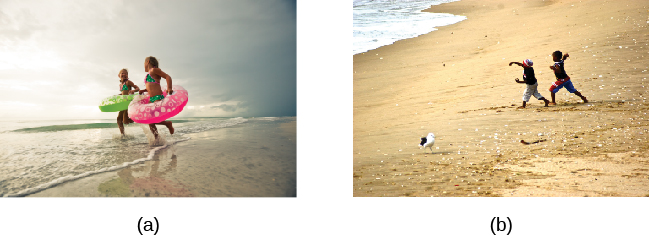
All children across the world love to play. Whether in (a) Florida or (b) South Africa, children enjoy exploring sand, sunshine, and the sea. (credit a: modification of work by “Visit St. Pete/Clearwater”/Flickr; credit b: modification of work by "stringer_bel"/Flickr)
世界中の子どもはみな、遊ぶことが大好きである。(a)フロリダでも(b)南アフリカでも、子どもたちは砂や日の光、海を探索して楽しむ。(出典a:“Visit St. Pete/Clearwater”/Flickrの作品を改変、出典b:"stringer_bel"/Flickrの作品を改変)
How Do Nature and Nurture Influence Development?生まれと育ちは発達にどのように影響するか
Are we who we are because of nature (biology and genetics), or are we who we are because of nurture (our environment and culture)? This longstanding question is known in psychology as the nature versus nurture debate. It seeks to understand how our personalities and traits are the product of our genetic makeup and biological factors, and how they are shaped by our environment, including our guardians, peers, and culture. For instance, why do biological children sometimes act like their parents—is it because of genetics or because of early childhood environment and what the child has learned from the parents? What about children who are adopted—are they more like their biological families or more like their adoptive families? And how can siblings from the same family be so different?
英語のヒント
私たちが今の私たちであるのは、生まれ(生物学的要因と遺伝)のためだろうか。それとも、育ち(環境と文化)のためだろうか。この長年の問いは、心理学では「生まれか育ちか」論争として知られている。この論争は、私たちのパーソナリティや特性が、どのように遺伝的構成と生物学的要因の産物であり、また、保護者や仲間、文化を含む環境によってどのように形づくられるのかを理解しようとするものである。たとえば、実の子どもがときに親に似た振る舞いをするのはなぜだろうか。遺伝のためだろうか、それとも幼少期の環境や、子どもが親から学んだことのためだろうか。養子になった子どもはどうだろうか。生物学上の家族に似ているのだろうか、それとも養子先の家族に似ているのだろうか。そして、同じ家族のきょうだいが、どうしてこれほど違うことがありうるのだろうか。
We are all born with specific genetic traits inherited from our biological parents, such as eye color, height, and certain personality traits. Beyond our basic genotype, however, there is a deep interaction between our genes and our environment: Our unique experiences in our environment influence whether and how particular traits are expressed, and at the same time, our genes influence how we interact with our environment (Diamond, 2009; Lobo, 2008). This chapter will show that there is a reciprocal interaction between nature and nurture as they both shape who we become, but the debate continues as to the relative contributions of each.
英語のヒント
私たちは誰もが、目の色、身長、ある種のパーソナリティ特性など、生物学上の親から受け継いだ特定の遺伝的特性を持って生まれてくる。しかし、基本的な遺伝子型を超えたところで、遺伝子と環境のあいだには深い相互作用がある。環境の中での一人ひとりに固有の経験が、特定の特性が発現するかどうか、またどのように発現するかに影響を与え、同時に、遺伝子が、私たちが環境とどのように相互作用するかに影響を与えるのである(Diamond, 2009; Lobo, 2008)。この章では、生まれと育ちがともに私たちがどんな人になるかを形づくるなかで、両者のあいだに双方向の相互作用があることを示していく。ただし、それぞれがどの程度寄与しているかについては、議論が続いている。