第9章生涯発達
Adolescence青年期
Adolescence is a socially constructed concept. In pre-industrial society, children were considered adults when they reached physical maturity, but today we have an extended time between childhood and adulthood called adolescence. Adolescence is the period of development that begins at puberty and ends at emerging adulthood, which is discussed later. In the United States, adolescence is seen as a time to develop independence from parents while remaining connected to them (Figure 9.15). The typical age range of adolescence is from 12 to 18 years, and this stage of development also has some predictable physical, cognitive, and psychosocial milestones.
英語のヒント
青年期は社会的に構成された概念である。産業化以前の社会では、子どもは身体的に成熟すると大人とみなされたが、今日では、児童期と成人期のあいだに、青年期と呼ばれる長い期間がある。青年期とは、思春期に始まり、後で論じる成人形成期に終わる発達の時期である。アメリカでは、青年期は、親とのつながりを保ちながら親からの自立を育む時期とみなされている(図9.15)。青年期の典型的な年齢の範囲は12歳から18歳であり、この発達段階にも、身体、認知、心理社会の面で、予測可能な節目がいくつかある。

OpenStax, Rice University; Psychology 2e. (credit: "manseok_Pixabay"/ Pixabay) · CC BY 4.0 · Source出典
Figure 9.15図 9.15
Peers are a primary influence on our development in adolescence. (credit: "manseok_Pixabay"/ Pixabay)
青年期には、仲間が私たちの発達に主要な影響を与える。(出典:"manseok_Pixabay"/ Pixabay)
Physical Development身体発達
As noted above, adolescence begins with puberty. While the sequence of physical changes in puberty is predictable, the onset and pace of puberty vary widely. Several physical changes occur during puberty, such as adrenarche and gonadarche, the maturing of the adrenal glands and sex glands, respectively. Also during this time, primary and secondary sexual characteristics develop and mature. Primary sexual characteristics are organs specifically needed for reproduction, like the uterus and ovaries and testes. Secondary sexual characteristics are physical signs of sexual maturation that do not directly involve sex organs, such as development of breasts and hips, and development of facial hair and a deepened voice. Menarche, the beginning of menstrual periods, usually occurs around 12–13 years old, and spermarche, the first ejaculation, around 13–14 years old.
英語のヒント
先に述べたように、青年期は思春期とともに始まる。思春期の身体的変化の順序は予測できるが、思春期が始まる時期と進む速さは人によって大きく異なる。思春期にはいくつかの身体的変化が起こる。たとえば、副腎皮質の成熟(アドレナーキ)と性腺の成熟(ゴナダーキ)、すなわち、それぞれ副腎と性腺が成熟することである。またこの時期には、一次性徴と二次性徴が発達し成熟する。一次性徴とは、子宮、卵巣、精巣のように、生殖のためにとくに必要な器官である。二次性徴とは、性器に直接かかわらない、性的成熟の身体的なしるしであり、乳房や腰回りの発達、ひげの発達や声が低くなることなどがある。初経、すなわち月経の始まりはたいてい12〜13歳ごろに起こり、精通、すなわち初めての射精は13〜14歳ごろに起こる。
During puberty, people experience a rapid increase in height (i.e., growth spurt). For females this begins between 8 and 13 years old, with adult height reached between 10 and 16 years old. Males begin their growth spurt slightly later, usually between 10 and 16 years old, and reach their adult height between 13 and 17 years old. Both nature (i.e., genes) and nurture (e.g., nutrition, medications, and medical conditions) can influence height.
英語のヒント
思春期には、身長が急速に伸びる(すなわち成長スパート)。女性ではこれが8歳から13歳のあいだに始まり、10歳から16歳のあいだに大人の身長に達する。男性の成長スパートはやや遅く、たいてい10歳から16歳のあいだに始まり、13歳から17歳のあいだに大人の身長に達する。生まれ(すなわち遺伝子)と育ち(たとえば、栄養、薬、病気)の両方が、身長に影響しうる。
Because rates of physical development vary so widely among teenagers, puberty can be a source of pride or embarrassment. Early maturing boys tend to be stronger, taller, and more athletic than their later maturing peers. They are usually more popular, confident, and independent, but they are also at a greater risk for substance abuse and early sexual activity (Flannery, Rowe, & Gulley, 1993; Kaltiala-Heino, Rimpela, Rissanen, & Rantanen, 2001). Early maturing girls may be teased or overtly admired, which can cause them to feel self-conscious about their developing bodies. These girls are at a higher risk for depression, substance abuse, and eating disorders (Ge, Conger, & Elder, 2001; Graber, Lewinsohn, Seeley, & Brooks-Gunn, 1997; Striegel-Moore & Cachelin, 1999). Late blooming boys and girls (i.e., they develop more slowly than their peers) may feel self-conscious about their lack of physical development. Negative feelings are particularly a problem for late maturing boys, who are at a higher risk for depression and conflict with parents (Graber et al., 1997) and more likely to be bullied (Pollack & Shuster, 2000).
英語のヒント
10代の若者のあいだでは身体発達の速さが非常に大きく異なるため、思春期は誇りの源にも、恥ずかしさの源にもなりうる。早熟な男子は、成熟の遅い仲間よりも力が強く、背が高く、運動能力が高い傾向がある。早熟な男子はたいてい、より人気があり、自信に満ち、自立しているが、物質乱用や早期の性的活動のリスクも高い(Flannery, Rowe, & Gulley, 1993; Kaltiala-Heino, Rimpela, Rissanen, & Rantanen, 2001)。早熟な女子は、からかわれたり、あからさまに称賛されたりすることがあり、それによって、発達していく自分の体を気にして気恥ずかしく感じることがある。こうした女子は、抑うつ、物質乱用、摂食障害のリスクが高い(Ge, Conger, & Elder, 2001; Graber, Lewinsohn, Seeley, & Brooks-Gunn, 1997; Striegel-Moore & Cachelin, 1999)。晩熟の男子と女子(すなわち、仲間よりも発達がゆっくりな子)は、自分の身体発達が遅れていることを気にするかもしれない。否定的な感情は、とりわけ成熟の遅い男子にとって問題となる。そうした男子は、抑うつや親との衝突のリスクが高く(Graber et al., 1997)、いじめを受ける可能性も高い(Pollack & Shuster, 2000)。
Psychologists and clinicians also study the impact of gender identity and the impacts of puberty on transgender and gender-nonconforming youth. This is a relatively recent area of study, and the impacts should not be over-generalized. However, the research seems to indicate that transgender and gender-nonconforming youth who are supported in their identity do not have significantly higher incidences of depression or anxiety symptoms when compared to control groups, while those who are not supported exhibit more symptoms and risk factors (Olson, Durwood, & McLaughlin, 2016). Expression and exploration of gender identity can take many forms and manifest at different times depending on a wide array of factors.
英語のヒント
心理学者や臨床家は、性自認の影響や、トランスジェンダーおよび性別の規範に当てはまらない若者に思春期が与える影響も研究している。これは比較的新しい研究領域であり、その影響を過度に一般化すべきではない。しかし研究は、自分のアイデンティティを支えられているトランスジェンダーや性別の規範に当てはまらない若者では、統制群と比べて、抑うつや不安の症状の発生率が有意に高いわけではない一方で、支えられていない若者はより多くの症状や危険因子を示すことを示唆しているようである(Olson, Durwood, & McLaughlin, 2016)。性自認の表現や探索はさまざまな形をとりうるし、幅広い要因に応じて異なる時期に現れうる。
The adolescent brain also remains under development. Up until puberty, brain cells continue to bloom in the frontal region. Adolescents engage in increased risk-taking behaviors and emotional outbursts possibly because the frontal lobes of their brains are still developing (Figure 9.16). Recall that this area is responsible for judgment, impulse control, and planning, and it is still maturing into early adulthood (Casey, Tottenham, Liston, & Durston, 2005).
英語のヒント
青年期の脳もまた、まだ発達の途中にある。思春期に至るまで、脳細胞は前頭部で盛んに増え続ける。青年がリスクを冒す行動や感情の爆発を増やすのは、おそらく脳の前頭葉がまだ発達の途中にあるためだろう(図9.16)。この領域は判断、衝動の制御、計画を担っており、成人前期に入っても成熟を続けていることを思い出そう(Casey, Tottenham, Liston, & Durston, 2005)。
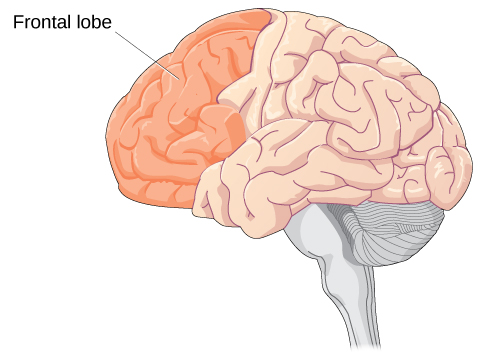


Figure 9.16図 9.16
Brain growth continues into the early 20s. The development of the frontal lobe, in particular, is important during this stage.
脳の成長は20代前半まで続く。とりわけ前頭葉の発達は、この段階で重要である。