第9章生涯発達
Beyond Formal Operational Thought形式的操作的思考を超えて
As with other major contributors of theories of development, several of Piaget’s ideas have come under criticism based on the results of further research. For example, several contemporary studies support a model of development that is more continuous than Piaget’s discrete stages (Courage & Howe, 2002; Siegler, 2005, 2006). Many others suggest that children reach cognitive milestones earlier than Piaget describes (Baillargeon, 2004; de Hevia & Spelke, 2010).
英語のヒント
発達理論に大きく貢献したほかの人々の場合と同じく、ピアジェの考えのいくつかも、その後の研究の結果に基づいて批判を受けてきた。たとえば、現代のいくつかの研究は、ピアジェのいう区切られた段階よりも連続的な発達のモデルを支持している(Courage & Howe, 2002; Siegler, 2005, 2006)。ほかの多くの研究は、子どもがピアジェの記述よりも早く認知的な節目に到達することを示唆している(Baillargeon, 2004; de Hevia & Spelke, 2010)。
According to Piaget, the highest level of cognitive development is formal operational thought, which develops between 11 and 20 years old. However, many developmental psychologists disagree with Piaget, suggesting a fifth stage of cognitive development, known as the postformal stage (Basseches, 1984; Commons & Bresette, 2006; Sinnott, 1998). In postformal thinking, decisions are made based on situations and circumstances, and logic is integrated with emotion as adults develop principles that depend on contexts. One way that we can see the difference between an adult in postformal thought and an adolescent in formal operations is in terms of how they handle emotionally charged issues.
英語のヒント
ピアジェによれば、認知発達の最も高い水準は形式的操作的思考で、それは11歳から20歳のあいだに発達する。しかし、多くの発達心理学者はピアジェに反対し、ポスト形式的段階と呼ばれる、認知発達の第五の段階を提唱している(Basseches, 1984; Commons & Bresette, 2006; Sinnott, 1998)。ポスト形式的思考では、状況や事情に基づいて判断が下され、大人が文脈に左右される原則を築いていくにつれて、論理が感情と統合されていく。ポスト形式的思考の段階にある大人と、形式的操作の段階にある青年との違いが分かる一つの点は、感情のからむ問題をどのように扱うかである。
It seems that once we reach adulthood our problem solving abilities change: As we attempt to solve problems, we tend to think more deeply about many areas of our lives, such as relationships, work, and politics (Labouvie-Vief & Diehl, 1999). Because of this, postformal thinkers are able to draw on past experiences to help them solve new problems. Problem-solving strategies using postformal thought vary, depending on the situation. What does this mean? Adults can recognize, for example, that what seems to be an ideal solution to a problem at work involving a disagreement with a colleague may not be the best solution to a disagreement with a significant other.
英語のヒント
大人になると、私たちの問題解決能力は変化するようである。問題を解決しようとするとき、私たちは、人間関係、仕事、政治など、人生の多くの領域についてより深く考える傾向がある(Labouvie-Vief & Diehl, 1999)。そのため、ポスト形式的思考をする人は、過去の経験を生かして新しい問題を解決することができる。ポスト形式的思考を用いた問題解決方略は、状況によって変わる。これはどういうことだろうか。たとえば大人は、同僚との意見の対立がからむ職場の問題に対して理想的に見える解決策が、パートナーとの意見の対立に対しては最善の解決策ではないかもしれない、と認識することができる。
SOCIOCULTURAL THEORY OF DEVELOPMENT社会文化的発達理論
Lev Vygotsky was a Russian psychologist who proposed a sociocultural theory of development. He suggested that human development is rooted in one’s culture. A child’s social world, for example, forms the basis for the formation of language and thought. The language one speaks and the ways a person thinks about things are dependent on one’s cultural background. Vygotsky also considered historical influences as key to one’s development. He was interested in the process of development and the individual’s interactions with their environment (John-Steiner & Mahn, 1996).
英語のヒント
レフ・ヴィゴツキーはロシアの心理学者で、社会文化的発達理論を提唱した。彼は、人間の発達はその人の文化に根ざしていると示唆した。たとえば、子どもの社会的な世界は、言語や思考が形成される基盤となる。人が話す言語や、物事についての考え方は、その人の文化的背景に左右される。ヴィゴツキーはまた、歴史的な影響も人の発達にとって鍵となると考えた。彼が関心を持っていたのは、発達の過程と、個人とその環境との相互作用だった(John-Steiner & Mahn, 1996)。
Moral Theory Of Development道徳性発達理論
A major task beginning in childhood and continuing into adolescence is discerning right from wrong. Psychologist Lawrence Kohlberg (1927–1987) extended upon the foundation that Piaget built regarding cognitive development. Kohlberg believed that moral development, like cognitive development, follows a series of stages. To develop this theory, Kohlberg posed moral dilemmas to people of all ages, and then he analyzed their answers to find evidence of their particular stage of moral development. Before reading about the stages, take a minute to consider how you would answer one of Kohlberg's best-known moral dilemmas, commonly known as the Heinz dilemma:
英語のヒント
子ども時代に始まり青年期まで続く大きな課題の一つは、善悪を見分けることである。心理学者ローレンス・コールバーグ(1927〜1987)は、ピアジェが認知発達について築いた基盤をさらに発展させた。コールバーグは、道徳性の発達も、認知発達と同じく、一連の段階をたどると考えた。この理論を構築するために、コールバーグはあらゆる年齢の人々に道徳的ジレンマを示し、その答えを分析して、その人が道徳性の発達のどの段階にあるかを示す証拠を探した。段階について読む前に、少し時間をとって、一般にハインツのジレンマとして知られる、コールバーグの最もよく知られた道徳的ジレンマの一つにあなたならどう答えるかを考えてみよう。
In Europe, a woman was near death from a special kind of cancer. There was one drug that the doctors thought might save her. It was a form of radium that a druggist in the same town had recently discovered. The drug was expensive to make, but the druggist was charging ten times what the drug cost him to make. He paid $200 for the radium and charged $2,000 for a small dose of the drug. The sick woman's husband, Heinz, went to everyone he knew to borrow the money, but he could only get together about $1,000, which is half of what it cost. He told the druggist that his wife was dying and asked him to sell it cheaper or let him pay later. But the druggist said: “No, I discovered the drug and I'm going to make money from it.” So Heinz got desperate and broke into the man's store to steal the drug for his wife. Should the husband have done that? (Kohlberg, 1969, p. 379)英語のヒント
ヨーロッパで、ある女性が特殊な種類のがんで死にかけていた。医師たちが、彼女を救えるかもしれないと考える薬が一つあった。それはラジウムの一種で、同じ町の薬剤師が最近発見したものだった。その薬は作るのに費用がかかったが、薬剤師は作るのにかかった費用の10倍の値段をつけていた。彼はラジウムに200ドルを払い、少量の薬に2,000ドルを請求した。病気の女性の夫ハインツは、お金を借りるために知り合いを一人残らず訪ねたが、集められたのは約1,000ドルで、薬の値段の半分だった。彼は薬剤師に、妻が死にかけていることを話し、もっと安く売るか、後払いにさせてほしいと頼んだ。しかし薬剤師は言った。「だめだ。私がこの薬を発見したんだ。これで金をもうけるつもりだ。」そこでハインツは追いつめられ、妻のために薬を盗もうとその男の店に押し入った。夫はそうすべきだったのだろうか。(Kohlberg, 1969, p. 379)
How would you answer this dilemma? Kohlberg was not interested in whether you answer yes or no to the dilemma: Instead, he was interested in the reasoning behind your answer.
英語のヒント
あなたならこのジレンマにどう答えるだろうか。コールバーグが関心を持っていたのは、あなたがこのジレンマに「はい」と答えるか「いいえ」と答えるかではなかった。そうではなく、彼はあなたの答えの背後にある推論に関心を持っていた。
After presenting people with this and various other moral dilemmas, Kohlberg reviewed people’s responses and placed them in different stages of moral reasoning (Figure 9.6). According to Kohlberg, an individual progresses from the capacity for pre-conventional morality (before age 9) to the capacity for conventional morality (early adolescence), and toward attaining post-conventional morality (once formal operational thought is attained), which only a few fully achieve. Kohlberg placed in the highest stage responses that reflected the reasoning that Heinz should steal the drug because his wife’s life is more important than the pharmacist making money. The value of a human life overrides the pharmacist’s greed.
英語のヒント
コールバーグは、このジレンマやそのほかのさまざまな道徳的ジレンマを人々に示した後、その反応を検討し、道徳的推論の異なる段階に位置づけた(図9.6)。コールバーグによれば、人は前慣習的道徳の能力(9歳以前)から慣習的道徳の能力(青年期初期)へと進み、さらに脱慣習的道徳の獲得(形式的操作的思考が獲得されたとき)へと向かう。脱慣習的道徳を完全に達成するのは、ごく一部の人だけである。コールバーグが最も高い段階に位置づけたのは、薬剤師が金をもうけることよりも妻の命の方が大切なのだから、ハインツは薬を盗むべきだ、という推論を反映した反応だった。人間の命の価値は、薬剤師の強欲に優先するのである。
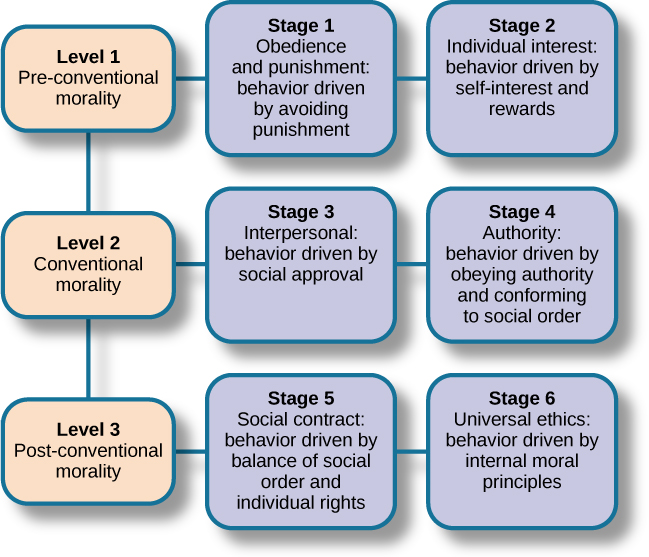

Figure 9.6図 9.6
Kohlberg identified three levels of moral reasoning: pre-conventional, conventional, and post-conventional: Each level is associated with increasingly complex stages of moral development.
コールバーグは、道徳的推論の三つの水準、すなわち前慣習的、慣習的、脱慣習的の水準を見いだした。それぞれの水準には、しだいに複雑になっていく道徳性の発達段階が対応している。
It is important to realize that even those people who have the most sophisticated, post-conventional reasons for some choices may make other choices for the simplest of pre-conventional reasons. Many psychologists agree with Kohlberg's theory of moral development but point out that moral reasoning is very different from moral behavior. Sometimes what we say we would do in a situation is not what we actually do in that situation. In other words, we might “talk the talk,” but not “walk the walk.”
英語のヒント
理解しておくべき重要な点は、ある選択については最も洗練された脱慣習的な理由を持つ人でさえ、別の選択については最も単純な前慣習的な理由で決めることがある、ということである。多くの心理学者はコールバーグの道徳性発達理論に賛同しているが、道徳的推論は道徳的行動とは大きく異なると指摘する。ある状況で自分ならこうすると言うことが、その状況で実際にすることではない場合がある。言い換えれば、私たちは「口では言う」かもしれないが、「そのとおりに行う」とは限らないのである。
How does this theory apply to people of different genders? Kohlberg (1969) felt that more men than women move past stage four in their moral development. He went on to note that women seem to be deficient in their moral reasoning abilities. These ideas were not well received by Carol Gilligan, a research assistant of Kohlberg, who consequently developed her own ideas of moral development. In her groundbreaking book, In a Different Voice: Psychological Theory and Women’s Development, Gilligan (1982) criticized her former mentor’s theory because it was based only on upper class White men and boys. She argued that women are not deficient in their moral reasoning—she proposed that different genders reason differently. Girls and women focus more on staying connected and the importance of interpersonal relationships. Therefore, in the Heinz dilemma, many girls and women respond that Heinz should not steal the medicine. Their reasoning is that if he steals the medicine, is arrested, and is put in jail, then he and his wife will be separated, and she could die while he is still in prison.
英語のヒント
この理論は、異なるジェンダーの人々にどう当てはまるのだろうか。コールバーグ(1969)は、道徳性の発達において第4段階を超えて進む人は、女性より男性の方が多いと考えた。さらに彼は、女性は道徳的推論の能力が劣っているように見えるとも述べた。こうした考えは、コールバーグの研究助手だったキャロル・ギリガンには受け入れられなかった。ギリガンはその結果、道徳性の発達について独自の考えを発展させた。ギリガン(1982)は画期的な著書『もうひとつの声:心理学の理論と女性の発達』で、かつての師の理論を、上流階級の白人の男性と少年だけに基づいているとして批判した。彼女は、女性の道徳的推論は劣っているのではないと論じ、ジェンダーが異なれば推論の仕方も異なると提唱した。少女や女性は、つながりを保つことと、対人関係の大切さにより重点を置く。そのため、ハインツのジレンマでは、多くの少女や女性が、ハインツは薬を盗むべきではないと答える。その理由は、もし彼が薬を盗んで逮捕され、刑務所に入れられたら、彼と妻は引き離され、彼がまだ刑務所にいるあいだに妻が死んでしまうかもしれない、というものである。