第9章生涯発達
Cognitive Theory of Development認知発達理論
Jean Piaget (1896–1980) is another stage theorist who studied childhood development (Figure 9.5). Instead of approaching development from a psychoanalytical or psychosocial perspective, Piaget focused on children’s cognitive growth. He believed that thinking is a central aspect of development and that children are naturally inquisitive. However, he said that children do not think and reason like adults (Piaget, 1930, 1932). His theory of cognitive development holds that our cognitive abilities develop through specific stages, which exemplifies the discontinuity approach to development. As we progress to a new stage, there is a distinct shift in how we think and reason.
英語のヒント
ジャン・ピアジェ(1896〜1980)も、子どもの発達を研究した段階理論家である(図9.5)。ピアジェは、精神分析的あるいは心理社会的な観点から発達にアプローチするのではなく、子どもの認知的な成長に焦点を当てた。彼は、思考は発達の中心的な側面であり、子どもは生まれつき好奇心が強いと考えた。しかし、子どもは大人と同じようには考えたり推論したりしない、とも述べた(Piaget, 1930, 1932)。ピアジェの認知発達理論は、私たちの認知能力は特定の段階を経て発達すると主張する。これは、発達を非連続的にとらえるアプローチの典型例である。新しい段階に進むと、私たちの考え方や推論の仕方にははっきりとした変化が起こる。
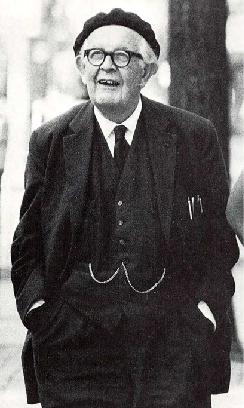

Figure 9.5図 9.5
Jean Piaget spent over 50 years studying children and how their minds develop.
ジャン・ピアジェは50年以上にわたり、子どもと、その心がどのように発達するかを研究した。
Piaget said that children develop schemata to help them understand the world. Schemata are concepts (mental models) that are used to help us categorize and interpret information. By the time children have reached adulthood, they have created schemata for almost everything. When children learn new information, they adjust their schemata through two processes: assimilation and accommodation. First, they assimilate new information or experiences in terms of their current schemata: assimilation is when they take in information that is comparable to what they already know. Accommodation describes when they change their schemata based on new information. This process continues as children interact with their environment.
英語のヒント
ピアジェは、子どもは世界を理解する助けとしてスキーマを発達させると述べた。スキーマとは、私たちが情報を分類し解釈する助けとして用いられる概念(心的モデル)である。子どもは大人になるころまでには、ほとんどあらゆるものについてスキーマをつくり上げている。子どもは新しい情報を学ぶと、同化と調節という二つの過程を通して自分のスキーマを修正する。まず、子どもは新しい情報や経験を、今持っているスキーマに照らして同化する。同化とは、すでに知っていることと同じような情報を取り込むことである。調節とは、新しい情報に基づいてスキーマを変えることを指す。この過程は、子どもが環境と関わり合うなかで続いていく。
For example, 2-year-old Abdul learned the schema for dogs because his family has a Labrador retriever. When Abdul sees other dogs in his picture books, he says, “Look mommy, dog!” Thus, he has assimilated them into his schema for dogs. One day, Abdul sees a sheep for the first time and says, “Look mommy, dog!” Having a basic schema that a dog is an animal with four legs and fur, Abdul thinks all furry, four-legged creatures are dogs. When Abdul’s mom tells him that the animal he sees is a sheep, not a dog, Abdul must accommodate his schema for dogs to include more information based on his new experiences. Abdul’s schema for dog was too broad, since not all furry, four-legged creatures are dogs. He now modifies his schema for dogs and forms a new one for sheep.
英語のヒント
たとえば、2歳のアブドゥルは、家でラブラドール・レトリーバーを飼っているので、犬についてのスキーマを学んだ。アブドゥルは絵本でほかの犬を見ると、「ママ見て、わんわん!」と言う。つまり、彼はそれらの犬を、犬についてのスキーマに同化したのである。ある日、アブドゥルは初めて羊を見て、「ママ見て、わんわん!」と言う。犬とは4本の脚と毛皮を持つ動物だという基本的なスキーマを持っているので、アブドゥルは、毛がふさふさした4本脚の生き物はすべて犬だと考えているのである。アブドゥルの母親が、今見ている動物は犬ではなく羊だと教えると、アブドゥルは、新しい経験に基づいてより多くの情報を含めるように、犬についてのスキーマを調節しなければならない。毛がふさふさした4本脚の生き物がすべて犬であるわけではないので、アブドゥルの犬についてのスキーマは広すぎたのである。彼はいまや犬についてのスキーマを修正し、羊についての新しいスキーマをつくる。
Like Freud and Erikson, Piaget thought development unfolds in a series of stages approximately associated with age ranges. He proposed a theory of cognitive development that unfolds in four stages: sensorimotor, preoperational, concrete operational, and formal operational (Table 9.2).
英語のヒント
フロイトやエリクソンと同じく、ピアジェも、発達はおおよそ年齢の範囲に対応した一連の段階をたどって展開すると考えた。彼は、感覚運動期、前操作期、具体的操作期、形式的操作期の四つの段階をたどって展開する認知発達の理論を提唱した(表9.2)。
Piaget’s Stages of Cognitive Development ピアジェの認知発達の段階 |
|||
|---|---|---|---|
Age (years) 年齢(歳) |
Stage 段階 |
Description 説明 |
Developmental issues 発達上のテーマ |
0–2 |
Sensorimotor 感覚運動期 |
World experienced through senses and actions 感覚と行為を通して世界を経験する |
Object permanence Stranger anxiety 対象の永続性人見知り |
2–6 |
Preoperational 前操作期 |
Use words and images to represent things, but lack logical reasoning 言葉やイメージを使って物事を表すが、論理的な推論はできない |
Pretend play Egocentrism Language development ごっこ遊び自己中心性言語の発達 |
7–11 |
Concrete operational 具体的操作期 |
Understand concrete events and analogies logically; perform arithmetical operations 具体的な出来事や類推を論理的に理解する。算術の計算を行う |
Conservation Mathematical transformations 保存数学的な変換 |
12– |
Formal operational 形式的操作期 |
Formal operations Utilize abstract reasoning 形式的操作抽象的な推論を用いる |
Abstract logic Moral reasoning 抽象的な論理道徳的推論 |
The first stage is the sensorimotor stage, which lasts from birth to about 2 years old. During this stage, children learn about the world through their senses and motor behavior. Young children put objects in their mouths to see if the items are edible, and once they can grasp objects, they may shake or bang them to see if they make sounds. Between 5 and 8 months old, the child develops object permanence, which is the understanding that even if something is out of sight, it still exists (Bogartz, Shinskey, & Schilling, 2000). According to Piaget, young infants do not remember an object after it has been removed from sight. Piaget studied infants’ reactions when a toy was first shown to an infant and then hidden under a blanket. Infants who had already developed object permanence would reach for the hidden toy, indicating that they knew it still existed, whereas infants who had not developed object permanence would appear confused.
英語のヒント
第一の段階は感覚運動期で、誕生からおよそ2歳まで続く。この段階の子どもは、感覚と運動行動を通して世界について学ぶ。幼い子どもは、物が食べられるかどうかを確かめるために口に入れ、物をつかめるようになると、音が出るかどうかを確かめるために振ったり打ちつけたりすることがある。生後5か月から8か月のあいだに、子どもは対象の永続性を身につける。対象の永続性とは、何かが見えなくなってもそれは存在し続けている、という理解である(Bogartz, Shinskey, & Schilling, 2000)。ピアジェによれば、幼い乳児は、物が視界から取り除かれると、その物のことを覚えていない。ピアジェは、まずおもちゃを乳児に見せ、次にそれを毛布の下に隠したときの乳児の反応を調べた。すでに対象の永続性を身につけていた乳児は、隠されたおもちゃに手を伸ばし、それがまだ存在していると知っていることを示した。これに対して、対象の永続性をまだ身につけていなかった乳児は、戸惑っているように見えた。
In Piaget’s view, around the same time children develop object permanence, they also begin to exhibit stranger anxiety, which is a fear of unfamiliar people. Babies may demonstrate this by crying and turning away from a stranger, by clinging to a caregiver, or by attempting to reach their arms toward familiar faces such as parents. Stranger anxiety results when a child is unable to assimilate the stranger into an existing schema; therefore, she can’t predict what her experience with that stranger will be like, which results in a fear response.
英語のヒント
ピアジェの見方では、子どもは対象の永続性を身につけるのとほぼ同じころに、人見知りも示しはじめる。人見知りとは、見慣れない人に対する恐れである。赤ちゃんは、泣きながら見知らぬ人から顔をそむけたり、養育者にしがみついたり、親などのよく知っている顔に向かって腕を伸ばそうとしたりすることで、これを示すことがある。人見知りは、子どもが見知らぬ人を既存のスキーマに同化できないときに生じる。そのため、その人と接するとどうなるのかを予測できず、それが恐れの反応を生むのである。
Piaget’s second stage is the preoperational stage, which is from approximately 2 to 7 years old. In this stage, children can use symbols to represent words, images, and ideas, which is why children in this stage engage in pretend play. A child’s arms might become airplane wings as they zoom around the room, or a child with a stick might become a brave knight with a sword. Children also begin to use language in the preoperational stage, but they cannot understand adult logic or mentally manipulate information (the term operational refers to logical manipulation of information, so children at this stage are considered to be pre-operational). Children’s logic is based on their own personal knowledge of the world so far, rather than on conventional knowledge. For example, dad gave a slice of pizza to 10-year-old Keiko and another slice to her 3-year-old brother, Kenny. Kenny’s pizza slice was cut into five pieces, so Kenny told his sister that he got more pizza than she did. Children in this stage cannot perform mental operations because they have not developed an understanding of conservation, which is the idea that even if you change the appearance of something, it is still equal in size as long as nothing has been removed or added.
英語のヒント
ピアジェの第二の段階は前操作期で、およそ2歳から7歳までである。この段階の子どもは、言葉やイメージ、考えを表すのにシンボルを使うことができる。この段階の子どもがごっこ遊びをするのはこのためである。部屋の中を勢いよく走り回るとき、子どもの腕は飛行機の翼になるかもしれないし、棒を持った子どもは剣を持った勇敢な騎士になるかもしれない。子どもは前操作期に言葉を使いはじめもするが、大人の論理を理解したり、情報を頭の中で操作したりすることはできない(操作的という語は情報を論理的に操作することを指し、そのためこの段階の子どもは前操作的とみなされる)。子どもの論理は、一般に通用している知識ではなく、それまでに自分が得てきた世界についての個人的な知識に基づいている。たとえば、父親が10歳のケイコにピザを1切れ、3歳の弟のケニーにもう1切れを与えた。ケニーのピザは五つに切り分けられていたので、ケニーは姉に、自分の方がたくさんピザをもらったと言った。この段階の子どもは、保存の理解が発達していないため、心的操作を行うことができない。保存とは、何かの見た目を変えても、何も取り除いたり加えたりしていないかぎり、その大きさは変わらないという考えである。
During this stage, we also expect children to display egocentrism, which means that the child is not able to take the perspective of others. A child at this stage thinks that everyone sees, thinks, and feels just as they do. Let’s look at Kenny and Keiko again. Keiko’s birthday is coming up, so their mom takes Kenny to the toy store to choose a present for his sister. He selects an Iron Man action figure for her, thinking that if he likes the toy, his sister will too. An egocentric child is not able to infer the perspective of other people and instead attributes his own perspective.
英語のヒント
この段階では、子どもが自己中心性を示すことも予想される。自己中心性とは、子どもが他者の視点に立てないことを意味する。この段階の子どもは、誰もが自分とまったく同じように見て、考え、感じていると思っている。もう一度ケニーとケイコを見てみよう。ケイコの誕生日が近づいているので、母親は姉へのプレゼントを選ばせるために、ケニーをおもちゃ屋に連れていく。ケニーは、自分がそのおもちゃを気に入れば姉も気に入るだろうと考えて、姉のためにアイアンマンのアクションフィギュアを選ぶ。自己中心的な子どもは、他者の視点を推測することができず、代わりに自分自身の視点を当てはめてしまうのである。
Piaget’s third stage is the concrete operational stage, which occurs from about 7 to 11 years old. In this stage, children can think logically about real (concrete) events; they have a firm grasp on the use of numbers and start to employ memory strategies. They can perform mathematical operations and understand transformations, such as addition is the opposite of subtraction, and multiplication is the opposite of division. In this stage, children also master the concept of conservation: Even if something changes shape, its mass, volume, and number stay the same. For example, if you pour water from a tall, thin glass to a short, fat glass, you still have the same amount of water. Remember Keiko and Kenny and the pizza? How did Keiko know that Kenny was wrong when he said that he had more pizza?
英語のヒント
ピアジェの第三の段階は具体的操作期で、およそ7歳から11歳にかけて生じる。この段階の子どもは、現実の(具体的な)出来事について論理的に考えることができる。数の使い方をしっかり理解し、記憶方略を使いはじめる。数学的な演算を行い、足し算は引き算の逆であり、掛け算は割り算の逆である、といった変換を理解できる。この段階では、子どもは保存の概念も身につける。何かの形が変わっても、その質量、体積、数は変わらないということである。たとえば、背が高く細いグラスから、背が低く太いグラスに水を注いでも、水の量は同じである。ケイコとケニーとピザの話を覚えているだろうか。ケニーが自分の方がピザが多いと言ったとき、ケイコはどうしてそれが間違いだと分かったのだろうか。
Children in the concrete operational stage also understand the principle of reversibility, which means that objects can be changed and then returned back to their original form or condition. Take, for example, water that you poured into the short, fat glass: You can pour water from the fat glass back to the thin glass and still have the same amount (minus a couple of drops).
英語のヒント
具体的操作期の子どもは、可逆性の原理も理解する。可逆性とは、物は変化させた後で、もとの形や状態に戻すことができるということである。たとえば、背の低い太いグラスに注いだ水を考えてみよう。その水は、太いグラスから細いグラスに注ぎ戻すことができ、それでも(数滴減るのを除けば)量は同じである。
The fourth, and last, stage in Piaget’s theory is the formal operational stage, which is from about age 11 to adulthood. Whereas children in the concrete operational stage are able to think logically only about concrete events, children in the formal operational stage can also deal with abstract ideas and hypothetical situations. Children in this stage can use abstract thinking to problem solve, look at alternative solutions, and test these solutions. In adolescence, a renewed egocentrism occurs. For example, a 15-year-old with a very small pimple on her face might think it is huge and incredibly visible, under the mistaken impression that others must share her perceptions.
英語のヒント
ピアジェの理論の第四の、そして最後の段階は形式的操作期で、およそ11歳から大人になるまでである。具体的操作期の子どもは具体的な出来事についてしか論理的に考えられないのに対して、形式的操作期の子どもは、抽象的な考えや仮説的な状況も扱うことができる。この段階の子どもは、抽象的な思考を使って問題を解決し、別の解決策を検討し、それらの解決策を試すことができる。青年期には、自己中心性がふたたび現れる。たとえば、顔にごく小さなにきびができた15歳の少女は、それがとても大きく、ひどく目立っていると思うかもしれない。他者も自分と同じように知覚しているに違いない、と思い違いをしているのである。