第1章非負整数
1.4 Multiply Whole Numbers1.4 非負整数を掛ける
Learning Objectives学習目標
Learning Objectives学習目標
By the end of this section, you will be able to:
この節を終えると、次のことができるようになる。
- Use multiplication notation掛け算の表記を使う
- Model multiplication of whole numbers非負整数の掛け算をモデルで表す
- Multiply whole numbers非負整数を掛ける
- Translate word phrases to math notation言葉による表現を数学の表記に直す
- Multiply whole numbers in applications応用問題で非負整数を掛ける
Before You Begin (2)準備問題(2題)
Use Multiplication Notation乗法の表記を使う
Suppose you were asked to count all these pennies shown in Figure 1.12.
図1.12の1セント硬貨を全部数えるように言われたとしよう。

Figure 1.12図 1.12
Would you count the pennies individually? Or would you count the number of pennies in each row and add that number times.
1セント硬貨を1枚ずつ数えるだろうか。それとも、1列の硬貨の枚数を数え、その数を回足すだろうか。
Multiplication is a way to represent repeated addition. So instead of adding three times, we could write a multiplication expression.
乗法は、同じ数を繰り返し足すことを表す方法である。したがって、を3回足す代わりに、掛け算の式で書ける。
We call each number being multiplied a factor and the result the product. We read as three times eight, and the result as the product of three and eight.
掛け合わせるそれぞれの数を因数、結果を積という。は「3掛ける8」と読み、結果は3と8の積と読む。
There are several symbols that represent multiplication. These include the symbol as well as the dot, , and parentheses
掛け算を表す記号はいくつかある。という記号のほか、点や丸括弧も使う。
Example 1.39例題 1.39
Translate from math notation to words:
数学の記号で表されたものを、言葉で表す:
- ⓐ
- ⓑ
- ⓒ
Solution解答
- ⓐ We read this as seven times six and the result is the product of seven and six.ⓐ 「7掛ける6」と読む。結果は7と6の積である。
- ⓑ We read this as twelve times fourteen and the result is the product of twelve and fourteen.ⓑ 「12掛ける14」と読む。結果は12と14の積である。
- ⓒ We read this as six times thirteen and the result is the product of six and thirteen.ⓒ 「6掛ける13」と読む。結果は6と13の積である。
Try It (2)確認問題(2題)
Model Multiplication of Whole Numbers非負整数の乗法を模型で表す
There are many ways to model multiplication. Unlike in the previous sections where we used blocks, here we will use counters to help us understand the meaning of multiplication. A counter is any object that can be used for counting. We will use round blue counters.
掛け算を模型で表す方法は数多くある。前の節ではブロックを使ったが、ここでは掛け算の意味を理解するために数え駒を使う。数え駒とは、数えるのに使える物のことである。ここでは青く丸い数え駒を使う。
Example 1.40例題 1.40
Model:
モデルで表す:
Solution解答
To model the product we’ll start with a row of counters.
積を模型で表すため、まず数え駒個の列を作る。

The other factor is so we’ll make rows of counters.
もう一つの因数はなので、数え駒個の列を列作る。
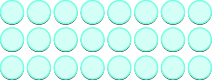
Now we can count the result. There are counters in all.
これで結果を数えられる。数え駒は全部で個ある。
If you look at the counters sideways, you’ll see that we could have also made rows of counters. The product would have been the same. We’ll get back to this idea later.
数え駒を横から見ると、個ずつの列を列作ることもできたと分かる。積は同じになったはずである。この考えには後で戻る。
Try It (2)確認問題(2題)
Multiply Whole Numbers非負整数を掛ける
In order to multiply without using models, you need to know all the one digit multiplication facts. Make sure you know them fluently before proceeding in this section.
模型を使わずに掛け算をするには、1桁の数どうしの掛け算の結果をすべて知っている必要がある。この節を先へ進む前に、それらをすらすら使えることを確かめよう。
Table 1.4 shows the multiplication facts. Each box shows the product of the number down the left column and the number across the top row. If you are unsure about a product, model it. It is important that you memorize any number facts you do not already know so you will be ready to multiply larger numbers.
表1.4に基本的な掛け算の計算結果を示す。各マスは、左端の列の数と一番上の行の数の積を示している。積が分からなければ模型で表そう。より大きな数の掛け算に備え、まだ覚えていない計算結果を覚えることが重要である。
× |
0 |
1 |
2 |
3 |
4 |
5 |
6 |
7 |
8 |
9 |
|---|---|---|---|---|---|---|---|---|---|---|
0 |
0 |
0 |
0 |
0 |
0 |
0 |
0 |
0 |
0 |
0 |
1 |
0 |
1 |
2 |
3 |
4 |
5 |
6 |
7 |
8 |
9 |
2 |
0 |
2 |
4 |
6 |
8 |
10 |
12 |
14 |
16 |
18 |
3 |
0 |
3 |
6 |
9 |
12 |
15 |
18 |
21 |
24 |
27 |
4 |
0 |
4 |
8 |
12 |
16 |
20 |
24 |
28 |
32 |
36 |
5 |
0 |
5 |
10 |
15 |
20 |
25 |
30 |
35 |
40 |
45 |
6 |
0 |
6 |
12 |
18 |
24 |
30 |
36 |
42 |
48 |
54 |
7 |
0 |
7 |
14 |
21 |
28 |
35 |
42 |
49 |
56 |
63 |
8 |
0 |
8 |
16 |
24 |
32 |
40 |
48 |
56 |
64 |
72 |
9 |
0 |
9 |
18 |
27 |
36 |
45 |
54 |
63 |
72 |
81 |
What happens when you multiply a number by zero? You can see that the product of any number and zero is zero. This is called the Multiplication Property of Zero.
数にゼロを掛けるとどうなるだろうか。どの数も、ゼロとの積はゼロになる。これをゼロの乗法の性質という。
Example 1.41例題 1.41
Multiply:
掛けよ。
- ⓐ
- ⓑ
Solution解答
ⓐ |
|
The product of any number and zero is zero. どの数も、ゼロとの積はゼロである。 |
|
ⓑ |
|
Multiplying by zero results in zero. ゼロを掛けると結果はゼロになる。 |
Try It (2)確認問題(2題)
What happens when you multiply a number by one? Multiplying a number by one does not change its value. We call this fact the Identity Property of Multiplication, and is called the multiplicative identity.
数に1を掛けるとどうなるだろうか。数に1を掛けても、その値は変わらない。これを乗法の単位元の性質といい、を乗法の単位元と呼ぶ。
Example 1.42例題 1.42
Multiply:
掛けよ。
- ⓐ
- ⓑ
Solution解答
ⓐ |
|
The product of any number and one is the number. どの数も、1との積はその数自身である。 |
|
ⓑ |
|
Multiplying by one does not change the value. 1を掛けても値は変わらない。 |
Try It (2)確認問題(2題)
Earlier in this chapter, we learned that the Commutative Property of Addition states that changing the order of addition does not change the sum. We saw that is the same as
この章の前の部分で、加法の交換法則は、足す順序を変えても和が変わらないことを述べると学んだ。とは同じであることを見た。
Is this also true for multiplication? Let’s look at a few pairs of factors.
掛け算でも同じことが成り立つだろうか。因数の組をいくつか見よう。
When the order of the factors is reversed, the product does not change. This is called the Commutative Property of Multiplication.
因数の順序を逆にしても積は変わらない。これを乗法の交換法則という。
Example 1.43例題 1.43
Multiply:
掛けよ。
- ⓐ
- ⓑ
Solution解答
ⓐ |
|
Multiply. 掛ける。 |
|
ⓑ |
|
Multiply. 掛ける。 |
Changing the order of the factors does not change the product.
因数の順序を変えても積は変わらない。
Try It (2)確認問題(2題)
To multiply numbers with more than one digit, it is usually easier to write the numbers vertically in columns just as we did for addition and subtraction.
2桁以上の数の掛け算は、足し算や引き算のときと同じように、数を縦に並べて書く方が分かりやすいことが多い。
We start by multiplying by
まず、にを掛ける。
We write the in the ones place of the product. We carry the tens by writing above the tens place.
積の一の位にを書く。十の位の上にを書いて、十個を繰り上げる。
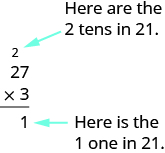
Then we multiply the by the and add the above the tens place to the product. So and Write the in the tens place of the product.
次ににを掛け、十の位の上のを積に加える。したがって、、そしてとなる。積の十の位にを書く。
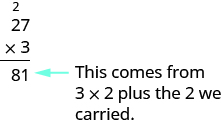
The product is
積はである。
When we multiply two numbers with a different number of digits, it’s usually easier to write the smaller number on the bottom. You could write it the other way, too, but this way is easier to work with.
桁数の異なる二つの数を掛けるときには、小さい方の数を下に書く方が通常は分かりやすい。逆に書くこともできるが、この方が計算しやすい。
Example 1.44例題 1.44
Multiply:
次の乗法を計算する:
Solution解答
Write the numbers so the digits and line up vertically. 数字とが縦にそろうように数を書く。 |
|
Multiply by the digit in the ones place of にの一の位の数字を掛ける。 |
|
Write in the ones place of the product and carry the tens. 積の一の位にを書き、十個を繰り上げる。 |
|
Multiply by the digit in the tens place of . Add the tens we carried. . にの十の位の数字を掛ける。。繰り上げた十個を加える。。 |
|
Write the in the tens place of the product. 積の十の位にを書く。 |
Try It (2)確認問題(2題)
Example 1.45例題 1.45
Multiply:
次の乗法を計算する:
Solution解答
Solution解答
Write the numbers so the digits and line up vertically. 数字とが縦にそろうように数を書く。 |
|
Multiply by the digit in the ones place of にの一の位の数字を掛ける。 |
|
Write the in the ones place of the product and carry the to the tens place.Multiply by the digit in the tens place of . 積の一の位にを書き、を十の位へ繰り上げる。にの十の位の数字を掛ける。。 |
|
Add the tens we carried to get . Write the in the tens place of the product and carry the 4 to the hundreds place. 繰り上げた十個を加えると、となる。積の十の位にを書き、4を百の位へ繰り上げる。 |
|
Multiply by the digit in the hundreds place of Add the hundreds we carried to get Write the in the hundreds place of the product and the to the thousands place. にの百の位の数字を掛ける。。繰り上げた百個を加えると、となる。積の百の位に、千の位にを書く。 |
Try It (2)確認問題(2題)
When we multiply by a number with two or more digits, we multiply by each of the digits separately, working from right to left. Each separate product of the digits is called a partial product. When we write partial products, we must make sure to line up the place values.
英語のヒント
2桁以上の数を掛けるときには、右から左へ進みながら、各桁の数字をそれぞれ掛ける。各桁の数字による個々の積を部分積という。部分積を書くときには、位をそろえる必要がある。
Example 1.46例題 1.46
Multiply:
次の乗法を計算する:
Solution解答
Write the numbers so each place lines up vertically. 各位が縦にそろうように数を書く。 |
 |
Start by multiplying 7 by 62. Multiply 7 by the digit in the ones place of 62. Write the 4 in the ones place of the product and carry the 1 to the tens place. まず7に62を掛ける。7に62の一の位の数字を掛ける。。積の一の位に4を書き、1を十の位へ繰り上げる。 |
 |
Multiply 7 by the digit in the tens place of 62. Add the 1 ten we carried. . Write the 3 in the tens place of the product and the 4 in the hundreds place. 7に62の十の位の数字を掛ける。。繰り上げた十1個を加える。。積の十の位に3、百の位に4を書く。 |
 |
The first partial product is 434. 最初の部分積は434である。 |
|
Now, write a 0 under the 4 in the ones place of the next partial product as a placeholder since we now multiply the digit in the tens place of 87 by 62. Multiply 8 by the digit in the ones place of 62. Write the 6 in the next place of the product, which is the tens place. Carry the 1 to the tens place. 次に87の十の位の数字に62を掛けるので、次の部分積の一の位には、4の下に位の位置を保つ0を書く。8に62の一の位の数字を掛ける。。積の次の位、すなわち十の位に6を書く。1を十の位へ繰り上げる。 |
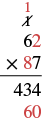 |
Multiply 8 by 6, the digit in the tens place of 62, then add the 1 ten we carried to get 49. Write the 9 in the hundreds place of the product and the 4 in the thousands place. 8に62の十の位の数字6を掛け、繰り上げた十1個を加えて49を得る。積の百の位に9、千の位に4を書く。 |
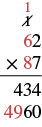 |
The second partial product is 4960. Add the partial products. 二つ目の部分積は4960である。部分積を足す。 |
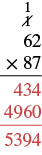 |
The product is
積はである。
Try It (2)確認問題(2題)
Example 1.47例題 1.47
Multiply:
掛けよ。
- ⓐ
- ⓑ
Solution解答
ⓐ . |
|
ⓑ |
When we multiplied times the product was Notice that has one zero, and we put one zero after to get the product. When we multiplied times the product was Notice that has two zeros and we put two zeros after to get the product.
にを掛けたとき、積はだった。にはゼロが一つあり、の後ろにゼロを一つ置くと積が得られることに注意しよう。にを掛けたとき、積はだった。にはゼロが二つあり、の後ろにゼロを二つ置くと積が得られる。
Do you see the pattern? If we multiplied times which has four zeros, we would put four zeros after to get the product
規則が分かるだろうか。に、ゼロが四つあるを掛けるなら、の後ろにゼロを四つ置いて、積を得る。
Try It (2)確認問題(2題)
Example 1.48例題 1.48
Multiply:
次の乗法を計算する:
Solution解答
Solution解答
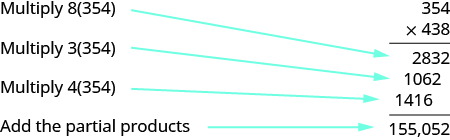
There are three digits in the factors so there will be partial products. We do not have to write the as a placeholder as long as we write each partial product in the correct place.
因数は3桁なので、部分積は個になる。各部分積を正しい位置に書けば、位置を保つためのを書く必要はない。
Try It (2)確認問題(2題)
Example 1.49例題 1.49
Multiply:
次の乗法を計算する:
Solution解答
There should be partial products. The second partial product will be the result of multiplying by
部分積は個になるはずである。二つ目の部分積は、にを掛けた結果になる。
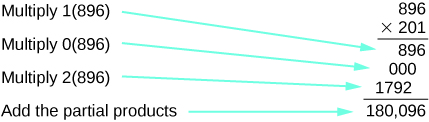
Notice that the second partial product of all zeros doesn’t really affect the result. We can place a zero as a placeholder in the tens place and then proceed directly to multiplying by the in the hundreds place, as shown.
すべてゼロである二つ目の部分積は、結果に影響しないことに注意しよう。図のように、十の位に位置を保つゼロを置いて、そのまま百の位のを掛ける計算に進める。
Multiply by but insert only one zero as a placeholder in the tens place. Multiply by putting the from the in the hundreds place.
を掛けるが、位置を保つゼロは十の位に一つだけ入れる。を掛け、のを百の位に置く。
Try It (2)確認問題(2題)
When there are three or more factors, we multiply the first two and then multiply their product by the next factor. For example:
因数が三つ以上あるときには、最初の二つを掛け、その積に次の因数を掛ける。例えば、次のようにする。
to multiply 掛けるには |
|
first multiply まずを計算する |
|
then multiply . 次にを計算する。 |