第1章非負整数
1.1 Introduction to Whole Numbers1.1 非負整数入門
Learning Objectives学習目標
Learning Objectives学習目標
By the end of this section, you will be able to:
この節を終えると、次のことができるようになる。
- Identify counting numbers and whole numbers数える数と非負整数を見分ける
- Model whole numbers非負整数を模型で表す
- Identify the place value of a digit数字の位の値を特定する
- Use place value to name whole numbers位取りを使って非負整数を言葉で表す
- Use place value to write whole numbers位取りを使って非負整数を書く
- Round whole numbers非負整数を丸める
Identify Counting Numbers and Whole Numbers数える数と非負整数を見分ける
Learning algebra is similar to learning a language. You start with a basic vocabulary and then add to it as you go along. You need to practice often until the vocabulary becomes easy to you. The more you use the vocabulary, the more familiar it becomes.
英語のヒント
代数を学ぶことは言語を学ぶことに似ている。基本的な語彙から始め、学習を進めながら語彙を増やしていく。語彙を容易に使えるようになるまで、頻繁に練習する必要がある。使えば使うほど、その語彙に親しめるようになる。
Algebra uses numbers and symbols to represent words and ideas. Let’s look at the numbers first. The most basic numbers used in algebra are those we use to count objects: and so on. These are called the counting numbers. The notation “…” is called an ellipsis, which is another way to show “and so on”, or that the pattern continues endlessly. Counting numbers are also called natural numbers.
英語のヒント
代数では、数と記号を使って言葉や考えを表す。まず数を見てみよう。代数で使う最も基本的な数は、物を数えるための数、などである。これらを数える数という。「…」という表記は省略記号と呼ばれ、「など」、つまり規則的な並びがどこまでも続くことを示す別の方法である。数える数は自然数とも呼ばれる。
Counting numbers and whole numbers can be visualized on a number line as shown in Figure 1.2.
数える数と非負整数は、図1.2のように数直線で視覚的に表せる。

Figure 1.2図 1.2
The numbers on the number line increase from left to right, and decrease from right to left.
数直線上の数は左から右へ進むと大きくなり、右から左へ進むと小さくなる。
The point labeled is called the origin. The points are equally spaced to the right of and labeled with the counting numbers. When a number is paired with a point, it is called the coordinate of the point.
英語のヒント
と記された点を原点という。の右側には等間隔に点が並び、数える数が記されている。数を点と対応させたとき、その数をその点の座標という。
The discovery of the number zero was a big step in the history of mathematics. Including zero with the counting numbers gives a new set of numbers called the whole numbers.
英語のヒント
数のゼロの発見は、数学の歴史における大きな一歩だった。数える数にゼロを加えると、非負整数という新しい数の集合が得られる。
We stopped at when listing the first few counting numbers and whole numbers. We could have written more numbers if they were needed to make the patterns clear.
数える数と非負整数の最初のいくつかを並べたときには、で止めた。並びの規則を明確にするために必要なら、もっと多くの数を書いてもよかった。
Example 1.1例題 1.1
Which of the following are ⓐ counting numbers? ⓑ whole numbers?
次のうち、ⓐ数える数、ⓑ非負整数はどれか。
Solution解答
- ⓐ The counting numbers start at so is not a counting number. The numbers are all counting numbers.ⓐ 数える数はから始まるので、は数える数ではない。はいずれも数える数である。
- ⓑ Whole numbers are counting numbers and The numbers are whole numbers.ⓑ 非負整数は数える数とを合わせたものである。は非負整数である。
The numbers and are neither counting numbers nor whole numbers. We will discuss these numbers later.
とは、数える数でも非負整数でもない。これらの数は後で取り上げる。
Try It (2)確認問題(2題)
Model Whole Numbers非負整数を模型で表す
Our number system is called a place value system because the value of a digit depends on its position, or place, in a number. The number has a different value than the number Even though they use the same digits, their value is different because of the different placement of the and the
英語のヒント
私たちの記数法は位取り記数法と呼ばれる。数字の値が、数の中での位置、すなわち位によって決まるからである。という数はという数とは値が異なる。同じ数字を使っていても、との位置が異なるため、値が違うのである。
Money gives us a familiar model of place value. Suppose a wallet contains three bills, seven bills, and four bills. The amounts are summarized in Figure 1.3. How much money is in the wallet?
お金は位取りの身近な模型になる。財布に札が3枚、札が7枚、札が4枚入っているとしよう。図1.3にそれぞれの金額をまとめた。財布にはいくら入っているか。
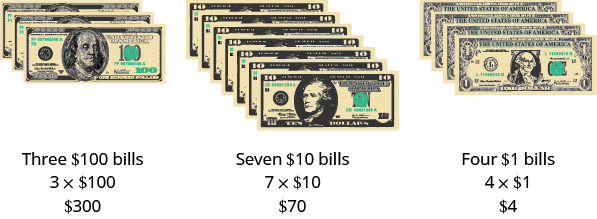
Figure 1.3図 1.3
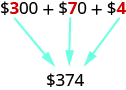
Find the total value of each kind of bill, and then add to find the total. The wallet contains
紙幣の種類ごとに金額を求め、それらを足して合計を求める。財布に入っている金額はである。
Base-10 blocks provide another way to model place value, as shown in Figure 1.4. The blocks can be used to represent hundreds, tens, and ones. Notice that the tens rod is made up of ones, and the hundreds square is made of tens, or ones.
英語のヒント
図1.4に示す十進法ブロックも、位取りを模型で表す方法である。ブロックを使って百、十、一を表せる。十を表す棒は一のブロック個でできており、百を表す正方形は十の棒本、すなわち一のブロック個でできていることに注目しよう。
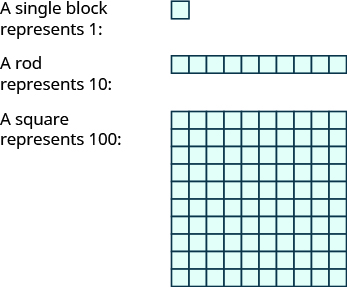
Figure 1.4図 1.4
Figure 1.5 shows the number modeled with blocks.
図1.5では、という数をブロックで表している。
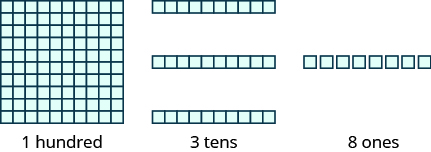
Figure 1.5図 1.5
We use place value notation to show the value of the number
位取り表記を使って、という数の値を示す。

Digit 数字 |
Place value 位の値 |
Number 数 |
Value 値 |
Total value 合計の値 |
|---|---|---|---|---|
hundreds 百の位 |
||||
tens 十の位 |
||||
ones 一の位 |
||||
Example 1.2例題 1.2
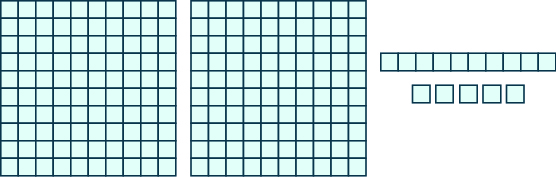
Use place value notation to find the value of the number modeled by the blocks shown.
示されたブロックが表す数の値を、位取り表記を使って求めよ。
Solution解答
There are hundreds squares, which is
百を表す正方形が枚あり、を表す。
There is tens rod, which is
十を表す棒が本あり、を表す。
There are ones blocks, which is
一を表すブロックが個あり、を表す。

Digit 数字 |
Place value 位の値 |
Number 数 |
Value 値 |
Total value 合計の値 |
|---|---|---|---|---|
hundreds 百の位 |
||||
tens 十の位 |
||||
ones 一の位 |
||||
The blocks model the number
ブロックはという数を表している。