第12章現代哲学と社会理論Contemporary Philosophies and Social Theories
12.4 The Frankfurt School12.4 フランクフルト学派
Learning Objectives学習目標
By the end of this section, you will be able to:
この節を終えると、次のことができるようになる。
Identify the main goal of critical theory as developed by the Frankfurt School.
フランクフルト学派が発展させた批判理論の、主要な目標を特定する。
Describe the Frankfurt School’s revision of Enlightenment and Marxist ideas.
フランクフルト学派が、啓蒙思想とマルクス主義の考えをどう修正したかを説明する。
Evaluate communicative action as a tool for liberation.
解放の道具としての、コミュニケーション的行為を評価する。
Explain how critical theory is messianic.
批判理論が、どのような意味でメシア的であるかを説明する。
What we know as critical theory emerged from the work of a group of early 20th-century Marxist German philosophers and social theorists at the Institute for Social Research at Goethe University in Frankfurt, Germany—a group that came to be known as the Frankfurt School. It arose within the turbulent political environment of the socialist revolutions of the early 20th century and the rise of the Nazi Party in Germany.
英語のヒント
今日、批判理論として知られるものは、20世紀初頭、ドイツ・フランクフルトのゲーテ大学社会研究所に集まった、マルクス主義の哲学者や社会理論家たちの仕事から生まれた。この集団は、フランクフルト学派として知られるようになった。批判理論は、20世紀初頭の社会主義革命と、ドイツでのナチ党の台頭という、激動する政治環境の中で生まれた。
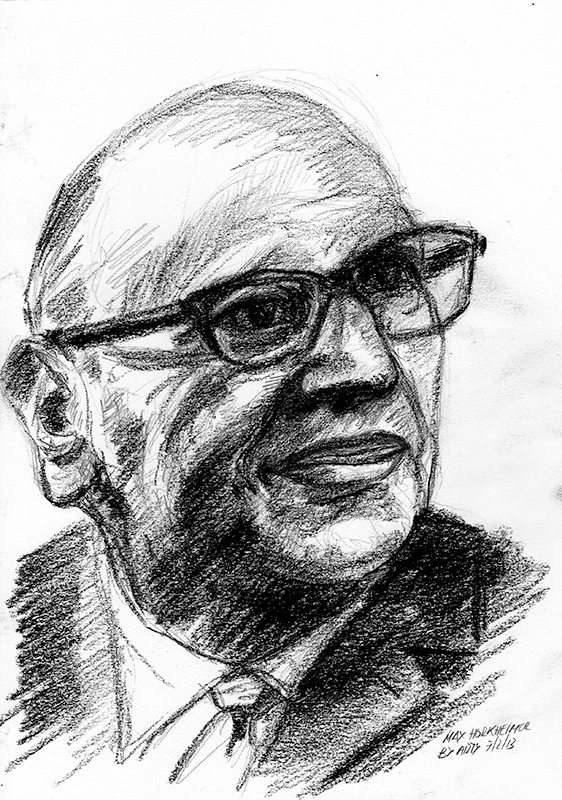
Following World War I, the socialist 1918–19 November Revolution dethroned the existing monarchy in Germany, replacing it with a parliamentary system that was later known as the Weimar Republic. Felix Weil (1898–1975), who would go on to provide the financial backing for what would become the Frankfurt School, was on the front lines of the revolution, serving in the Frankfurt Workers’ and Soldiers’ Council. The son of a wealthy entrepreneur, Weil aligned himself with philosophers, artists, and others who had been shifted to the left by the experiences of WWI and by other socialists. In 1923, Weil helped establish what was known as “Marxist Study Week,” a gathering of left-leaning thinkers, many of whom would later be affiliated with the Institute for Social Research. Although the Institute for Social Research was founded in 1924, it was under the leadership of Max Horkheimer, who became director in 1930, that the institute began to focus on practical responses to social oppression (Horkheimer [1972] 1992).
英語のヒント
第一次世界大戦後、1918〜1919年の社会主義的な十一月革命は、ドイツの君主制を倒し、後にヴァイマル共和国と呼ばれる議会制へ置き換えた。後にフランクフルト学派となる集団の財政的支援者となったフェリックス・ヴァイル(1898〜1975年)は、フランクフルト労兵評議会で活動し、革命の最前線に立っていた。裕福な実業家の息子だったヴァイルは、第一次世界大戦の経験や、他の社会主義者の影響で左傾化した、哲学者、芸術家などの人々と行動をともにした。1923年、ヴァイルは「マルクス主義研究週間」と呼ばれた、左派の思想家の集会の開催を助けた。参加者の多くは、後に社会研究所に関わることになった。社会研究所は1924年に設立されたが、社会的抑圧への実践的な応答に力を入れ始めたのは、1930年に所長となったマックス・ホルクハイマーの指導の下でのことだった(Horkheimer [1972] 1992)。
In 1933, in response to the rise of the Nazi regime, the institute moved from Frankfurt to Geneva, Switzerland (Löwenthal 1981). From Geneva, the institute relocated to New York City, where it was made a part of Columbia University. It was while the institute was part of Columbia that the Frankfurt School gained notice and prestige, with its research methods gaining acceptance among other academics. After the end of World War II, some of the Frankfurt School intellectuals returned to West Germany while others remained in the United States. A full return of the institute to Frankfurt occurred in the 1950s (Held 1980).
英語のヒント
1933年、ナチ体制の台頭に対応して、研究所はフランクフルトからスイスのジュネーヴへ移った(Löwenthal 1981)。そこからさらにニューヨークへ移り、コロンビア大学の一部となった。フランクフルト学派が注目と名声を得たのは、研究所がコロンビア大学に属していた時期だった。その研究方法は、他の学者たちの間でも受け入れられるようになった。第二次世界大戦の終結後、学派の知識人の一部は西ドイツへ戻り、他の人々はアメリカにとどまった。研究所全体がフランクフルトへ復帰したのは、1950年代である(Held 1980)。
The Formation of a Critical Theory批判理論の形成
Although the Frankfurt School did not articulate one singular view, one identifying mark of its critical theory was a push toward emancipating humanity from the multitude of forces viewed as enslaving it. Max Horkheimer (1895–1973) argued that a plausible critical theory must do several things: explain the ills of society, identify the means by which change can occur, provide a rubric for critique, and articulate reasonable goals (Horkheimer [1972] 1992). The Frankfurt School not only sought to free those oppressed through cultural, economic, and political structures but also sought to free philosophical theory from the chains of oppressive ideologies. The members of the Frankfurt School critiqued Enlightenment thought, revised key Marxist concepts, and proposed new strategies pertaining to how social change can be accomplished.
英語のヒント
フランクフルト学派は、単一の見解を示したわけではない。しかし、その批判理論を特徴づけるものの一つは、人類を奴隷状態にしているとみなす、多数の力から人類を解放しようとする運動だった。マックス・ホルクハイマー(1895〜1973年)は、説得力のある批判理論には、複数の仕事が必要だと論じた。社会の弊害を説明すること、変化が起こる手段を特定すること、批判のための基準を与えること、そして妥当な目標を明確に述べることである(Horkheimer [1972] 1992)。フランクフルト学派は、文化的・経済的・政治的構造によって抑圧された人々を解放するだけでなく、抑圧的なイデオロギーの鎖から、哲学理論そのものを解放しようともした。学派の人々は、啓蒙思想を批判し、マルクス主義の重要な概念を修正し、社会変革をどう実現できるかについて、新たな戦略を提案した。
Critique of the Enlightenment Concept of Knowledge啓蒙思想における知識概念の批判
The Frankfurt School was critical of the Enlightenment view of true knowledge as conceptual, hence separate from the world. Drawing on the work of other branches of philosophy that had arisen in continental Europe during the 19th and 20th centuries—in particular, phenomenology and hermeneutics—the school focused on how the context within which we experience a phenomenon or observe an object can change our interpretation of its meaning. The Frankfurt School rejected the Enlightenment’s faith in the ability of reason to lay bare the secrets of the universe. For these thinkers, knowledge did not consist of absolute “facts” but instead an awareness of the structures of our social world that shape what we believe to be facts (Corradetti 2021).
英語のヒント
フランクフルト学派は、真の知識は概念的なものであり、したがって世界から切り離されているという、啓蒙思想の見方を批判した。19〜20世紀にヨーロッパ大陸で生まれた他の哲学分野、特に現象学と解釈学の仕事を取り入れ、学派は、現象を経験したり対象を観察したりする文脈が、その意味の解釈をどう変えうるかに注目した。フランクフルト学派は、理性には宇宙の秘密を明らかにする能力があるという、啓蒙思想の信頼を退けた。彼らにとって知識とは、絶対的な「事実」の集まりではない。私たちが事実だと信じるものを形作る、社会世界の構造への自覚だった(Corradetti 2021)。
While many philosophical systems revolved around abstract ideas made popular by the Enlightenment, the critical theory developed at the Frankfurt School attempted to engage the world as it was and not as philosophical frameworks painted it to be. The theorists of the Frankfurt School asserted that philosophical ideas are not abstract concepts. Rather, the ideas that structure the world as we live in it are the result of social, political, cultural, and religious forces and are therefore lived issues. Moreover, to the degree that these forces are oppressive, so are the accepted beliefs or knowledge generated by these forces. The purpose of true knowledge is thus to inform us on how the social world can be liberated from marginalizing and oppressive concepts (Corradetti 2021).
英語のヒント
多くの哲学体系が、啓蒙時代に広まった抽象的な観念を中心に展開したのに対し、フランクフルト学派の批判理論は、哲学の枠組みが描くとおりの世界ではなく、現にある世界に関わろうとした。学派の理論家たちは、哲学の観念は抽象概念ではないと主張した。むしろ、私たちが生きる世界を形作る観念は、社会的、政治的、文化的、宗教的な力の結果であり、したがって、実際に生きられる問題であるという。さらに、それらの力が抑圧的である程度に応じて、その力から生まれ、受け入れられている信念や知識も、抑圧的となる。したがって、真の知識の目的は、人々を周縁へ追いやり、抑圧する概念から、社会世界をどう解放できるかについて、知見を与えることにある(Corradetti 2021)。
Horkheimer’s Rejection of the Primacy of Reasonホルクハイマーによる理性の優位の拒否
The Enlightenment had established a hierarchical relationship between philosophy—and by extension reason—and science. Kant had positioned reason itself as the key to understanding science and to making sense of how scientific discoveries fit into the overall framework of knowledge. According to the Kantian view, proper philosophical reflection was based in reason. Horkheimer rejected this prioritization of reason. He asserted that the objects of scientific reflection were shaped and determined through context (Horkheimer [1972] 1992). Horkheimer and others criticized Kant and Enlightenment philosophy as abstract, irrelevant, or in the worst case, enabling the oppression that occurred since Kant’s time. Instead, the Frankfurt School offered a focus on how philosophy could be used to make a practical difference within that world.
英語のヒント
啓蒙思想は、哲学、ひいては理性と、科学との間に、階層的な関係を設定した。カントは、科学を理解し、科学的発見が知識の全体的な枠組みにどう収まるかを理解する鍵として、理性そのものを位置付けた。カントの見方では、適切な哲学的省察は、理性に基礎を置く。ホルクハイマーは、理性をこうして優先することを退けた。科学的省察の対象は、文脈を通じて形作られ、規定される、と主張したのである(Horkheimer [1972] 1992)。ホルクハイマーらは、カントと啓蒙哲学を、抽象的で、現実に関わらず、最悪の場合にはカントの時代以降の抑圧を可能にしたものとして批判した。代わりに、フランクフルト学派は、その世界の中で、実際の変化をもたらすために、哲学をどう用いうるかに焦点を当てた。