第12章現代哲学と社会理論Contemporary Philosophies and Social Theories
Benjamin’s Disruption of the Status Quoベンヤミンによる現状の中断
A common denominator among the multiplicity of ideas within the Frankfurt School could arguably be what German-Jewish philosopher Walter Benjamin (1892–1940) called the “messianic.” By this, he meant a disruption within the status quo that eventually responds in various ways to the oppression occurring in a society (Horkheimer [1972] 1992). Jewish and Judeo-Christian theology prophesies a messianic redeemer who will eventually bring peace to an unstable world. Benjamin adapted the term to indicate a conceptual resistance to hegemonic systems (another term for the power structures of the status quo). This resistance is not part of and does not flow from linear history but rather interrupts it. Benjamin understood systems such as capitalism to be linear pathways of history that the messianic impulse interrupts, thus bringing forth a reality that does not flow from past to present but always is. Benjamin held that such a disruption of linear time disrupts systems of power by creating a classless moment (Khatib 2013).
英語のヒント
フランクフルト学派の多様な考えに共通するものは、ドイツのユダヤ人哲学者ヴァルター・ベンヤミン(1892〜1940年)が「メシア的なもの」と呼んだものだ、と言えるかもしれない。彼はこの語で、社会の中で起こる抑圧に、やがてさまざまな形で応答する、現状の中断を意味した(Horkheimer [1972] 1992)。ユダヤ教、およびユダヤ・キリスト教の神学は、不安定な世界に、最終的に平和をもたらす、メシアたる救済者を予言する。ベンヤミンはこの語を転用し、覇権的なシステム、すなわち現状の権力構造に対する、概念的な抵抗を示した。この抵抗は、直線的な歴史の一部でも、そこから流れ出すものでもなく、歴史を中断する。ベンヤミンは、資本主義などのシステムを、メシア的な衝動が中断する、歴史の直線的な経路と捉えた。その中断は、過去から現在へ流れるのではなく、常に存在する現実をもたらす。彼は、このように直線的な時間を中断することが、階級のない瞬間を作り出すことによって、権力のシステムを断ち切ると考えた(Khatib 2013)。
One example of Benjamin’s idea of the messianic would be the eradication of the socially constructed hierarchy of race. Disrupting this concept would presumably result in a society devoid of the stratification that is connected to notions of race. The difficulty with this idea is that messianic moments within human societies don’t seem to last. With the messianic deconstruction of one status quo (such as race) arises another construction that eventually takes the place of the former as the status quo (such as class).
英語のヒント
ベンヤミンのメシア的なものの一例は、社会的に作られた人種の階層をなくすことだろう。この概念を中断すれば、おそらく、人種という観念に結び付いた階層化のない社会が生まれる。この考えの難点は、人間社会のメシア的な瞬間が、長続きしないように見えることである。人種のような一つの現状が、メシア的に脱構築されると、別の構築物が生じる。そしてそれが、階級のような新たな現状として、やがて前のものに取って代わる。
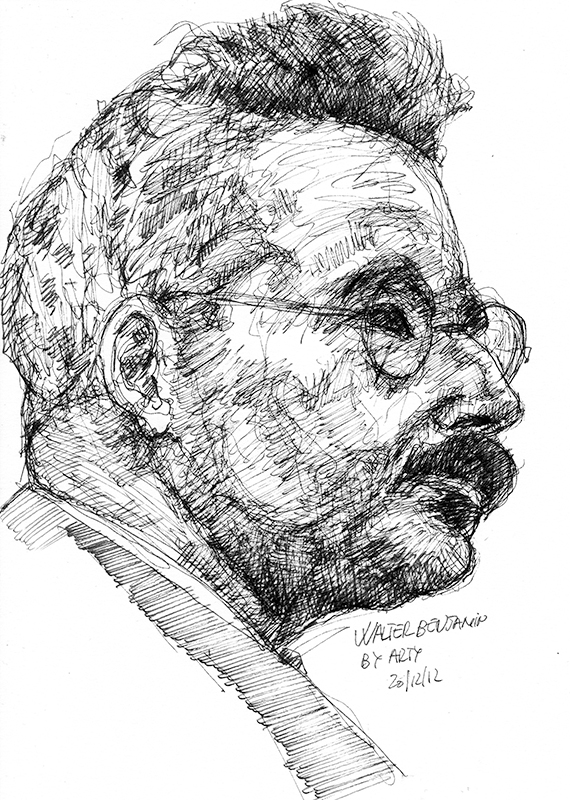
Figure 12.10 Walter Benjamin was an early member of the Frankfurt School. He started as a literary critic but contributed profoundly original ideas to the school. (credit: “Walter Benjamin for PIFAL” by Artruro Espinoza/Flickr, CC BY 2.0)
図12.10 ヴァルター・ベンヤミンは、フランクフルト学派の初期の一員だった。文芸批評家として出発し、非常に独創的な考えを学派に提供した。 (credit: “Walter Benjamin for PIFAL” by Artruro Espinoza/Flickr, CC BY 2.0)
The Revision of the Marxist Dialecticマルクス主義的弁証法の修正
The Frankfurt School amended the dialectical method to address what they saw as the shortcomings of Marx’s belief that the progression of the world from capitalism to socialism was inevitable. As we can see now, a socialist future has yet to be the inevitable end point of all capitalist societies. In the hands of Frankfurt School theorists, the dialectical method became not a forecast for humanity’s future, but a “down and dirty” understanding of the arbitrariness of the social situation in any given era (Horkheimer [1972] 1992). This understanding indicated that what is to come must be shaped in a real way by intentional action, as opposed to theoretical reflection. While utilizing elements of Marxist philosophies, many Frankfurt School thinkers held that social transformation was not inevitable but needed to be worked toward in conscious ways.
英語のヒント
フランクフルト学派は、世界が資本主義から社会主義へ進むことは必然だという、マルクスの信念に見いだした欠点に対処するため、弁証法的方法を修正した。今日から見ても、社会主義的な未来は、すべての資本主義社会が必ず至る終点とは、まだなっていない。フランクフルト学派の理論家の手にかかると、弁証法的方法は、人類の未来の予測ではなく、ある時代の社会状況が持つ恣意性を、現実に踏み込んで把握するものとなった(Horkheimer [1972] 1992)。この理解が示すのは、来たるべきものは、理論的な省察ではなく、意図的な行為によって、現実に形作られなければならないということである。マルクス主義哲学の要素を用いながらも、学派の多くの思想家は、社会変革は必然的に起こるものではなく、意識的にその実現へ取り組む必要があると考えた。
Jürgen Habermas’s Communicative Actionユルゲン・ハーバーマスのコミュニケーション的行為
The Frankfurt School sociologist and philosopher Jürgen Habermas (b. 1929) is the most prolific figure associated with the Frankfurt School, producing work touching on a variety of topics in social life (Bronner 2011). Habermas took Max Horkheimer’s place as the chair in sociology and philosophy at the Institute for Social Research in 1964.
英語のヒント
フランクフルト学派の社会学者・哲学者ユルゲン・ハーバーマス(1929年生)は、同学派に関わる人物の中で最も多作であり、社会生活のさまざまな話題に触れる著作を生み出している(Bronner 2011)。1964年、ハーバーマスは、社会研究所の社会学・哲学の教授職を、マックス・ホルクハイマーから引き継いだ。
A prized possession of many societies is a democratic right to free speech; this right was championed by Habermas. As articulated by Habermas, the emancipation of a society is fueled by more than the mere act of people saying what they feel. Rather, people must say what they feel in a public forum in which their ideas can be challenged—in a forum through which people debate freely and thus sharpen their ideas. Habermas viewed this sort of open discussion as having the potential to shape and transform how political systems are run. Habermas calls this sort of pressure by dialogue communicative action.
英語のヒント
多くの社会が大切にしているものに、言論の自由という民主的権利がある。ハーバーマスは、この権利を擁護した。彼によれば、社会の解放を促すには、人々が感じたことを口にするというだけでは足りない。人々は、自分の考えに異議が唱えられうる公共の場で、感じたことを述べなければならない。人々が自由に討論し、こうして自分の考えを磨き上げる場である。ハーバーマスは、このような開かれた討論が、政治制度の運営の仕方を形作り、変える可能性を持つと捉えた。彼は、このように対話を通じて働きかけることを、コミュニケーション的行為と呼ぶ。
The foundation upon which communicative action rests is the ground of language. Communicative action views language not as an unchanging system that will always produce certain conclusions but as a process of discovery that is most effective when the ideas we hold most dear are put to intense scrutiny. Language becomes the process by which humans create and agree upon the norms that are most important to them (Bronner 2011).
英語のヒント
コミュニケーション的行為が拠って立つ基盤は、言語である。この考えは、言語を、決まった結論を常に生み出す不変の体系とは捉えない。むしろ、私たちが最も大切にする考えが、厳しい吟味にさらされたときに、最も効果的に働く発見の過程と捉える。言語は、人間が自分たちにとって最も重要な規範を作り、それに合意する過程となる(Bronner 2011)。
Habermas viewed communicative action as taking place in the public sphere. The public sphere refers both to the spaces in which people discuss the issues of the day and the collective conceptual realm of people involved in such discussions. The public sphere is a realm outside of nation and state politics where people can be persuaded to engage in some sort of political action (Asen 1999). Habermas contrasts the public sphere with the private sphere, which is the realm where the mechanisms that perpetuate society reside, such as the organizations and enterprises responsible for the production of commodities within an economy (Habermas 1989, 30).
英語のヒント
ハーバーマスは、コミュニケーション的行為が、公共圏で起こると考えた。公共圏は、人々がその時々の問題を論じる場所と、その議論に参加する人々が共有する概念的な領域の、双方を指す。公共圏は、国家の政治の外部にあり、人々が説得されて、何らかの政治的行動へ関わるようになる領域である(Asen 1999)。ハーバーマスは、公共圏を私的領域と対比する。私的領域は、社会を存続させる仕組みが置かれる領域である。たとえば、経済の中で商品の生産を担う、諸組織や企業などが含まれる(Habermas 1989, 30)。
Modern-day examples of the public sphere might be social media platforms or coffeehouses. The hip-hop element of rap is another type of public sphere, with rapper Chuck D of Public Enemy famously stating that rap is the “CNN” of Black America. Public sphere theory asserts that the best governments are the ones that take heed of the communicative action that takes place in the public sphere (Benhabib 1992).
英語のヒント
公共圏の現代的な例には、ソーシャルメディアのプラットフォームや、喫茶店があるだろう。ヒップホップの要素の一つであるラップも、別の形の公共圏である。パブリック・エナミーのラッパー、チャックDは、ラップを黒人アメリカ社会の「CNN」と呼んだことで知られる。公共圏の理論は、最善の政府とは、公共圏で起こるコミュニケーション的行為に、注意を払う政府だと主張する(Benhabib 1992)。
Paulo Freire’s Critical Pedagogyパウロ・フレイレの批判的教育学
Inspired by Frankfurt School thinkers, Brazilian philosopher Paulo Freire (1921–1997) made key contributions to a school of thought known as the critical pedagogy movement. Freire asserted that the education provided to people living in the postcolonized world wasn’t adequate for emancipation. Freire argued that the type of education needed would move toward a deconstruction of the means by which knowledge production is structured and disseminated in a colonial society. Similar to Habermas’s communicative action, Freire affirmed that authentic communication must occur between teacher and student for true education to take place. True education involves asking “why” questions of the most foundational aspects of the society. This challenging of assumptions prompts the student to consider whether the foundational aspects of a society are actually beneficial or are simply accepted as normal and natural since things have “always” been this way. For Freire, you are only authentically human when you live a life that practices free critical reflection, which leads to emancipation (Freire [2000] 2012). In other words, emancipated humans not only think for themselves but also question the very ways in which society says we should think.
英語のヒント
フランクフルト学派の思想家に影響を受けた、ブラジルの哲学者パウロ・フレイレ(1921〜1997年)は、批判的教育学運動として知られる思想の流れに、重要な貢献をした。フレイレは、植民地支配を経た世界の人々に与えられている教育は、解放のためには不十分だと主張した。必要なのは、植民地社会で知識の生産が構造化され、広められる手段を、脱構築する方向へ向かう教育だと論じた。ハーバーマスのコミュニケーション的行為と同じように、フレイレは、真の教育が生じるには、教師と学生の間に真正なコミュニケーションがなければならないとした。真の教育には、社会の最も基礎的な側面に、「なぜ」と問うことが含まれる。このように前提に異議を唱えることで、学生は考えるよう促される。社会の基礎的な側面は、本当に利益をもたらしているのか。それとも、「いつも」そうだったというだけで、正常で自然なものとして受け入れられているのか。フレイレにとって、人が真に人間であるのは、自由で批判的な省察を実践し、解放へつながる生き方をしているときだけである(Freire [2000] 2012)。言い換えれば、解放された人間は、自分で考えるだけでなく、社会が「こう考えるべきだ」とする、その考え方そのものも問い直す。