第12章現代哲学と社会理論Contemporary Philosophies and Social Theories
12.2 The Marxist Solution12.2 マルクス主義による解決
Learning Objectives学習目標
By the end of this section, you will be able to:
この節を終えると、次のことができるようになる。
Explain the dialectic method.
弁証法的方法を説明する。
Contrast the Hegelian and Marxian concepts of dialectic.
ヘーゲルとマルクスの弁証法の概念を対比する。
Outline the stages of Marx’s proletariat revolution.
マルクスが考えたプロレタリア革命の段階を概説する。
Describe how Maoism reframed Marxism as an anti-imperialist revolution.
毛沢東主義が、マルクス主義を反帝国主義革命としてどう捉え直したかを説明する。
Unlike Enlightenment social theory, Marxist theories did not try to solve specific social problems that arose from industrialization and urbanization. Rather, they advocated removing the economic system that they felt caused these problems—capitalism. When German philosophers Karl Marx and Frederick Engels published The Communist Manifesto in 1848, they made a prediction: the workers would overthrow capitalism in the most advanced industrial nation, England. The natural forces of history, they argued, made this revolution inevitable. They derived their views of these historical forces from the work of German philosopher Georg Wilhelm Friedrich Hegel (1770–1831) on the dialectic method.
英語のヒント
啓蒙時代の社会理論とは異なり、マルクス主義の諸理論は、工業化と都市化から生じた個々の社会問題を解決しようとはしなかった。むしろ、これらの問題を引き起こしたと考える経済体制、すなわち資本主義を取り除くことを主張した。ドイツの哲学者カール・マルクスとフリードリヒ・エンゲルスが、1848年に『共産党宣言』を刊行した際、彼らはある予測を行った。最も工業が発展した国であるイングランドで、労働者が資本主義を打倒するという予測だった。歴史の自然な力によって、この革命は必然的なものとなる、と彼らは論じた。こうした歴史の力についての彼らの見解は、ドイツの哲学者ゲオルク・ヴィルヘルム・フリードリヒ・ヘーゲル(1770〜1831年)が、弁証法的方法について行った仕事に由来していた。
Hegel’s Dialectic Methodヘーゲルの弁証法的方法
Hegel argued that history itself was the movement created by the interaction between a thesis (an original state) and a force countering that original state (antithesis), resulting in a new and higher state (synthesis). This dialectic can be likened to a grade report: based on the original grades (the thesis), a student will ideally reflect on their performance and address areas of weakness (antithesis) to ultimately arrive at a higher understanding of the topics under study (synthesis).
英語のヒント
ヘーゲルは、歴史そのものが、定立(もとの状態)と、それに対抗する力(反定立)との相互作用によって生み出される運動であり、その結果、新たな、より高い状態(総合)が生まれると論じた。この弁証法は、成績表にたとえられる。もとの成績(定立)に基づいて、学生は、理想的には自分の学習成果を振り返り、弱点となる領域に取り組む(反定立)。そして最終的に、学んでいる内容について、より高い理解(総合)へと到達する。
Hegel argued that in various eras of history, Absolute Spirit—which might be understood in many ways, including God or the collective human consciousness—confronts its own essence and transitions to a higher state. Hegel saw this most clearly in the life of Jesus and the birth of Christianity. Hegel presents Jesus as a rational philosopher who reflects on and confronts Judaism—antithesis challenging thesis. The resurrection of Jesus following his crucifixion symbolizes an awakened consciousness both in the individual of Jesus and in humanity. Within this framework, the birth of Christianity following Jesus’s resurrection is viewed as the synthesis, the higher state (Dale 2006).
英語のヒント
ヘーゲルは、歴史のさまざまな時代において、絶対精神が自らの本質に向き合い、より高い状態へ移行すると論じた。絶対精神は、神や、人間の集合的な意識など、多様な仕方で理解できる。ヘーゲルは、この動きを、イエスの生涯とキリスト教の誕生に最も明瞭に見た。彼はイエスを、ユダヤ教を省察し、それに対抗する合理的な哲学者として描く。定立に挑む反定立である。十字架刑の後のイエスの復活は、イエスという個人と人類の双方で、意識が目覚めることを象徴する。この枠組みでは、イエスの復活の後に起こるキリスト教の誕生が、総合、すなわち、より高い状態とみなされる(Dale 2006)。
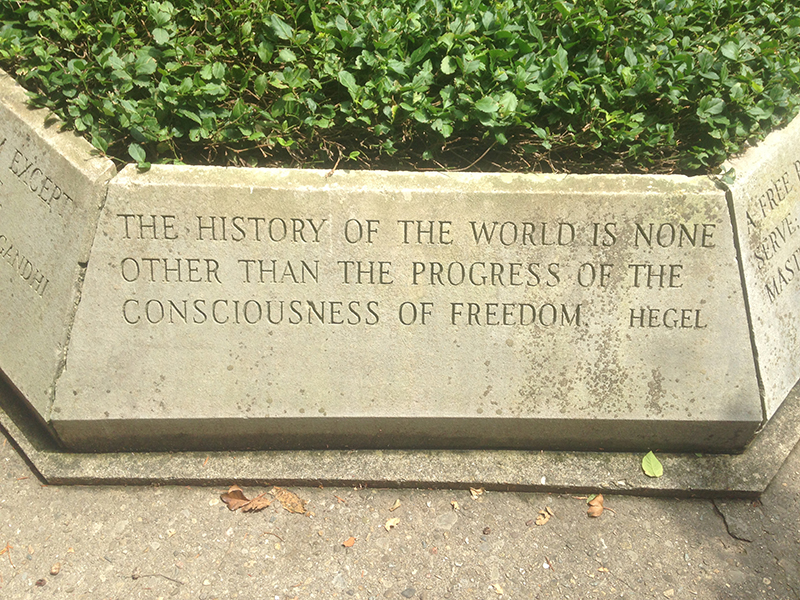
Figure 12.5 This quote from Hegel, carved into a public monument in Rocky Ripple, Indiana, captures his belief in the power of thoughts to change the world. (credit: “Hegel Quote” by Bart Everson/Flickr, CC BY 2.0)
図12.5 インディアナ州ロッキー・リップルの公共記念碑に彫られたこのヘーゲルの言葉は、思考には世界を変える力があるという、彼の信念を表している。 (credit: “Hegel Quote” by Bart Everson/Flickr, CC BY 2.0)
Marx’s Dialectical Materialism and the Proletariat Revolutionマルクスの弁証法的唯物論とプロレタリア革命
In contrast to Hegel’s idealistic dialectic, Karl Marx (1818–1883) proposed a view of the dialectic called dialectical materialism. Dialectical materialism identities the contradictions within material, real-world phenomena as the driving force of change. Most important to Marx were the economic conflicts between social classes. The Communist Manifesto, written by Marx and his collaborator Friedrich Engels (1820–1895) states, “The history of all hitherto existing society is the history of class struggles” (Marx and Engels [1969] 2000, ch. 1). Marx and Engels note that in every epoch of history (as understood at the time) society has been divided into social orders and that tensions between these social orders determine the direction of history, rather than the realization of any abstract ideals. Specifically, they identified the colonization of the Americas and the rise of trade with India and China as the revolutionary forces that created and enriched the bourgeois class, ultimately resulting in the death of feudalism. Similarly, Marx regarded the clash of economic interests between the bourgeoisie (owners of the means of production) and the proletariat (workers) as the contradiction that would bring down capitalism and give rise to a classless society (Marx and Engels [1969] 2000).
英語のヒント
ヘーゲルの観念論的な弁証法に対して、カール・マルクス(1818〜1883年)は、弁証法的唯物論と呼ばれる弁証法の見方を提案した。弁証法的唯物論は、現実世界の物質的な現象の中にある矛盾を、変化を生み出す原動力と捉える。マルクスにとって最も重要だったのは、社会階級間の経済的な対立だった。マルクスと、その協力者フリードリヒ・エンゲルス(1820〜1895年)が執筆した『共産党宣言』は、「これまでに存在したあらゆる社会の歴史は、階級闘争の歴史である」と述べている(Marx and Engels [1969] 2000, ch. 1)。マルクスとエンゲルスは、当時理解されていた歴史のあらゆる時代で、社会は複数の社会的身分に分かれており、歴史の方向を決めるのは、何らかの抽象的理想の実現ではなく、それらの身分間の緊張だと指摘する。具体的には、南北アメリカの植民地化と、インド・中国との貿易の拡大を、ブルジョア階級を生み出して富ませ、最終的に封建制を終わらせた革命的な力とみなした。同様にマルクスは、ブルジョアジー(生産手段の所有者)とプロレタリアート(労働者)の経済的利害の衝突こそ、資本主義を倒し、階級のない社会を生む矛盾だと考えた(Marx and Engels [1969] 2000)。
Marx laid out a detailed plan for how the proletariat revolution would occur. Marx proposed the concept of surplus value as a contradictory force within capitalism. Surplus value was the profit the capitalists made above and beyond the wages of the workers. This profit strengthens the capitalists’ monetarily and so gives them more power over the workers and a greater ability to exploit them. Marx viewed this surplus value as a key part of the “economic law of motion of modern society” that would inevitably lead to revolution (Marx [1954] 1999).
英語のヒント
マルクスは、プロレタリア革命がどのように起こるかについて、詳細な構想を示した。資本主義の内部で矛盾を生む力として、剰余価値という概念を提案したのである。剰余価値とは、労働者の賃金を上回って資本家が得る利益だった。この利益は資本家を金銭面で強化し、その結果、労働者に対する権力と、労働者を搾取する能力をいっそう増す。マルクスは、この剰余価値を、必然的に革命へ至る「近代社会の経済的運動法則」の、重要な部分と捉えた(Marx [1954] 1999)。
Despite there being competition among workers for jobs, Marx believed that conflict with their employers would bind them. As capitalism advanced, the workers would form into a class of proletariats, which would then form trade unions and political parties to represent its interests. As the revolution advanced, the most resolute members of the working-class political parties, those with the clearest understanding of the movement, would establish the communist party. The proletariat, led by the communists, would then “wrest, by degree, all capital from the bourgeoisie, to centralize all instruments of production in the hands of the State” (Marx and Engels [1969] 2000, ch. 2). The communist party would need to rule society as “the dictatorship of the proletariat” and enact reforms that would lead to a classless society.
英語のヒント
仕事をめぐって労働者同士が競争していても、雇用主との対立は彼らを結び付ける、とマルクスは考えた。資本主義が発展すると、労働者はプロレタリアートの階級を形成し、その階級が自らの利益を代表する労働組合や政党を作る。革命が進むにつれ、労働者階級の政党の中でも最も断固とした人々、すなわち、運動を最も明晰に理解する人々が、共産党を結成する。続いて、共産主義者が率いるプロレタリアートは、「ブルジョアジーから段階的にすべての資本を奪い取り、あらゆる生産用具を国家の手に集中する」ことになる(Marx and Engels [1969] 2000, ch. 2)。共産党は、「プロレタリアートの独裁」として社会を統治し、階級のない社会へつながる改革を実行しなければならない。
These developments did, in fact, materialize—but in Russia, not in England, as Marx had predicted. Marx had expected the revolution to begin in England, since it was the most industrial society, and to spread to other nations as their capitalist economies advanced to the same degree. The unfolding of actual events in a way contrary to Marx’s predictions led Marxists and others to doubt the reliability of Marx’s system of dialectical materialism. This doubt was compounded by the realizations that the Russian communist party was responsible for killing millions of farmers and dissidents and that some working-class parties and unions were turning to fascism as an alternative to communism. By the early to mid-20th century, opponents of the capitalist system were questioning orthodox Marxism as a method of realizing the ideal of a government by the working class.
英語のヒント
こうした展開は、実際に起きた。しかし、マルクスが予測したイングランドではなく、ロシアで起きたのである。マルクスは、最も工業化した社会であるイングランドで革命が始まり、他の国々の資本主義経済が同じ程度に発展すると、そこへ革命が広がると予想していた。現実の出来事が、マルクスの予測に反する形で進んだことで、マルクス主義者や他の人々は、弁証法的唯物論というマルクスの体系の信頼性を疑うようになった。さらに、ロシア共産党が何百万人もの農民や反体制派を殺害したこと、また、一部の労働者階級の政党や労働組合が、共産主義に代わるものとしてファシズムへ向かっていたことが明らかになり、この疑いはいっそう強まった。20世紀前半から半ばまでに、資本主義体制に反対する人々は、労働者階級による政府という理想を実現する方法としての、正統的マルクス主義を疑問視していた。