第6章形而上学Metaphysics
The Ontological Argument for God神の存在についての存在論的論証
An ontological argument for God was proposed by the Italian philosopher, monk, and Archbishop of Canterbury Anselm (1033–1109). Anselm lived in a time where belief in a deity was often assumed. He, as a person and as a prior of an abbey, had experienced and witnessed doubt. To assuage this doubt, Anselm endeavored to prove the existence of God in such an irrefutable way that even the staunchest of nonbelievers would be forced, by reason, to admit the existence of a God.
英語のヒント
神の存在についての存在論的論証は、イタリアの哲学者、修道士、そしてカンタベリー大司教であったアンセルムス(1033~1109年)によって提唱された。アンセルムスが生きた時代には、神への信仰はしばしば当然のこととされていた。彼は一人の人間として、また修道院の副院長として、疑いを自ら経験し、他者の疑いも目にしていた。この疑いを和らげるためにアンセルムスは、最も頑強な不信仰者でさえも、理性によって神の存在を認めざるをえなくなるほど、反駁の余地のない仕方で神の存在を証明しようと努めた。
Anselm’s proof is a priori and does not appeal to empirical or sense data as its basis. Much like a proof in geometry, Anselm is working from a set of “givens” to a set of demonstrable concepts. Anselm begins by defining the most central term in his argument—God. For the purpose of this argument, Anselm suggests, let “God” = “a being than which nothing greater can be conceived.” He makes two key points:
英語のヒント
アンセルムスの証明はア・プリオリであり、その根拠として経験的な情報や感覚情報に訴えない。幾何学の証明と同じように、一組の「与えられたもの」から、一組の証明可能な概念へと進む。アンセルムスは、論証の最も中心的な語である「神」を定義するところから始める。この論証では、「神」を「それより偉大なものが何も考えられない存在者」としよう、と提案する。そして二つの重要な点を示す。
When we speak of God (whether we are asserting God is or God is not), we are contemplating an entity who can be defined as “a being than which nothing greater can be conceived.”
英語のヒント
神について語るとき、神が存在すると主張していようと、存在しないと主張していようと、私たちは「それより偉大なものが何も考えられない存在者」と定義できる存在者を思い浮かべている。
When we speak of God (either as believer or nonbeliever), we have an intramental understanding of that concept—in other words, the idea is within our understanding.
神について語るとき、信仰者であっても不信仰者であっても、私たちはその概念を心の中で理解している。つまり、その観念は私たちの理解のうちにある。
Anselm continues by examining the difference between that which exists in the mind and that which exists both in the mind and outside of the mind. The question is: Is it greater to exist in the mind alone or in the mind and in reality (or outside of the mind)? Anselm asks you to consider the painter—for example, define which is greater: the reality of a painting as it exists in the mind of an artist or that same painting existing in the mind of that same artist and as a physical piece of art. Anselm contends that the painting, existing both within the mind of the artist and as a real piece of art, is greater than the mere intramental conception of the work.
英語のヒント
アンセルムスは続いて、心の中に存在するものと、心の中にも心の外にも存在するものとの違いを検討する。問われるのは、心の中だけに存在するほうが偉大なのか、それとも心の中と実在のうち、つまり心の外にも存在するほうが偉大なのか、ということである。アンセルムスは、画家を考えるよう求める。たとえば、どちらがより偉大かを定めてみよう。画家の心の中に存在する絵画の実在性か、それとも、その同じ画家の心の中に存在し、かつ物理的な作品としても存在する同じ絵画か。アンセルムスは、画家の心の中と現実の美術作品の両方として存在する絵画のほうが、作品を心の中に思い描いただけのものより偉大だと論じる。
At this point, a third key point is established:
ここで、第三の重要な点が確立される。
It is greater to exist in the mind and in reality than to exist in the mind alone.
心の中と実在の両方に存在するほうが、心の中だけに存在するより偉大である。
Have you figured out where Anselm is going with this argument?
アンセルムスがこの論証をどこへ進めようとしているのか、分かっただろうか。
If God is a being than which nothing greater can be conceived (established in #1 above);
神が、それより偉大なものが何も考えられない存在者であるならば(上の1で確立)、
And since it is greater to exist in the mind and in reality than in the mind alone (established in #3 above);
そして、心の中だけに存在するよりも、心の中と実在の両方に存在するほうが偉大なのだから(上の3で確立)、
Then God must exist both in the mind (established in #2 above) and in reality;
神は心の中(上の2で確立)にも、実在のうちにも、存在しなければならない。
In short, God must be. God is not merely an intramental concept but an extra-mental reality as well.
要するに、神は存在しなければならない。神は単なる心内の概念ではなく、心の外の実在でもある。
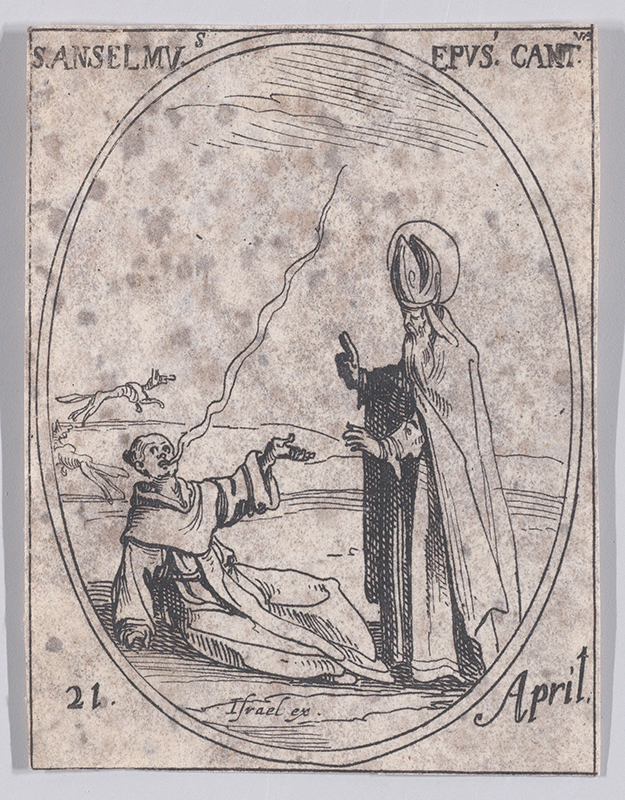
Figure 6.11 Anselm’s proof for the existence of God is structured like a mathematical proof, working from a definition of the term “God” to the conclusion that God must exist. (credit: “S. Anselme, évêque de Cantorbéry (St. Anslem, Bishop of Canterbury), April 21st, from Les Images De Tous Les Saincts et Saintes de L'Année (Images of All of the Saints and Religious Events of the Year)” by Jacques Callot/The Metropolitan Museum of Art, Public Domain)
図6.11 アンセルムスの神の存在証明は、数学の証明のように組み立てられており、「神」という語の定義から、神は存在しなければならないという結論へ進む。(クレジット:“S. Anselme, évêque de Cantorbéry (St. Anslem, Bishop of Canterbury), April 21st, from Les Images De Tous Les Saincts et Saintes de L'Année (Images of All of the Saints and Religious Events of the Year)” by Jacques Callot/The Metropolitan Museum of Art, パブリックドメイン)
Hindu Cosmologyヒンドゥー教の宇宙論
One of the primary arguments for the existence of God as found within Hindu traditions is based on cosmological conditions necessary to explain the reality of karma. As explained in the introduction to philosophy chapter and earlier in this chapter, karma may be thought of as the causal law that links causes to effects. Assuming the doctrine of interdependence, karma asserts that if we act in such a way to cause harm to others, we increase the amount of negativity in nature. We therefore hurt ourself by harming others. As the self moves through rebirth (samsara), the karmic debt incurred is retained. Note that positive actions also are retained. The goal is liberation of the soul from the cycle of rebirth.
英語のヒント
ヒンドゥー教の伝統に見られる神の存在論証の主要なものの一つは、カルマの実在を説明するために必要な宇宙論的条件に基づく。「哲学入門」の章と本章の前半で説明したように、カルマは原因と結果を結びつける因果法則と考えられる。相互依存の教えを前提にすると、カルマは、他者に害を及ぼすように行動すれば、自然の中の否定的なものの量を増やすことになると主張する。したがって、他者を傷つけることで自分自身を傷つけるのである。自己が輪廻(サンサーラ)を通じて移っていくとき、負ったカルマの負債は保たれる。肯定的な行為も保たれることに注意しよう。目標は、魂を再生の循環から解放することである。
Maintenance of the Law of Karmaカルマの法則の維持
While one can understand karmic causality without an appeal to divinity, how the causal karmic chain is so well-ordered and capable of realizing just results is not as easily explainable without an appeal to divinity. One possible presentation of the argument for the existence of God from karma could therefore read as follows:
英語のヒント
神性に訴えずにカルマの因果性を理解することはできるが、カルマの因果連鎖がこれほどよく秩序づけられ、正しい結果を実現できるのはなぜかということは、神性に訴えない限り、それほど容易には説明できない。したがって、カルマから神の存在を導く論証は、たとえば次のように提示できる。
If karma is, there must be some force/entity that accounts for the appropriateness (justice) of the karmic debt or karmic reward earned.
カルマが存在するなら、負ったカルマの負債や得られた報いの適切さ、つまり正しさを説明する何らかの力・存在者がなければならない。
The source responsible for the appropriateness (justice) of the debt or reward earned must be a conscious agent capable of lending order to all karmic interactions (past, present, and future).
負った負債や得られた報いの適切さ、つまり正しさを担う源は、過去・現在・未来のあらゆるカルマの相互作用に秩序を与えられる、意識をもった行為者でなければならない。
Karmic appropriateness (justice) does exist.
カルマの適切さ、つまり正しさは確かに存在する。
Therefore, a conscious agent capable of lending order to all karmic interactions (past, present, and future) must exist.
したがって、過去・現在・未来のあらゆるカルマの相互作用に秩序を与えられる、意識をもった行為者が存在しなければならない。
Therefore, God exists.
したがって、神が存在する。
Physical World as Manifestation of Divine Consciousness神的意識の現れとしての物理的世界
The cosmology built upon the religious doctrines allows for an argument within Hindu thought that joins a version of the moral argument and the design argument. Unless a divine designer were assumed, the moral and cosmological fabric assumed within the perspective could not be asserted.
英語のヒント
宗教的な教義に基づく宇宙論は、ヒンドゥー思想の内部で、道徳的論証の一形態と設計論証とを結びつける論証を可能にする。神的な設計者が想定されなければ、この見方が前提とする道徳的・宇宙論的な構造を主張することはできないだろう。
Hindu Arguments Against the Existence of God神の存在に反対するヒンドゥー教の論証
One of the primary arguments against the existence of God is found in the Mīmāmsā tradition. This ancient school suggests that the Vedas were eternal but without authors. The cosmological and teleological evidence as examined above was deemed inconclusive. The focus of this tradition and its several subtraditions was on living properly.
英語のヒント
神の存在に反対する主要な論証の一つは、ミーマーンサーの伝統に見られる。この古い学派は、ヴェーダは永遠であるが作者をもたないとする。先に検討した宇宙論的・目的論的な証拠は、決定的ではないと判断された。この伝統とそこに属するいくつかの分派の焦点は、正しく生きることにあった。