第6章形而上学Metaphysics
The Mind as Self自己としての心
Many philosophers, Western and non-Western, have equated the self to the mind. But what is the mind? A monist response is the mind is the brain. Yet, if the mind is the brain, a purely biological entity, then how do we explain consciousness? Moreover, if we take the position that the mind is immaterial but the body is material, we are left with the question of how two very different types of things can causally affect the other. The question of “How do the two nonidentical and dissimilar entities experience a causal relationship?” is known as the mind-body problem. This section explores some alternative philosophical responses to these questions.
英語のヒント
西洋・非西洋を問わず、多くの哲学者は自己を心と同一視してきた。しかし、心とは何か。一元論的な答えは、心とは脳であるというものだ。だが心が、純粋に生物学的な存在者である脳ならば、意識をどう説明するのだろうか。さらに、心は非物質的で身体は物質的だという立場を取れば、まったく異なる二種類のものが、どのように互いに因果的な影響を与えられるのかという問いが残る。「同一でも類似してもいない二つの存在者が、どうして因果関係をもつのか」という問いは、心身問題として知られている。ここでは、これらの問いに対する哲学上のいくつかの異なる答えを検討する。
Physicalism物理主義
Reducing the mind to the brain seems intuitive given advances in neuroscience and other related sciences that deepen our understanding of cognition. As a doctrine, physicalism is committed to the assumption that everything is physical. Exactly how to define the physical is a matter of contention. Driving this view is the assertion that nothing that is nonphysical has physical effects.
英語のヒント
神経科学をはじめとする関連諸科学が進歩し、認知への理解が深まっていることを踏まえると、心を脳に還元するのは直観的にもっともらしく見える。物理主義は、一つの学説として、すべてのものは物理的であるという前提に立つ。何を正確に物理的と定義するかは、論争の対象となっている。この見方を支えているのは、物理的でないものが物理的な結果を生むことはないという主張である。
John Locke and Identityジョン・ロックと同一性
In place of the biological, Locke defined identity as the continuity lent through what we refer to as consciousness. His approach is often referred to as the psychological continuity approach, as our memories and our ability to reflect upon our memories constitute identity for Locke. In his Essay on Human Understanding, Locke (as cited by Gordon-Roth 2019) observed, “We must consider what Person stands for . . . which, I think, is a thinking intelligent Being, that has reason and reflection, and can consider it self as itself, the same thinking thing in different times and places.” He offered a thought experiment to illustrate his point. Imagine a prince and cobbler whose memories (we might say consciousness) were swapped. The notion is far-fetched, but if this were to happen, we would assert that the prince was now the cobbler and the cobbler was now the prince. Therefore, what individuates us cannot be the body (or the biological).
英語のヒント
ロックは、生物学的なものの代わりに、私たちが意識と呼ぶものによってもたらされる連続性として同一性を定義した。その立場は、しばしば心理的連続性説と呼ばれる。ロックにとって、私たちの記憶と、その記憶を振り返る能力が同一性を構成するからである。『人間知性論』でロックは次のように述べた。「人格という語が何を意味するかを考えなければならない……それは、私の考えでは、理性と反省の能力をもち、異なる時と場所において同一の思考するものとして、自分を自分自身と考えることのできる、思考する知的な存在者である」(Gordon-Roth 2019 に引用)。この点を説明するため、ロックは思考実験を示した。記憶、あるいは意識と言ってもよいものが入れ替わった王子と靴職人を想像してみよう。突飛な考えだが、もしこれが起きたなら、私たちは、王子はいまや靴職人であり、靴職人はいまや王子だと主張するだろう。したがって、私たちを個体として区別するものは、身体、つまり生物学的なものではありえない。
The Problem of Consciousness意識の問題
Christof Koch (2018) has said that “consciousness is everything you experience.” Koch offered examples, such as “a tune stuck in your head,” the “throbbing pain from a toothache,” and “a parent’s love for a child” to illustrate the experience of consciousness. Our first-person experiences are what we think of intuitively when we try to describe what consciousness is. If we were to focus on the throbbing pain of a toothache as listed above, we can see that there is the experiencing of the toothache. Curiously, there is also the experiencing of the experiencing of the toothache. Introspection and theorizing built upon first-person inspections affords vivid and moving accounts of the things experienced, referred to as qualia.
英語のヒント
クリストフ・コッホ(2018)は、「意識とは、あなたが経験するすべてのものだ」と述べている。コッホは、意識の経験を説明するために、「頭から離れない曲」、「歯痛のずきずきする痛み」、「親の子に対する愛」などを例に挙げた。意識とは何かを説明しようとするとき、私たちが直観的に思い浮かべるのは、一人称の経験である。先ほど挙げた歯痛のずきずきする痛みに注目すると、歯痛を経験することがあると分かる。興味深いことに、歯痛を経験していることを経験することもある。一人称による観察を基盤とする内省と理論化は、経験されるものについて、生き生きとして心を動かす記述をもたらす。この経験されるものは、クオリアと呼ばれる。
An optimal accounting of consciousness, however, should not only explain what consciousness is but should also offer an explanation concerning how consciousness came to be and why consciousness is present. What difference or differences does consciousness introduce?
英語のヒント
しかし、意識を最もよく説明するには、意識とは何かを説明するだけでなく、意識がどのように生まれ、なぜ存在するのかも説明すべきである。意識があることで、どのような違いが一つ、あるいは複数、生じるのだろうか。
Rene Descartes and Dualismルネ・デカルトと二元論
Dualism, as the name suggests, attempts to account for the mind through the introduction of two entities. The dualist split was addressed earlier in the discussion of substance. Plato argued for the reality of immaterial forms but admitted another type of thing—the material. Aristotle disagreed with his teacher Plato and insisted on the location of the immaterial within the material realm. How might the mind and consciousness be explained through dualism?
英語のヒント
二元論は、その名が示すとおり、二つの存在者を導入して心を説明しようとする。二元論的な分割は、前の実体についての議論でも取り上げた。プラトンは非物質的なイデアの実在を論じたが、別の種類のもの、すなわち物質的なものも認めた。アリストテレスは師プラトンに反対し、非物質的なものは物質的な領域の内部にあると主張した。二元論を通じて、心と意識はどのように説明できるだろうか。
A substance dualist, in reference to the mind problem, asserts that there are two fundamental and irreducible realities that are needed to fully explain the self. The mind is nonidentical to the body, and the body is nonidentical to the mind. The French philosopher René Descartes (1596–1650) offered a very influential version of substance dualism in his 1641 work Meditations on First Philosophy. In that work, Descartes referred to the mind as a thinking thing (res cogitans) and the body as an extended nonthinking thing (res extensa). Descartes associated identity with the thinking thing. He introduced a model in which the self and the mind were eternal.
英語のヒント
心の問題に関して、実体二元論者は、自己を十分に説明するためには、二つの根本的で還元不可能な実在が必要だと主張する。心は身体と同一ではなく、身体は心と同一ではない。フランスの哲学者ルネ・デカルト(1596~1650年)は、1641年の著作『第一哲学についての省察』で、非常に影響力の大きい実体二元論を示した。この著作でデカルトは、心を思考するもの(レス・コギタンス)、身体を延長をもち思考しないもの(レス・エクステンサ)と呼んだ。同一性を思考するものと結びつけ、自己と心が永遠であるというモデルを導入したのである。
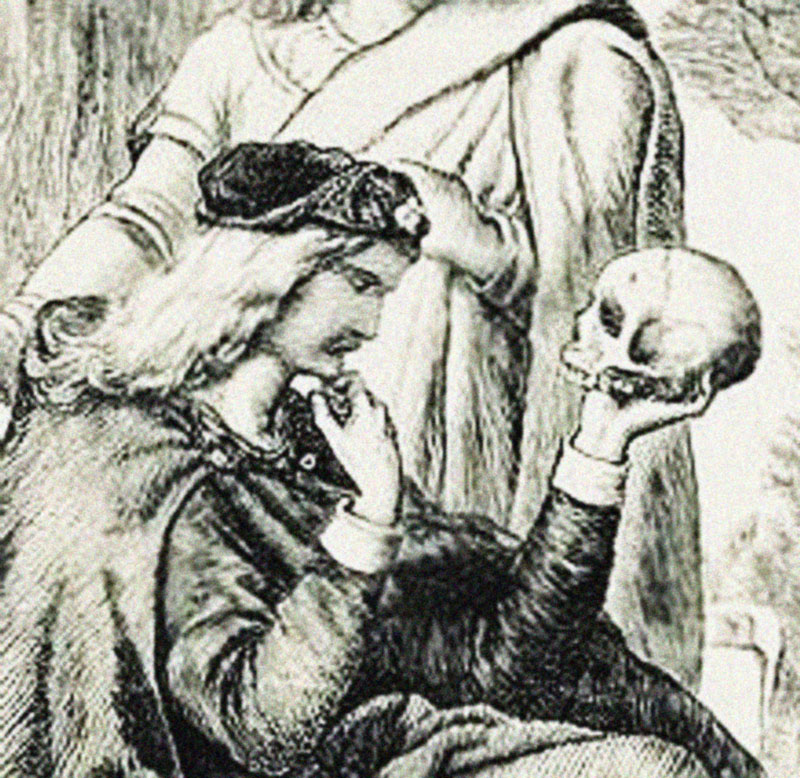
Figure 6.9 Alas Poor Yorick. In Shakespeare’s Hamlet, the character of Hamlet holds the skull of a court jester, his departed childhood companion, and laments his passing. Hamlet contemplates the fleetingness of existence through the moment. But what exactly is it that experiences existence? What is the self? (credit: “Hamlet with Yorick’s skull” by Henry Courtney Selous/Wikimedia, Public Domain)
図6.9 ああ、哀れなヨリック。シェイクスピアの『ハムレット』で、ハムレットは亡くなった幼なじみである宮廷道化師の頭蓋骨を持ち、その死を嘆く。このひとときを通じて、ハムレットは存在のはかなさを考える。しかし、存在を経験するものとは、正確には何なのだろうか。自己とは何か。(クレジット:“Hamlet with Yorick’s skull” by Henry Courtney Selous/Wikimedia, パブリックドメイン)