第6章形而上学Metaphysics
The Five Aggregates五蘊
How might the self (atman) experience the world and follow a path toward liberation? Buddhist philosophy posits five aggregates (skandhas), which are the thoughtful and iterative processes, through which the self interacts with the world.
英語のヒント
自己(アートマン)は、どのように世界を経験し、解放への道を歩めるのだろうか。仏教哲学は、五つの集まり、すなわち五蘊(スカンダ)を措定する。それらは思考を伴う反復的な過程であり、自己はそれらを通じて世界と相互作用する。
Form (rupa): the aggregate of matter, or the body.
色(ルーパ):物質、すなわち身体の集まり。
Sensation (vedana): emotional and physical feelings.
受(ヴェーダナー):感情的・身体的な感覚。
Perception (samjna): thinking, the processing of sense data; “knowledge that puts together.”
想(サンジュニャー):思考、感覚情報の処理。「まとめ合わせる知識」。
Mental formation (samskara): how thoughts are processed into habits, predispositions, moods, volitions, biases, interests, etc. The fourth skandhas is related to karma, as much of our actions flow from these elements.
英語のヒント
行(サンスカーラ):思考がどのように処理され、習慣、性向、気分、意志、偏見、関心などになるか。この第四の蘊はカルマと関連する。私たちの行動の多くは、これらの要素から生じるからである。
Consciousness (vijnana): awareness and sensitivity concerning a thing that does not include conceptualization.
識(ヴィジュニャーナ):あるものについての、概念化を含まない意識と感受性。
Although the self uses the aggregates, the self is not thought of as a static and enduring substance underlying the processes. These aggregates are collections that are very much subject to change in an interdependent world.
英語のヒント
自己は諸蘊を用いるものの、それらの過程の下にある、静的で持続する実体とは考えられていない。これらの蘊は、相互依存する世界で大いに変化を被る集まりである。
Secular Notions of Self世俗的な自己概念
In theology, continuity of the self is achieved through the soul. Secular scholars reject this idea, defining self in different ways, some of which are explored in the next sections.
英語のヒント
神学では、自己の連続性は魂によって実現される。世俗的な学者はこの考えを退け、自己をさまざまに定義する。以下では、そのいくつかを検討する。
Bundle Theory束理論
One of the first and most influential scholars in the Western tradition to propose a secular concept of self was Scottish philosopher David Hume (1711–1776). Hume formed his thoughts in response to empiricist thinkers’ views on substance and knowledge. British philosopher John Locke (1632–1704) offered a definition of substance in his Essay Concerning Human Understanding. In Book XXIII, Locke described substance as “a something, I know not what.” He asserted that although we cannot know exactly what substance is, we can reason from experience that there must be a substance “standing under or upholding” the qualities that exist within a thing itself. The meaning of substance is taken from the Latin substantia, or “that which supports.”
英語のヒント
西洋の伝統で世俗的な自己概念を提案した、最初期の、しかも最も影響力ある学者の一人が、スコットランドの哲学者デイヴィッド・ヒューム(1711~1776年)である。ヒュームは、実体と知識についての経験論者たちの見方に応答して、自らの考えを形づくった。イギリスの哲学者ジョン・ロック(1632~1704年)は、『人間知性論』で実体の定義を示した。第23巻でロックは、実体を「ある何か、それが何なのかは私には分からない」と述べた。実体が正確には何かを知ることはできなくても、ものそのもののうちにある諸性質の「下に立ち、あるいは支える」実体があるはずだと、経験から推論できると主張したのである。実体という語の意味は、ラテン語の substantia、つまり「支えるもの」に由来する。
If we return to the acorn and oak example, the reality of what it means to be an oak is rooted in the ultimate reality of what it means to be an oak tree. The ultimate reality, like the oak’s root system, stands beneath every particular instance of an oak tree. While not every tree is exactly the same, all oak trees do share a something, a shared whatness, that makes an oak an oak. Philosophers call this whatness that is shared among oaks a substance.
英語のヒント
ドングリとオークの例に戻ると、オークであるとはどういうことかという実在性は、オークの木であるとはどういうことかという究極の実在に根ざしている。究極の実在は、オークの根系のように、あらゆる個別のオークの木の下にある。一本一本の木がまったく同じわけではないが、すべてのオークの木は確かにある何かを、オークをオークたらしめる共通の「何であるか」を共有している。哲学者は、オークに共有されるこの「何であるか」を実体と呼ぶ。
Arguments against a static and enduring substance ensued. David Hume’s answer to the related question of “What is the self?” illustrates how a singular thing may not require an equally singular substance. According to Hume, the self was not a Platonic form or an Aristotelian composite of matter and form. Hume articulated the self as a changing bundle of perceptions. In his Treatise of Human Nature (Book 1, Part IV), Hume described the self as “a bundle or collection of different perceptions, which succeed each other with inconceivable rapidity, and are in a perpetual flux and movement.”
英語のヒント
やがて、静的で持続する実体に反対する論証が登場した。これに関連する「自己とは何か」という問いに対するデイヴィッド・ヒュームの答えは、一つのものが存在するために、それに対応する一つの実体が必ずしも必要ではないことを示している。ヒュームによれば、自己はプラトン的なイデアでも、アリストテレス的な質料と形相の複合体でもない。自己とは、変わり続ける知覚の束だと述べたのである。『人間本性論』(第1巻、第4部)でヒュームは、自己を「さまざまな知覚の束または集合であり、それらの知覚は想像もできない速さで次々に入れ替わり、絶え間なく流動し運動している」と記述した。
Hume noted that what has been mistaken for a static and enduring self was nothing more than a constantly changing set of impressions that were tied together through their resemblance to one another, the order or predictable pattern (succession) of the impressions, and the appearance of causation lent through the resemblance and succession. The continuity we experience was not due to an enduring self but due to the mind’s ability to act as a sort of theater: “The mind is a kind of theatre, where several perceptions successively make their appearance; pass, re-pass, glide away, and mingle in an infinite variety of postures and situations” (Hume 1739, 252).
英語のヒント
ヒュームが指摘したのは、静的で持続する自己と誤認されてきたものは、絶えず変化する印象の集まりにすぎないということだ。印象は、相互の類似、印象の順序や予測可能な配列(継起)、そして類似と継起が与える因果性の見かけを通じて結びつけられている。私たちが経験する連続性は、持続する自己によるものではなく、心が一種の劇場として働く能力によるものだった。「心は一種の劇場であり、そこにはさまざまな知覚が次々と現れ、過ぎ去り、また現れ、滑り去り、無限に多様な姿勢や状況の中で入り交じる」(Hume 1739, 252)。
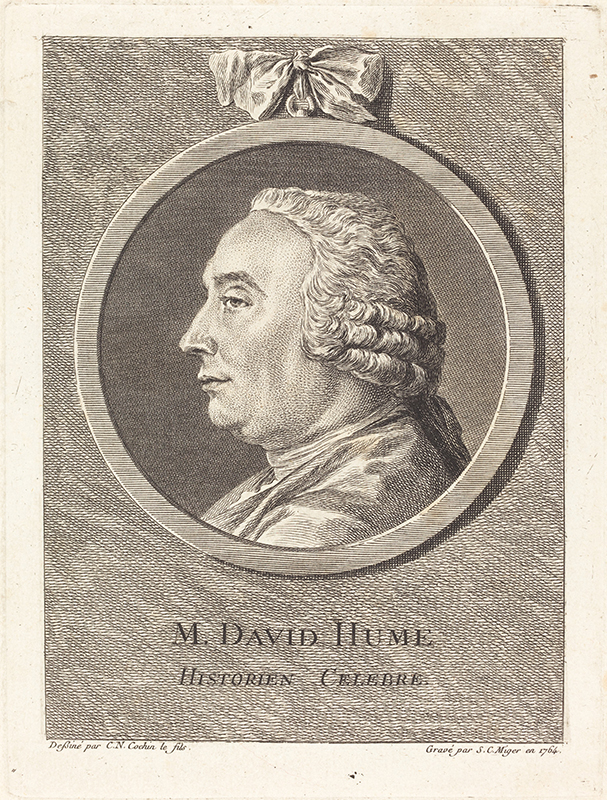
Figure 6.8 David Hume (1711–1776) took British empiricism to its logical extreme. Immanuel Kant credited Hume as awakening him from his “dogmatic slumbers.” (credit: “M. David Hume, 1764” by Simon Charles Miger after Charles-Nicolas Cochin II/National Gallery of Art, Public Domain)
図6.8 デイヴィッド・ヒューム(1711~1776年)は、イギリス経験論をその論理的な極限まで推し進めた。イマヌエル・カントは、自分を「独断のまどろみ」から目覚めさせたのはヒュームだと述べた。(クレジット:“M. David Hume, 1764” by Simon Charles Miger after Charles-Nicolas Cochin II/National Gallery of Art, パブリックドメイン)
Which theories of self—and substance—should we accept? The Greek theories of substance and the theological theories of a soul offer advantages. Substance allows us to explain what we observe. For example, an apple, through its substance, allows us to make sense of the qualities of color, taste, the nearness of the object, etc. Without a substance, it could be objected that the qualities are merely unintelligible and unrelated qualities without a reference frame. But bundle theory allows us to make sense of a thing without presupposing a mythical form, or “something I know not what!” Yet, without the mythical form of a soul, how do we explain our own identities?
英語のヒント
私たちは、自己について、そして実体について、どの理論を受け入れるべきだろうか。ギリシアの実体論と神学的な魂の理論には利点がある。実体は、私たちが観察するものを説明できるようにする。たとえばリンゴの場合、その実体を通じて、色、味、対象が近くにあることなどの性質を理解できる。実体がなければ、諸性質は参照枠のない、理解不能で無関係な性質にすぎない、という反論が成り立つ。しかし束理論では、神話的なイデアや「それが何なのかは私には分からない何か」を前提とせずに、ものを理解できる。それでもなお、魂という神話的な形相なしに、私たち自身の同一性をどう説明すればよいのだろうか。
Anthropological Views人類学的な見方
Anthropological views of the self question the cultural and social constructs upon which views of the self are erected. For example, within Western thought, it is supposed that the self is distinct from the “other.” In fact, throughout this section, we have assumed the need for a separate and distinct self and have used a principle of continuity based on the assumption that a self must persist over time. Yet, non-Western cultures blur or negate this distinction. The African notion of ubuntu, for example, posits a humanity that cannot be divided. The Nguni proverb that best describes this concept is “umuntu ngumuntu ngabantu” sometimes translated as “a person is a person through other persons” (Gade 2011). The word ubuntu is from the Zulu language, but cultures from southern Africa to Tanzania, Kenya, and Democratic Republic of the Congo all have words for this concept. Anthropological approaches attempt to make clear how the self and the culture share in making meaning.
英語のヒント
自己についての人類学的な見方は、自己観がその上に築かれている文化的・社会的な構築物を問い直す。たとえば西洋思想では、自己は「他者」と区別されると考えられている。実際、本節を通じて私たちは、分離し区別された自己の必要性を前提とし、自己は時間を通じて存続しなければならないという想定に基づく連続性の原理を用いてきた。しかし、西洋以外の文化はこの区別を曖昧にしたり、否定したりする。たとえばアフリカのウブントゥという概念は、分割できない人間性を措定する。この概念を最もよく表すングニのことわざは「umuntu ngumuntu ngabantu」であり、「人はほかの人々を通じて人になる」と訳されることがある(Gade 2011)。ウブントゥという語はズールー語に由来するが、アフリカ南部からタンザニア、ケニア、コンゴ民主共和国に至る諸文化に、この概念を表す語がある。人類学的な取り組みは、意味を生み出す営みに自己と文化がどのように共に関与するかを明らかにしようとする。