第6章形而上学Metaphysics
Aristotle on Matter and Form質料と形相についてのアリストテレスの考え
Aristotle, a student of Plato, disagreed with his teacher. If forms did exist, he challenged, then how could forms influence things? How could an immaterial form–which lacks matter—cause change to material entities?
英語のヒント
プラトンの弟子アリストテレスは、師と意見を異にした。もしイデアが本当に存在するとして、それはどうやってものに影響できるのか、と問い返した。質料を持たない非物質的なイデアが、物質的な存在に、どうして変化を引き起こせるのだろうか。
In addition, what about concepts that are not easily reducible to a simple meaning or idea? Aristotle noted that “good was said in many ways” (Ethics 1096a–b as found in Adamson 2016, 232). The reduction to a single form to identify the whatness for something works when the concept is simple but does not work when a wide-ranging concept (such as “the good”) is considered. Aristotle agreed with the approach of isolating dogness as the essence, but through the study of specific instances or particulars. He encouraged natural observation of the entity in question and introduced the categories of species and genera.
英語のヒント
また、一つの単純な意味や観念へ、容易には還元できない概念はどうなるのだろうか。アリストテレスは、「善は多くの仕方で語られる」と指摘した(『倫理学』1096a–b、Adamson 2016, 232に所収)。あるものが何であるかを明らかにするために一つの形へ還元する方法は、概念が単純なら機能する。しかし「善」のように、幅広い概念を考えると機能しない。アリストテレスは、「犬であること」を本質として取り出すアプローチには同意したが、それを具体的な事例、すなわち個物の研究を通じて行った。彼は、問題となっている存在を自然の中で観察するよう勧め、種と類の分類を導入した。
Unlike Plato, Aristotle does not posit an otherworldly form or collection of forms. In his middle and later works, Aristotle explained substance through a composite of matter and form. Form, much like an idea a sculptor has in mind, is the unchanging purpose or whatness informing each particular or individual instance. In this case of a sculpture, the sculptor’s vision or idea was referred to as the formal cause. The marble would be the material cause. The ability and artistic skill of the sculptor was termed the efficient cause. The final cause reflected the purpose of the being, or the reason why the sculpture was made in the first place.
英語のヒント
プラトンと異なり、アリストテレスは、この世を離れたイデアや、その集まりを想定しない。中期以降の著作で、アリストテレスは、質料と形相の複合体として実体を説明した。形相とは、彫刻家が心に抱く構想にも似た、それぞれの個物や個々の事例に形を与える、不変の目的や「何であるか」である。彫刻の場合、彫刻家の構想や着想は「形相因」と呼ばれた。大理石は「質料因」に当たる。彫刻家の能力や芸術的技能は「作用因」と呼ばれた。「目的因」は、その存在の目的、すなわち、そもそも彫刻が作られた理由を表した。
The idea of substance being a composite of form within matter became known as hylomorphism. The Greek word hyle translates as “wood.” Here wood is figurative, a symbol of basic building material that is shaped by the form within a particular instance. The form does not reside in the Platonic heavens but, through purpose and efficiency, moves a particular thing from its beginning state (potentiality) along a continuum toward its final goal (actuality). The acorn is driven by its form and purpose to become the mighty oak. The movement from potentiality to actuality requires material and the efficient (proper) application of these materials such that the acorn can become!
英語のヒント
実体は、質料の中にある形相との複合体だという考えは、「質料形相論」として知られるようになった。ギリシア語のヒュレーは、「木材」と訳される。ここで木材は比喩であり、個々の事例の中の形相によって形を与えられる、基礎的な構成材料を表す。形相はプラトン的な天上にあるのではない。目的と働きを通じ、個々のものを、その始まりの状態である可能態から、最終目標である現実態へ、連続的に動かしていく。ドングリは、自らの形相と目的によって、堂々たるオークへと成長するよう促される。可能態から現実態への運動には、ドングリが生成できるようにする、材料と、その適切な働きとしての適用が必要なのである。
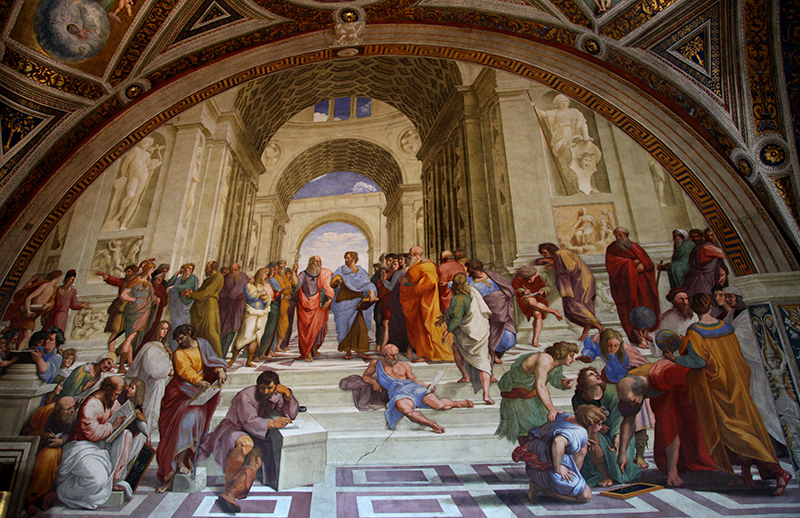
The attitudes of Plato and Aristotle are reflected in Figure 6.5. The School of Athens was discussed in the introduction to philosophy chapter. This section details the interaction between the two central characters in the oil-on-canvas painting. Plato is the subject displayed to the left of center, and Aristotle is the subject depicted to the right of center. Plato’s gesture toward the heavens with his right hand was the artist’s way of recognizing Plato’s theory of forms. For Plato, forms were immutable and the ultimate reality. Forms were supposed to exist outside of our earthly realm as the things we observe are subject to change. Aristotle’s gesture with his right hand was the artist’s representation of Aristotle’s stressing of the form embedded within particular matter. The ultimate reality was supposed to be within each instance of matter observed. The material components were subject to change, but the form was not.
英語のヒント
図6.5には、プラトンとアリストテレスの姿勢が表れている。『アテナイの学堂』は、「哲学入門」の章で取り上げた。ここでは、このカンヴァスに描かれた油彩画の、中央の二人のやり取りを詳しく見る。中心の左側に描かれているのがプラトン、右側がアリストテレスである。プラトンが右手で天を指す身振りは、画家がプラトンのイデア論を示す方法であった。プラトンにとって、イデアは不変で、究極の実在である。私たちが観察するものは変化するため、イデアは地上の領域の外に存在するとされた。アリストテレスの右手の身振りは、個々の質料の中に組み込まれた形相を彼が重視したことを、画家が表現したものであった。究極の実在は、観察される質料の個々の事例の中にあるとされた。物質的な構成要素は変化するが、形相は変化しない。
What do you think? The crucial difference introduced at this historical point was the emphasis placed upon particulars—individual instances of an entity—by Aristotle. While Plato stressed forms and asserted that there could be no individual instance without the form, Aristotle stressed particulars and asserted that without individual instances, there could be no knowledge of the form. Whereas Plato holds that beauty itself causes the beauty we see in flowers or faces, Aristotle asserts that there is no such thing as beauty without beautiful things, such as flowers and faces (Adamson, 2016, p. 231).
英語のヒント
あなたはどう考えるだろうか。この歴史上の時点で生じた決定的な違いは、アリストテレスが、個物、すなわち、ある存在の個々の事例を重視したことであった。プラトンはイデアを強調し、イデアなしには個々の事例は存在しえないと主張した。それに対してアリストテレスは個物を強調し、個々の事例なしには形相の知識はありえないと主張した。プラトンが、美そのものが花や顔に見られる美を生じさせるとするのに対し、アリストテレスは、花や顔のような美しいものなしには、美というものは存在しないと主張する(Adamson 2016, p. 231)。
Summaryまとめ
The Latin term substantia, translated as “substance,” is often used to refer to the basic reality supporting or standing under features that are incidental to that same thing. Ancient Greek philosophers were both monists and dualists. Indian philosophers developed the idea of atomism. The challenge of persistence (i.e., whether a thing could be said to retain identity despite changes introduced through time) can be explored through the Ship of Theseus thought experiment.
実体と訳されるラテン語substantiaは、あるものに付随的な特徴を支え、その下に存する基礎的な実在を指すために、しばしば用いられる。古代ギリシアの哲学者には、一元論者も二元論者もいた。インドの哲学者は原子論の考えを発展させた。持続の問題、すなわち、時間の経過によって変化が生じても、あるものは同一性を保つと言えるのかという問題は、「テセウスの船」の思考実験を通じて探究できる。
Review Questions復習問題
Why does Thales believe that water is the most basic reality?
タレスはなぜ、水が最も基礎的な実在だと信じるのだろうか。
The Pre-Socratics were wrong in their various metaphysical explanations. Yet they are considered to have contributed significantly to the history of philosophy and metaphysics. How could they have contributed if they were wrong?
ソクラテス以前の哲学者たちの、さまざまな形而上学的説明は誤っていた。それでも彼らは、哲学と形而上学の歴史に大きく貢献したと考えられている。誤っていたのに、どうして貢献できたのだろうか。
What inspired Kanad and his atomistic understanding of reality?
カナーダと、その原子論的な実在理解に着想を与えたのは何だろうか。
What does the Sun represent within Plato’s Allegory of the Cave?
プラトンの洞窟の比喩で、太陽は何を表すだろうか。
How does Aristotle connect the acorn and the oak? What do they share?
アリストテレスは、ドングリとオークをどう結び付けるだろうか。両者は何を共有するだろうか。