第5章論理学と推論Logic and Reasoning
Fallacies of Weak Induction弱い帰納の誤謬
The fallacies of weak induction are mistakes in reasoning in which a person’s evidence or reasons are too weak to firmly establish a conclusion. The reasoner uses relevant premises, but the evidence contained therein is weak or defective in some way. These errors are errors of induction. When we inductively reason, we gather evidence using our experience in the world and draw conclusions based on that experience. Earlier in the chapter I used a generalization about the return of the red-winged blackbirds in March. But what if I based my generalization on just two years of experience? Now my conclusion—that the blackbirds return every mid-March—seems much weaker. In such cases, the reasoner uses induction properly by using relevant evidence, but her evidence is simply too weak to support the generalization she makes. An inductive inference may also be weak because it too narrowly focuses on one type of evidence, or the inference may apply to a generalization in the wrong way.
英語のヒント
弱い帰納の誤謬とは、示された証拠や理由が、結論を確立するには弱すぎるという、推論の誤りである。論証する人は関連のある前提を使うが、そこに含まれる証拠が弱いか、何らかの欠陥をもつ。これらは帰納の誤りである。帰納的に推論するとき、私たちは世界の経験を使って証拠を集め、その経験に基づいて結論を導く。本章では先に、ハゴロモガラスが3月に戻るという一般化を使った。しかし、たった二年間の経験に基づいていたらどうだろう。その鳥が毎年3月中旬に戻るという結論は、ずっと弱く見える。この場合、論証する人は関連のある証拠を使う点では適切に帰納しているが、その証拠は、自分の一般化を支持するには弱すぎる。帰納的推論は、一種類の証拠だけに狭く焦点を絞るために弱くなることもある。また、一般化への適用の仕方が誤っていることもある。
Hasty Generalization性急な一般化
A hasty generalization is a fallacy of weak induction in which a person draws a conclusion using too little evidence to support the conclusion. A hasty generalization was made in the red-winged blackbird case above. Here is another example:
英語のヒント
性急な一般化は、弱い帰納の誤謬の一つであり、結論を支持するには少なすぎる証拠から結論を導くことである。先ほどのハゴロモガラスの事例では、性急な一般化が行われていた。別の例を示す。
Don’t eat at the restaurant. It’s bad. I had lunch there once, and it was awful. Another time I had dinner, and the portions were too small.
あのレストランでは食べないほうがいい。ひどい店だ。一度そこで昼食を取ったが、ひどかった。別のときに夕食を取ったら、量が少なすぎた。
This person draws the conclusion that the restaurant is bad from two instances of eating there. But two instances are not enough to support such a robust conclusion. Consider another example:
英語のヒント
この人は、その店で二度食事をした事例から、そのレストランは悪いと結論している。しかし二つの事例では、これほど強い結論を支持するのに十分ではない。別の例を考えよう。
Sixty-five percent of a random poll of 50 registered voters in the state said they would vote for the amendment. We conclude that the state amendment will pass.
州内の登録有権者50人を無作為に調査したところ、65%が改正案に賛成票を投じると答えた。したがって、この州の改正案は可決されると結論する。
Fifty voters is not a large enough sample size to draw predictive conclusions about an election. So to say the amendment will pass based on such limited evidence is a hasty generalization. Just how much evidence we need to support a generalization depends upon the conclusion being made. If we already have good reason to believe that the class of entities that is the subject of our generalization are all very similar, then we will not need a very large sample size to make a reliable generalization. For instance, physics tells us that electrons are very similar, so a study drawn from observing just a few electrons may be reasonable. Humans (particularly their political beliefs and behaviors) are not the same, so a much larger sample size is needed to determine political behavior. The fallacy of hasty generalization highlights the empirical nature of induction—we need a basic understanding of the world to know exactly how much evidence is needed to support many of our claims.
英語のヒント
有権者50人では、選挙の結果について予測的な結論を導くには、標本の大きさが十分ではない。したがって、これほど限られた証拠から改正案が可決されると言うのは、性急な一般化である。一般化を支持するためにどれほど証拠が必要かは、どのような結論を述べるかによって変わる。一般化の対象となる存在者の集まりが、どれもよく似ていると考える十分な理由がすでにあるなら、信頼できる一般化のために、非常に大きな標本は必要ない。たとえば、物理学によれば電子はよく似ているので、ごく少数の電子の観察から行う研究も、合理的かもしれない。人間、とりわけ政治的信念や行動は、同じではない。そのため、政治的行動を判断するには、ずっと大きな標本が必要である。性急な一般化の誤謬は、帰納の実証的性格を浮き彫りにする。主張の多くを支持するために必要な証拠の量を正確に知るには、世界についての基本的理解が必要なのだ。
Biased Sample偏った標本
A biased sample has some things in common with a hasty generalization. Consider the following:
偏った標本には、性急な一般化と共通する点がある。次の例を考えよう。
Don’t eat dinner at that restaurant. It’s bad. My book club has met there once a week for breakfast for the past year, and they overcook their eggs.
あのレストランで夕食を取ってはいけない。ひどい店だ。私の読書会は、過去一年間、毎週一回、そこで朝食を取りながら集まっているが、卵料理をいつも加熱しすぎる。
This seems much better than the restaurant example offered above. If the book club has gone to the restaurant once per week for a year, the arguer has more than 50 instances as data. However, notice that the arguer’s evidence concerns breakfast, not dinner, and focuses on the eggs. Suppose the restaurant has an entirely different, more expensive dinner menu; then we cannot draw reliable conclusions about the restaurant’s success at dinner. This is an example of a biased sample. With a hasty generalization, the problem is that not enough evidence is used. In a biased sample, the problem is that the evidence used is biased in some way.
英語のヒント
これは、先ほどのレストランの例より、ずっとよさそうに見える。読書会が一年間、週に一度その店へ行っていれば、論証する人は、50を超える事例をデータとしてもっている。しかし、証拠は夕食ではなく朝食に関するもので、卵料理に焦点が当たっていることに注意してほしい。その店には、まったく異なる、もっと高価な夕食メニューがあるとしよう。そうであれば、夕食のできばえについて、信頼できる結論は導けない。これが、偏った標本の例である。性急な一般化では、証拠の量が足りないことが問題である。偏った標本では、使われる証拠が何らかの仕方で偏っていることが問題なのだ。
Appeal to Ignorance無知への訴え
Appeal to ignorance is another type of fallacy of weak induction. Consider the following line of reasoning:
無知への訴えも、弱い帰納の誤謬の一つである。次の推論の筋道を考えよう。
In my philosophy class, we reviewed all the traditional arguments for the existence of God. All of them have problems. Because no one can prove that God exists, we can only conclude that God doesn’t exist.
哲学の授業で、神の存在を支持する伝統的な論証をすべて検討した。どれにも問題があった。神が存在すると証明できる人はいないので、神は存在しないと結論するしかない。
Notice that the arguer wants to conclude that because we do not have evidence or sufficient arguments for God’s existence, then God cannot exist. In an appeal to ignorance, the reasoner relies on the lack of knowledge or evidence for a thing (our ignorance of it) to draw a definite conclusion about that thing. But in many cases, this simply does not work. The same reasoning can be used to assert that God must exist:
英語のヒント
この人が、神の存在の証拠や十分な論証がないので、神は存在しえない、と結論しようとしていることに注目してほしい。無知への訴えでは、ある事柄についての知識や証拠の欠如、つまり無知に頼って、その事柄について確定的な結論を導く。しかし多くの場合、これはうまくいかない。同じ推論を使って、神は存在しなければならないとも主張できてしまう。
In my philosophy class, we reviewed different arguments against the existence of God. All of them have problems. Because no one can prove that God doesn’t exist, we can only conclude that God exists.
哲学の授業で、神の存在に反対するさまざまな論証を検討した。どれにも問題があった。神が存在しないと証明できる人はいないので、神は存在すると結論するしかない。
Any form of reasoning that allows you to draw contradictory conclusions ought to be suspect. Appeals to ignorance ignore the idea that absence of evidence is not evidence of absence. The fact that we lack evidence for X should not always function as evidence that X is false or does not exist.
英語のヒント
互いに矛盾する結論を導けてしまう推論の形式は、どんなものでも疑うべきである。無知への訴えは、「証拠がないことは、不在の証拠ではない」という考えを無視している。Xについて証拠がないという事実を、いつでもXが偽である、または存在しないことの証拠にしてはいけない。
False Cause Attribution誤った原因の帰属
The fallacy of false cause occurs when a causal relation is assumed to exist between two events or things when it is unlikely that such a causal relationship exists. People often make this mistake when the two events occur together. The phrase “correlation does not equal causation” captures a common critique of this form of false cause reasoning. For example, a person may think that swimsuits cause sunburns because people often get sunburned when wearing swimsuits. There is a correlation between sunburn and swimsuits, but the suits are not a cause of sunburns.
英語のヒント
誤った原因の誤謬は、二つの出来事や物事のあいだに因果関係があるとは考えにくいのに、あると想定するときに生じる。人は、二つの出来事が一緒に起こると、この誤りをよく犯す。「相関は因果と同じではない」という言葉は、この種の誤った原因推論への、一般的な批判を表す。たとえば、水着を着ているときに日焼けすることが多いので、水着が日焼けを引き起こすと考える人がいるかもしれない。日焼けと水着には相関があるが、水着が日焼けの原因ではない。
False cause fallacies also occur when a person believes that just because one event occurs after another, the first event is the cause of the second one. This poor form of reasoning, in tandem with confirmation bias, leads to many superstitious beliefs. Confirmation bias is the natural tendency to look for, interpret, or recall information that confirms already-established beliefs or values. For example, some sports fans may notice that their team won sometimes on days when they were wearing a specific item of clothing. They may come to believe that this clothing item is “lucky.” Furthermore, because of confirmation bias, they may remember only instances when the team won when they were wearing that item (and not remember when the team lost when they were also wearing the item). The resulting superstition amounts to believing that wearing a special team jersey somehow causes the team to win.
英語のヒント
誤った原因の誤謬は、ある出来事が別の出来事の後に起きたというだけで、先の出来事が後の出来事の原因だと信じるときにも生じる。この不適切な推論は、確証バイアスと組み合わさって、多くの迷信を生む。確証バイアスとは、すでに確立した信念や価値観を裏づける情報を探し、解釈し、思い出そうとする自然な傾向である。たとえば、スポーツのファンが、特定の衣服を着ていた日に、応援するチームが勝つことがあったと気づくかもしれない。そして、その服は「縁起がよい」と信じるようになる。さらに確証バイアスのため、その服を着た日にチームが勝った例だけを覚え、同じ服を着ていて負けた例は思い出さないかもしれない。その結果としての迷信は、特別なチームのユニフォームを着ることが、何らかの仕方でチームの勝利を引き起こすと信じることに等しいのだ。
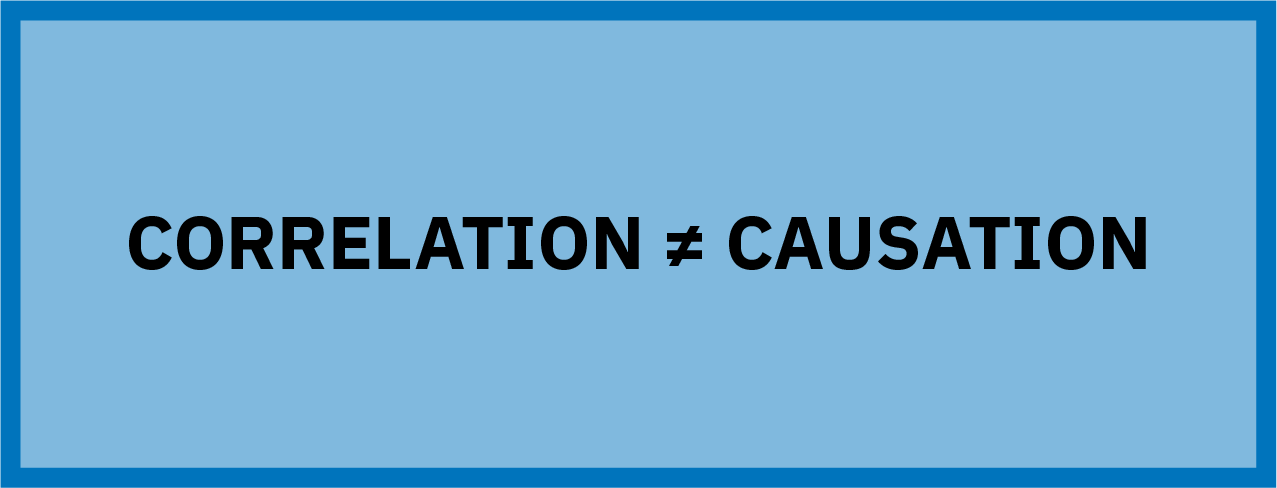
In short, as emphasized by Figure 5.7, just because two things are often correlated (connected in that they occur together in time or place) does not mean that a cause-and-effect relationship exists between them.
つまり、図5.7が強調するように、二つの物事にしばしば相関がある、すなわち時間や場所を共にして起こるという結びつきがあるだけでは、そのあいだに原因と結果の関係が存在することにはならない。