第5章論理学と推論Logic and Reasoning
Greek Dialectics and Debateギリシアにおける弁証法と討論
Ancient Greek philosophy is also known for its use of dialectic and debate. Socrates, perhaps the most famous ancient Greek philosopher, claimed that knowledge is true opinion backed by argument (Plato, Meno). “Opinion” here means unjustified belief: your beliefs could be true, but they cannot count as knowledge unless you have reasons for them and can offer justifications for your beliefs when questioned by others. Furthermore, Socrates’s method of gaining knowledge was to engage in dialectics with others. All of what we know about Socrates is through the writings of others—particularly the writings of Plato. Quite appropriately, Plato uses dialogues in all his works, in which Socrates is almost always a participant.
英語のヒント
古代ギリシア哲学も、弁証法や討論を用いることで知られている。おそらく最も有名な古代ギリシアの哲学者ソクラテスは、知識とは、論証によって支えられた真なる思わくであると主張した(Plato, Meno)。ここでの「思わく」とは、正当化されていない信念を意味する。信念は真かもしれないが、その理由をもち、他人に問われたときに正当化を示せなければ、知識とは数えられない。さらに、ソクラテスが知識を得る方法は、ほかの人々と弁証法的に対話することだった。私たちがソクラテスについて知るすべては、他人の著作、とりわけプラトンの著作を通じたものだ。まさにふさわしいことに、プラトンはすべての著作で対話形式を用いており、そのほとんどにソクラテスが参加者として登場する。
Socrates never wrote anything down. In the Phaedrus, one of Plato’s dialogues, Socrates criticizes written works as being a dead discourse of sorts. Books cannot respond to you when you ask questions. He states, “You’d think they were speaking as if they had some understanding, but if you question anything that has been said because you want to learn more, it continues to signify just the very same thing forever” (Phaedrus, 275e). Clearly, dialectics was central to Socrates’s philosophical method.
英語のヒント
ソクラテスは何も書き残さなかった。プラトンの対話篇の一つ『パイドロス』で、ソクラテスは、書かれた著作を、一種の死んだ言説として批判する。本は、問いを投げかけても応答できない。彼はこう述べる。「それらが何かを理解して語っているかのように思うだろう。だが、もっと学びたくて、語られたことについて何か尋ねても、永遠にまったく同じことを示し続ける」(Phaedrus, 275e)。明らかに、弁証法はソクラテスの哲学的方法の中心にあった。
Plato’s dialogues are a testament to the importance of public discourse as a form of rational inquiry in ancient Greece. Based on Greek philosophical writings, we can assume reasoned public debate took place and that Socrates preferred it as a method of teaching and learning. In Plato’s dialogues, many questions are asked, and Socrates’s interlocuters offer answers to which Socrates asks further clarifying questions. Through the process of questioning, false beliefs and inadequate understanding are exposed. Socrates’s goal was not simply to offer people truth. Rather, through questioning, Socrates guides people to discover the truth on their own, provided they are willing to keep an open mind and admit, when necessary, that they are in the wrong. In Plato’s dialogues, participants don’t always land on a determinate answer, but they as well as readers are always left with a clearer understanding of the correct way to reason.
英語のヒント
プラトンの対話篇は、古代ギリシアで、公の言論が理性的探究の一つの形として重要だったことの証しである。ギリシアの哲学的著作から、理にかなった公の討論が行われ、ソクラテスが教え学ぶ方法としてそれを好んだと考えられる。プラトンの対話篇では多くの問いが出され、ソクラテスの対話相手が答えると、彼はさらに明確化のための問いを重ねる。問いかけの過程を通じて、誤った信念や不十分な理解が明らかになる。ソクラテスの目標は、ただ真理を人々に与えることではなかった。人々が開かれた心を保ち、必要なときには自分の誤りを認める用意さえあれば、問いかけを通じて、自分で真理を発見するよう導いたのだ。プラトンの対話篇の参加者は、いつも確定した答えに達するわけではない。しかし、参加者も読者も、正しい推論の方法を、それまでより明晰に理解することになる。
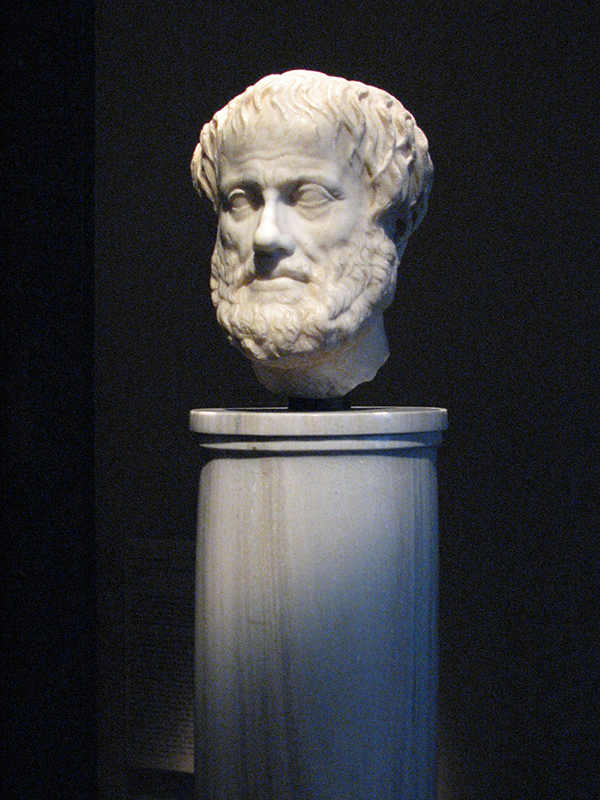
If any ancient Greek philosopher most embodies the tie between dialectic and logic, it is Aristotle (c. 384–322 BCE), who was a student of Plato. Aristotle wrote books on the art of dialectic (Smith 2020). And he probably participated in gymnastic dialectic—a structured dialectic contest practiced in the Academy (the school founded by Plato, which Aristotle attended). But more importantly, Aristotle created a complex system of logic upon which skill in the art of dialectic relied. Aristotle’s logic is the earliest formal systematized account of inference we know of and was considered the most accurate and complete system until the late 19th century (Smith 2020). Aristotle’s system is taught in logic classes to this day.
英語のヒント
古代ギリシアの哲学者で、弁証法と論理の結びつきを誰よりも体現する人がいるとすれば、それはプラトンの弟子アリストテレス(紀元前384年頃–322年)である。アリストテレスは弁証法の技法について本を書いた(Smith 2020)。また、アカデメイアで行われていた、体系的な弁証法の競技、すなわち弁証法の訓練競技にも、おそらく参加した。アカデメイアは、プラトンが設立し、アリストテレスが学んだ学校である。しかし、さらに重要なのは、アリストテレスが、弁証法の技量の基礎となる複雑な論理体系を作ったことである。アリストテレスの論理学は、私たちが知る最古の、形式的に体系化された推論の説明であり、19世紀末まで、最も正確で完全な体系と考えられていた(Smith 2020)。その体系は、今日まで論理学の授業で教えられている。
The Use of Reason to Discover Truth真理を発見するために理性を使う
Reasoning allows us to hypothesize, work out consequences of our hypotheses, run thought experiments, assess the coherence of a set of beliefs, and generate plausible explanations of the world around us. As Chapter 1 explained, coherence is the property of consistency in a set of beliefs. Thus, when a set of beliefs is inconsistent, it is not possible for every belief in the set to be true. We must use reason to determine whether a set of beliefs is consistent and work out the logical implications of beliefs, given their truth. In this way, reason can be used to discover truth.
英語のヒント
推論によって、私たちは仮説を立て、その仮説の帰結を考え、思考実験を行い、一組の信念の整合性を評価し、周囲の世界についてもっともらしい説明を生み出せる。第1章で説明したように、整合性とは、一組の信念の中で矛盾せずに一貫している性質である。したがって、一組の信念が矛盾しているなら、その中のすべての信念が真であることは不可能である。信念の組が矛盾していないかを判断し、信念が真であるとしたときの論理的含意を考え抜くために、理性を使わなければならない。このように、理性は真理を発見するために使える。
The rules of logic are like the rules of math; you cannot make 1 + 1 = 3. Indeed, math is a form of deductive reasoning that ensures truth. Answers to problems in math are derived using known functions and rules, which is also true in logic. Unlike math, however, not all of logic can guarantee correct answers. Nonetheless, logic supplies means by which to derive better answers—answers that are more likely to be true. Because logic is the study of proper reasoning, and proper reasoning is an essential tool for discovering truth, logic is foundational to the pursuit of learning.
英語のヒント
論理の規則は数学の規則と似ており、1+1=3とすることはできない。実際、数学は真を保証する演繹的推論の一つの形である。数学の問題の答えは、既知の関数と規則を使って導かれ、論理学でも同じことがいえる。しかし数学とは異なり、論理学のすべてが正しい答えを保証できるわけではない。それでも論理学は、よりよい答え、つまり真である可能性のより高い答えを導く手段を提供する。論理学は適切な推論の研究であり、適切な推論は真理を発見するための不可欠な道具なので、学ぶことを追求するうえで、論理学は基礎となる。
Testing Hypotheses仮説を検証する
A hypothesis is a proposed explanation for an observed process or phenomenon. Human beings formulate hypotheses because they wish to answer specific questions about the world. Usually, the sciences come to mind when we think of the word “hypothesis.” However, hypotheses can be created on many subjects, and chances are that you have created many hypotheses without realizing it. For example, if you often come home and find that one of your outside potted plants has been knocked over, you might hypothesize that “the wind must have knocked that one over.” In doing so, you answer the question, “Why is that plant often knocked over?” Generating and testing hypotheses engages different forms of reasoning— abduction, induction, and deduction—all of which will be explained in further detail below.
英語のヒント
仮説とは、観察された過程や現象について提案された説明である。人間は世界についての特定の問いに答えたいので、仮説を立てる。「仮説」という語を考えると、通常は科学が思い浮かぶ。しかし、仮説は多くの話題について作れるし、あなたも気づかないまま、多くの仮説を作ってきただろう。たとえば、帰宅すると外の鉢植えの一つが倒れていることが多ければ、「風が倒したに違いない」と仮説を立てるかもしれない。その際、「なぜあの植物はよく倒れているのか」という問いに答えているのだ。仮説を作り検証することには、アブダクション、すなわち最良の説明への推論、帰納、演繹という異なる推論の形が関わる。これらはすべて、以下でさらに詳しく説明する。
Clearly, simply coming up with a hypothesis isn’t enough for us to gain knowledge; rather, we must use logic to test the truth of our supposition. Of course, the aim of testing hypotheses is to get to the truth. In testing we often formulate if–then statements: “If it is windy, then my plant will get knocked over” or “If nitrogen levels are high in the river, then algae will grow.” If–then statements in logic are called conditionals and are testable. For example, we can keep a log registering the windy days, cross-checked against the days on which the plant was found knocked over, to test our if–then hypothesis.
英語のヒント
明らかに、仮説を思いつくだけでは知識を得るのに十分ではない。論理を使って、想定が真かどうかを検証しなければならない。もちろん、仮説検証の目標は真理に至ることである。検証ではしばしば、「風が強ければ、植物が倒れる」「川の窒素濃度が高ければ、藻類が増える」といった「もし〜ならば〜」の文を作る。論理学では、このような文を条件文と呼び、検証が可能である。たとえば、風の強い日を記録し、植物が倒れていた日と照合すれば、「もし〜ならば〜」という仮説を検証できる。
Reasoning is also used to assess the evidence collected for testing and to determine whether the test itself is good enough for drawing a reliable conclusion. In the example above, if on no windy days is the plant knocked over, logic demands that the hypothesis be rejected. If the plant is sometimes knocked over on windy days, then the hypothesis needs refinement (for example, wind direction or wind speed might be a factor in when the plant goes down). Notice that logic and reasoning play a role in every step of the process: creating hypotheses, figuring out how to test them, compiling data, analyzing results, and drawing a conclusion.
英語のヒント
推論は、検証のために集めた証拠を評価し、その検証自体が信頼できる結論を導くのに十分かを判断するためにも使われる。上の例では、風の強い日に植物が一度も倒れなければ、論理は仮説の棄却を要求する。風の強い日にときどき倒れるなら、仮説は改良が必要である。たとえば、風向きや風速が、植物が倒れるかどうかの要因かもしれない。仮説の作成、検証方法の考案、データの収集、結果の分析、結論の導出という、過程のすべての段階で、論理と推論が役割を果たすことに注目してほしい。

Figure 5.3 “If it is windy, the plant will be knocked over” is a testable hypothesis. If the plant is found knocked over on days that aren’t windy, another force may be responsible. Hypotheses help philosophers, as well as scientists, answer specific questions about the world. (credit: “strollin’ with Fräulein Zeiss - 5” by torne (where’s my lens cap?)/Flickr, CC BY 2.0)
図5.3 「風が強ければ、植物が倒れる」は検証可能な仮説である。風の強くない日に植物が倒れていれば、別の力が原因かもしれない。仮説は、科学者と同様に哲学者が、世界についての特定の問いに答える助けになる。(クレジット:torne (where’s my lens cap?)/Flickr「strollin’ with Fräulein Zeiss - 5」、CC BY 2.0)
We’ve been looking at an inconsequential example—porch plants. But testing hypotheses is serious business in many fields, such as when pharmaceutical companies test the efficacy of a drug in treating a life-threatening illness. Good reasoning requires researchers to gather enough data to compare an experimental group and control group (patients with the illness who received the drug and those who did not). If scientists find a statistically significant difference in positive outcomes for the experimental group when compared to the control group, they can draw the reasonable conclusion that the drug could alleviate illness or even save lives in the future.
英語のヒント
ここまでは、ポーチの植物という、ささいな例を見てきた。しかし、製薬会社が命に関わる病気の治療に薬が有効かを試す場合など、多くの分野で仮説の検証は重大な仕事である。よい推論のためには、研究者は、実験群と対照群、すなわち薬を投与された患者と、投与されなかった患者とを比較できるだけのデータを集めなければならない。科学者が、対照群に比べて実験群の良好な結果に統計的に有意な差を見いだしたなら、その薬が将来、病気を和らげ、さらには命を救うかもしれないという、合理的な結論を導ける。