第7章化学結合と分子の形
Properties of Polar Molecules極性分子の性質
Polar molecules tend to align when placed in an electric field with the positive end of the molecule oriented toward the negative plate and the negative end toward the positive plate (Figure 7.28). We can use an electrically charged object to attract polar molecules, but nonpolar molecules are not attracted. Also, polar solvents are better at dissolving polar substances, and nonpolar solvents are better at dissolving nonpolar substances.
英語のヒント
極性分子を電場に置くと、正の端を負の極板へ、負の端を正の極板へ向けて、向きをそろえる傾向がある(図7.28)。帯電した物体で極性分子を引き付けることができるが、無極性分子は引き付けられない。また、極性溶媒は極性物質をよく溶かし、無極性溶媒は無極性物質をよく溶かす。
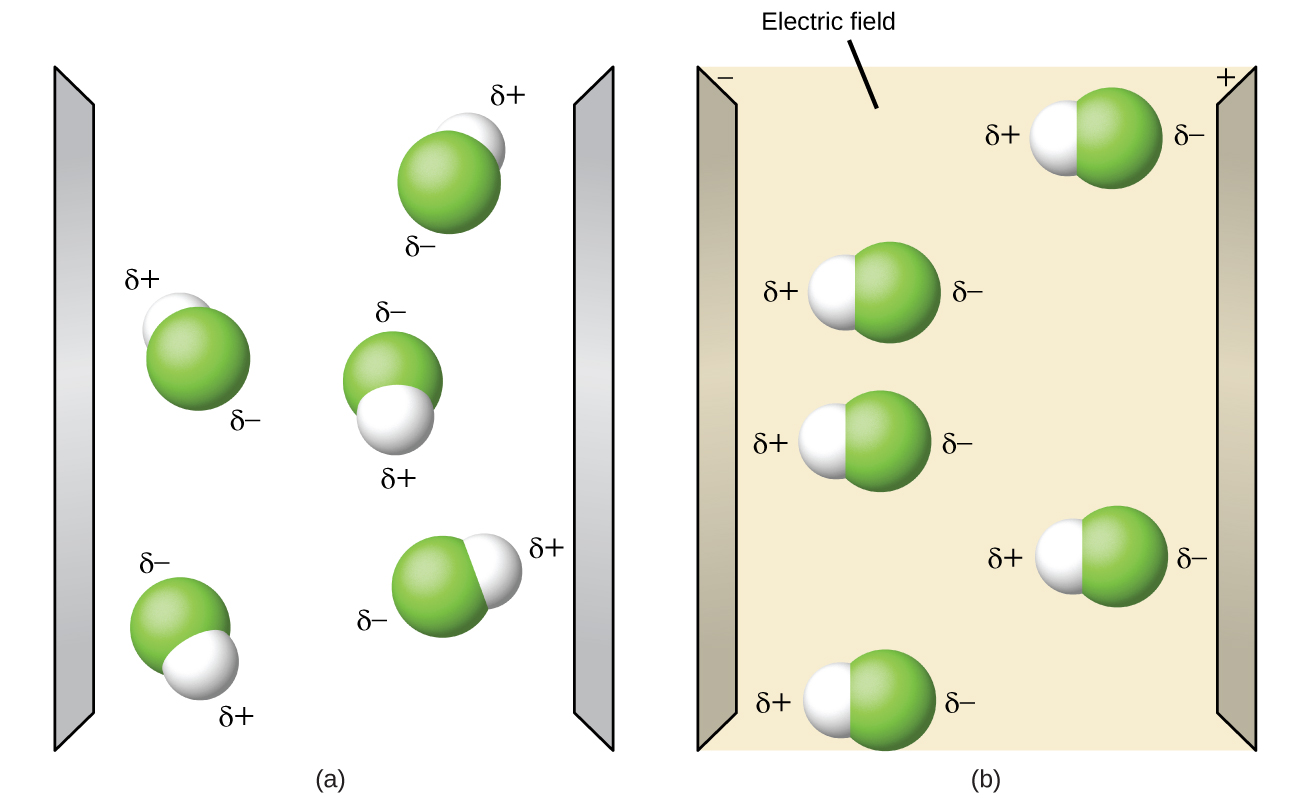
Figure 7.28図 7.28
(a) Molecules are always randomly distributed in the liquid state in the absence of an electric field. (b) When an electric field is applied, polar molecules like HF will align to the dipoles with the field direction.
(a) 電場がなければ、液体状態の分子は常に無秩序に分布している。(b) 電場をかけると、HFのような極性分子は、双極子の向きを電場の方向にそろえる。
Example 7.18例題 7.18
Polarity Simulations極性のシミュレーション
Open the molecule polarity simulation and select the “Three Atoms” tab at the top. This should display a molecule ABC with three electronegativity adjustors. You can display or hide the bond moments, molecular dipoles, and partial charges at the right. Turning on the Electric Field will show whether the molecule moves when exposed to a field, similar to Figure 7.28.
英語のヒント
分子の極性シミュレーションを開き、上部の「Three Atoms」タブを選ぼう。分子ABCと、3つの電気陰性度調節器が表示される。右側で、結合モーメント、分子の双極子、部分電荷の表示を切り替えられる。「Electric Field」をオンにすると、図7.28のように、分子を電場に置いたときに動くかどうかを確認できる。
Use the electronegativity controls to determine how the molecular dipole will look for the starting bent molecule if:
電気陰性度を調節して、最初の折れ線形の分子で、次の場合に分子双極子がどうなるか調べなさい。
(a) A and C are very electronegative and B is in the middle of the range.
(a) AとCの電気陰性度が非常に大きく、Bは調節範囲の中間にある。
(b) A is very electronegative, and B and C are not.
(b) Aの電気陰性度は非常に大きいが、BとCは大きくない。
Solution解答
(a) Molecular dipole moment points immediately between A and C.
(a) 分子の双極子モーメントは、AとCのちょうど間を向く。
(b) Molecular dipole moment points along the A–B bond, toward A.
(b) 分子の双極子モーメントは、A–B結合に沿ってAを向く。
Check Your Learning理解を確かめよう
Determine the partial charges that will give the largest possible bond dipoles.
結合双極子が最大になる部分電荷を求めなさい。
Key Concepts and Summary重要な概念とまとめ
VSEPR theory predicts the three-dimensional arrangement of atoms in a molecule. It states that valence electrons will assume an electron-pair geometry that minimizes repulsions between areas of high electron density (bonds and/or lone pairs). Molecular structure, which refers only to the placement of atoms in a molecule and not the electrons, is equivalent to electron-pair geometry only when there are no lone electron pairs around the central atom. A dipole moment measures a separation of charge. For one bond, the bond dipole moment is determined by the difference in electronegativity between the two atoms. For a molecule, the overall dipole moment is determined by both the individual bond moments and how these dipoles are arranged in the molecular structure. Polar molecules (those with an appreciable dipole moment) interact with electric fields, whereas nonpolar molecules do not.
英語のヒント
VSEPR理論は、分子内の原子の三次元配置を予測する。価電子は、電子密度の高い領域(結合や非共有電子対)どうしの反発を最小にする電子対配置をとる。分子構造は、電子ではなく原子の位置だけを表すので、中心原子の周りに非共有電子対がない場合に限り、電子対配置と一致する。双極子モーメントは電荷の分離を表す尺度である。1本の結合では、結合双極子モーメントは2原子間の電気陰性度の差で決まる。分子全体の双極子モーメントは、個々の結合モーメントと、それらの分子構造内での配置の両方によって決まる。無視できない大きさの双極子モーメントをもつ極性分子は電場と相互作用するが、無極性分子は相互作用しない。
Chemistry End of Chapter Exercises章末問題
Exercises 85–116練習問題 85–116
Exercise 85問題 85
Explain why the HOH molecule is bent, whereas the HBeH molecule is linear.
HOH分子が折れ線形であるのに対し、HBeH分子が直線形になる理由を説明しなさい。
Solution解き方
The placement of the two sets of unpaired electrons in water forces the bonds to assume a tetrahedral arrangement, and the resulting HOH molecule is bent. The HBeH molecule (in which Be has only two electrons to bond with the two electrons from the hydrogens) must have the electron pairs as far from one another as possible and is therefore linear.
水では2組の不対電子の位置によって、結合は正四面体状の配置をとり、その結果HOH分子は折れ線形になる。HBeH分子では、Beがもつ電子は2個だけで、2個の水素に由来する電子と結合する。この電子対は互いにできるだけ離れる必要があるため、分子は直線形となる。
Exercise 86問題 86
What feature of a Lewis structure can be used to tell if a molecule’s (or ion’s) electron-pair geometry and molecular structure will be identical?
ルイス構造のどの特徴を見れば、分子(またはイオン)の電子対配置と分子構造が同じになるかどうか判断できるか。
Exercise 87問題 87
Explain the difference between electron-pair geometry and molecular structure.
電子対配置と分子構造の違いを説明しなさい。
Solution解き方
Space must be provided for each pair of electrons whether they are in a bond or are present as lone pairs. Electron-pair geometry considers the placement of all electrons. Molecular structure considers only the bonding-pair geometry.
電子対が結合をつくっているか、非共有電子対として存在するかにかかわらず、それぞれの電子対のための空間が必要である。電子対配置では、すべての電子の位置を考える。分子構造では、結合電子対の配置だけを考える。
Exercise 88問題 88
Why is the H–N–H angle in NH3 smaller than the H–C–H bond angle in CH4? Why is the H–N–H angle in identical to the H–C–H bond angle in CH4?
NH3のH–N–H角がCH4のH–C–H結合角より小さいのはなぜか。のH–N–H角がCH4のH–C–H結合角と等しいのはなぜか。
Exercise 89問題 89
Explain how a molecule that contains polar bonds can be nonpolar.
極性結合を含む分子が、無極性になることがある理由を説明しなさい。
Solution解き方
As long as the polar bonds are compensated (for example. two identical atoms are found directly across the central atom from one another), the molecule can be nonpolar.
極性結合の効果が打ち消し合えば、分子は無極性になりうる。たとえば、同じ原子が2個、中心原子を挟んで互いに正反対の位置にある場合である。
Exercise 90問題 90
As a general rule, MXn molecules (where M represents a central atom and X represents terminal atoms; n = 2 – 5) are polar if there is one or more lone pairs of electrons on M. NH3 (M = N, X = H, n = 3) is an example. There are two molecular structures with lone pairs that are exceptions to this rule. What are they?
一般に、MXn分子(Mは中心原子、Xは末端原子を表し、n = 2〜5)では、Mに1組以上の非共有電子対があれば極性をもつ。NH3(M = N、X = H、n = 3)がその例である。この規則の例外となる、非共有電子対をもつ分子構造が2つある。それは何か。
Exercise 91問題 91
Predict the electron pair geometry and the molecular structure of each of the following molecules or ions:
次の各分子またはイオンの電子対配置と分子構造を予測しなさい。
(a) SF6
(a) SF6
(b) PCl5
(b) PCl5
(c) BeH2
(c) BeH2
(d)
(d)
Solution解き方
(a) Both the electron geometry and the molecular structure are octahedral. (b) Both the electron geometry and the molecular structure are trigonal bipyramid. (c) Both the electron geometry and the molecular structure are linear. (d) Both the electron geometry and the molecular structure are trigonal planar.
英語のヒント
(a) 電子対配置も分子構造も正八面体形。(b) 電子対配置も分子構造も三方両錐形。(c) 電子対配置も分子構造も直線形。(d) 電子対配置も分子構造も平面三角形。
Exercise 92問題 92
Identify the electron pair geometry and the molecular structure of each of the following molecules or ions:
次の各分子またはイオンの電子対配置と分子構造を答えなさい。
(a)
(a)
(b) CF4
(b) CF4
(c) BF3
(c) BF3
(d)
(d)
(e) BeCl2
(e) BeCl2
Exercise 93問題 93
What are the electron-pair geometry and the molecular structure of each of the following molecules or ions?
次の各分子またはイオンの電子対配置と分子構造はどうなるか。
(a) ClF5
(a) ClF5
(b)
(b)
(c)
(c)
(d) PCl3
(d) PCl3
(e) SeF4
(e) SeF4
(f)
(f)
Solution解き方
(a) electron-pair geometry: octahedral, molecular structure: square pyramidal; (b) electron-pair geometry: tetrahedral, molecular structure: bent; (c) electron-pair geometry: octahedral, molecular structure: square planar; (d) electron-pair geometry: tetrahedral, molecular structure: trigonal pyramidal; (e) electron-pair geometry: trigonal bypyramidal, molecular structure: seesaw; (f) electron-pair geometry: tetrahedral, molecular structure: bent (109°)
(a) 電子対配置:正八面体形。分子構造:四角錐形。(b) 電子対配置:正四面体形。分子構造:折れ線形。(c) 電子対配置:正八面体形。分子構造:正方形。(d) 電子対配置:正四面体形。分子構造:三角錐形。(e) 電子対配置:三方両錐形。分子構造:シーソー形。(f) 電子対配置:正四面体形。分子構造:折れ線形(109°)。
Exercise 94問題 94
Predict the electron pair geometry and the molecular structure of each of the following ions:
次の各イオンの電子対配置と分子構造を予測しなさい。
(a) H3O+
(a) H3O+
(b)
(b)
(c)
(c)
(d)
(d)
(e) ICl3
(e) ICl3
(f) XeF4
(f) XeF4
(g) SF2
(g) SF2
Exercise 95問題 95
Identify the electron pair geometry and the molecular structure of each of the following molecules:
次の各分子の電子対配置と分子構造を答えなさい。
(a) ClNO (N is the central atom)
(a) ClNO(Nが中心原子)
(b) CS2
(b) CS2
(c) Cl2CO (C is the central atom)
(c) Cl2CO(Cが中心原子)
(d) Cl2SO (S is the central atom)
(d) Cl2SO(Sが中心原子)
(e) SO2F2 (S is the central atom)
(e) SO2F2(Sが中心原子)
(f) XeO2F2 (Xe is the central atom)
(f) XeO2F2(Xeが中心原子)
(g) (Cl is the central atom)
(g) (Clが中心原子)
Solution解き方
(a) electron-pair geometry: trigonal planar, molecular structure: bent (120°); (b) electron-pair geometry: linear, molecular structure: linear; (c) electron-pair geometry: trigonal planar, molecular structure: trigonal planar; (d) electron-pair geometry: tetrahedral, molecular structure: trigonal pyramidal; (e) electron-pair geometry: tetrahedral, molecular structure: tetrahedral; (f) electron-pair geometry: trigonal bipyramidal, molecular structure: seesaw; (g) electron-pair geometry: tetrahedral, molecular structure: trigonal pyramidal
(a) 電子対配置:平面三角形。分子構造:折れ線形(120°)。(b) 電子対配置:直線形。分子構造:直線形。(c) 電子対配置:平面三角形。分子構造:平面三角形。(d) 電子対配置:正四面体形。分子構造:三角錐形。(e) 電子対配置:正四面体形。分子構造:正四面体形。(f) 電子対配置:三方両錐形。分子構造:シーソー形。(g) 電子対配置:正四面体形。分子構造:三角錐形。
Exercise 96問題 96
Predict the electron pair geometry and the molecular structure of each of the following:
次のそれぞれについて、電子対配置と分子構造を予測しなさい。
(a) IOF5 (I is the central atom)
(a) IOF5(Iが中心原子)
(b) POCl3 (P is the central atom)
(b) POCl3(Pが中心原子)
(c) Cl2SeO (Se is the central atom)
(c) Cl2SeO(Seが中心原子)
(d) ClSO+ (S is the central atom)
(d) ClSO+(Sが中心原子)
(e) F2SO (S is the central atom)
(e) F2SO(Sが中心原子)
(f)
(f)
(g)
(g)
Exercise 97問題 97
Which of the following molecules and ions contain polar bonds? Which of these molecules and ions have dipole moments?
次の分子やイオンのうち、極性結合を含むのはどれか。双極子モーメントをもつのはどれか。
(a) ClF5
(a) ClF5
(b)
(b)
(c)
(c)
(d) PCl3
(d) PCl3
(e) SeF4
(e) SeF4
(f)
(f)
(g) XeF2
(g) XeF2
Solution解き方
All of these molecules and ions contain polar bonds. Only ClF5, PCl3, SeF4, and have dipole moments.
これらの分子とイオンは、すべて極性結合を含む。双極子モーメントをもつのは、ClF5、、PCl3、SeF4、だけである。
Exercise 98問題 98
Which of these molecules and ions contain polar bonds? Which of these molecules and ions have dipole moments?
これらの分子やイオンのうち、極性結合を含むのはどれか。双極子モーメントをもつのはどれか。
(a) H3O+
(a) H3O+
(b)
(b)
(c)
(c)
(d)
(d)
(e) ICl3
(e) ICl3
(f) XeF4
(f) XeF4
(g) SF2
(g) SF2
Exercise 99問題 99
Which of the following molecules have dipole moments?
次の分子のうち、双極子モーメントをもつのはどれか。
(a) CS2
(a) CS2
(b) SeS2
(b) SeS2
(c) CCl2F2
(c) CCl2F2
(d) PCl3 (P is the central atom)
(d) PCl3(Pが中心原子)
(e) ClNO (N is the central atom)
(e) ClNO(Nが中心原子)
Solution解き方
SeS2, CCl2F2, PCl3, and ClNO all have dipole moments.
SeS2、CCl2F2、PCl3、ClNOはいずれも双極子モーメントをもつ。
Exercise 100問題 100
Identify the molecules with a dipole moment:
双極子モーメントをもつ分子を選びなさい。
(a) SF4
(a) SF4
(b) CF4
(b) CF4
(c) Cl2CCBr2
(c) Cl2CCBr2
(d) CH3Cl
(d) CH3Cl
(e) H2CO
(e) H2CO
Exercise 101問題 101
The molecule XF3 has a dipole moment. Is X boron or phosphorus?
分子XF3は双極子モーメントをもつ。Xはホウ素か、リンか。
Solution解き方
P
P
Exercise 102問題 102
The molecule XCl2 has a dipole moment. Is X beryllium or sulfur?
分子XCl2は双極子モーメントをもつ。Xはベリリウムか、硫黄か。
Exercise 103問題 103
Is the Cl2BBCl2 molecule polar or nonpolar?
Cl2BBCl2分子は極性分子か、無極性分子か。
Solution解き方
nonpolar
無極性分子。
Exercise 104問題 104
There are three possible structures for PCl2F3 with phosphorus as the central atom. Draw them and discuss how measurements of dipole moments could help distinguish among them.
リンを中心原子とするPCl2F3には、3つの構造が考えられる。それらを書き、双極子モーメントの測定によってどのように区別できるかを論じなさい。
Exercise 105問題 105
Describe the molecular structure around the indicated atom or atoms:
指定された原子の周りの分子構造を説明しなさい。
(a) the sulfur atom in sulfuric acid, H2SO4 [(HO)2SO2]
(a) 硫酸H2SO4[(HO)2SO2]の硫黄原子
(b) the chlorine atom in chloric acid, HClO3 [HOClO2]
(b) 塩素酸HClO3[HOClO2]の塩素原子
(c) the oxygen atom in hydrogen peroxide, HOOH
(c) 過酸化水素HOOHの酸素原子
(d) the nitrogen atom in nitric acid, HNO3 [HONO2]
(d) 硝酸HNO3[HONO2]の窒素原子
(e) the oxygen atom in the OH group in nitric acid, HNO3 [HONO2]
(e) 硝酸HNO3[HONO2]のOH基の酸素原子
(f) the central oxygen atom in the ozone molecule, O3
(f) オゾンO3の中心の酸素原子
(g) each of the carbon atoms in propyne, CH3CCH
(g) プロピンCH3CCHの各炭素原子
(h) the carbon atom in Freon, CCl2F2
(h) フロンCCl2F2の炭素原子
(i) each of the carbon atoms in allene, H2CCCH2
(i) アレンH2CCCH2の各炭素原子
Solution解き方
(a) tetrahedral; (b) trigonal pyramidal; (c) bent (109°); (d) trigonal planar; (e) bent (<120°); (f) bent (109°); (g) CH3CCH tetrahedral, CH3CCH linear; (h) tetrahedral; (i) H2CCCH2 linear; H2CCCH2 trigonal planar
(a) 正四面体形。(b) 三角錐形。(c) 折れ線形(109°)。(d) 平面三角形。(e) 折れ線形(120°未満)。(f) 折れ線形(109°)。(g) CH3CCHのCH₃の炭素:正四面体形。CH3CCHの残り2個の炭素:直線形。(h) 正四面体形。(i) H2CCCH2の中央の炭素:直線形。H2CCCH2の両端の炭素:平面三角形。
Exercise 106問題 106
Draw the Lewis structures and predict the shape of each compound or ion:
各化合物またはイオンのルイス構造を書き、形を予測しなさい。
(a) CO2
(a) CO2
(b)
(b)
(c) SO3
(c) SO3
(d)
(d)
Exercise 107問題 107
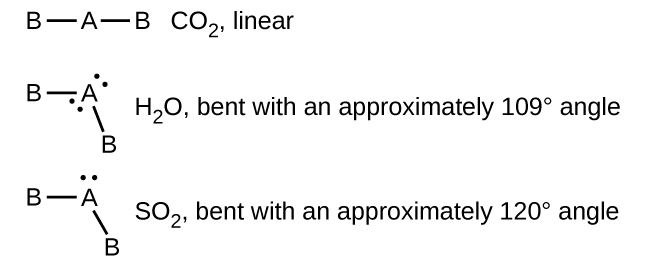
A molecule with the formula AB2, in which A and B represent different atoms, could have one of three different shapes. Sketch and name the three different shapes that this molecule might have. Give an example of a molecule or ion for each shape.
AとBが異なる原子を表すとき、化学式AB2の分子には3つの異なる形が考えられる。3つの形を簡単に描いて名称を答え、各形をとる分子またはイオンの例を挙げなさい。
Exercise 108問題 108
A molecule with the formula AB3, in which A and B represent different atoms, could have one of three different shapes. Sketch and name the three different shapes that this molecule might have. Give an example of a molecule or ion that has each shape.
AとBが異なる原子を表すとき、化学式AB3の分子には3つの異なる形が考えられる。3つの形を簡単に描いて名称を答え、各形をとる分子またはイオンの例を挙げなさい。
Exercise 109問題 109
Draw the Lewis electron dot structures for these molecules, including resonance structures where appropriate:
次の分子のルイス電子点構造を書きなさい。必要な場合は共鳴構造も含めること。
(a)
(a)
(b) CS2
(b) CS2
(c) CS
(c) CS
(d) predict the molecular shapes for and CS2 and explain how you arrived at your predictions
(d) とCS2の分子の形を予測し、その予測に至った理由を説明しなさい。
Solution解き方
(a)
(a)

(b)
(b)

(c)
(c)

(d) includes three regions of electron density (all are bonds with no lone pairs); the shape is trigonal planar; CS2 has only two regions of electron density (all bonds with no lone pairs); the shape is linear
(d) は電子密度の高い領域を3つもつ。すべて結合で、非共有電子対はない。形は平面三角形である。CS2は電子密度の高い領域が2つだけで、すべて結合、非共有電子対はない。形は直線形である。
Exercise 110問題 110
What is the molecular structure of the stable form of FNO2? (N is the central atom.)
FNO2の安定な形態の分子構造はどうなるか。Nを中心原子とする。
Exercise 111問題 111
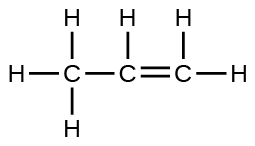
A compound with a molar mass of about 42 g/mol contains 85.7% carbon and 14.3% hydrogen. What is its molecular structure?
モル質量が約42 g/molで、炭素85.7%、水素14.3%を含む化合物がある。その分子構造はどうなるか。


Exercise 112問題 112
Use the simulation to perform the following exercises for a two-atom molecule:
シミュレーションを使い、二原子分子について次の課題を行いなさい。
(a) Adjust the electronegativity value so the bond dipole is pointing toward B. Then determine what the electronegativity values must be to switch the dipole so that it points toward A.
(a) 結合双極子がBを向くように、電気陰性度を調節しなさい。次に、双極子をAへ向けるには、電気陰性度をどう変えればよいか調べなさい。
(b) With a partial positive charge on A, turn on the electric field and describe what happens.
(b) Aに部分的な正電荷を与えて電場をオンにし、何が起こるか説明しなさい。
(c) With a small partial negative charge on A, turn on the electric field and describe what happens.
(c) Aに小さな部分的な負電荷を与えて電場をオンにし、何が起こるか説明しなさい。
(d) Reset all, and then with a large partial negative charge on A, turn on the electric field and describe what happens.
(d) すべてリセットしたあと、Aに大きな部分的な負電荷を与えて電場をオンにし、何が起こるか説明しなさい。
Exercise 113問題 113
Use the simulation to perform the following exercises for a real molecule. You may need to rotate the molecules in three dimensions to see certain dipoles.
シミュレーションを使い、実際の分子について次の課題を行いなさい。双極子によっては、見るために分子を三次元的に回転させる必要がある。
(a) Sketch the bond dipoles and molecular dipole (if any) for O3. Explain your observations.
(a) O3.の結合双極子と、存在する場合は分子双極子を簡単に描きなさい。観察したことを説明しなさい。
(b) Look at the bond dipoles for NH3. Use these dipoles to predict whether N or H is more electronegative.
(b) NH3の結合双極子を調べなさい。それを用い、NとHのどちらの電気陰性度が大きいか予測しなさい。
(c) Predict whether there should be a molecular dipole for NH3 and, if so, in which direction it will point. Check the molecular dipole box to test your hypothesis.
(c) NH3に分子双極子があるか予測し、ある場合はその向きを予測しなさい。分子双極子のボックスにチェックを入れ、仮説を確かめなさい。
Solution解き方
The molecular dipole points away from the hydrogen atoms.
分子双極子は、水素原子から離れる方向を向く。
Exercise 114問題 114
Use the Molecule Shape simulator to build a molecule. Starting with the central atom, click on the double bond to add one double bond. Then add one single bond and one lone pair. Rotate the molecule to observe the complete geometry. Name the electron group geometry and molecular structure and predict the bond angle. Then click the check boxes at the bottom and right of the simulator to check your answers.
分子の形シミュレーターで分子を組み立てなさい。中心原子から始め、二重結合をクリックして1本加える。次に、単結合1本と非共有電子対1組を加える。分子を回転させ、配置の全体を観察しなさい。電子領域の配置と分子構造の名称を答え、結合角を予測しなさい。その後、シミュレーターの下部と右側のチェックボックスをクリックし、答えを確かめなさい。
Exercise 115問題 115
Use the Molecule Shape simulator to explore real molecules. On the Real Molecules tab, select H2O. Switch between the “real” and “model” modes. Explain the difference observed.
分子の形シミュレーターで実際の分子を調べなさい。「Real Molecules」タブでH2Oを選び、「real」と「model」のモードを切り替え、観察した違いを説明しなさい。
Solution解き方
The structures are very similar. In the model mode, each electron group occupies the same amount of space, so the bond angle is shown as 109.5°. In the “real” mode, the lone pairs are larger, causing the hydrogens to be compressed. This leads to the smaller angle of 104.5°.
構造は非常によく似ている。「model」モードでは各電子領域が同じ大きさの空間を占めるので、結合角は109.5°と示される。「real」モードでは非共有電子対が大きく、そのため水素が押し寄せられ、角度は104.5°と小さくなる。
Exercise 116問題 116
Use the Molecule Shape simulator to explore real molecules. On the Real Molecules tab, select “model” mode and S2O. What is the model bond angle? Explain whether the “real” bond angle should be larger or smaller than the ideal model angle.
分子の形シミュレーターで実際の分子を調べなさい。「Real Molecules」タブで「model」モードとS2Oを選びなさい。モデルの結合角はいくつか。「real」の結合角が理想モデルの角度より大きくなるか小さくなるかを説明しなさい。
axial position
アキシアル位
location in a trigonal bipyramidal geometry in which there is another atom at a 180° angle and the equatorial positions are at a 90° angle
三方両錐形で、別の原子と180°の角度をなし、エクアトリアル位とは90°の角度をなす位置。
bond angle
結合角
angle between any two covalent bonds that share a common atom
1つの原子を共有する任意の2本の共有結合の間の角度。
bond distance
結合距離
(also, bond length) distance between the nuclei of two bonded atoms
結合した2つの原子の原子核間の距離。結合長ともいう。
bond dipole moment
結合双極子モーメント
separation of charge in a bond that depends on the difference in electronegativity and the bond distance represented by partial charges or a vector
電気陰性度の差と結合距離に依存する、結合内の電荷の分離。部分電荷またはベクトルで表す。
dipole moment
双極子モーメント
property of a molecule that describes the separation of charge determined by the sum of the individual bond moments based on the molecular structure
分子中の電荷の分離を表す性質。分子構造に基づいて個々の結合モーメントを足し合わせることで決まる。
electron-pair geometry
電子対の配置
arrangement around a central atom of all regions of electron density (bonds, lone pairs, or unpaired electrons)
中心原子の周りにある、電子密度をもつすべての領域(結合、非共有電子対、不対電子)の配置。
equatorial position
エクアトリアル位
one of the three positions in a trigonal bipyramidal geometry with 120° angles between them; the axial positions are located at a 90° angle
三方両錐形で、互いに120°の角度をなす3つの位置の1つ。アキシアル位とは90°の角度をなす。
linear
直線形
shape in which two outside groups are placed on opposite sides of a central atom
中心原子を挟んで反対側に、外側の2つの集団が配置される形。
molecular structure
分子構造
structure that includes only the placement of the atoms in the molecule
分子内の原子の位置だけを含めた構造。
octahedral
正八面体形
shape in which six outside groups are placed around a central atom such that a three-dimensional shape is generated with four groups forming a square and the other two forming the apex of two pyramids, one above and one below the square plane
中心原子の周りに外側の6つの集団を置く形。4つが正方形をつくり、残り2つがその平面の上下にある2つの角錐の頂点をつくる三次元構造。
polar molecule
極性分子
(also, dipole) molecule with an overall dipole moment
分子全体として双極子モーメントをもつ分子。双極子ともいう。
tetrahedral
正四面体形
shape in which four outside groups are placed around a central atom such that a three-dimensional shape is generated with four corners and 109.5° angles between each pair and the central atom
中心原子の周りに外側の4つの集団を置く形。4つの頂点をもつ三次元構造で、それぞれの2つの集団と中心原子がつくる角度は109.5°。
trigonal bipyramidal
三方両錐形
shape in which five outside groups are placed around a central atom such that three form a flat triangle with 120° angles between each pair and the central atom, and the other two form the apex of two pyramids, one above and one below the triangular plane
中心原子の周りに外側の5つの集団を置く形。3つが平面上の三角形をつくり、それぞれの2つの集団と中心原子がつくる角度は120°となる。残り2つは三角形の平面の上下にある2つの角錐の頂点をつくる。
trigonal planar
平面三角形
shape in which three outside groups are placed in a flat triangle around a central atom with 120° angles between each pair and the central atom
中心原子の周りに外側の3つの集団を平面上の三角形に配置する形。それぞれの2つの集団と中心原子がつくる角度は120°。
valence shell electron-pair repulsion theory (VSEPR)
原子価殻電子対反発理論(VSEPR)
theory used to predict the bond angles in a molecule based on positioning regions of high electron density as far apart as possible to minimize electrostatic repulsion
静電反発を最小にするため、電子密度の高い領域をできるかぎり離して配置することに基づき、分子内の結合角を予測する理論。
vector
ベクトル
quantity having magnitude and direction
大きさと向きをもつ量。