第7章化学結合と分子の形
Molecular Structure for Multicenter Molecules複数の中心原子をもつ分子の構造
When a molecule or polyatomic ion has only one central atom, the molecular structure completely describes the shape of the molecule. Larger molecules do not have a single central atom, but are connected by a chain of interior atoms that each possess a “local” geometry. The way these local structures are oriented with respect to each other also influences the molecular shape, but such considerations are largely beyond the scope of this introductory discussion. For our purposes, we will only focus on determining the local structures.
英語のヒント
分子や多原子イオンの中心原子が1つだけであれば、その分子構造によって分子の形を完全に記述できる。もっと大きな分子には単一の中心原子はなく、それぞれが「局所的な」配置をもつ内部の原子が、鎖のようにつながっている。こうした局所構造の相互の向きも分子の形に影響するが、その検討の大半は、この入門的な説明の範囲を超える。ここでは局所構造を決めることだけに焦点を当てる。
Example 7.16例題 7.16
Predicting Structure in Multicenter Molecules複数の中心原子をもつ分子の構造を予測する
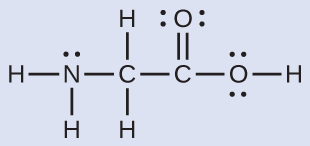
The Lewis structure for the simplest amino acid, glycine, H2NCH2CO2H, is shown here. Predict the local geometry for the nitrogen atom, the two carbon atoms, and the oxygen atom with a hydrogen atom attached:
最も単純なアミノ酸であるグリシンH2NCH2CO2Hのルイス構造を示す。窒素原子、2個の炭素原子、水素原子が結合した酸素原子について、それぞれの局所的な配置を予測しなさい。
Solution解答
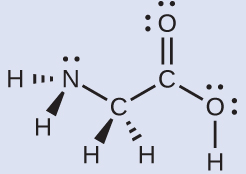
Consider each central atom independently. The electron-pair geometries:
各中心原子を別々に考える。電子対配置は次のとおり。
- nitrogen––four regions of electron density; tetrahedral窒素:電子密度の高い領域4つ。正四面体形。
- carbon (CH2)––four regions of electron density; tetrahedral炭素(CH2):電子密度の高い領域4つ。正四面体形。
- carbon (CO2)—three regions of electron density; trigonal planar炭素(CO2):電子密度の高い領域3つ。平面三角形。
- oxygen (OH)—four regions of electron density; tetrahedral酸素(OH):電子密度の高い領域4つ。正四面体形。
The local structures:
局所構造は次のとおり。
- nitrogen––three bonds, one lone pair; trigonal pyramidal窒素:結合3本、非共有電子対1組。三角錐形。
- carbon (CH2)—four bonds, no lone pairs; tetrahedral炭素(CH2):結合4本、非共有電子対なし。正四面体形。
- carbon (CO2)—three bonds (double bond counts as one bond), no lone pairs; trigonal planar炭素(CO2):結合3本(二重結合を1本と数える)、非共有電子対なし。平面三角形。
- oxygen (OH)—two bonds, two lone pairs; bent (109°)酸素(OH):結合2本、非共有電子対2組。折れ線形(109°)。
Check Your Learning理解を確かめよう
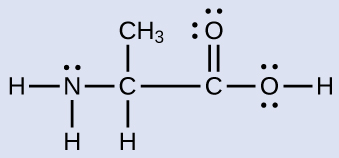
Another amino acid is alanine, which has the Lewis structure shown here. Predict the electron-pair geometry and local structure of the nitrogen atom, the three carbon atoms, and the oxygen atom with hydrogen attached:
別のアミノ酸であるアラニンのルイス構造を示す。窒素原子、3個の炭素原子、水素が結合した酸素原子について、それぞれ電子対配置と局所構造を予測しなさい。
Example 7.17例題 7.17
Molecular Simulation分子のシミュレーション
Using molecular shape simulator allows us to control whether bond angles and/or lone pairs are displayed by checking or unchecking the boxes under “Options” on the right. We can also use the “Name” checkboxes at bottom-left to display or hide the electron pair geometry (called “electron geometry” in the simulator) and/or molecular structure (called “molecular shape” in the simulator).
英語のヒント
分子の形シミュレーターでは、右側の「Options」のチェックを付けたり外したりして、結合角や非共有電子対の表示を切り替えられる。左下の「Name」のチェックボックスでは、電子対配置(シミュレーターでは「electron geometry」)や分子構造(同「molecular shape」)を表示したり隠したりできる。
Build the molecule HCN in the simulator based on the following Lewis structure:
次のルイス構造をもとに、シミュレーターでHCN分子を組み立てなさい。
Click on each bond type or lone pair at right to add that group to the central atom. Once you have the complete molecule, rotate it to examine the predicted molecular structure. What molecular structure is this?
右側の各結合や非共有電子対をクリックすると、そのグループを中心原子に追加できる。分子が完成したら回転させ、予測された分子構造を調べなさい。これはどのような分子構造か。
Solution解答
The molecular structure is linear.
分子構造は直線形である。
Check Your Learning理解を確かめよう
Build a more complex molecule in the simulator. Identify the electron-group geometry, molecular structure, and bond angles. Then try to find a chemical formula that would match the structure you have drawn.
シミュレーターで、さらに複雑な分子を組み立てなさい。電子領域の配置、分子構造、結合角を調べなさい。次に、その構造に対応する化学式を見つけてみなさい。
Molecular Polarity and Dipole Moment分子の極性と双極子モーメント
As discussed previously, polar covalent bonds connect two atoms with differing electronegativities, leaving one atom with a partial positive charge (δ+) and the other atom with a partial negative charge (δ–), as the electrons are pulled toward the more electronegative atom. This separation of charge gives rise to a bond dipole moment. The magnitude of a bond dipole moment is represented by the Greek letter mu (µ) and is given by the formula shown here, where Q is the magnitude of the partial charges (determined by the electronegativity difference) and r is the distance between the charges:
英語のヒント
前に述べたように、極性共有結合は電気陰性度の異なる2原子を結ぶ。電子が電気陰性度の大きい原子へ引き寄せられるため、一方の原子は部分的な正電荷(δ+)、もう一方は部分的な負電荷(δ−)をもつ。この電荷の分離によって、結合双極子モーメントが生じる。結合双極子モーメントの大きさはギリシャ文字のミュー(µ)で表し、次の式で与えられる。Qは部分電荷の大きさ(電気陰性度の差で決まる)、rは電荷間の距離である。
This bond moment can be represented as a vector, a quantity having both direction and magnitude (Figure 7.26). Dipole vectors are shown as arrows pointing along the bond from the less electronegative atom toward the more electronegative atom. A small plus sign is drawn on the less electronegative end to indicate the partially positive end of the bond. The length of the arrow is proportional to the magnitude of the electronegativity difference between the two atoms.
英語のヒント
この結合モーメントは、向きと大きさの両方をもつ量であるベクトルとして表せる(図7.26)。双極子ベクトルは、電気陰性度の小さい原子から大きい原子へ、結合に沿って向かう矢印で示す。電気陰性度の小さい側には小さな正号を付け、結合の部分的に正となる端を示す。矢印の長さは、2原子間の電気陰性度の差の大きさに比例する。
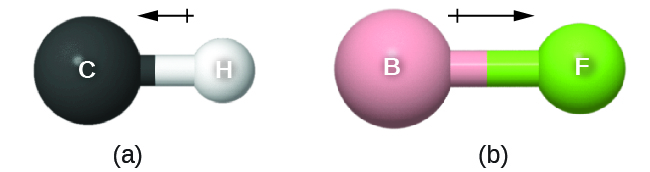
Figure 7.26図 7.26
(a) There is a small difference in electronegativity between C and H, represented as a short vector. (b) The electronegativity difference between B and F is much larger, so the vector representing the bond moment is much longer.
(a) CとHの電気陰性度の差は小さく、短いベクトルで表される。(b) BとFの電気陰性度の差ははるかに大きいので、結合モーメントを表すベクトルもはるかに長い。
A whole molecule may also have a separation of charge, depending on its molecular structure and the polarity of each of its bonds. If such a charge separation exists, the molecule is said to be a polar molecule (or dipole); otherwise the molecule is said to be nonpolar. The dipole moment measures the extent of net charge separation in the molecule as a whole. We determine the dipole moment by adding the bond moments in three-dimensional space, taking into account the molecular structure.
英語のヒント
分子構造と各結合の極性によっては、分子全体でも電荷の分離が生じる。このような電荷の分離があれば、極性分子(または双極子)といい、なければ無極性分子という。双極子モーメントは、分子全体としてどれほど電荷が分離しているかを表す尺度である。分子構造を考慮し、三次元空間で各結合モーメントを足し合わせて求める。
For diatomic molecules, there is only one bond, so its bond dipole moment determines the molecular polarity. Homonuclear diatomic molecules such as Br2 and N2 have no difference in electronegativity, so their dipole moment is zero. For heteronuclear molecules such as CO, there is a small dipole moment. For HF, there is a larger dipole moment because there is a larger difference in electronegativity.
英語のヒント
二原子分子には結合が1本しかないため、その結合双極子モーメントが分子の極性を決める。Br2やN2のような等核二原子分子には電気陰性度の差がないので、双極子モーメントは0である。COのような異核分子には、小さな双極子モーメントがある。HFは電気陰性度の差がより大きいため、双極子モーメントも大きい。
When a molecule contains more than one bond, the geometry must be taken into account. If the bonds in a molecule are arranged such that their bond moments cancel (vector sum equals zero), then the molecule is nonpolar. This is the situation in CO2 (Figure 7.27). Each of the bonds is polar, but the molecule as a whole is nonpolar. From the Lewis structure, and using VSEPR theory, we determine that the CO2 molecule is linear with polar C=O bonds on opposite sides of the carbon atom. The bond moments cancel because they are pointed in opposite directions. In the case of the water molecule (Figure 7.27), the Lewis structure again shows that there are two bonds to a central atom, and the electronegativity difference again shows that each of these bonds has a nonzero bond moment. In this case, however, the molecular structure is bent because of the lone pairs on O, and the two bond moments do not cancel. Therefore, water does have a net dipole moment and is a polar molecule (dipole).
英語のヒント
分子に結合が複数あるときは、配置を考慮しなければならない。各結合モーメントが打ち消し合う(ベクトルの和が0になる)ように結合が並んでいれば、分子は無極性である。CO2がその例である(図7.27)。各結合は極性をもつが、分子全体は無極性である。ルイス構造とVSEPR理論から、CO2は直線形で、極性のあるC=O結合が炭素原子の互いに反対側にあるとわかる。結合モーメントが逆向きなので、打ち消し合う。水分子(図7.27)でも、ルイス構造には中心原子へ向かう結合が2本あり、電気陰性度の差から、各結合が0でない結合モーメントをもつとわかる。しかし、この場合はO上の非共有電子対によって分子構造が折れ線形となり、2つの結合モーメントは打ち消し合わない。したがって、水には分子全体として双極子モーメントがあり、極性分子(双極子)である。
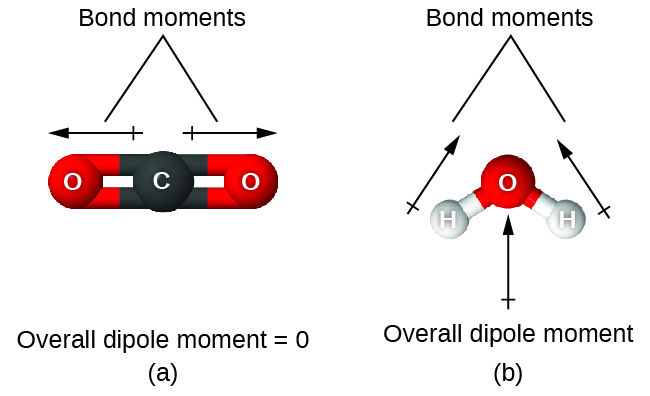
Figure 7.27図 7.27
The overall dipole moment of a molecule depends on the individual bond dipole moments and how they are arranged. (a) Each CO bond has a bond dipole moment, but they point in opposite directions so that the net CO2 molecule is nonpolar. (b) In contrast, water is polar because the OH bond moments do not cancel out.
分子全体の双極子モーメントは、個々の結合双極子モーメントと、その配置によって決まる。(a) 各CO結合は結合双極子モーメントをもつが、互いに逆を向くため、CO2分子全体は無極性となる。(b) 対照的に、水ではOH結合モーメントが打ち消し合わないため、極性がある。
The OCS molecule has a structure similar to CO2, but a sulfur atom has replaced one of the oxygen atoms. To determine if this molecule is polar, we draw the molecular structure. VSEPR theory predicts a linear molecule:
OCS分子はCO2に似た構造をもち、酸素原子の1つが硫黄原子に置き換わっている。この分子に極性があるか判断するため、分子構造を書く。VSEPR理論では、直線形の分子が予測される。
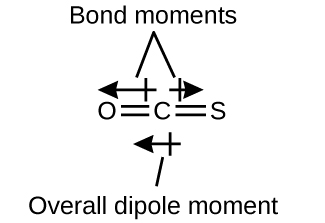
The C-O bond is considerably polar. Although C and S have very similar electronegativity values, S is slightly more electronegative than C, and so the C-S bond is just slightly polar. Because oxygen is more electronegative than sulfur, the oxygen end of the molecule is the negative end.
英語のヒント
C–O結合はかなり強い極性をもつ。CとSの電気陰性度は非常に近いが、Sのほうがわずかに大きいため、C–S結合にもごく弱い極性がある。酸素のほうが硫黄より電気陰性度が大きいので、この分子では酸素側が負の端となる。
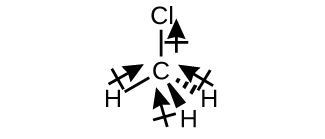
Chloromethane, CH3Cl, is a tetrahedral molecule with three slightly polar C-H bonds and a more polar C-Cl bond. The relative electronegativities of the bonded atoms is H < C < Cl, and so the bond moments all point toward the Cl end of the molecule and sum to yield a considerable dipole moment (the molecules are relatively polar).
クロロメタンCH3Clは正四面体形の分子で、弱い極性をもつC–H結合が3本と、それより強い極性をもつC–Cl結合が1本ある。結合原子の電気陰性度の大小関係はH < C < Clなので、結合モーメントはすべてClのある側を向き、足し合わせるとかなり大きな双極子モーメントとなる。この分子は比較的強い極性をもつ。
For molecules of high symmetry such as BF3 (trigonal planar), CH4 (tetrahedral), PF5 (trigonal bipyramidal), and SF6 (octahedral), all the bonds are of identical polarity (same bond moment) and they are oriented in geometries that yield nonpolar molecules (dipole moment is zero). Molecules of less geometric symmetry, however, may be polar even when all bond moments are identical. For these molecules, the directions of the equal bond moments are such that they sum to give a nonzero dipole moment and a polar molecule. Examples of such molecules include hydrogen sulfide, H2S (nonlinear), and ammonia, NH3 (trigonal pyramidal).
英語のヒント
BF3(平面三角形)、CH4(正四面体形)、PF5(三方両錐形)、SF6(正八面体形)のように対称性の高い分子では、すべての結合が同じ極性(同じ結合モーメント)をもち、無極性分子となるように配置されている。双極子モーメントは0である。しかし、形の対称性が低い分子では、すべての結合モーメントが等しくても、極性をもつことがある。このような分子では、同じ大きさの結合モーメントの向きが、足し合わせると0でない双極子モーメントになるように並び、極性分子となる。例として、硫化水素H2S(非直線形)やアンモニアNH3(三角錐形)がある。



To summarize, to be polar, a molecule must:
まとめると、分子が極性をもつには、次の条件が必要である。
- Contain at least one polar covalent bond.少なくとも1本の極性共有結合を含む。
- Have a molecular structure such that the sum of the vectors of each bond dipole moment does not cancel.各結合双極子モーメントのベクトルを足し合わせても打ち消し合わない分子構造をもつ。