第7章化学結合と分子の形
7.3 Lewis Symbols and Structures7.3 ルイス記号とルイス構造
Learning Objectives学習目標
By the end of this section, you will be able to:
この節を学ぶと、次のことができるようになる。
- Write Lewis symbols for neutral atoms and ions中性原子とイオンのルイス記号を書く。
- Draw Lewis structures depicting the bonding in simple molecules単純な分子の結合を表すルイス構造を書く。
Thus far in this chapter, we have discussed the various types of bonds that form between atoms and/or ions. In all cases, these bonds involve the sharing or transfer of valence shell electrons between atoms. In this section, we will explore the typical method for depicting valence shell electrons and chemical bonds, namely Lewis symbols and Lewis structures.
英語のヒント
ここまでは、原子やイオンの間にできるさまざまな種類の結合を扱ってきた。いずれの結合にも、原子間での価電子殻の電子の共有または移動が関わる。この節では、価電子殻の電子と化学結合を表す代表的な方法、すなわちルイス記号とルイス構造を学ぶ。
Lewis Symbolsルイス記号
We use Lewis symbols to describe valence electron configurations of atoms and monatomic ions. A Lewis symbol consists of an elemental symbol surrounded by one dot for each of its valence electrons:
英語のヒント
原子や単原子イオンの価電子の配置を表すために、ルイス記号を使う。ルイス記号は元素記号の周囲に、価電子1個につき1つの点を置いたものである。

Figure 7.9 shows the Lewis symbols for the elements of the third period of the periodic table.
図7.9は、周期表の第3周期の元素のルイス記号を示す。
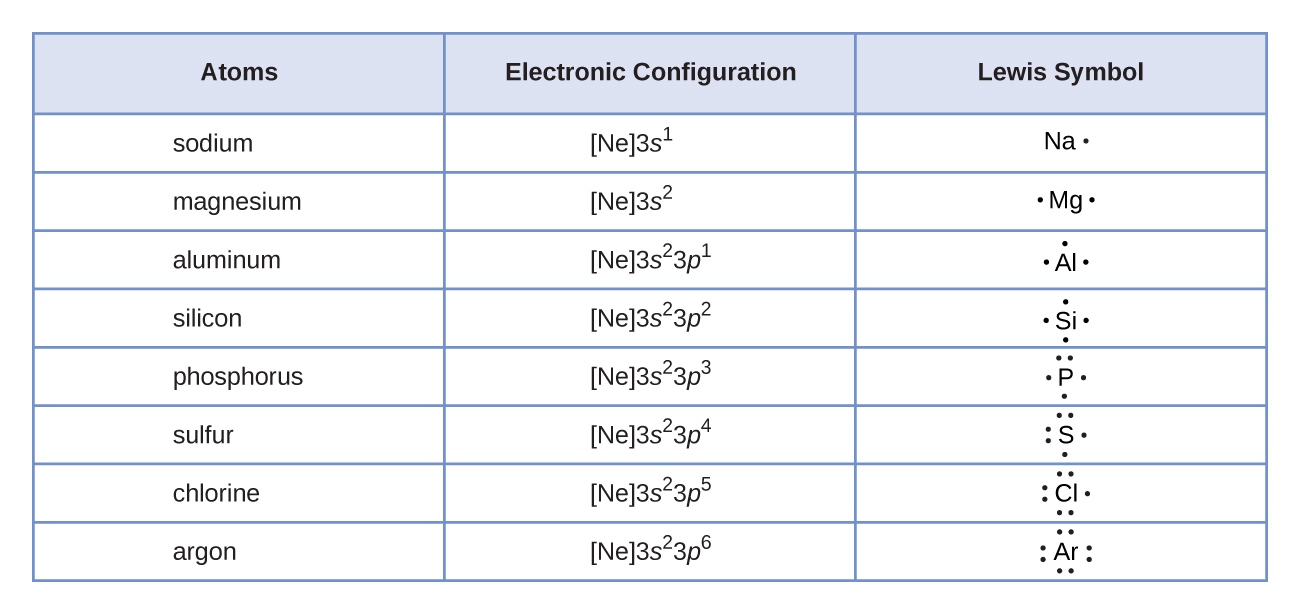
Figure 7.9図 7.9
Lewis symbols illustrating the number of valence electrons for each element in the third period of the periodic table.
周期表の第3周期の各元素について、価電子数を示したルイス記号。
Lewis symbols can also be used to illustrate the formation of cations from atoms, as shown here for sodium and calcium:
ルイス記号は、原子から陽イオンができる過程にも使える。ナトリウムとカルシウムの例を次に示す。

Likewise, they can be used to show the formation of anions from atoms, as shown here for chlorine and sulfur:
同様に、原子から陰イオンができる過程も表せる。塩素と硫黄の例を次に示す。

Figure 7.10 demonstrates the use of Lewis symbols to show the transfer of electrons during the formation of ionic compounds.
図7.10は、イオン化合物ができるときの電子の移動を、ルイス記号で示したものである。
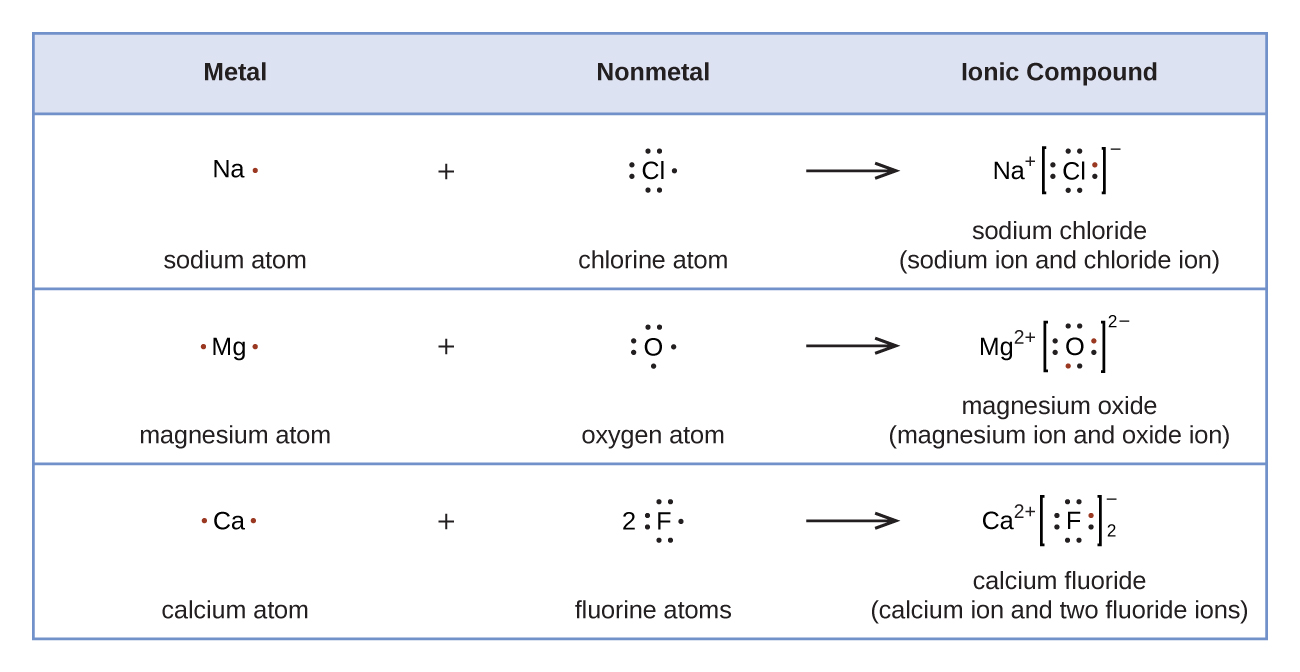
Figure 7.10図 7.10
Cations are formed when atoms lose electrons, represented by fewer Lewis dots, whereas anions are formed by atoms gaining electrons. The total number of electrons does not change.
原子が電子を失うと陽イオンができ、ルイス記号の点の数が減る。一方、原子が電子を受け取ると陰イオンができる。電子の総数は変わらない。
Lewis Structuresルイス構造
We also use Lewis symbols to indicate the formation of covalent bonds, which are shown in Lewis structures, drawings that describe the bonding in molecules and polyatomic ions. For example, when two chlorine atoms form a chlorine molecule, they share one pair of electrons:
ルイス記号は共有結合の形成にも使う。共有結合は、分子や多原子イオンの結合を示す図であるルイス構造に表される。たとえば、2つの塩素原子が塩素分子をつくるとき、1組の電子対を共有する。
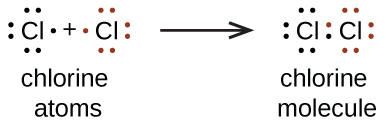
The Lewis structure indicates that each Cl atom has three pairs of electrons that are not used in bonding (called lone pairs) and one shared pair of electrons (written between the atoms). A dash (or line) is sometimes used to indicate a shared pair of electrons:
英語のヒント
このルイス構造は、各Cl原子が、結合に使われない3組の電子対(非共有電子対)と、共有する1組の電子対(原子間に書かれている)をもつことを示す。共有する1組の電子対を、ダッシュ(線)で表すこともある。
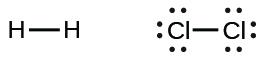
A single shared pair of electrons is called a single bond. Each Cl atom interacts with eight valence electrons: the six in the lone pairs and the two in the single bond.
1組の電子対を共有する結合を単結合という。各Cl原子は、非共有電子対にある6個と、単結合にある2個の、計8個の価電子と相互作用する。
The Octet Ruleオクテット則
The other halogen molecules (F2, Br2, I2, and At2) form bonds like those in the chlorine molecule: one single bond between atoms and three lone pairs of electrons per atom. This allows each halogen atom to have a noble gas electron configuration. The tendency of main group atoms to form enough bonds to obtain eight valence electrons is known as the octet rule.
英語のヒント
他のハロゲン分子(F2、Br2、I2、At2)も、塩素分子と同じように結合する。原子間には単結合が1本あり、各原子には非共有電子対が3組ある。これにより、各ハロゲン原子は希ガスの電子配置をとる。典型元素の原子が、価電子8個を得るのに必要な数の結合をつくる傾向を、オクテット則という。
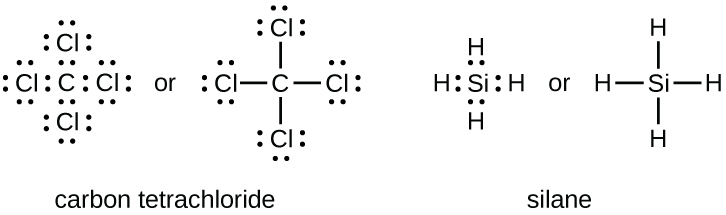
The number of bonds that an atom can form can often be predicted from the number of electrons needed to reach an octet (eight valence electrons); this is especially true of the nonmetals of the second period of the periodic table (C, N, O, and F). For example, each atom of a group 14 element has four electrons in its outermost shell and therefore requires four more electrons to reach an octet. These four electrons can be gained by forming four covalent bonds, as illustrated here for carbon in CCl4 (carbon tetrachloride) and silicon in SiH4 (silane). Because hydrogen only needs two electrons to fill its valence shell, it is an exception to the octet rule. The transition elements and inner transition elements also do not follow the octet rule:
英語のヒント
原子がつくれる結合の数は、オクテット(8個の価電子)に達するために必要な電子数から、予測できることが多い。これは特に、周期表の第2周期の非金属(C、N、O、F)によく当てはまる。たとえば、第14族の元素の原子は最外殻に4個の電子をもち、オクテットになるにはさらに4個必要である。これら4個の電子は、4本の共有結合をつくることで得られる。CCl4(四塩化炭素)の炭素と、SiH4(シラン)のケイ素について、次にその例を示す。水素は、価電子殻を満たすのに電子を2個しか必要としないため、オクテット則の例外である。遷移元素と内部遷移元素も、オクテット則に従わない。
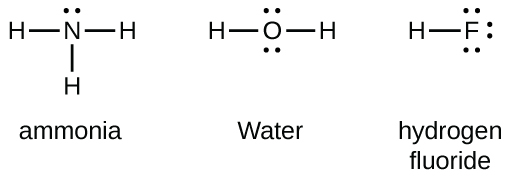
Group 15 elements such as nitrogen have five valence electrons in the atomic Lewis symbol: one lone pair and three unpaired electrons. To obtain an octet, these atoms form three covalent bonds, as in NH3 (ammonia). Oxygen and other atoms in group 16 obtain an octet by forming two covalent bonds:
英語のヒント
窒素などの第15族の原子のルイス記号には、1組の非共有電子対と3個の不対電子、計5個の価電子がある。これらの原子は、NH3(アンモニア)のように3本の共有結合をつくってオクテットになる。酸素など第16族の原子は、2本の共有結合でオクテットになる。
Double and Triple Bonds二重結合と三重結合
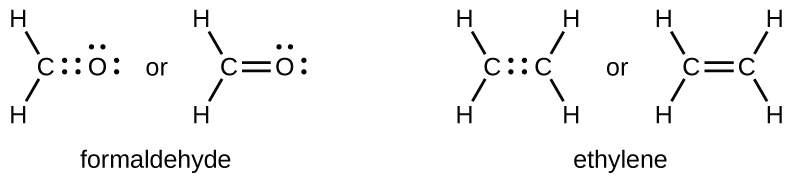
As previously mentioned, when a pair of atoms shares one pair of electrons, we call this a single bond. However, a pair of atoms may need to share more than one pair of electrons in order to achieve the requisite octet. A double bond forms when two pairs of electrons are shared between a pair of atoms, as between the carbon and oxygen atoms in CH2O (formaldehyde) and between the two carbon atoms in C2H4 (ethylene):
英語のヒント
すでに述べたように、2つの原子が1組の電子対を共有するとき、その結合を単結合という。しかし、必要なオクテットを満たすために、2組以上の電子対を共有しなければならないこともある。2つの原子が2組の電子対を共有すると二重結合になる。CH2O(ホルムアルデヒド)の炭素と酸素の間や、C2H4(エチレン)の2つの炭素の間がその例である。
A triple bond forms when three electron pairs are shared by a pair of atoms, as in carbon monoxide (CO) and the cyanide ion (CN–):
一酸化炭素(CO)やシアン化物イオン(CN–)のように、2つの原子が3組の電子対を共有すると、三重結合になる。



