第7章化学結合と分子の形
7.2 Covalent Bonding7.2 共有結合
Learning Objectives学習目標
By the end of this section, you will be able to:
この節を学ぶと、次のことができるようになる。
- Describe the formation of covalent bonds共有結合ができる仕組みを説明する。
- Define electronegativity and assess the polarity of covalent bonds電気陰性度を定義し、共有結合の極性を評価する。
Ionic bonding results from the electrostatic attraction of oppositely charged ions that are typically produced by the transfer of electrons between metallic and nonmetallic atoms. A different type of bonding results from the mutual attraction of atoms for a “shared” pair of electrons. Such bonds are called covalent bonds. Covalent bonds are formed between two atoms when both have similar tendencies to attract electrons to themselves (i.e., when both atoms have identical or fairly similar ionization energies and electron affinities). For example, two hydrogen atoms bond covalently to form an H2 molecule; each hydrogen atom in the H2 molecule has two electrons stabilizing it, giving each atom the same number of valence electrons as the noble gas He.
英語のヒント
イオン結合は、逆符号に帯電したイオンどうしの静電引力によって生じる。このようなイオンは、通常、金属原子と非金属原子の間で電子が移ることによってできる。これとは別に、両方の原子が「共有する」電子対を引き付けることによって生じる結合もある。これを共有結合という。2つの原子が、電子を自分のほうへ引き付ける傾向を同じくらいもつとき、共有結合ができる。つまり、両方の原子のイオン化エネルギーと電子親和力が、同じか、かなり近い場合である。たとえば、2つの水素原子は共有結合してH2分子をつくる。H2分子中の各水素原子は2個の電子によって安定化され、それぞれが希ガスHeと同じ数の価電子をもつことになる。
Compounds that contain covalent bonds exhibit different physical properties than ionic compounds. Because the attraction between molecules, which are electrically neutral, is weaker than that between electrically charged ions, covalent compounds generally have much lower melting and boiling points than ionic compounds. In fact, many covalent compounds are liquids or gases at room temperature, and, in their solid states, they are typically much softer than ionic solids. Furthermore, whereas ionic compounds are good conductors of electricity when dissolved in water, most covalent compounds are insoluble in water; since they are electrically neutral, they are poor conductors of electricity in any state.
英語のヒント
共有結合を含む化合物は、イオン化合物とは異なる物理的性質を示す。電気的に中性な分子どうしの引力は、帯電したイオンどうしの引力より弱いため、共有結合性の化合物の融点や沸点は、一般にイオン化合物よりかなり低い。実際、多くの共有結合性化合物は室温で液体または気体であり、固体のときも、通常はイオン性の固体よりずっと柔らかい。さらに、イオン化合物は水に溶けると電気をよく通すのに対し、共有結合性化合物の多くは水に溶けない。また、電気的に中性であるため、どの状態でも電気を通しにくい。
Formation of Covalent Bonds共有結合の形成
Nonmetal atoms frequently form covalent bonds with other nonmetal atoms. For example, the hydrogen molecule, H2, contains a covalent bond between its two hydrogen atoms. Figure 7.4 illustrates why this bond is formed. Starting on the far right, we have two separate hydrogen atoms with a particular potential energy, indicated by the red line. Along the x-axis is the distance between the two atoms. As the two atoms approach each other (moving left along the x-axis), their valence orbitals (1s) begin to overlap. The single electrons on each hydrogen atom then interact with both atomic nuclei, occupying the space around both atoms. The strong attraction of each shared electron to both nuclei stabilizes the system, and the potential energy decreases as the bond distance decreases. If the atoms continue to approach each other, the positive charges in the two nuclei begin to repel each other, and the potential energy increases. The bond length is determined by the distance at which the lowest potential energy is achieved.
英語のヒント
非金属原子は、しばしば他の非金属原子と共有結合をつくる。たとえば、水素分子H2では、2つの水素原子の間に共有結合がある。図7.4は、この結合ができる理由を示している。図の右端から見ていこう。そこでは2つの水素原子が離れており、赤い線で示した一定の位置エネルギーをもつ。x軸は2原子間の距離を示す。2原子が近づくと(x軸に沿って左へ移動すると)、価電子軌道(1s)が重なり始める。すると、各水素原子の1個ずつの電子が両方の原子核と相互作用し、両原子の周囲の空間を占めるようになる。共有された各電子と両方の原子核との強い引力が系を安定化し、結合距離が小さくなるにつれて位置エネルギーが下がる。しかし、原子がさらに近づくと、2つの原子核の正電荷が反発し始め、位置エネルギーは上がる。位置エネルギーが最小になる距離が、結合長を決める。
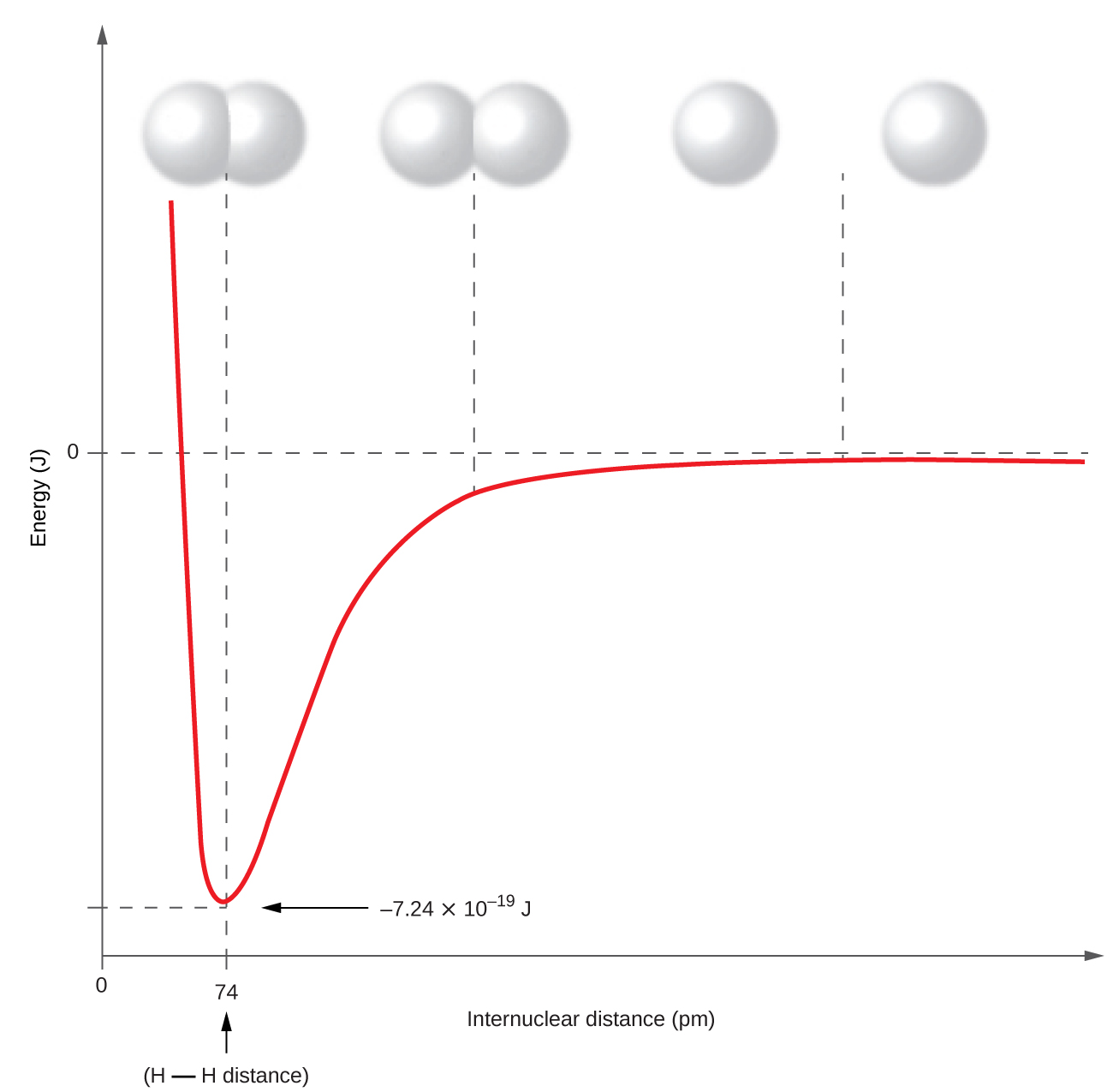
Figure 7.4図 7.4
The potential energy of two separate hydrogen atoms (right) decreases as they approach each other, and the single electrons on each atom are shared to form a covalent bond. The bond length is the internuclear distance at which the lowest potential energy is achieved.
英語のヒント
離れた2つの水素原子(右)が近づくと位置エネルギーが下がり、各原子の1個ずつの電子が共有されて共有結合をつくる。結合長は、位置エネルギーが最小になる原子核間距離である。
It is essential to remember that energy must be added to break chemical bonds (an endothermic process), whereas forming chemical bonds releases energy (an exothermic process). In the case of H2, the covalent bond is very strong; a large amount of energy, 436 kJ, must be added to break the bonds in one mole of hydrogen molecules and cause the atoms to separate:
英語のヒント
化学結合を切るにはエネルギーを加える必要があり(吸熱過程)、化学結合ができるときにはエネルギーが放出される(発熱過程)ことを覚えておくことが重要である。H2の共有結合は非常に強い。水素分子1モルの結合を切って原子をばらばらにするには、436 kJという大きなエネルギーを加えなければならない。
Conversely, the same amount of energy is released when one mole of H2 molecules forms from two moles of H atoms:
英語のヒント
逆に、H原子2モルからH2分子1モルができるときには、同じ量のエネルギーが放出される。
Pure vs. Polar Covalent Bonds無極性共有結合と極性共有結合
If the atoms that form a covalent bond are identical, as in H2, Cl2, and other diatomic molecules, then the electrons in the bond must be shared equally. We refer to this as a pure covalent bond. Electrons shared in pure covalent bonds have an equal probability of being near each nucleus.
英語のヒント
H2、Cl2などの二原子分子のように、共有結合する原子が同じであれば、結合中の電子は等しく共有されなければならない。これを無極性共有結合という。無極性共有結合で共有される電子は、どちらの原子核の近くにも同じ確率で存在する。
In the case of Cl2, each atom starts off with seven valence electrons, and each Cl shares one electron with the other, forming one covalent bond:
英語のヒント
Cl2の場合、各原子は最初に7個の価電子をもち、それぞれのClが電子を1個ずつ相手と共有して、1本の共有結合をつくる。
The total number of electrons around each individual atom consists of six nonbonding electrons and two shared (i.e., bonding) electrons for eight total electrons, matching the number of valence electrons in the noble gas argon. Since the bonding atoms are identical, Cl2 also features a pure covalent bond.
英語のヒント
各原子の周りには、非結合電子6個と、共有された電子(結合電子)2個の、計8個の電子がある。これは希ガスのアルゴンの価電子数と一致する。結合している原子が同じなので、Cl2の結合も無極性共有結合である。
When the atoms linked by a covalent bond are different, the bonding electrons are shared, but no longer equally. Instead, the bonding electrons are more attracted to one atom than the other, giving rise to a shift of electron density toward that atom. This unequal distribution of electrons is known as a polar covalent bond, characterized by a partial positive charge on one atom and a partial negative charge on the other. The atom that attracts the electrons more strongly acquires the partial negative charge and vice versa. For example, the electrons in the H–Cl bond of a hydrogen chloride molecule spend more time near the chlorine atom than near the hydrogen atom. Thus, in an HCl molecule, the chlorine atom carries a partial negative charge and the hydrogen atom has a partial positive charge. Figure 7.5 shows the distribution of electrons in the H–Cl bond. Note that the shaded area around Cl is much larger than it is around H. Compare this to Figure 7.4, which shows the even distribution of electrons in the H2 nonpolar bond.
英語のヒント
共有結合でつながる原子が異なる場合、結合電子は共有されるものの、等しくは共有されなくなる。片方の原子がもう片方より強く電子を引き付け、電子密度がその原子のほうへ偏る。このように電子が不均等に分布する結合を、極性共有結合という。一方の原子が部分的な正電荷を、他方が部分的な負電荷をもつことが特徴である。電子をより強く引き付ける原子が部分的な負電荷を帯び、もう一方はその逆になる。たとえば、塩化水素分子のH–Cl結合の電子は、水素原子の近くよりも塩素原子の近くに長い時間存在する。したがって、HCl分子では塩素原子が部分的な負電荷を、水素原子が部分的な正電荷をもつ。図7.5はH–Cl結合の電子分布を示す。Clの周りの影を付けた領域は、Hの周りよりもずっと大きい。これを、H2の無極性結合で電子が均等に分布する様子を示した図7.4と比較してみよう。
We sometimes designate the positive and negative atoms in a polar covalent bond using a lowercase Greek letter “delta,” δ, with a plus sign or minus sign to indicate whether the atom has a partial positive charge (δ+) or a partial negative charge (δ–). This symbolism is shown for the H–Cl molecule in Figure 7.5.
英語のヒント
極性共有結合の正側・負側の原子を示すため、ギリシャ文字デルタの小文字δに正号または負号を付けることがある。部分的な正電荷はδ+、部分的な負電荷はδ–で表す。図7.5のH–Cl分子に、この記号の使い方を示してある。
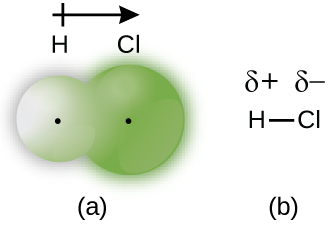


Figure 7.5図 7.5
(a) The distribution of electron density in the HCl molecule is uneven. The electron density is greater around the chlorine nucleus. The small, black dots indicate the location of the hydrogen and chlorine nuclei in the molecule. (b) Symbols δ+ and δ– indicate the polarity of the H–Cl bond.
(a)HCl分子の電子密度の分布は均一でない。塩素原子核の周りで電子密度が高くなっている。黒い小さな点は、分子中の水素と塩素の原子核の位置を示す。(b)δ+とδ–の記号は、H–Cl結合の極性を示す。