第7章化学結合と分子の形
Ionic Bond Strength and Lattice Energyイオン結合の強さと格子エネルギー
An ionic compound is stable because of the electrostatic attraction between its positive and negative ions. The lattice energy of a compound is a measure of the strength of this attraction. The lattice energy (ΔHlattice) of an ionic compound is defined as the energy required to separate one mole of the solid into its component gaseous ions. For the ionic solid MX, the lattice energy is the enthalpy change of the process:
イオン化合物は、陽イオンと陰イオンの間の静電引力によって安定になっている。化合物の格子エネルギーは、この引力の強さを表す尺度である。イオン化合物の格子エネルギー(ΔHlattice)は、固体1 molを、構成成分である気体イオンへと分離するのに必要なエネルギーと定義される。イオン性固体MXでは、格子エネルギーは次の過程のエンタルピー変化である。
Note that we are using the convention where the ionic solid is separated into ions, so our lattice energies will be endothermic (positive values). Some texts use the equivalent but opposite convention, defining lattice energy as the energy released when separate ions combine to form a lattice and giving negative (exothermic) values. Thus, if you are looking up lattice energies in another reference, be certain to check which definition is being used. In both cases, a larger magnitude for lattice energy indicates a more stable ionic compound. For sodium chloride, ΔHlattice = 769 kJ. Thus, it requires 769 kJ to separate one mole of solid NaCl into gaseous Na+ and Cl– ions. When one mole each of gaseous Na+ and Cl– ions form solid NaCl, 769 kJ of heat is released.
英語のヒント
ここでは、イオン性固体をイオンへ分離するという取り決めを使っている。したがって、格子エネルギーは吸熱の値(正の値)となる。別の教科書では、等価だが逆向きの取り決めを使うことがある。その場合、格子エネルギーは、離れていたイオンが結合して格子をつくるときに放出するエネルギーと定義され、負の値(発熱)で表される。他の資料で格子エネルギーを調べるときは、どちらの定義を使っているか必ず確認しよう。いずれの定義でも、格子エネルギーの絶対値が大きいほどイオン化合物は安定である。塩化ナトリウムではΔHlattice = 769 kJである。つまり、固体NaClを1 mol、気体のNa+イオンとCl–イオンに分離するには769 kJが必要である。気体のNa+イオンとCl–イオンがそれぞれ1 molずつ結合して固体NaClをつくると、769 kJの熱が放出される。
The lattice energy ΔHlattice of an ionic crystal can be expressed by the following equation (derived from Coulomb’s law, governing the forces between electric charges):
英語のヒント
イオン結晶の格子エネルギーΔHlatticeは、次の式で表せる。この式は、電荷間に働く力を規定するクーロンの法則から導かれる。
in which C is a constant that depends on the type of crystal structure; Z+ and Z– are the charges on the ions; and Ro is the interionic distance (the sum of the radii of the positive and negative ions). Thus, the lattice energy of an ionic crystal increases rapidly as the charges of the ions increase and the sizes of the ions decrease. When all other parameters are kept constant, doubling the charge of both the cation and anion quadruples the lattice energy. For example, the lattice energy of LiF (Z+ and Z– = 1) is 1023 kJ/mol, whereas that of MgO (Z+ and Z– = 2) is 3900 kJ/mol (Ro is nearly the same—about 200 pm for both compounds).
英語のヒント
ここで、Cは結晶構造の種類によって決まる定数、Z+とZ–はイオンの電荷、Roはイオン間距離(陽イオンと陰イオンの半径の和)である。したがって、イオンの電荷が大きくなり、大きさが小さくなるほど、イオン結晶の格子エネルギーは急速に増える。他の条件をすべて一定にすると、陽イオンと陰イオンの両方の電荷を2倍にすれば、格子エネルギーは4倍となる。たとえば、LiF(Z+とZ– = 1)の格子エネルギーは1023 kJ/molだが、MgO(Z+とZ– = 2)は3900 kJ/molである。Roはどちらの化合物でも約200 pmで、ほぼ同じである。
Different interatomic distances produce different lattice energies. For example, we can compare the lattice energy of MgF2 (2957 kJ/mol) to that of MgI2 (2327 kJ/mol) to observe the effect on lattice energy of the smaller ionic size of F– as compared to I–.
原子間距離が異なれば、格子エネルギーも異なる。たとえば、MgF2の格子エネルギー(2957 kJ/mol)とMgI2の格子エネルギー(2327 kJ/mol)を比較すれば、F–のイオンの大きさがI–より小さいことが、格子エネルギーにどう影響するかを確認できる。
Example 7.10例題 7.10
Lattice Energy Comparisons格子エネルギーの比較
The precious gem ruby is aluminum oxide, Al2O3, containing traces of Cr3+. The compound Al2Se3 is used in the fabrication of some semiconductor devices. Which has the larger lattice energy, Al2O3 or Al2Se3?
英語のヒント
宝石のルビーは、微量のCr3+を含む酸化アルミニウムAl2O3である。Al2Se3は、一部の半導体デバイスの製造に使われる。Al2O3とAl2Se3では、どちらの格子エネルギーが大きいか。
Solution解答
In these two ionic compounds, the charges Z+ and Z– are the same, so the difference in lattice energy will depend upon Ro. The O2– ion is smaller than the Se2– ion. Thus, Al2O3 would have a shorter interionic distance than Al2Se3, and Al2O3 would have the larger lattice energy.
この2つのイオン化合物では電荷Z+とZ–が同じなので、格子エネルギーの差はRoに依存する。O2–イオンはSe2–イオンより小さい。したがって、Al2O3のほうがAl2Se3よりイオン間距離が短くなり、Al2O3の格子エネルギーが大きくなる。
Check Your Learning理解を確かめよう
Zinc oxide, ZnO, is a very effective sunscreen. How would the lattice energy of ZnO compare to that of NaCl?
英語のヒント
酸化亜鉛ZnOは、非常に有効な日焼け止め成分である。ZnOの格子エネルギーは、NaClと比べてどうなるか。
The Born-Haber Cycleボルン・ハーバーサイクル
It is not possible to measure lattice energies directly. However, the lattice energy can be calculated using the equation given in the previous section or by using a thermochemical cycle. The Born-Haber cycle is an application of Hess’s law that breaks down the formation of an ionic solid into a series of individual steps:
英語のヒント
格子エネルギーを直接測定することはできない。しかし、前の節で示した式や、熱化学的なサイクルを使って計算できる。ボルン–ハーバーサイクルはヘスの法則を応用し、イオン性固体の生成を一連の個別の段階に分けるものである。
- the standard enthalpy of formation of the compound化合物の標準生成エンタルピー
- IE, the ionization energy of the metalIE:金属のイオン化エネルギー
- EA, the electron affinity of the nonmetalEA:非金属の電子親和力
- the enthalpy of sublimation of the metal金属の昇華エンタルピー
- D, the bond dissociation energy of the nonmetalD:非金属の結合解離エネルギー
- ΔHlattice, the lattice energy of the compoundΔHlattice:化合物の格子エネルギー
Figure 7.13 diagrams the Born-Haber cycle for the formation of solid cesium fluoride.
図7.13は、固体のフッ化セシウムを生成するボルン–ハーバーサイクルを図示している。
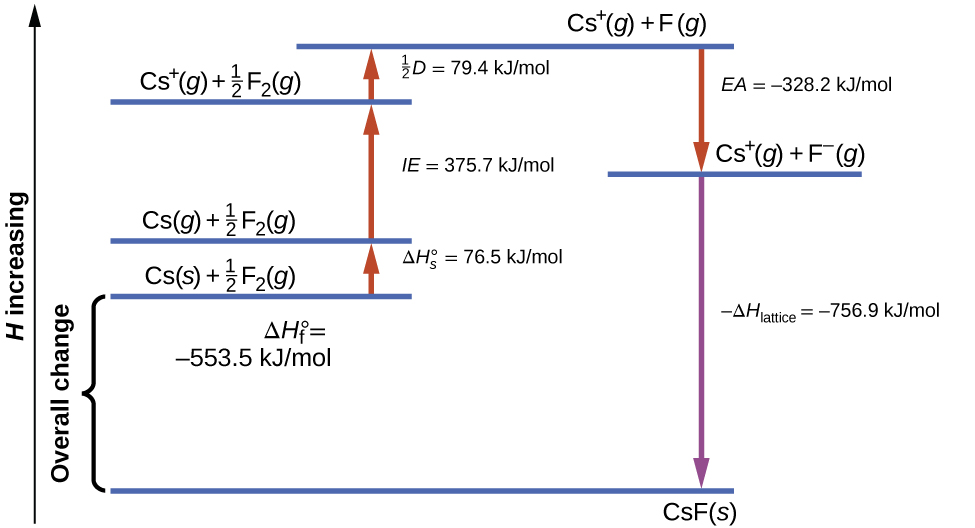

Figure 7.13図 7.13
The Born-Haber cycle shows the relative energies of each step involved in the formation of an ionic solid from the necessary elements in their reference states.
ボルン–ハーバーサイクルは、必要な元素の基準状態からイオン性固体が生成するまでの各段階の、相対的なエネルギーを示す。
We begin with the elements in their most common states, Cs(s) and F2(g). The represents the conversion of solid cesium into a gas, and then the ionization energy converts the gaseous cesium atoms into cations. In the next step, we account for the energy required to break the F–F bond to produce fluorine atoms. Converting one mole of fluorine atoms into fluoride ions is an exothermic process, so this step gives off energy (the electron affinity) and is shown as decreasing along the y-axis. We now have one mole of Cs cations and one mole of F anions. These ions combine to produce solid cesium fluoride. The enthalpy change in this step is the negative of the lattice energy, so it is also an exothermic quantity. The total energy involved in this conversion is equal to the experimentally determined enthalpy of formation, of the compound from its elements. In this case, the overall change is exothermic.
英語のヒント
まず、最も一般的な状態の元素、Cs(s)とF2(g)から始める。は固体セシウムを気体に変える過程を表し、その後、イオン化エネルギーによって気体のセシウム原子を陽イオンへ変える。次の段階では、F–F結合を切ってフッ素原子をつくるために必要なエネルギーを考える。フッ素原子1 molをフッ化物イオンに変える過程は発熱であり、エネルギー(電子親和力)を放出するので、図ではy軸方向に下がる。これでCs陽イオン1 molとF陰イオン1 molが得られた。このイオンが結合して、固体のフッ化セシウムをつくる。この段階のエンタルピー変化は、格子エネルギーに負号を付けた値なので、これも発熱を表す。この変化全体のエネルギーは、元素からこの化合物を生成するときの、実験で求めた生成エンタルピーに等しい。この場合、全体として発熱の変化になる。
Hess’s law can also be used to show the relationship between the enthalpies of the individual steps and the enthalpy of formation. Enthalpy of sublimation of Cs(s) Cs(s)⟶Cs(g) ΔH=ΔHs°=76.5kJ/mol One-half of the bond energy of F2 12 shows this for fluoride, CsF.
ヘスの法則を使うと、各段階のエンタルピーと生成エンタルピーの関係も示せる。次の表は、フッ化物CsFについてその関係を示している。Cs(s)の昇華エンタルピー Cs(s)⟶Cs(g) ΔH=ΔHs°=76.5 kJ/mol F2の結合エネルギーの半分 12
Enthalpy of sublimation of Cs(s) Cs(s)の昇華エンタルピー |
||
One-half of the bond energy of F2 F2の結合エネルギーの半分 |
||
Ionization energy of Cs(g) Cs(g)のイオン化エネルギー |
||
Electron affinity of F Fの電子親和力 |
||
Negative of the lattice energy of CsF(s) CsF(s)の格子エネルギーに負号を付けた値 |
||
Enthalpy of formation of CsF(s), add steps 1–5 CsF(s)の生成エンタルピー。段階1〜5を合計する。 |
Thus, the lattice energy can be calculated from other values. For cesium fluoride, using this data, the lattice energy is:
このように、格子エネルギーは他の値から計算できる。このデータを使うと、フッ化セシウムの格子エネルギーは次のようになる。
The Born-Haber cycle may also be used to calculate any one of the other quantities in the equation for lattice energy, provided that the remainder is known. For example, if the relevant enthalpy of sublimation ionization energy (IE), bond dissociation enthalpy (D), lattice energy ΔHlattice, and standard enthalpy of formation are known, the Born-Haber cycle can be used to determine the electron affinity of an atom.
英語のヒント
残りの量がわかっていれば、ボルン–ハーバーサイクルは格子エネルギーの式に含まれる他のどの量の計算にも使える。たとえば、関係する昇華エンタルピー、イオン化エネルギーIE、結合解離エンタルピーD、格子エネルギーΔHlattice,、標準生成エンタルピーが既知なら、ボルン–ハーバーサイクルを使って原子の電子親和力を求められる。
Lattice energies calculated for ionic compounds are typically much higher than bond dissociation energies measured for covalent bonds. Whereas lattice energies typically fall in the range of 600–4000 kJ/mol (some even higher), covalent bond dissociation energies are typically between 150–400 kJ/mol for single bonds. Keep in mind, however, that these are not directly comparable values. For ionic compounds, lattice energies are associated with many interactions, as cations and anions pack together in an extended lattice. For covalent bonds, the bond dissociation energy is associated with the interaction of just two atoms.
英語のヒント
イオン化合物について計算される格子エネルギーは、一般に、共有結合で測定される結合解離エネルギーよりはるかに大きい。格子エネルギーは通常600〜4000 kJ/molの範囲にあり、それ以上の場合もある。これに対し、共有結合の結合解離エネルギーは、単結合では通常150〜400 kJ/molである。しかし、これらの値は直接比較できるものではないことを覚えておこう。イオン化合物では、陽イオンと陰イオンが広がりのある格子の中に詰まっており、格子エネルギーには多くの相互作用が関わる。共有結合では、結合解離エネルギーが関わるのは2個の原子だけの相互作用である。