第7章化学結合と分子の形
Exceptions to the Octet Ruleオクテット則の例外
Many covalent molecules have central atoms that do not have eight electrons in their Lewis structures. These molecules fall into three categories:
英語のヒント
共有結合性の分子には、ルイス構造で中心原子の電子が8個にならないものも多い。これらの分子は、次の3種類に分けられる。
- Odd-electron molecules have an odd number of valence electrons, and therefore have an unpaired electron.奇数電子分子は価電子の総数が奇数なので、不対電子をもつ。
- Electron-deficient molecules have a central atom that has fewer electrons than needed for a noble gas configuration.電子不足分子は、中心原子の電子数が希ガスの電子配置に必要な数より少ない。
- Hypervalent molecules have a central atom that has more electrons than needed for a noble gas configuration.超原子価分子は、中心原子の電子数が希ガスの電子配置に必要な数より多い。
Odd-electron Molecules奇数個の電子をもつ分子
We call molecules that contain an odd number of electrons free radicals. Nitric oxide, NO, is an example of an odd-electron molecule; it is produced in internal combustion engines when oxygen and nitrogen react at high temperatures.
英語のヒント
奇数個の電子を含む分子をフリーラジカルという。一酸化窒素NOは、そのような奇数電子分子の例である。内燃機関で、酸素と窒素が高温で反応すると生成する。
To draw the Lewis structure for an odd-electron molecule like NO, we follow the same five steps we would for other molecules, but with a few minor changes:
NOのような奇数電子分子のルイス構造も、他の分子と同じ5段階の手順で書く。ただし、いくつかの小さな変更を加える。
- Determine the total number of valence (outer shell) electrons. The sum of the valence electrons is 5 (from N) + 6 (from O) = 11. The odd number immediately tells us that we have a free radical, so we know that not every atom can have eight electrons in its valence shell.
英語のヒント
価電子(最外殻電子)の総数を求める。Nの5個とOの6個を足して、5 + 6 = 11個となる。奇数であることから、これはフリーラジカルだとすぐわかる。したがって、すべての原子の価電子殻を8個の電子で満たすことはできない。 - Draw a skeleton structure of the molecule. We can easily draw a skeleton with an N–O single bond:
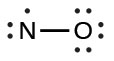
N–O分子の骨格構造を書く。N–O単結合で容易に骨格を書ける:N–O。 - Distribute the remaining electrons as lone pairs on the terminal atoms. In this case, there is no central atom, so we distribute the electrons around both atoms. We give eight electrons to the more electronegative atom in these situations; thus oxygen has the filled valence shell:残りの電子を末端原子の非共有電子対として配分する。この場合は中心原子がないため、両方の原子の周りに配分する。このような場合は、電気陰性度が大きいほうの原子に8個の電子を与える。したがって、酸素の価電子殻を満たす。
- Place all remaining electrons on the central atom. Since there are no remaining electrons, this step does not apply.残った電子をすべて中心原子に置く。この場合は電子が残っていないので、この手順は適用されない。
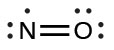
- Rearrange the electrons to make multiple bonds with the central atom in order to obtain octets wherever possible. We know that an odd-electron molecule cannot have an octet for every atom, but we want to get each atom as close to an octet as possible. In this case, nitrogen has only five electrons around it. To move closer to an octet for nitrogen, we take one of the lone pairs from oxygen and use it to form a NO double bond. (We cannot take another lone pair of electrons on oxygen and form a triple bond because nitrogen would then have nine electrons:)可能なかぎりオクテットにするため、電子を並べ替え、中心原子との間に多重結合をつくる。奇数電子分子ではすべての原子をオクテットにはできないが、各原子をできるだけオクテットに近づけたい。この場合、窒素の周りには電子が5個しかない。窒素をオクテットに近づけるため、酸素の非共有電子対の1組を使い、NとOの間に二重結合をつくる。酸素のもう1組の非共有電子対も使って三重結合にすることはできない。そうすると窒素の電子が9個になってしまうからである。
Electron-deficient Molecules電子不足分子
We will also encounter a few molecules that contain central atoms that do not have a filled valence shell. Generally, these are molecules with central atoms from groups 2 and 13, outer atoms that are hydrogen, or other atoms that do not form multiple bonds. For example, molecules of beryllium dihydride, BeH2, and boron trifluoride, BF3, contain central atoms with only two and three valence electrons, respectively. With only H as outer atoms, there is just one possibility for the Lewis structure of BeH2, and it does not satisfy the octet rule for the central Be atom (see as follows). It is possible to draw a structure with a double bond between a boron atom and a fluorine atom in BF3, satisfying the octet rule, but experimental evidence indicates the bond lengths are closer to that expected for B–F single bonds. This suggests the best Lewis structure has three B–F single bonds and an electron deficient boron. The reactivity of the compound is also consistent with an electron deficient boron. However, the B–F bonds are slightly shorter than what is actually expected for B–F single bonds, indicating that some double bond character is found in the actual molecule.
英語のヒント
中心原子の価電子殻が満たされない分子もいくつかある。一般に、中心原子が第2族または第13族の元素で、外側の原子が水素、あるいは多重結合をつくらない他の原子であるような分子が該当する。たとえば、二水素化ベリリウムBeH2と三フッ化ホウ素BF3では、中心原子の価電子はそれぞれ2個と3個しかない。BeH2の外側の原子はHだけなので、ルイス構造の候補は1つしかなく、中心のBe原子はオクテット則を満たさない(下図)。BF3では、BとFの間に二重結合を描けば、オクテット則を満たす構造を書くことはできる。しかし、実験で得られる結合長は、B–F単結合に予想される値に近い。これは、最もよいルイス構造が、B–F単結合3本と電子不足のホウ素をもつ構造であることを示唆する。化合物の反応性も、ホウ素が電子不足であることと整合する。それでもB–F結合は、単結合として実際に予想されるものよりわずかに短い。このことは、実際の分子に二重結合の性質がいくらか含まれていることを示す。
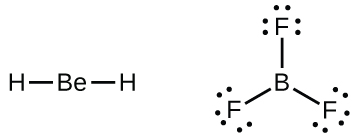
An atom like the boron atom in BF3, which does not have eight electrons, is very reactive. It readily combines with a molecule containing an atom with a lone pair of electrons. For example, NH3 reacts with BF3 because the lone pair on nitrogen can be shared with the boron atom:
BF3のホウ素のように電子8個をもたない原子は、反応性が非常に高い。非共有電子対をもつ原子を含む分子と、容易に結び付く。たとえばNH3は、窒素の非共有電子対をホウ素原子と共有できるため、BF3と反応する。

Hypervalent Molecules超原子価分子
Elements in the second period of the periodic table (n = 2) can accommodate only eight electrons in their valence shell orbitals because they have only four valence orbitals (one 2s and three 2p orbitals). Elements in the third and higher periods (n ≥ 3) have more than four valence orbitals and can share more than four pairs of electrons with other atoms because they have empty d orbitals in the same shell. Molecules formed from these elements are sometimes called hypervalent molecules. Figure 7.12 shows the Lewis structures for two hypervalent molecules, PCl5 and SF6.
英語のヒント
周期表の第2周期の元素(n = 2)は、価電子軌道が4つ(2s軌道1つと2p軌道3つ)しかないため、価電子殻の軌道に8個までの電子しか収容できない。第3周期以降の元素(n ≥ 3)は、価電子軌道が4つより多い。同じ殻に空のd軌道があるため、他の原子と4組を超える電子対を共有できる。これらの元素からできる分子を、超原子価分子と呼ぶことがある。図7.12に、PCl5とSF6.という2つの超原子価分子のルイス構造を示す。
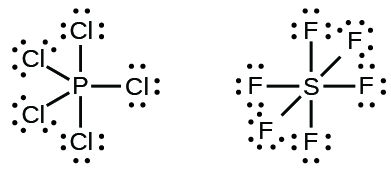
Figure 7.12図 7.12
In PCl5, the central atom phosphorus shares five pairs of electrons. In SF6, sulfur shares six pairs of electrons.
PCl5では、中心原子のリンが5組の電子対を共有する。SF6では、硫黄が6組の電子対を共有する。
In some hypervalent molecules, such as IF5 and XeF4, some of the electrons in the outer shell of the central atom are lone pairs:
IF5やXeF4のような一部の超原子価分子では、中心原子の最外殻の電子の一部が、非共有電子対になっている。
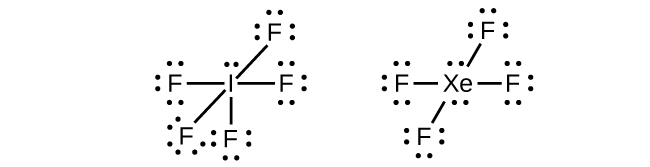
When we write the Lewis structures for these molecules, we find that we have electrons left over after filling the valence shells of the outer atoms with eight electrons. These additional electrons must be assigned to the central atom.
英語のヒント
これらの分子のルイス構造を書くと、外側の原子の価電子殻を8個の電子で満たしたあとにも、電子が残る。残った電子は、中心原子に割り当てなければならない。
Example 7.5例題 7.5
Writing Lewis Structures: Octet Rule Violationsルイス構造を書く:オクテット則に従わない場合
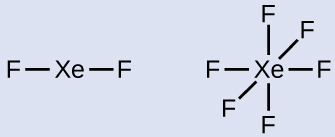
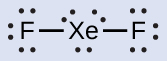
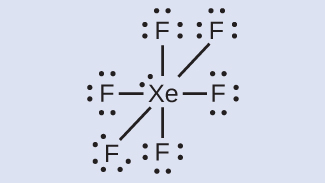
Xenon is a noble gas, but it forms a number of stable compounds. We examined XeF4 earlier. What are the Lewis structures of XeF2 and XeF6?
キセノンは希ガスだが、安定な化合物をいくつもつくる。先ほどXeF4を調べた。XeF2とXeF6のルイス構造はどうなるか。
Solution解答
We can draw the Lewis structure of any covalent molecule by following the six steps discussed earlier. In this case, we can condense the last few steps, since not all of them apply.
英語のヒント
前述の6段階の手順に従えば、どの共有結合性分子のルイス構造も書くことができる。この場合、最後のいくつかの手順は、すべてが当てはまるわけではないので、まとめて扱える。
- Calculate the number of valence electrons:
XeF2: 8 + (2 7) = 22
XeF6: 8 + (6 7) = 50価電子数を求める。XeF2:8 + (2 7) = 22XeF6:8 + (6 7) = 50 - Draw a skeleton joining the atoms by single bonds. Xenon will be the central atom because fluorine cannot be a central atom:原子を単結合でつないだ骨格を書く。フッ素は中心原子になれないため、キセノンが中心原子となる。
- Distribute the remaining electrons.
XeF2: We place three lone pairs of electrons around each F atom, accounting for 12 electrons and giving each F atom 8 electrons. Thus, six electrons (three lone pairs) remain. These lone pairs must be placed on the Xe atom. This is acceptable because Xe atoms have empty valence shell d orbitals and can accommodate more than eight electrons. The Lewis structure of XeF2 shows two bonding pairs and three lone pairs of electrons around the Xe atom:英語のヒント
残りの電子を配分する。XeF2:各F原子の周りに非共有電子対を3組ずつ置く。これで電子12個を使い、各F原子が電子8個をもつ。したがって、電子6個(非共有電子対3組)が残る。これらの非共有電子対は、Xe原子に置かなければならない。Xe原子には空の価電子殻d軌道があり、8個を超える電子を収容できるので、この配置が認められる。XeF2のルイス構造では、Xe原子の周りに結合電子対2組と非共有電子対3組がある。
XeF6: We place three lone pairs of electrons around each F atom, accounting for 36 electrons. Two electrons remain, and this lone pair is placed on the Xe atom:XeF6:各F原子の周りに非共有電子対を3組ずつ置くと、電子36個を使う。電子2個が残るので、この1組の非共有電子対をXe原子に置く。


Check Your Learning理解を確かめよう
The halogens form a class of compounds called the interhalogens, in which halogen atoms covalently bond to each other. Write the Lewis structures for the interhalogens BrCl3 and
英語のヒント
ハロゲンは、ハロゲン原子どうしが共有結合した、ハロゲン間化合物と呼ばれる一群の化合物をつくる。ハロゲン間化合物BrCl3とのルイス構造を書きなさい。