第7章化学結合と分子の形
Predicting Electron Pair Geometry and Molecular Structure電子対の配置と分子構造を予測する
The following procedure uses VSEPR theory to determine the electron pair geometries and the molecular structures:
次の手順でVSEPR理論を使い、電子対配置と分子構造を求める。
- Write the Lewis structure of the molecule or polyatomic ion.分子または多原子イオンのルイス構造を書く。
- Count the number of regions of electron density (lone pairs and bonds) around the central atom. A single, double, or triple bond counts as one region of electron density.中心原子の周りの電子密度の高い領域(非共有電子対と結合)の数を数える。単結合、二重結合、三重結合は、いずれも1つの電子領域として数える。
- Identify the electron-pair geometry based on the number of regions of electron density: linear, trigonal planar, tetrahedral, trigonal bipyramidal, or octahedral (Figure 7.19, first column).電子密度の高い領域の数をもとに、電子対配置を、直線形、平面三角形、正四面体形、三方両錐形、正八面体形のいずれかと判断する(図7.19、最初の列)。
- Use the number of lone pairs to determine the molecular structure (Figure 7.19). If more than one arrangement of lone pairs and chemical bonds is possible, choose the one that will minimize repulsions, remembering that lone pairs occupy more space than multiple bonds, which occupy more space than single bonds. In trigonal bipyramidal arrangements, repulsion is minimized when every lone pair is in an equatorial position. In an octahedral arrangement with two lone pairs, repulsion is minimized when the lone pairs are on opposite sides of the central atom.非共有電子対の数を使って分子構造を決める(図7.19)。非共有電子対と化学結合の配置が複数考えられる場合は、反発が最小となるものを選ぶ。非共有電子対は多重結合より広い空間を占め、多重結合は単結合より広い空間を占めることを忘れないようにしよう。三方両錐形では、すべての非共有電子対が赤道位にあると反発が最小になる。非共有電子対を2組もつ正八面体形では、非共有電子対が中心原子の反対側どうしにあると反発が最小になる。
The following examples illustrate the use of VSEPR theory to predict the molecular structure of molecules or ions that have no lone pairs of electrons. In this case, the molecular structure is identical to the electron pair geometry.
次の例は、非共有電子対をもたない分子やイオンの分子構造をVSEPR理論で予測する方法を示す。この場合、分子構造は電子対配置と同じになる。
Example 7.11例題 7.11
Predicting Electron-pair Geometry and Molecular Structure: CO2 and BCl3電子対の配置と分子構造を予測する:CO2とBCl3
Predict the electron-pair geometry and molecular structure for each of the following:
次のそれぞれについて、電子対配置と分子構造を予測しなさい。
(a) carbon dioxide, CO2, a molecule produced by the combustion of fossil fuels
(a) 化石燃料の燃焼で生じる分子、二酸化炭素CO2
(b) boron trichloride, BCl3, an important industrial chemical
(b) 重要な工業用化学物質、三塩化ホウ素BCl3
Solution解答
(a) We write the Lewis structure of CO2 as:
(a) CO2のルイス構造は次のように書ける。
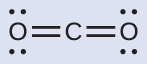
This shows us two regions of high electron density around the carbon atom—each double bond counts as one region, and there are no lone pairs on the carbon atom. Using VSEPR theory, we predict that the two regions of electron density arrange themselves on opposite sides of the central atom with a bond angle of 180°. The electron-pair geometry and molecular structure are identical, and CO2 molecules are linear.
炭素原子の周りには、電子密度の高い領域が2つある。各二重結合を1領域と数え、炭素原子に非共有電子対はない。VSEPR理論によれば、この2領域は中心原子の反対側に配置され、結合角は180°になると予測される。電子対配置と分子構造は同じで、CO2分子は直線形である。
(b) We write the Lewis structure of BCl3 as:
(b) BCl3のルイス構造は次のように書ける。
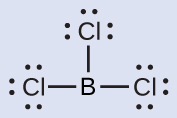
Thus we see that BCl3 contains three bonds, and there are no lone pairs of electrons on boron. The arrangement of three regions of high electron density gives a trigonal planar electron-pair geometry. The B–Cl bonds lie in a plane with 120° angles between them. BCl3 also has a trigonal planar molecular structure (Figure 7.21).
BCl3は結合を3本もち、ホウ素に非共有電子対はない。電子密度の高い3領域は、平面三角形の電子対配置をとる。B–Cl結合は同一平面内にあり、互いの角度は120°である。BCl3の分子構造も平面三角形となる(図7.21)。
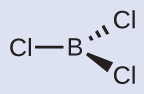
Figure 7.21図 7.21
The electron-pair geometry and molecular structure of BCl3 are both trigonal planar. Note that the VSEPR geometry indicates the correct bond angles (120°), unlike the Lewis structure shown above.
BCl3の電子対配置も分子構造も、平面三角形である。上に示したルイス構造とは異なり、VSEPRによる配置は正しい結合角120°を示すことに注意しよう。
Check Your Learning理解を確かめよう
Carbonate, is a common polyatomic ion found in various materials from eggshells to antacids. What are the electron-pair geometry and molecular structure of this polyatomic ion?
英語のヒント
炭酸イオンは、卵の殻から制酸剤まで、さまざまな物質に含まれる一般的な多原子イオンである。この多原子イオンの電子対配置と分子構造はどうなるか。
Example 7.12例題 7.12
Predicting Electron-pair Geometry and Molecular Structure: Ammonium電子対の配置と分子構造を予測する:アンモニウムイオン
Two of the top 50 chemicals produced in the United States, ammonium nitrate and ammonium sulfate, both used as fertilizers, contain the ammonium ion. Predict the electron-pair geometry and molecular structure of the cation.
英語のヒント
米国で生産量上位50に入る化学物質のうち、硝酸アンモニウムと硫酸アンモニウムは、ともに肥料に使われ、アンモニウムイオンを含む。陽イオンの電子対配置と分子構造を予測しなさい。
Solution解答
We write the Lewis structure of as:
のルイス構造は次のように書ける。
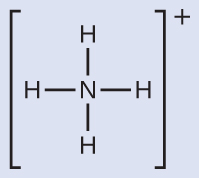
We can see that contains four bonds from the nitrogen atom to hydrogen atoms and no lone pairs. We expect the four regions of high electron density to arrange themselves so that they point to the corners of a tetrahedron with the central nitrogen atom in the middle (Figure 7.19). Therefore, the electron pair geometry of is tetrahedral, and the molecular structure is also tetrahedral (Figure 7.22).
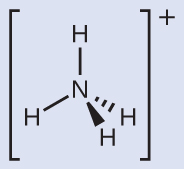
Figure 7.22図 7.22
The ammonium ion displays a tetrahedral electron-pair geometry as well as a tetrahedral molecular structure.
アンモニウムイオンは、電子対配置も分子構造も正四面体形である。
Check Your Learning理解を確かめよう
Identify a molecule with trigonal bipyramidal molecular structure.
三方両錐形の分子構造をもつ分子を1つ挙げなさい。
The next several examples illustrate the effect of lone pairs of electrons on molecular structure.
次のいくつかの例では、非共有電子対が分子構造に及ぼす影響を見る。
Example 7.13例題 7.13
Predicting Electron-pair Geometry and Molecular Structure: Lone Pairs on the Central Atom電子対の配置と分子構造を予測する:中心原子に非共有電子対がある場合
Predict the electron-pair geometry and molecular structure of a water molecule.
水分子の電子対配置と分子構造を予測しなさい。
Solution解答
The Lewis structure of H2O indicates that there are four regions of high electron density around the oxygen atom: two lone pairs and two chemical bonds:
H2Oのルイス構造では、酸素原子の周りに電子密度の高い領域が4つある。非共有電子対が2組、化学結合が2本である。
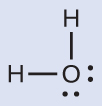
We predict that these four regions are arranged in a tetrahedral fashion (Figure 7.23), as indicated in Figure 7.19. Thus, the electron-pair geometry is tetrahedral and the molecular structure is bent with an angle slightly less than 109.5°. In fact, the bond angle is 104.5°.
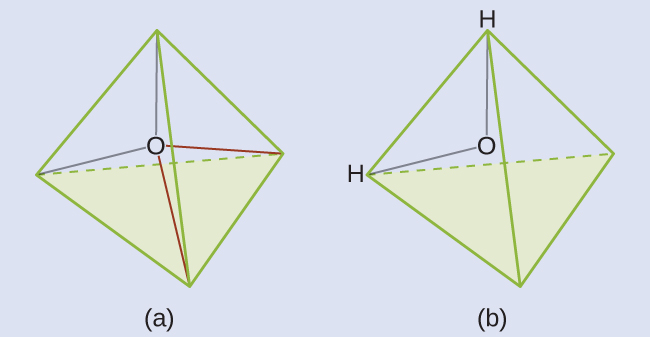
Figure 7.23図 7.23
(a) H2O has four regions of electron density around the central atom, so it has a tetrahedral electron-pair geometry. (b) Two of the electron regions are lone pairs, so the molecular structure is bent.
(a) H2Oは中心原子の周りに電子密度の高い領域が4つあるので、電子対配置は正四面体形である。(b) 電子領域のうち2つが非共有電子対なので、分子構造は折れ線形である。
Check Your Learning理解を確かめよう
The hydronium ion, H3O+, forms when acids are dissolved in water. Predict the electron-pair geometry and molecular structure of this cation.
酸を水に溶かすと、ヒドロニウムイオンH3O+が生じる。この陽イオンの電子対配置と分子構造を予測しなさい。
Example 7.14例題 7.14
Predicting Electron-pair Geometry and Molecular Structure: SF4電子対の配置と分子構造を予測する:SF4
Sulfur tetrafluoride, SF4, is extremely valuable for the preparation of fluorine-containing compounds used as herbicides (i.e., SF4 is used as a fluorinating agent). Predict the electron-pair geometry and molecular structure of a SF4 molecule.
英語のヒント
四フッ化硫黄SF4は、除草剤として使われるフッ素含有化合物をつくるうえで非常に有用である。すなわち、SF4はフッ素化剤として用いられる。SF4分子の電子対配置と分子構造を予測しなさい。
Solution解答
The Lewis structure of SF4 indicates five regions of electron density around the sulfur atom: one lone pair and four bonding pairs:
SF4のルイス構造では、硫黄原子の周りに電子密度の高い領域が5つある。非共有電子対が1組、結合電子対が4組である。
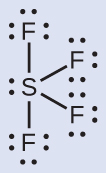
We expect these five regions to adopt a trigonal bipyramidal electron-pair geometry. To minimize lone pair repulsions, the lone pair occupies one of the equatorial positions. The molecular structure (Figure 7.24) is that of a seesaw (Figure 7.19).
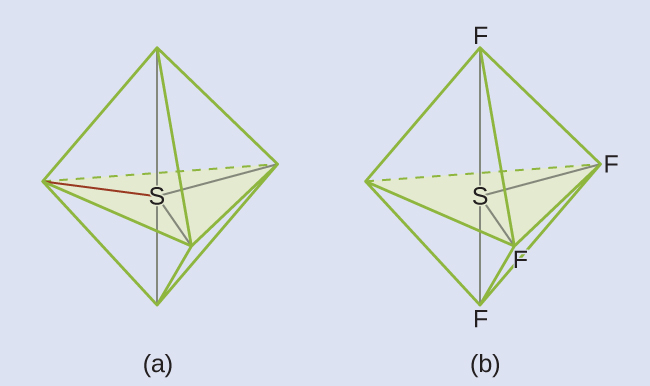
Figure 7.24図 7.24
(a) SF4 has a trigonal bipyramidal arrangement of the five regions of electron density. (b) One of the regions is a lone pair, which results in a seesaw-shaped molecular structure.
(a) SF4の5つの電子密度の高い領域は、三方両錐形に配置される。(b) 1つの領域が非共有電子対なので、分子構造はシーソー形となる。
Check Your Learning理解を確かめよう
Predict the electron pair geometry and molecular structure for molecules of XeF2.
XeF2分子の電子対配置と分子構造を予測しなさい。
Example 7.15例題 7.15
Predicting Electron-pair Geometry and Molecular Structure: XeF4電子対の配置と分子構造を予測する:XeF4
Of all the noble gases, xenon is the most reactive, frequently reacting with elements such as oxygen and fluorine. Predict the electron-pair geometry and molecular structure of the XeF4 molecule.
すべての希ガスの中でキセノンは最も反応性が高く、酸素やフッ素などの元素とよく反応する。XeF4分子の電子対配置と分子構造を予測しなさい。
Solution解答
The Lewis structure of XeF4 indicates six regions of high electron density around the xenon atom: two lone pairs and four bonds:
XeF4のルイス構造では、キセノン原子の周りに電子密度の高い領域が6つある。非共有電子対が2組、結合が4本である。
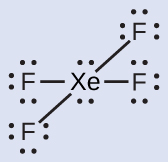
These six regions adopt an octahedral arrangement (Figure 7.19), which is the electron-pair geometry. To minimize repulsions, the lone pairs should be on opposite sides of the central atom (Figure 7.25). The five atoms are all in the same plane and have a square planar molecular structure.
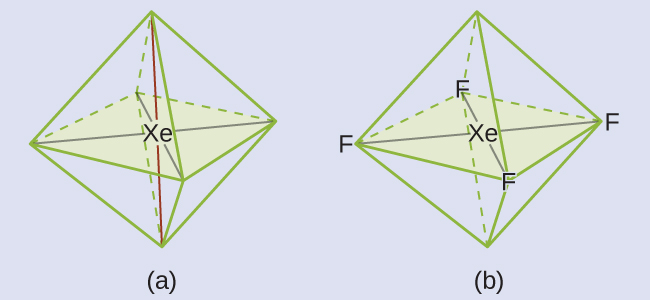


Figure 7.25図 7.25
(a) XeF4 adopts an octahedral arrangement with two lone pairs (red lines) and four bonds in the electron-pair geometry. (b) The molecular structure is square planar with the lone pairs directly across from one another.
(a) XeF4の電子対配置は、非共有電子対2組(赤い線)と結合4本による正八面体形である。(b) 非共有電子対は互いに正反対の位置にあり、分子構造は正方形である。
Check Your Learning理解を確かめよう
In a certain molecule, the central atom has three lone pairs and two bonds. What will the electron pair geometry and molecular structure be?
ある分子の中心原子は、非共有電子対を3組、結合を2本もつ。電子対配置と分子構造はどうなるか。